
Dermal fillers and skin boosters address distinct facial concerns through different physical formulations. While structural injectables correct volume loss and shape contours, conditioning treatments focus on superficial hydration, elasticity, and overall skin texture.
Understanding how hyaluronic acid fillers work clarifies why cross-linking separates structural support from surface conditioning. A clinical consultation determines the appropriate approach based on individual anatomical needs.
Two Different Goals for Facial Treatment
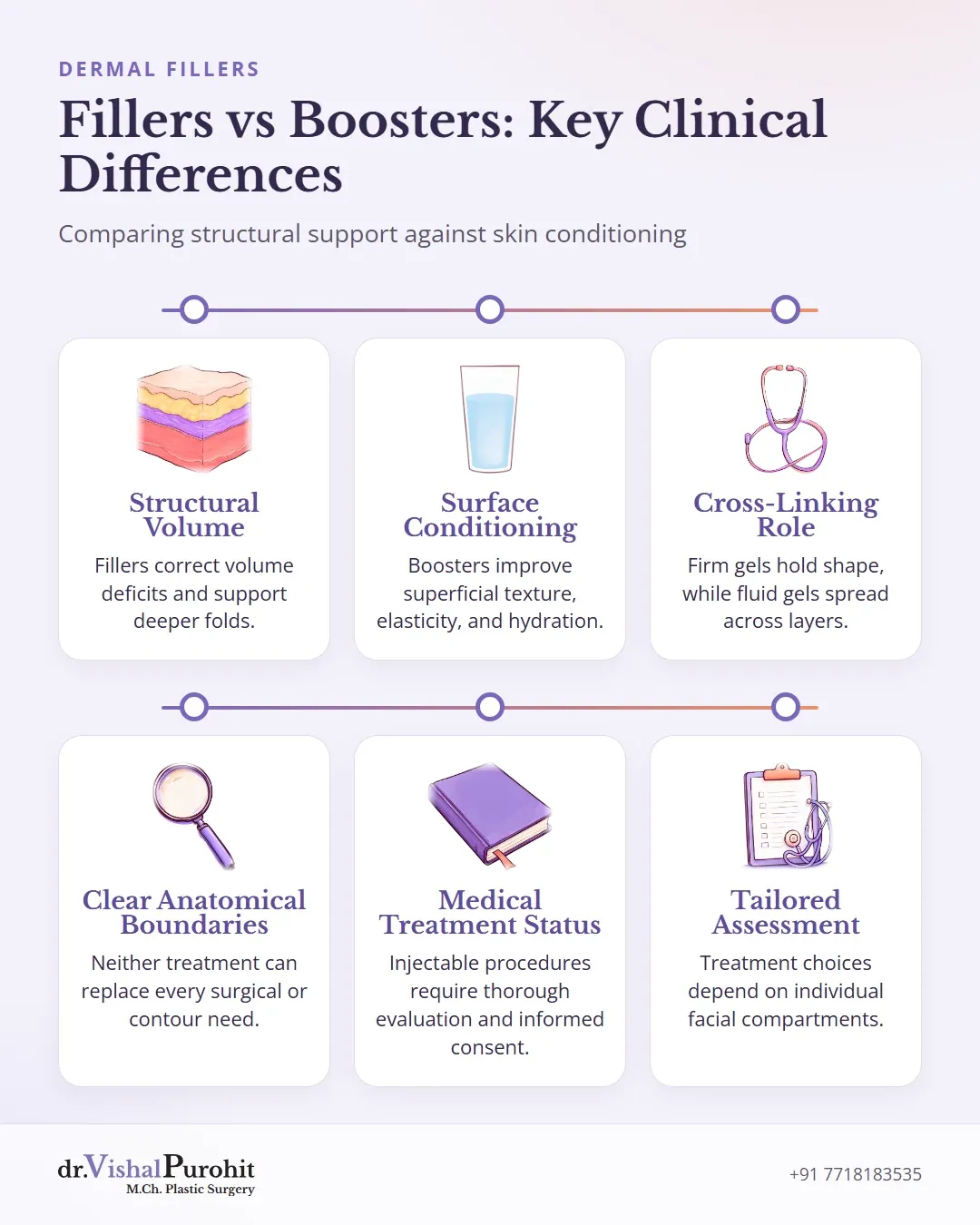
Dermal fillers and skin boosters serve distinct clinical purposes based on how they interact with facial tissues.
Distinct Clinical Objectives
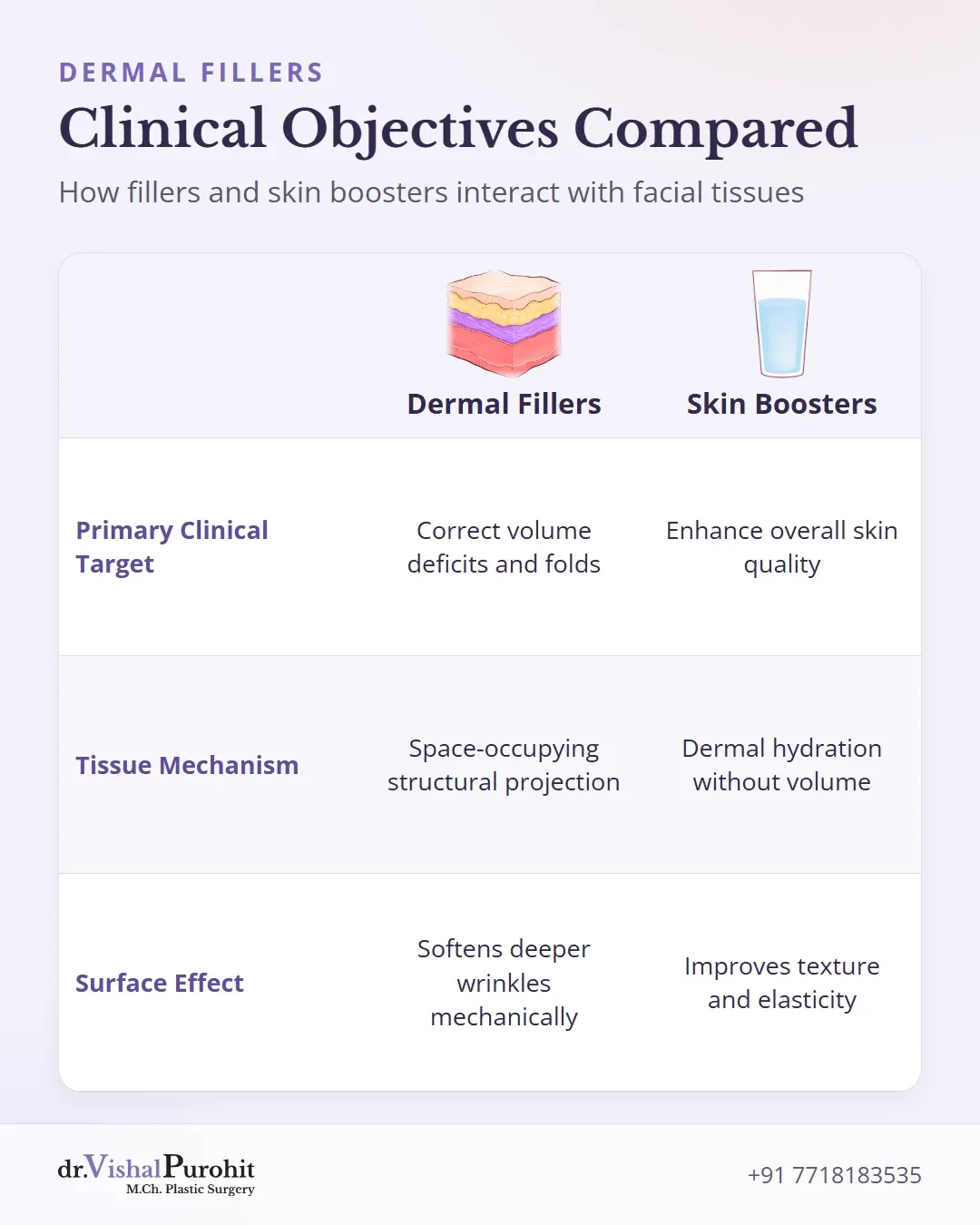
- Dermal fillers: These injectable gels are placed under the skin to correct volume deficits, shape contours, or soften deeper folds and wrinkles123. By acting as space-occupying implants, they provide mechanical projection and support to facial structures14.
- Skin boosters: Rather than providing structural projection or replacing lost volume, skin boosters are formulated to enhance overall skin quality456. They focus on improving superficial texture, fine lines, elasticity, and dermal hydration56.
Dr. Purohit’s note: Choosing between structural volume correction, superficial skin quality enhancement, or whether skin boosters are suitable is decided at consultation, where a personalized clinical assessment determines the appropriate approach for individual facial anatomy and aesthetic goals.
Why Hyaluronic Acid Is Not Used Identically
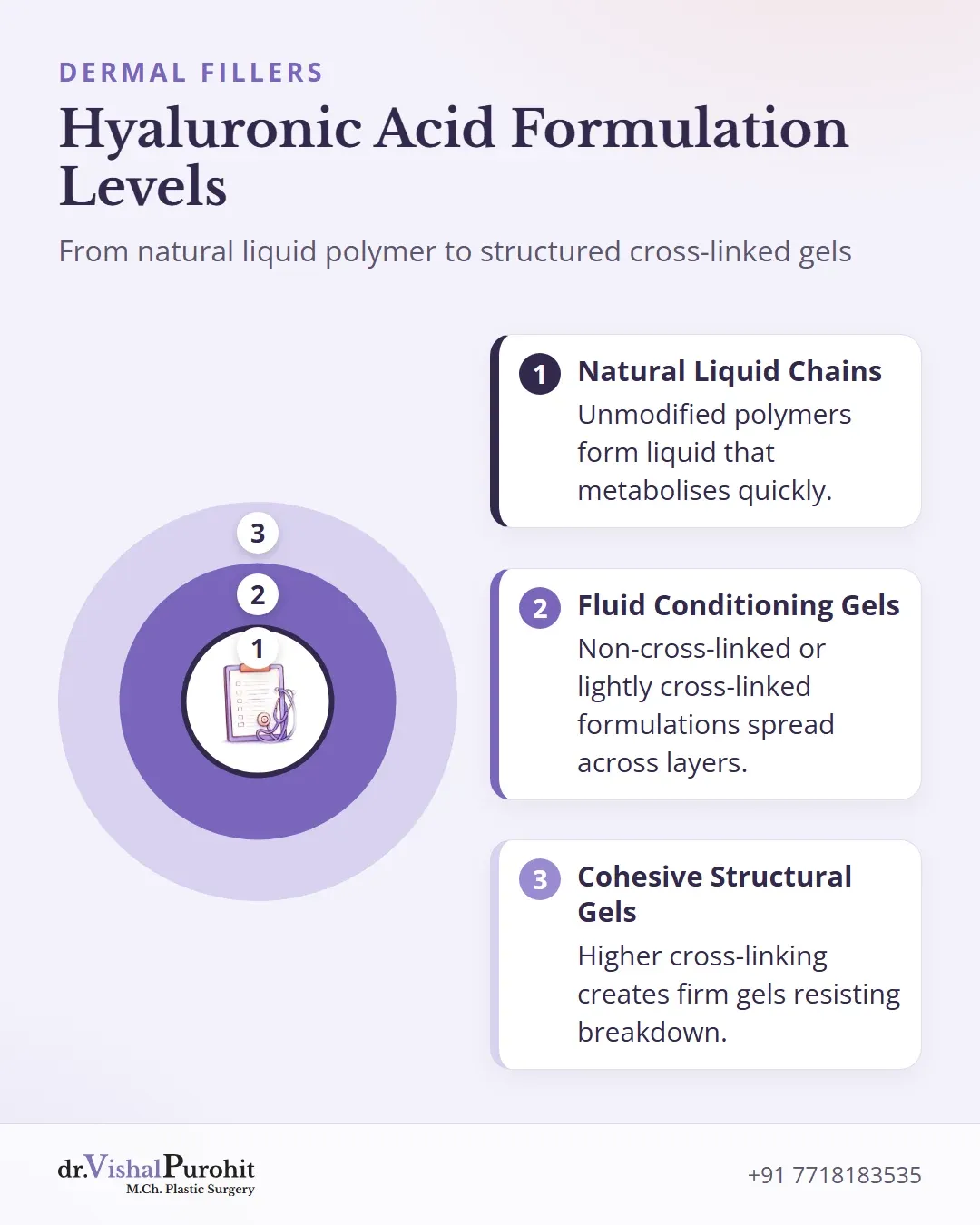
Hyaluronic acid serves different clinical purposes depending on its chemical cross-linking and physical formulation67. In its unmodified natural state, hyaluronic acid forms a liquid composed of individual polymer chains that metabolise quickly in the body789.
Key points
- Hyaluronic acid performs different clinical roles based on its degree of cross-linking and formulation.
- Dermal fillers use firmer cross-linked gels to restore structural volume and lift tissue.
- Skin boosters use fluid, low-cross-linked preparations to spread across tissue and improve skin texture and hydration.
Cross-linking chemically binds these liquid polymer chains together to create a cohesive gel that resists enzymatic breakdown79. The differences in formulation separate traditional fillers from skin conditioning treatments:
- Dermal fillers: Higher degrees of cross-linking produce firmer gels with higher elasticity that resist deformation under mechanical stress710. These formulations hold structural shape to restore facial volume or lift tissue6710.
- Skin boosters: Formulated with non-cross-linked or low-cross-linked hyaluronic acid, these products form more fluid gels67. Instead of providing structural projection or volume, they spread across tissue layers to improve hydration, elasticity, and overall skin texture67.
Not all skin boosters are interchangeable. Some formulations rely solely on free or lightly cross-linked hyaluronic acid, whereas hybrid preparations combine non-cross-linked hyaluronic acid with other microparticles such as poly-D,L-lactic acid611. Whether a structural filler or a skin booster is suitable is decided at the consultation.
What Each Option Cannot Accomplish
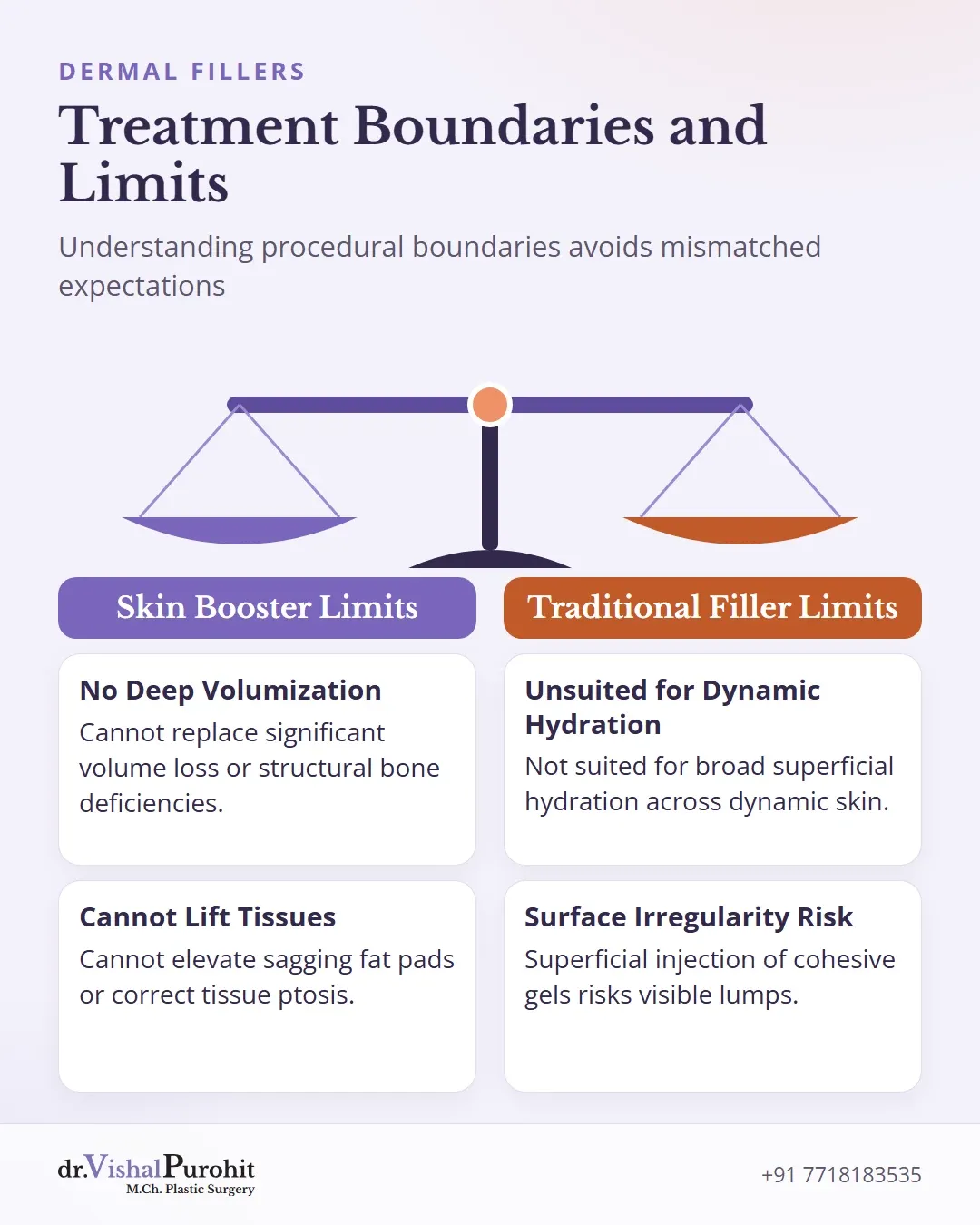
Both approaches have distinct anatomical boundaries, and understanding these limits helps avoid mismatched expectations.
Key points
- Neither treatment replaces every structural or textural requirement on its own.
- Skin boosters do not restore lost volume, lift sagging tissues, or provide focal projection.
- Traditional fillers are not meant for broad superficial hydration and risk surface lumps if injected too shallowly.
Limits of Skin Boosters
Skin boosters are formulated to enhance hydration, elasticity, and surface texture rather than reconstruct shape6. Consequently, they cannot:
- Replace significant volume loss or structural bone deficiencies1213.
- Elevate sagging fat pads or correct tissue ptosis caused by aging, which requires deeper repositioning or volumizing procedures14.
- Provide targeted focal projection or contouring in areas such as hollows or folds515.
Limits of Traditional Fillers
Traditional dermal fillers are designed for deeper tissue augmentation and volume replacement1416. When used for superficial concerns, their limits include:
- They are not suited for broad, superficial skin hydration or generalized crepiness across dynamic regions615.
- If injected too superficially or in high concentrations with strong cohesiveness, conventional fillers carry a risk of visible lumps, nodularity, or surface irregularities615.
Choosing no treatment is always a completely valid option. Every aesthetic intervention remains a personal choice, and deciding against injectable procedures requires no justification.
Regulatory Approval and Local Availability

Injectable soft tissue fillers and skin boosters represent medical treatments rather than simple cosmetic procedures1718. Published clinical evidence, intended anatomical indications, and expected durations vary significantly across individual brands and product formulations1719.
In international regulatory systems, such as the United States Food and Drug Administration, dermal fillers are classified as medical devices1718. Approvals in those jurisdictions are granted only for specific anatomical sites and indications following controlled clinical studies171920.
Clear distinctions must be made regarding regulatory status:
- Foreign clearance, such as US FDA approval or premarket approval, does not constitute approval in India17.
- Administrative listing or device registration does not equal full product approval17.
- The administration of injectables is a medical procedure requiring careful evaluation and clear informed consent1821.
Patients should discuss local registration, specific product labeling, and treatment indications prior to receiving any injection19. The choice of products and brands used by Dr.
Choosing the Right Approach for Your Concerns
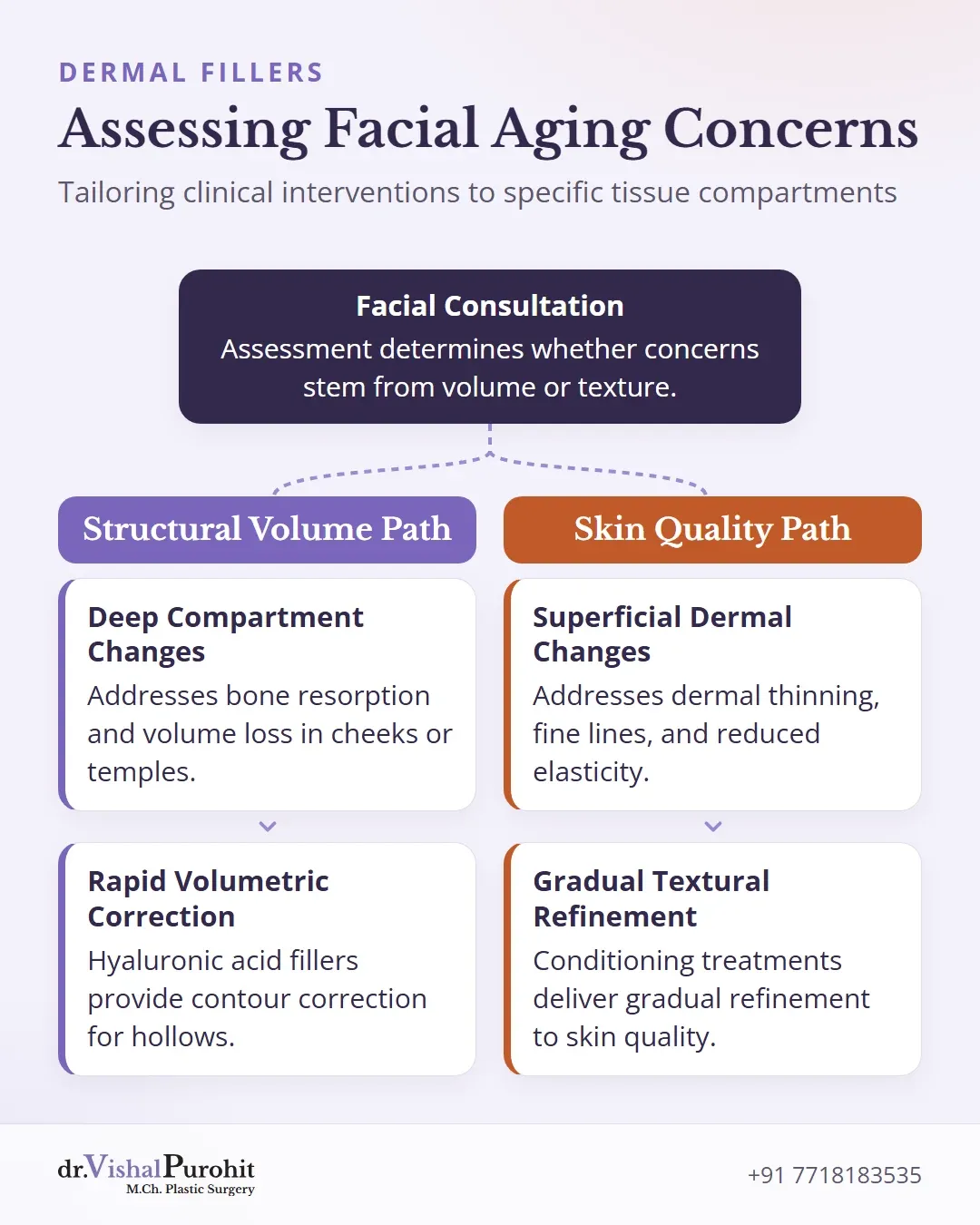
A comprehensive facial consultation determines whether your concerns stem from deeper structural volume loss or superficial issues like skin texture and laxity2223.
During an aesthetic assessment, the physician examines underlying anatomical changes, including bone resorption and fat redistribution across facial compartments2224. Facial aging often involves:
- Volume depletion in areas such as the cheeks or temples22
- Soft tissue deflation and contour hollows2224
- Superficial dermal thinning, fine lines, or reduced skin elasticity5
A targeted treatment plan must address individual facial anatomy, tissue characteristics, and aesthetic goals rather than following a single trending product25. Hyaluronic acid fillers provide rapid volumetric support and contour correction for structural hollows, whereas treatments aimed at skin quality provide gradual textural refinement5.
The specific products, techniques, and whether treatments are combined in Dr. Vishal Purohit’s practice are not preset; every plan is decided at the consultation following a detailed evaluation in Jaipur2325.
Facial Assessment and Consultation in Jaipur
Determining whether your concerns require structural projection or superficial conditioning begins with a detailed anatomical evaluation. Patients can explore clinical options for Dermal Fillers in Jaipur to address volume depletion, hollows, or deeper folds. To understand treatment limits, safety considerations, and clinical suitability, review the Dermal Fillers FAQs before your consultation.
This is educational information, not medical advice.