
TUE - SUN: 11:00 AM – 07:00 PM

Dermal Fillers: A Patient’s Guide to Getting Started

Author:Dr. Vishal Purohit
|
Published:

Aging often leads to structural volume depletion, softening facial contours and creating static tissue folds. Many individuals consider injectable treatments to replenish support in deeper tissue spaces without altering underlying cellular activity.

Learning about types of dermal fillers: HA, stimulators and permanent fillers allows patients to understand available material options before any clinical decision. A thorough medical evaluation ensures that treatment choices remain strictly aligned with personal aesthetic goals, while choosing no intervention remains a completely valid option.

What Dermal Fillers Are
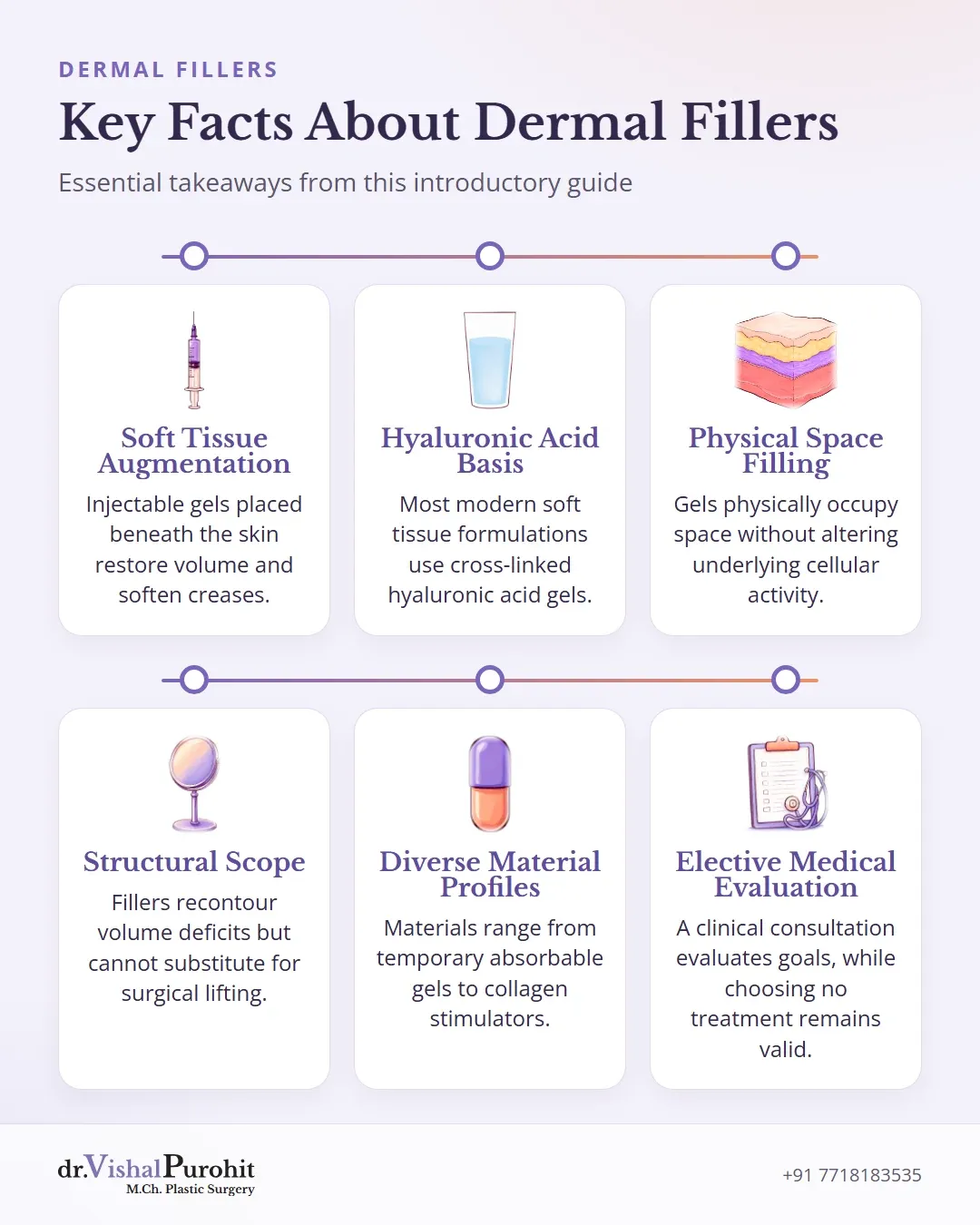
Summary card highlighting six key clinical principles of dermal filler treatments.

Dermal fillers are injectable soft gels placed beneath the skin for soft tissue augmentation12. They expand tissue volume to manage signs of the aging face, subtly restoring facial contours and softening static creases and rhytids134. By replenishing volume lost over time, these treatments provide structural support to focal areas of the face56.

Most modern soft tissue fillers are formulated with hyaluronic acid17. Hyaluronic acid is a naturally occurring glycosaminoglycan biopolymer found throughout human tissues and skin, where it binds water to retain moisture and provide structural integrity27. In its natural state, it breaks down within 1 to 2 days2. Modern aesthetic formulations are cross-linked to increase stability and create gels that resist compressive forces in the tissue27.

Dr. Purohit’s note: At his practice in Jaipur, Dr. Vishal Purohit assesses each patient individually, deciding the specific choice of filler product and brand at the consultation based on clinical suitability rather than fixing it beforehand.

How Injectable Gels Work
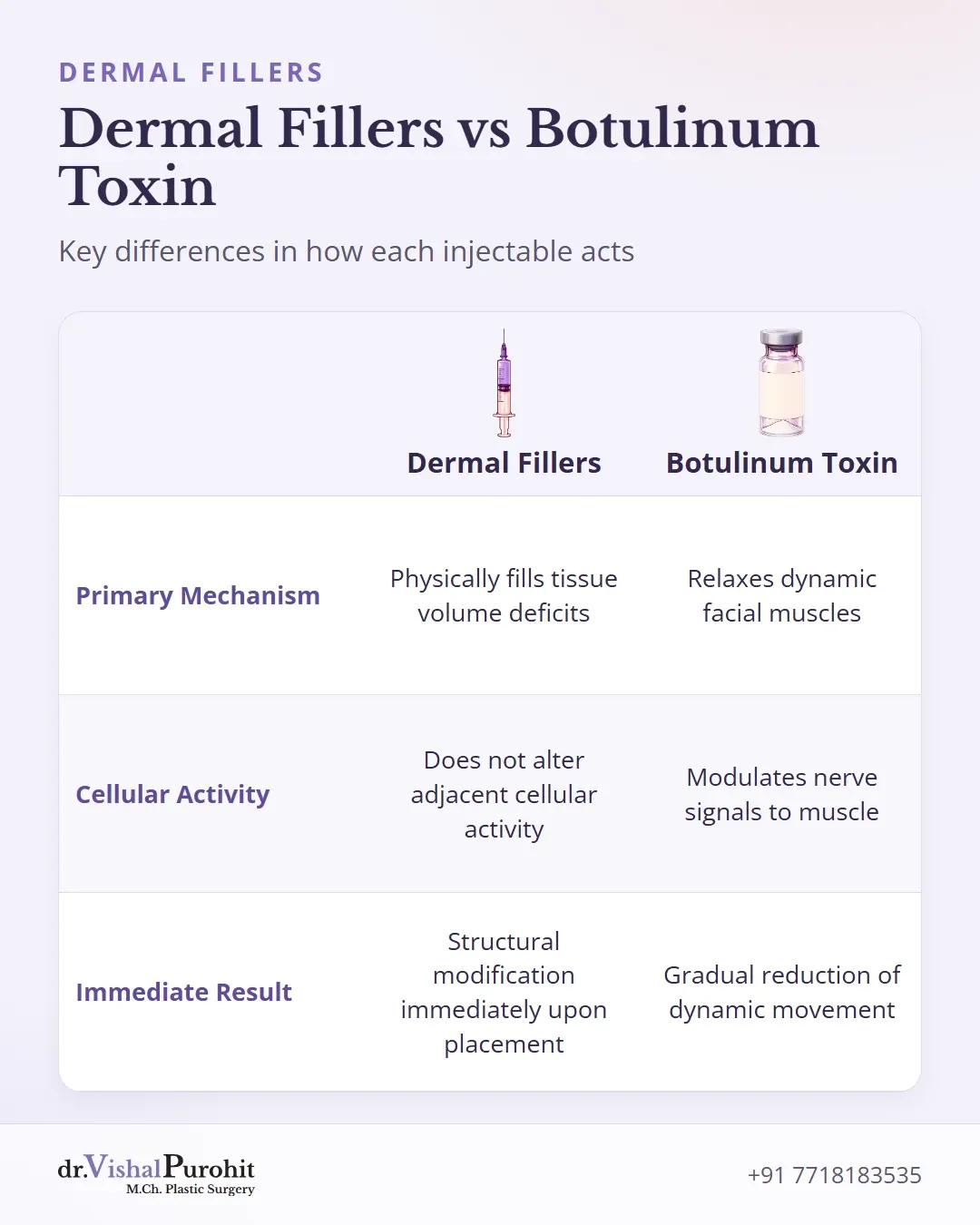
Matrix comparison showing mechanisms of dermal fillers versus botulinum toxin.

Injectable dermal fillers correct wrinkles and augment facial contours by physically filling volume deficits in tissue spaces8. Formulations such as hyaluronic acid gels integrate within tissues to restore volume and soften surface folds89.

Through this physical presence, space-occupying fillers replace lost volume to provide contour and projection without altering the underlying cellular activity of adjacent tissues810. In contrast to botulinum toxin, which acts by relaxing facial muscles, injectable fillers physically occupy space to increase soft-tissue volume and create structural modification immediately upon placement81011.

Deciding whether to address structural changes or age-related contour shifts remains a personal aesthetic choice. Choosing no treatment is always a valid option, and an individual should feel comfortable exploring non-surgical possibilities without pressure. Every face follows its own natural timeline, and a qualified consultation allows one to evaluate facial harmony calmly before considering any intervention.

What Fillers Can and Cannot Change
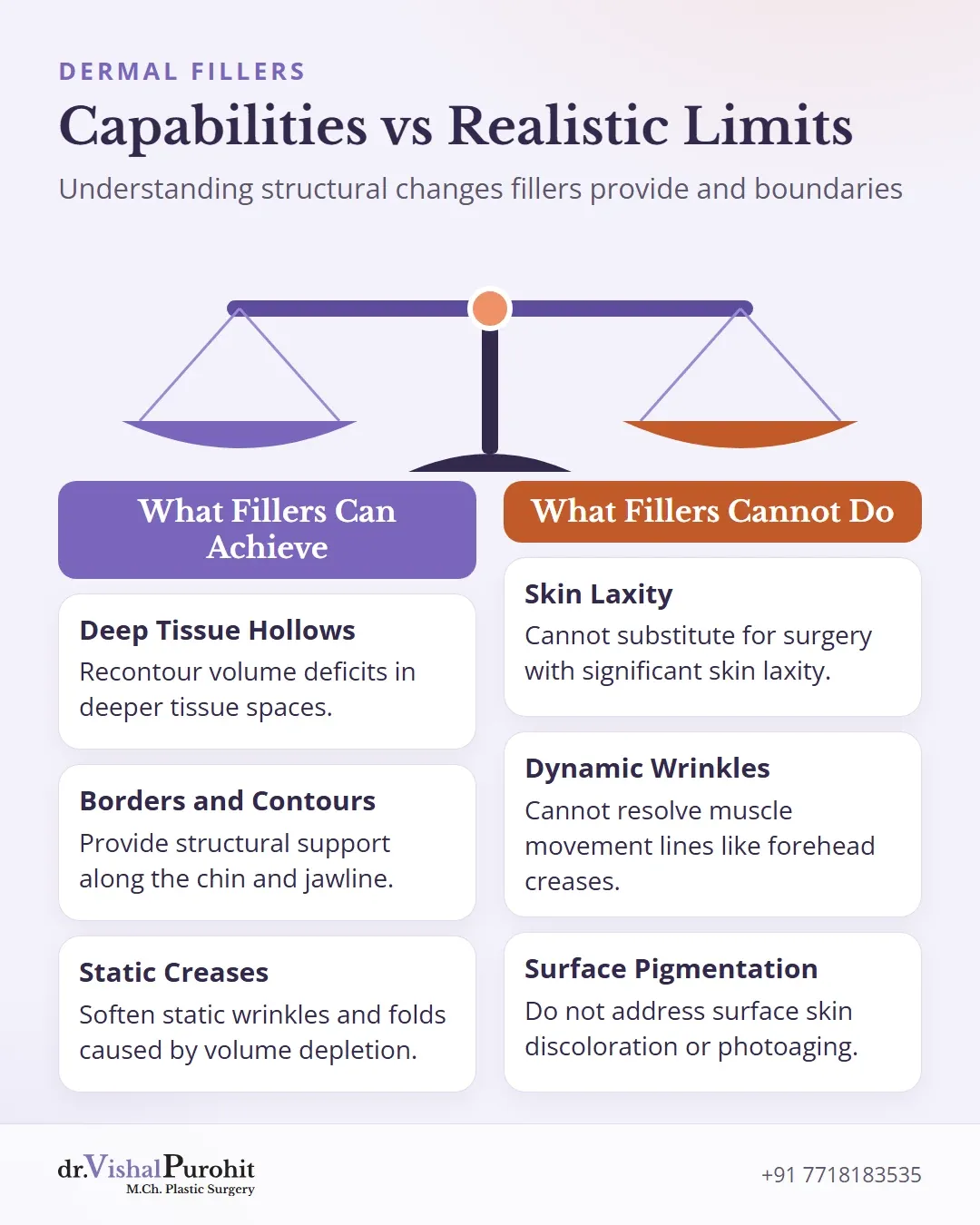
Balance chart comparing what dermal fillers can achieve against their clinical limitations.

Dermal fillers replace lost volume to restore youthful facial contours and balance812. Understanding their structural capabilities helps patients set realistic treatment goals.

Key points

  • Dermal fillers restore lost volume, support facial structure, and soften static wrinkles.
  • Fillers cannot correct severe skin laxity, dynamic wrinkles from muscle movement, or surface pigmentation.
  • Thorough anatomical evaluation ensures cosmetic goals align with what non-surgical options can deliver.

What Fillers Can Achieve

  • Recontour volume deficits and hollows in deeper tissue spaces8.
  • Provide structural support along borders such as the chin and jawline813.
  • Soften static wrinkles, deep creases, and tissue folds caused by volume depletion or gravity81214.

What Fillers Cannot Do

  • Fillers cannot serve as a substitute for surgical treatment in individuals presenting with significant loss of skin elasticity or extensive tissue laxity15.
  • They cannot resolve dynamic wrinkles produced by repetitive facial muscle movement, such as forehead lines or crow’s feet14.
  • They do not address surface skin discoloration or pronounced photoaging pigmentation16.

Realistic counseling regarding expectations and tissue quality is central to achieving satisfactory outcomes1517. At his practice in Jaipur, Dr. Vishal Purohit assesses individual anatomical needs to discuss whether non-surgical volume replacement aligns with a patient’s goals.

Main Materials and Common Areas
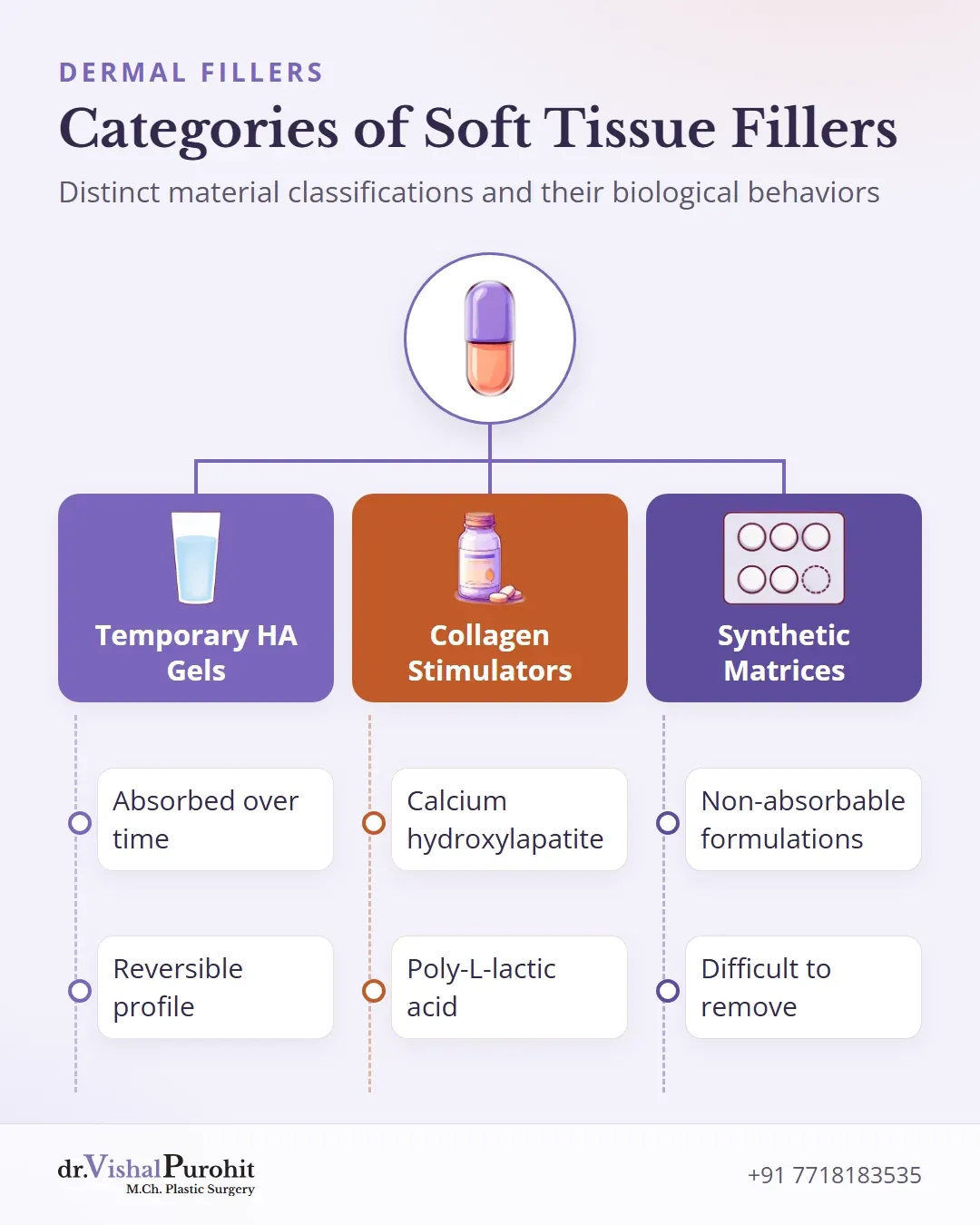
Tree diagram displaying three main injectable filler material categories.

Injectable options fall into distinct material categories18:

Temporary Hyaluronic Acid Gels

Most dermal fillers contain hyaluronic acid, which the body absorbs over time19. These gels are frequently used due to their reversibility and safety profile20.

Collagen Stimulators

Substances such as calcium hydroxylapatite (CaHA) and poly-L-lactic acid (PLLA) restore volume and stimulate the body’s natural collagen production18.

Long-Term Synthetic Matrices

Non-absorbable formulations, such as polymethylmethacrylate beads suspended in bovine collagen, remain in the body and are difficult or impossible to remove if side effects occur181921.

Common facial treatment areas include321:

  • Lips
  • Cheeks
  • Nasolabial folds
  • Chin
  • Jawline or mandible contour2223

Each facial region demands a tailored approach regarding product firmness and placement depth3. The specific choice of filler material and injection plan for an individual patient is not preset; it is decided at the consultation with Dr. Vishal Purohit.

How to Use This Guide

Bridge infographic showing the step-by-step patient preparation journey for filler consultation.

This guide outlines essential steps for patients considering soft tissue augmentation. It covers materials, safety warning signs, pretreatment preparation, and recovery. Patient education should be structured and thorough, giving individuals adequate time to understand the information2425.

A clear understanding of these details helps patients formulate informed questions for their M.Ch. plastic surgeon during the initial consultation24. The consultation serves as a comprehensive clinical evaluation to assess medical history, establish realistic expectations, and determine whether dermal filler procedures are appropriate2627. Patients should never attempt to self-prescribe treatments or select specific products before an individualized clinical assessment2728.

Choosing to have no treatment is always a completely valid and respected decision. Aesthetic procedures remain entirely elective, and no individual should feel pressured to undergo an intervention29.

Use this resource to:

  • Learn about filler materials and potential outcomes2127.
  • Recognize early adverse symptoms requiring prompt evaluation3031.
  • Prepare relevant medical details and questions for the consultation2732.

Consulting an M.Ch. Plastic Surgeon in Jaipur

Deciding whether to undergo soft tissue augmentation is a personal choice that requires structured education and clinical guidance. Learn more about treatment options by exploring Dermal Fillers in Jaipur or reviewing common answers in the Dermal Fillers FAQs. An in-person consultation provides an objective setting to review your anatomy, discuss realistic expectations, and ensure complete treatment safety.

This is educational information, not medical advice.

Frequently Asked Questions

What materials are used in soft tissue fillers?▼

Most soft tissue fillers are formulated with temporary hyaluronic acid gels, which naturally bind water in tissues. Other categories include collagen stimulators such as calcium hydroxylapatite or poly-L-lactic acid, and non-absorbable synthetic matrices. Material selection is tailored individually and decided during a consultation with Dr. Vishal Purohit in Jaipur.

Can dermal fillers replace facial plastic surgery?▼

No, injectable fillers cannot serve as a substitute for surgical treatment in individuals presenting with significant loss of skin elasticity or extensive tissue laxity. Fillers replace lost volume rather than lifting excess skin. Patients can evaluate whether non-surgical options align with their goals by consulting Dr. Vishal Purohit in Jaipur.

How do dermal fillers differ from botulinum toxin?▼

Dermal fillers physically occupy space to restore volume deficits, soften static creases, and recontour facial borders immediately upon placement. In contrast, botulinum toxin relaxes dynamic facial muscles that produce movement lines like crow’s feet. Non-surgical options and anatomical harmony are evaluated individually by Dr. Vishal Purohit in Jaipur.

Which facial regions are commonly treated with fillers?▼

Injectable fillers are placed to replenish volume or restore definition in several distinct facial regions. Common treatment areas include the lips, cheeks, nasolabial folds, chin, and jawline contour. Clinical suitability, injection depth, and product firmness for each specific area are decided during an assessment with Dr. Vishal Purohit in Jaipur.

Can dermal fillers correct surface skin pigmentation?▼

Dermal fillers expand deep tissue volume to soften static creases and support contours, but they do not address surface skin discoloration or pronounced photoaging pigmentation. Surface complexion concerns require distinct evaluation. A comprehensive discussion about realistic structural changes and tissue limitations is conducted with Dr. Vishal Purohit in Jaipur.

What happens during an initial filler evaluation?▼

An initial clinical evaluation reviews personal medical history, establishes realistic expectations, and determines whether soft tissue augmentation is appropriate. Choosing to have no treatment remains a respected and valid decision. Patients can discuss their aesthetic questions and receive an individualized assessment from Dr. Vishal Purohit in Jaipur.

Sources

  1. 10_1007__s00266-017-1063-0.pdf doi.org/10.1007/s00266-017-1063-0.pdf
  2. Cosmetic Medicine And Aesthetic Surgery Strategies For Success (textbook, PDF page 354).
  3. Comprehensive Analysis of Dermal Fillers and Soft Tissue Augmentation: Biomaterial Profiles, Regulatory Frameworks, Complication Management, and Autologous Alternatives.
  4. Procedures In Cosmetic Dermatology Soft Tissue Augmentation (textbook, PDF page 16).
  5. Illustrated Manual of Injectable Fillers (textbook, PDF page 91).
  6. Procedures In Cosmetic Dermatology Soft Tissue Augmentation (textbook, PDF page 177).
  7. Procedural Dermatosurgery A Step by Step Approach (textbook, PDF page 1243).
  8. Practical Guide to Dermal Filler Procedures (textbook, PDF page 17).
  9. Efficacy, Durability, and Safety of VYC‐17.5L Hyaluronic Acid Dermal Filler for Facial Enhancement: A Systematic Review and Single‐Arm Meta‐Analysis. Journal of Cosmetic Dermatology doi.org/10.1111/jocd.71233
  10. Beyond Volumization: Repositioning Hyaluronic Acid Fillers as Anatomy‐Guided Structural Support Tools in the Era of Biostimulators. Journal of Cosmetic Dermatology doi.org/10.1111/jocd.71179
  11. 10_1097__PRS_0000000000010767.pdf.
  12. Master Techniques In Otolaryngology Head And Neck Facial Plastic Surgery (textbook, PDF page 507).
  13. Aesthetic Procedures Nurse Practitioners Guide To Cosmetic Dermatology (textbook, PDF page 171).
  14. Dermal Fillers for Dental Professionals (textbook, PDF page 53).
  15. Dermatologic Surgery (textbook, PDF page 2251).
  16. Combined Hyaluronic Acid and Collagen Injections for Perioral Rejuvenation: A Randomized Controlled Trial. Journal of Cosmetic Dermatology doi.org/10.1111/jocd.71169
  17. Complications of Botulinum Toxin, Fillers, and Threads: A Narrative Review by the Special Interest Group (SIG) Aesthetics, Indian Association of Dermatologists, Venereologists and Leprologists (IADVL) Academy. Cureus doi.org/10.7759/cureus.115447
  18. 10_1097__PRS_0000000000010767.pdf.
  19. FDA-Approved Dermal Fillers (fda.gov).
  20. Isolated, Unilateral Lower Eyelid Mass Presenting as a Delayed Ocular Complication of Dermal Filler. Kansas Journal of Medicine doi.org/10.17161/kjm.vol19.25671
  21. Dermal Fillers (Soft Tissue Fillers).
  22. Dermal Fillers Facial Anatomy And Injection Techniques (textbook, PDF page 540).
  23. Dermal Fillers Facial Anatomy And Injection Techniques (textbook, PDF page 544).
  24. Augmentation Mammaplasty with DVD: Redefining the Patient and Surgeon Experience (textbook, PDF page 56).
  25. Augmentation Mammaplasty with DVD: Redefining the Patient and Surgeon Experience (textbook, PDF page 393).
  26. Dermatologic Surgery And Cosmetic Procedures In Primary Care (textbook, PDF page 358).
  27. Dermal Fillers for Dental Professionals (textbook, PDF page 48).
  28. The Lip Complexity Classification (LCC): A Proposed Framework Integrating Anatomical Assessment with Therapeutic Decision-Making in Lip Augmentation. Clinical, Cosmetic and Investigational Dermatology doi.org/10.2147/CCID.S634221
  29. 10_1007__s00266-017-1063-0.pdf.
  30. Permanent Complications After Dermal Fillers: Risks, Prevention, and Management Strategies. Aesthetic Plastic Surgery doi.org/10.1007/s00266-026-05989-8
  31. Pars Plana Vitrectomy for Inadvertent Intravitreal Injection of Hyaluronic Acid Dermal Filler: A Case Report. Case Reports in Ophthalmology doi.org/10.1159/cop/acaag005
  32. Aesthetic Facial Anatomy Essentials for Injections (textbook, PDF page 69).
More in Dermal Fillers & Injectables

Related Patient Guides

More in Dermal Fillers & Injectables
Specialist Consultation • Dr. Vishal Purohit

Considering Dermal Fillers & Injectables?

Consult directly with Dr. Vishal Purohit (M.Ch. Plastic Surgery) at his OPD suite, Kalpana Aesthetics (Tonk Road, Jaipur), to understand your surgical roadmap, risks, and recovery options.