
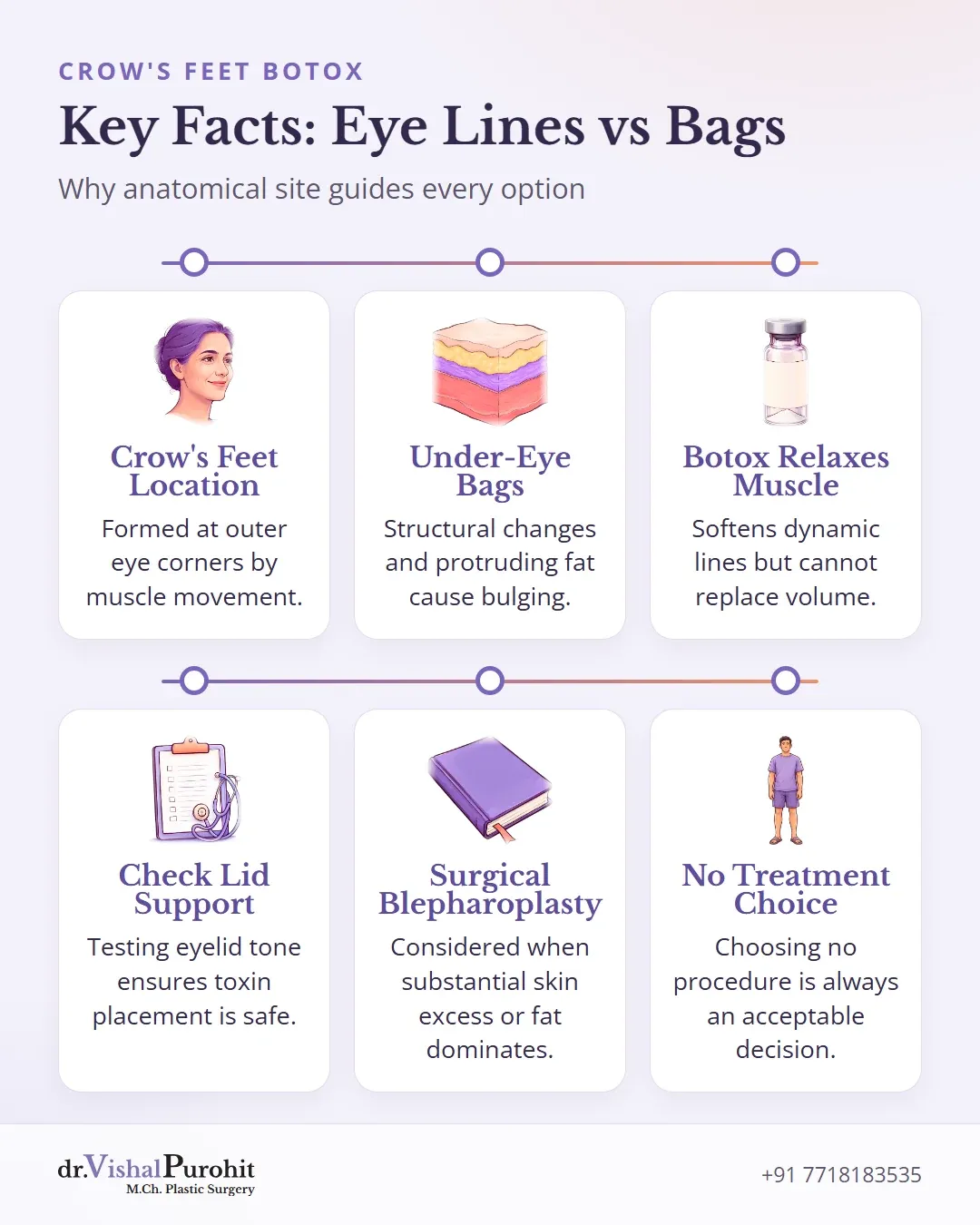
Lines at the outer corners of the eyes and puffiness along the lower eyelid involve distinct anatomical structures. Relaxing dynamic muscle can soften creases formed during facial expression, but it does not address tissue descent or bulging fat compartments.
Evaluating structural shadowing alongside Crow’s Feet When Smiling vs Resting Lines: What Botox Can Change helps clarify what non-surgical injections can achieve. A clinical examination distinguishes superficial movement from deeper volume changes before any procedure is considered.
Lateral Creases Versus Lower Eyelid Contour
Where crow’s feet sit
Crow’s feet are the lines at the outer corners of the eyes. They appear on the outer lateral orbital rim, produced by the orbital portion of the orbicularis oculi muscle, which moves with smiling1. The literature notes that rhytids and crow feet may be evident laterally, following ultraviolet exposure and age-related collagen remodeling2.
Key points
- Crow’s feet sit on the outer lateral orbital rim and are caused by muscle movement and collagen remodeling.
- Lower eyelid bags, dark circles, and tear troughs occupy a separate anatomical zone driven by structural laxity.
- Pinpointing the exact anatomical site ensures the correct muscle or tissue is addressed without impairing eyelid function.
Where bags, dark circles and troughs sit
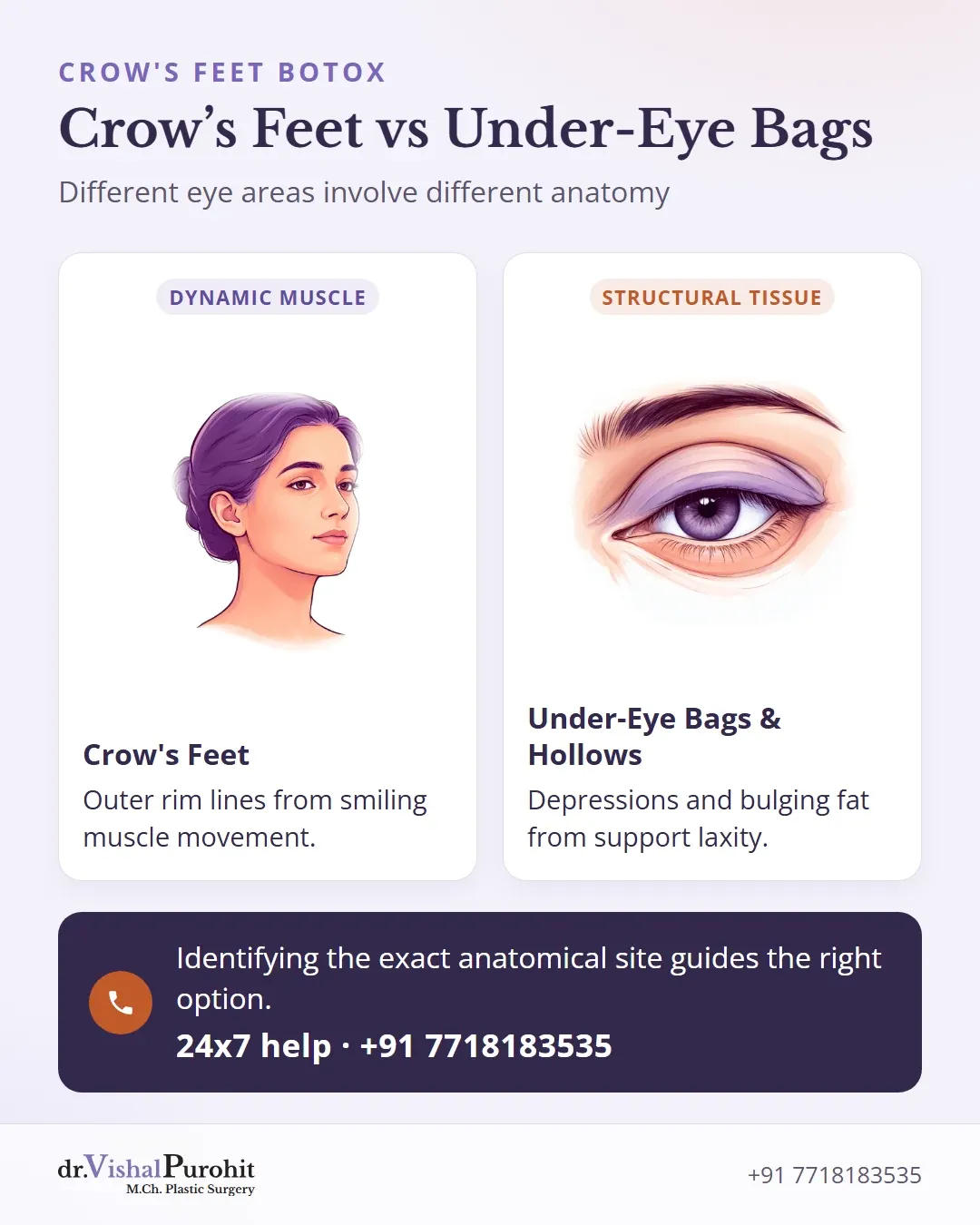
These occupy the lower lid and the infraorbital rim, a separate anatomical area. The tear trough is a depression along the infraorbital rim, often coexisting with dark circles and lower-eyelid laxity3. Lower eyelid bags arise from a complex aging process rather than an increase in adipose volume; laxity of the eye’s support structures pushes fat forward, contributing to bulging, dark circles and shadowing2.
Why the exact site matters
Identifying the exact anatomical site is essential before considering any procedure. Assessment should address the dominant anatomy3. Weakening the wrong portion of the muscle may improve the line incompletely while disturbing normal eyelid function1.
Why Relaxing Muscle Does Not Restore Volume
What the injection acts on
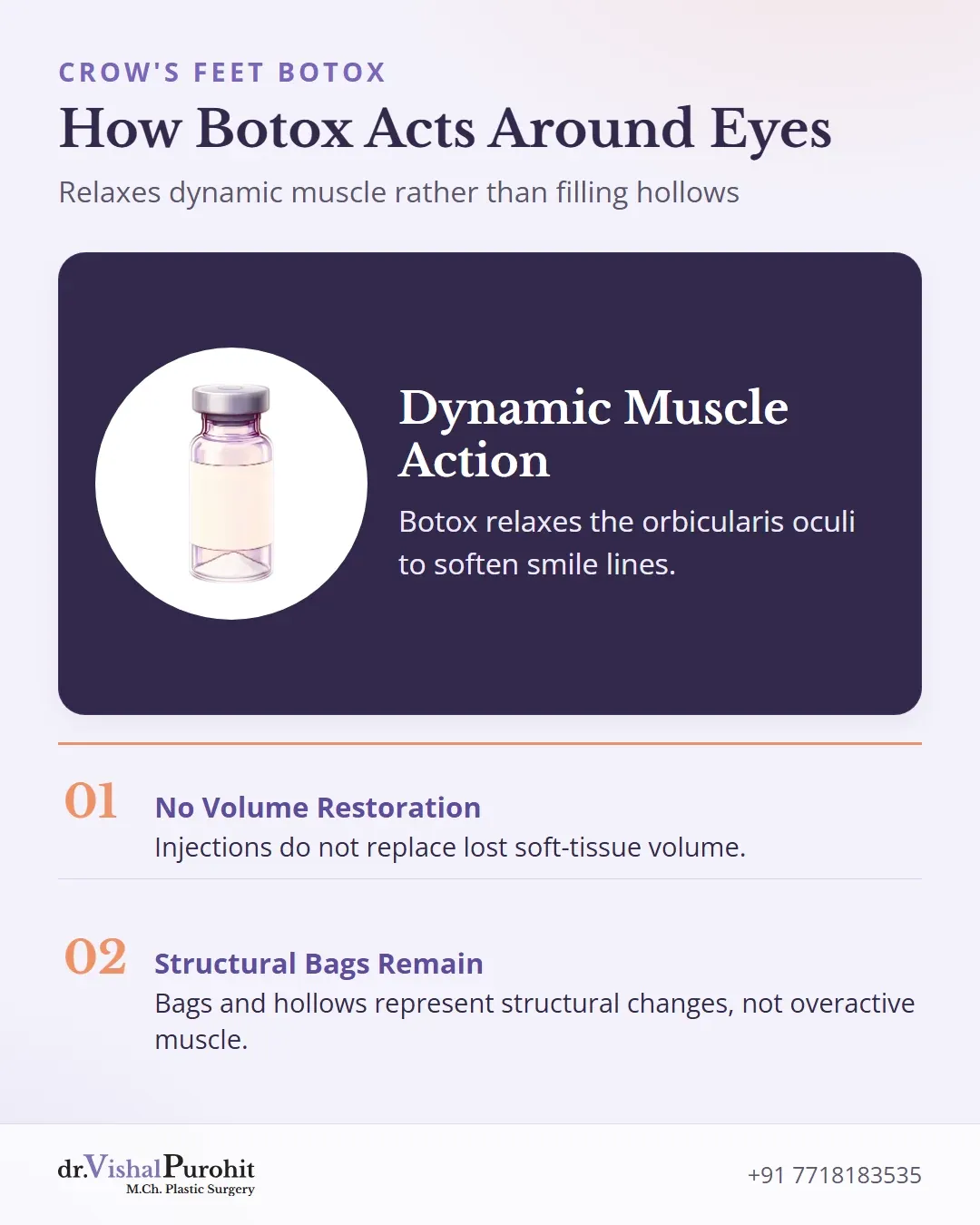
Botox relaxes muscle. Around the eye it acts on the orbicularis oculi, the muscle that pulls the skin into crow’s feet when you smile or squint4. This can soften the lines at the outer corners of the eyes. It does not replace soft-tissue volume that has been lost, and it does not clear prolapsed orbital fat pads35.
Key points
- Botox targets muscle movement rather than lost soft-tissue volume or prolapsed fat.
- Tear troughs and under-eye bags stem from structural anatomy and fat compartments.
- Nonsurgical injectables cannot substitute for surgery when correcting structural causes.
Why hollows and bags are different
A tear trough hollow is a depression along the rim of the eye socket. Its contributors include inherited anatomy, midface and fat-compartment volume loss, skin thinning, and orbital fat pseudoherniation3. Under-eye bags may be herniated orbital fat, excess skin, or a thickened muscle56. These are structural findings, not overactive muscle.
What the literature reports
Ophthalmic plastic surgery texts describe botulinum toxin injections as adjuncts to surgery, not alternatives, and note that nonsurgical options can improve the appearance of the tissue without correcting the cause5. Patients who complain of lower lid bags are counselled on the difference between fat herniation and muscle bulge, and accurate diagnosis is considered key6.
Clinical Evaluation of Bags and Dark Circles
Why the cause matters
Under-eye puffiness and shadowing do not share a single cause. Dark circles under the eyes are a clinical description rather than one disorder: pigmentary, vascular, structural and mixed forms may coexist, and management depends on identifying the dominant mechanism3. Structural shadowing follows tear trough deformity, fat pseudoherniation, skin laxity or midface volume loss3.
What the examination looks for
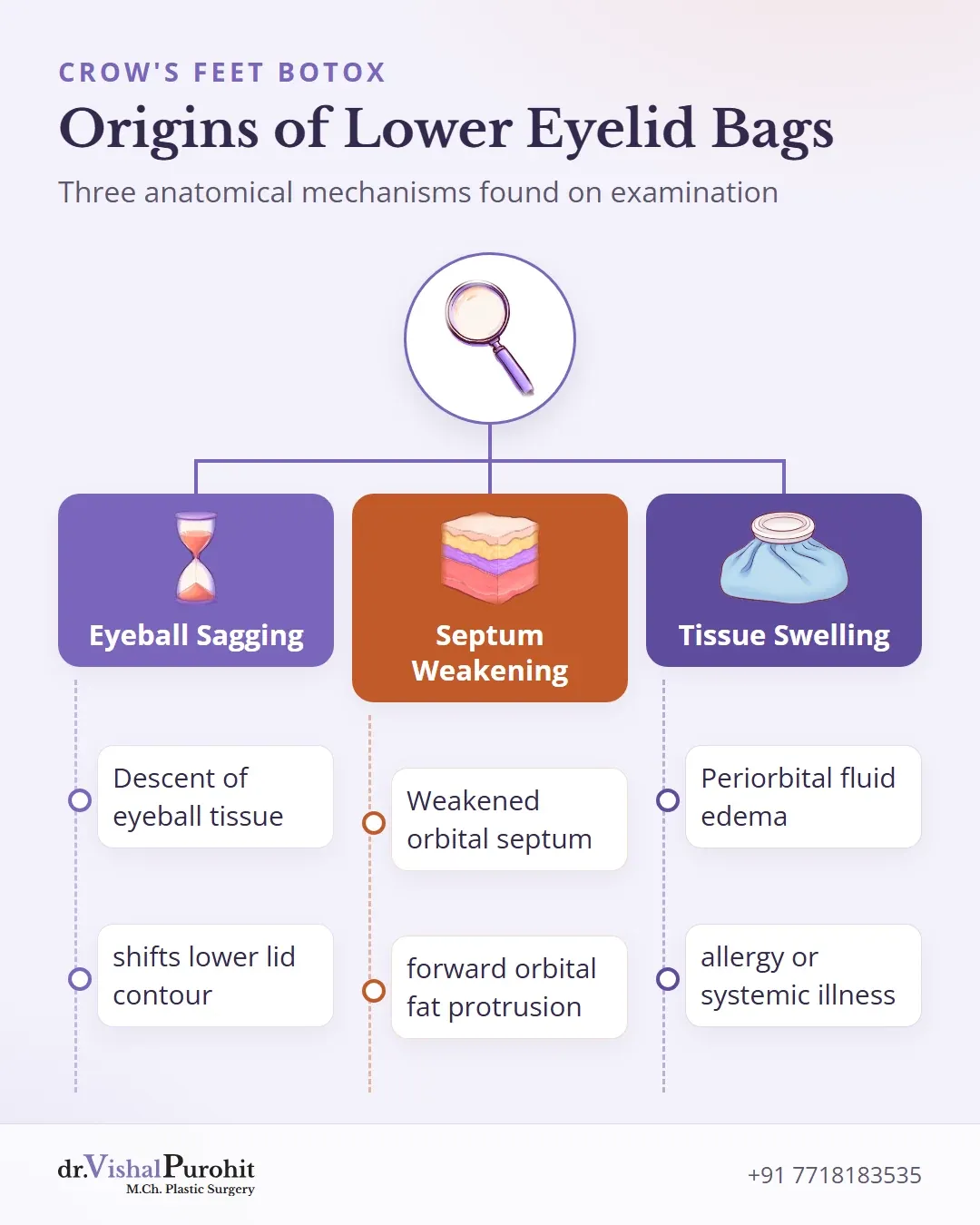
A palpebral bag may arise in three ways: sagging of the eyeball, weakening of the orbital septum that lets orbital fat protrude, or swelling of the tissues around the eyes from allergy or other illness7. Dark rings are a heterogeneous group with multifactorial causes, including periorbital edema, shadowing, loss of subcutaneous fat and skin laxity8.
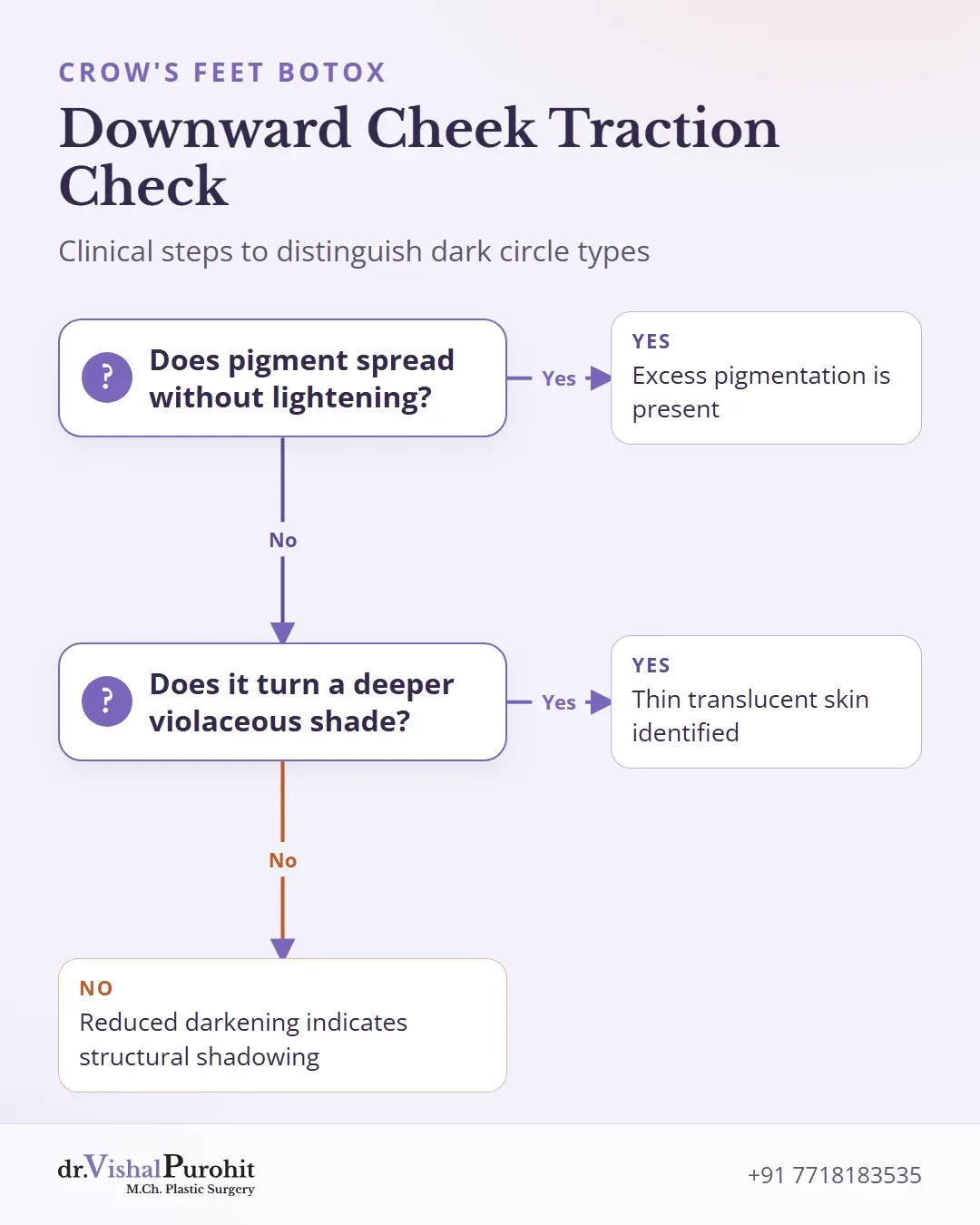
One described check applies downward traction on the infraorbital cheek: pigment that spreads without lightening suggests excess pigmentation, a deeper violaceous shade suggests thin translucent skin, and reduced darkening suggests shadowing9.
Several causes can coexist in the same under-eye area, so the examination identifies the dominant one before any option is proposed.
Dr. Purohit’s note: At his clinic in Jaipur, Dr. Purohit follows this approach, and what suits each patient is decided at the consultation.
Prior Eyelid Surgery and Lower Lid Support
How previous surgery changes the lid
Previous blepharoplasty or natural looseness of the lower lid margin affects eyelid position and support. Laxity of the lateral canthal tendon lowers the position and posture of the lower lid, and the lower lid tissue may round and bunch10. If lid laxity goes unrecognized and addressed, it can lead to scleral show or ectropion11.
Why it changes treatment planning
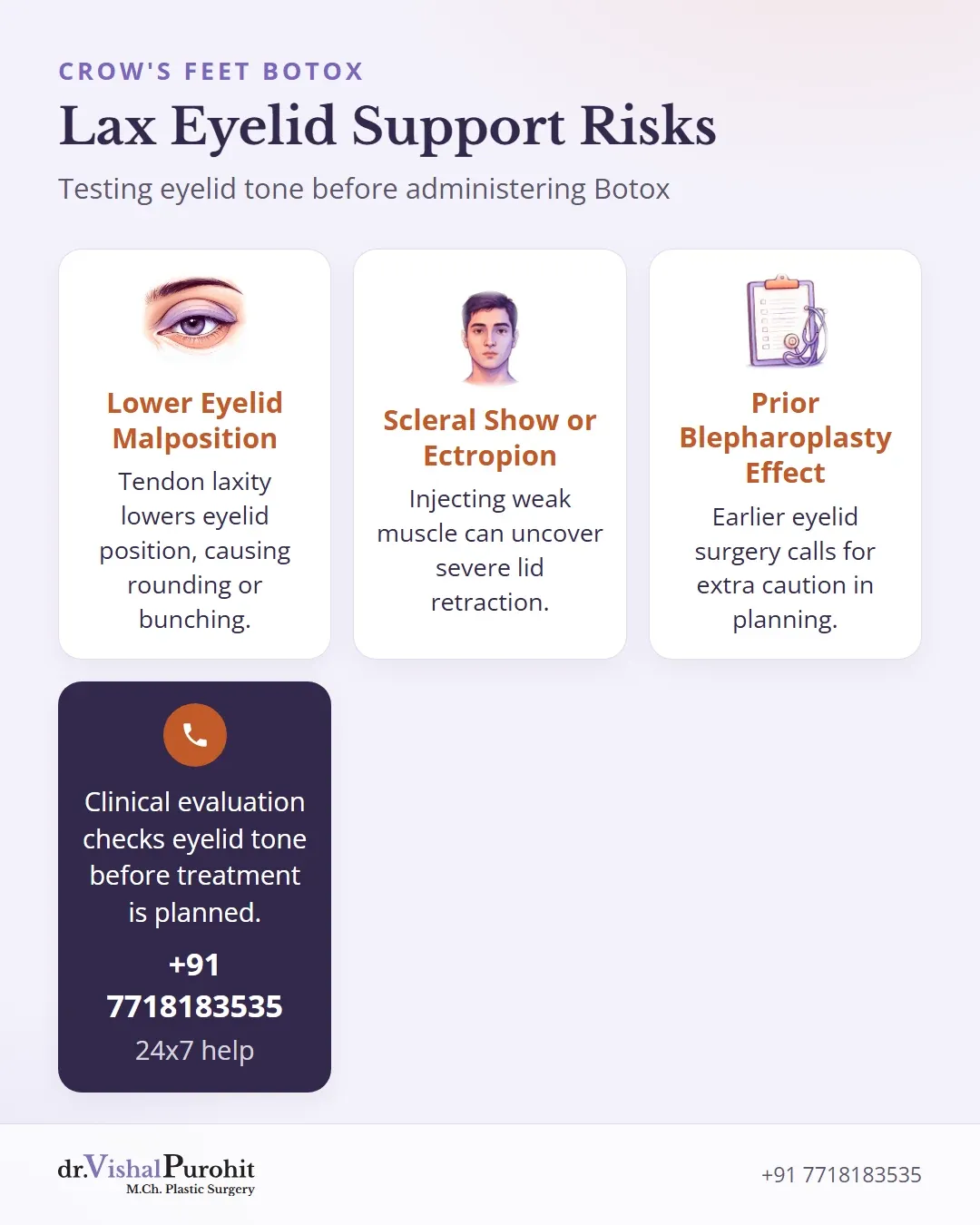
Weak lid tone changes how Botox for crow’s feet is planned. Patients with lower-lid laxity or prior blepharoplasty often benefit from the lower end of the dosing range and from particularly careful placement12. Scleral show or ectropion can occur after toxin injection into the lower orbicularis muscle when the lateral canthus is lax, and eyelid laxity can be tested before treatment13.
At his practice in Jaipur, whether a patient’s eyelid support suits Botox is decided at the consultation.
Surgical Referral and Choosing No Treatment
When excess skin or fat pads are the main issue
Where excess eyelid skin or prominent fat pads dominate, surgical options such as blepharoplasty may be discussed3. Surgery is the reference treatment for substantial dermatochalasis, fat prolapse or eyelid laxity3, while minimally invasive approaches may benefit selected mild cases3. Treatment is individualized according to the severity of tissue laxity, associated anatomical abnormalities and patient expectations3.
Non-surgical plans and the choice of no treatment
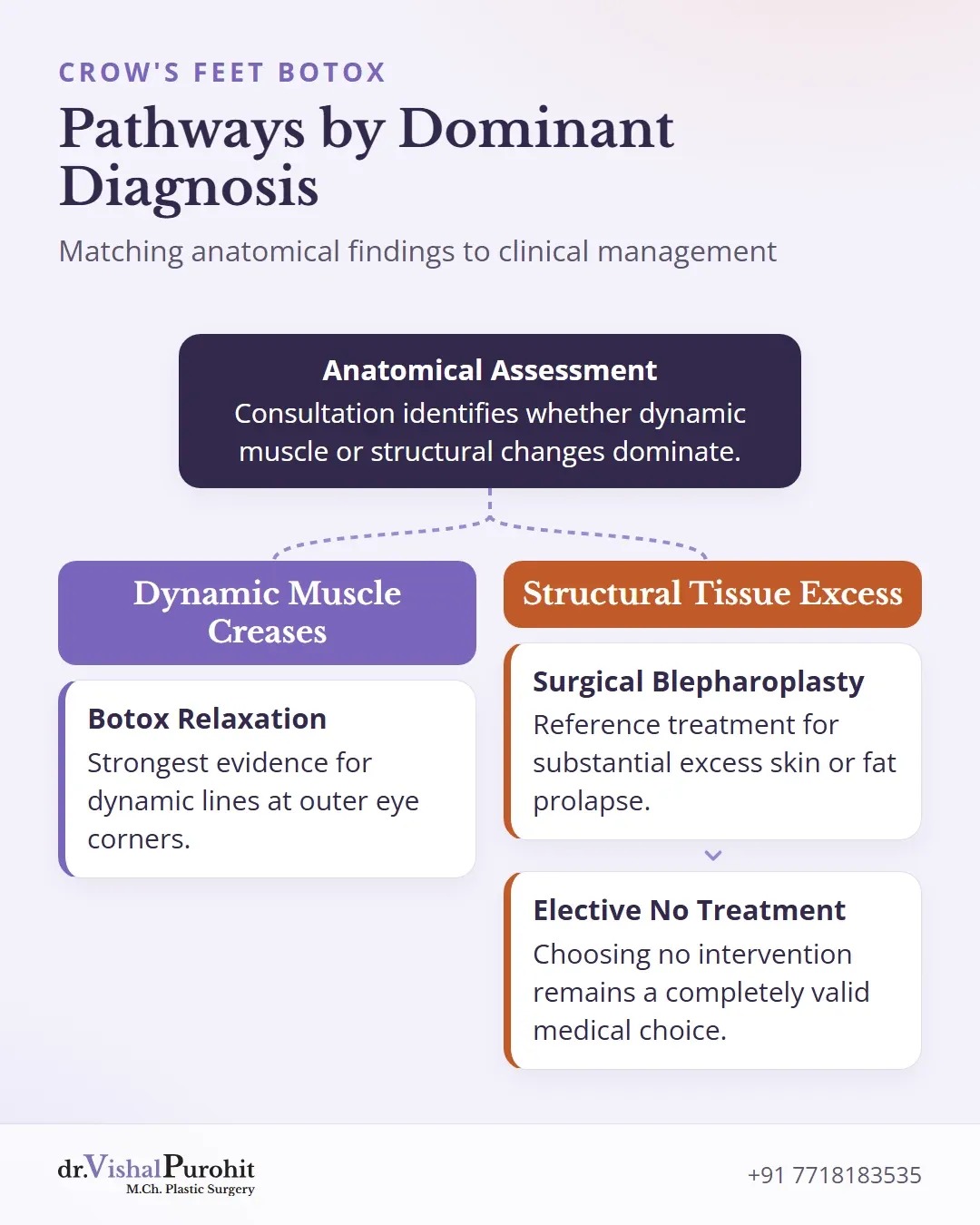
A plan that combines several non-surgical treatments is not required for every patient; the approach is matched to the predominant mechanism3. Botox has its strongest evidence for the dynamic lines at the outer corners of the eyes3, and it sits within a wider range of options3.
Choosing no treatment remains a valid option. In Dr. Purohit’s practice, the choice between surgical discussion and no treatment is decided at the consultation.
Consultation for Eye Area Assessment in Jaipur
Distinguishing between dynamic creases and structural changes ensures that any chosen approach matches individual anatomy. For dynamic lateral lines, explore Crow’s Feet Botox in Jaipur to understand how targeted muscle relaxation works. Review Crow’s Feet Botox FAQs for further details on suitability, or arrange a personal evaluation by calling or messaging +91 7718183535.
This is educational information, not medical advice.