
Injections around the outer corners of the eyes temporarily relax the orbicularis oculi muscle, which helps maintain regular eyelid closure and tear clearance. When normal muscle action slows, uneven tear distribution across the ocular surface can trigger subtle irritation or reflex watering.
Patients reviewing their pre-treatment precautions in Before Crow’s-Feet Botox: Eye History, Health and Medicines often note that existing ocular dryness makes post-injection monitoring essential. Recognizing early changes ensures timely professional guidance.
The Role of Blinking in Protecting the Eye
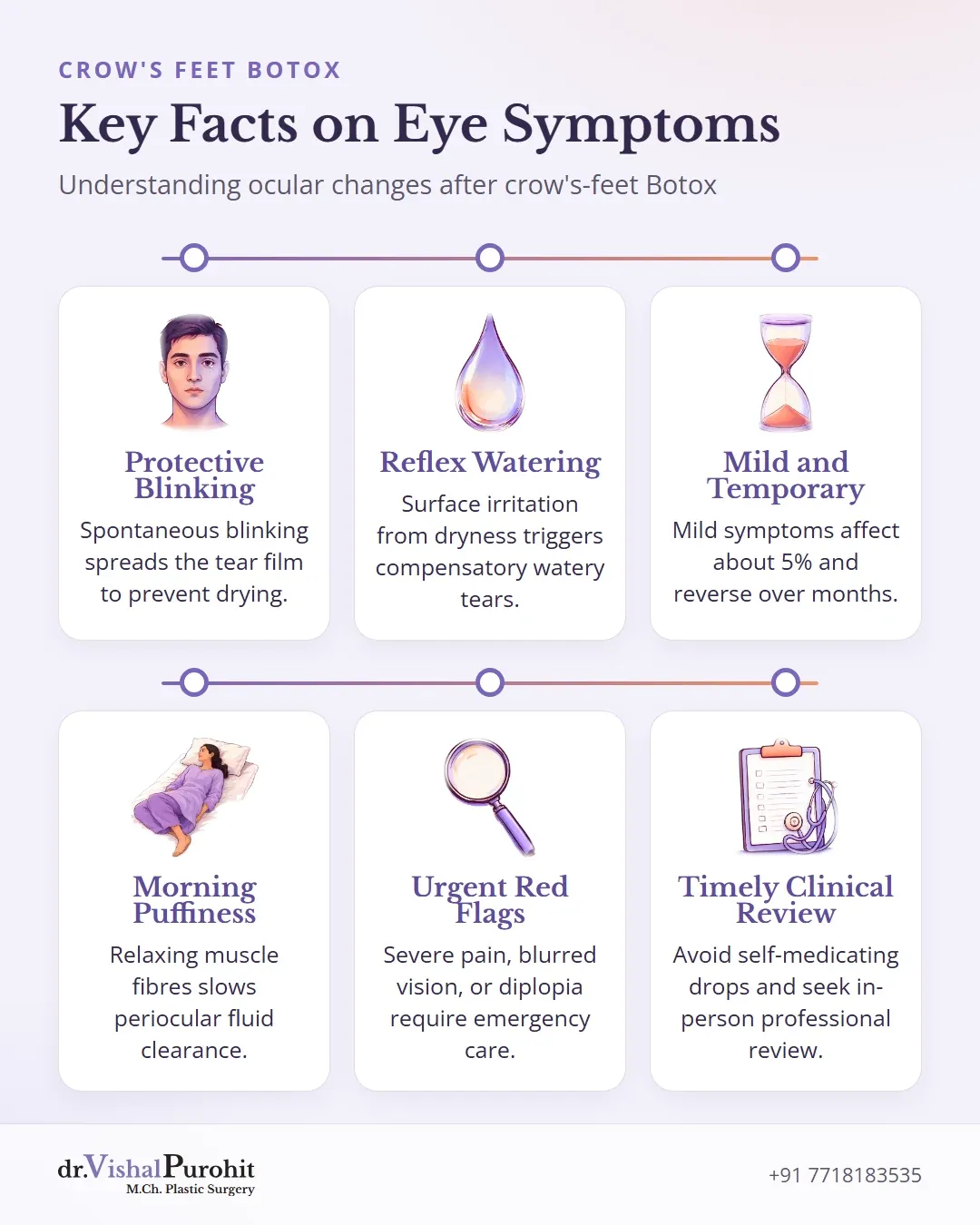

The orbicularis oculi muscle is essential for ocular protection, enabling eyelid closure to create a physical barrier against wind and foreign matter1. Repetitive spontaneous blinking spreads the precorneal tear film evenly across the ocular surface in a lateral to medial direction, which prevents corneal drying and irritation12. Furthermore, muscular action during blinking establishes a pump mechanism that directs tears into the drainage system and facilitates their clearance123.
When Botox is placed in the lateral canthal area, diffusion toward the palpebral portion of the orbicularis oculi can weaken muscles involved in eyelid dynamics4. This relaxation can temporarily disrupt tear film distribution, impair tear film stability, or reduce complete eyelid closure and blinking45.
Literature notes that reduced blinking from botulinum toxin injection in or near the orbicularis oculi can lead to corneal exposure, persistent epithelial defects, or ulceration5.
Dr. Purohit’s note: In Dr. Vishal Purohit’s practice, treatments are planned with careful anatomical precision to protect normal eyelid mechanics.
Why Dryness Can Cause Reflex Tearing
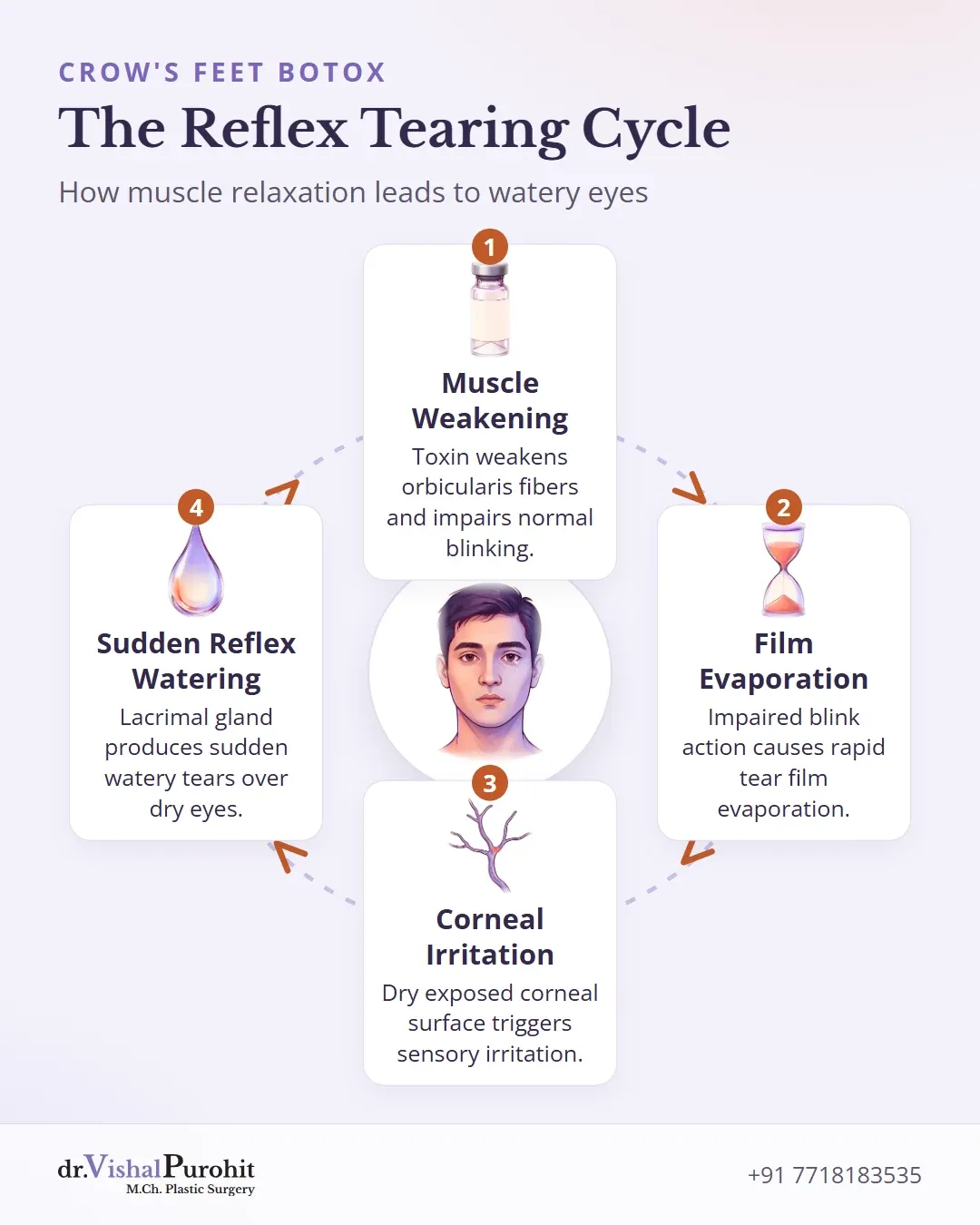
Watery eyes after botulinum toxin injection for crow’s feet frequently indicate underlying ocular surface dryness rather than excessive tear production6. In clinical evaluations, epiphora often stems from an irritated ocular surface rather than true hypersecretion6.
When botulinum neurotoxin chemodenervates the orbicularis oculi muscle, it can result in a poor blink mechanism, eyelid malposition, or lagophthalmos6. This impaired eyelid action disrupts tear-film distribution and stability across the eye46. As tear film evaporation exposes the cornea, the resulting surface irritation triggers the lacrimal gland to produce sudden compensatory reflex watering67.
Additional mechanical factors can worsen this paradoxical tearing:
- Weakness of the medial pretarsal fibers reduces tear outflow68.
- Malposition of the eyelids impairs normal tear retention6.
In his practice in Jaipur, Dr. Vishal Purohit approaches post-treatment eye complaints with anatomical precision and evidence-based evaluation. Persistent tearing warrants prompt clinical assessment to prevent complications such as corneal erosion6.
Reporting Irritation and Incomplete Closure Promptly
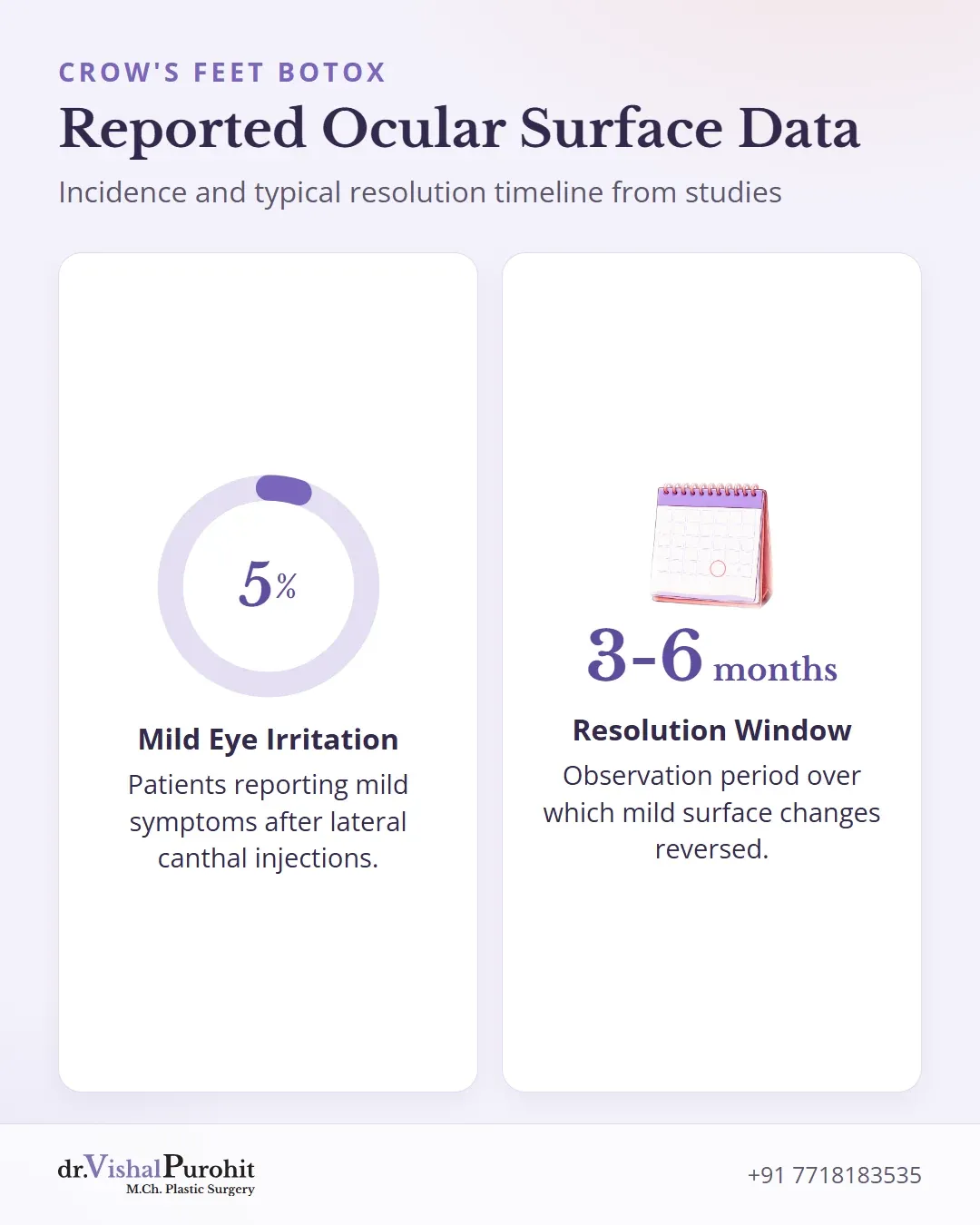
Subtle eye irritation, a foreign body sensation, or excessive tearing can emerge after botulinum toxin type A injections into the lateral canthal area6. In literature evaluating these injections, mild symptoms were reported in approximately 5% of patients6. These early manifestations appear linked to orbicularis oculi muscle weakness6. In addition, higher doses carry a risk of muscle paralysis that can result in ectropion9.
Key points
- Mild eye irritation or excessive tearing can occur after botulinum toxin injections near the lateral canthus.
- Higher doses can lead to muscle paralysis and eyelid malposition such as ectropion.
- Prompt in-person assessment is essential when symptoms like incomplete eyelid closure develop.
When new surface changes develop, an in-person evaluation is necessary rather than assuming symptoms will pass. At his practice in Jaipur, Dr. Vishal Purohit advises that concerning eye symptoms need in-person assessment.
Patients noticing changes around the eyelids should report them promptly:
- Persistent grittiness, redness, or a feeling of something in the eye6
- Tearing or visible eyelid malposition69
- Difficulty closing the eyelids completely
In clinical studies, discontinuing or delaying further lateral canthal injections allowed mild ocular surface changes to reverse over an observation period of approximately 3 to 6 months6.
Muscle Relaxation and Temporary Morning Eye Puffiness

The periocular region has thin skin, complex venous and lymphatic drainage, and orbital and malar septa that make small fluid shifts clinically visible10. In the periorbital area, the orbicularis oculi muscle serves a mechanical role in local fluid dynamics, where muscle action facilitates drainage611.
When botulinum toxin type A relaxes the orbicularis oculi muscle, this localized pumping action is altered6. While deep and superficial orbicularis fibres normally promote tear and fluid movement through regional structures11, reduced muscle tone can slow normal fluid clearance610.
True fluid accumulation around the eyes must be carefully distinguished from pre-existing structural issues, such as fat pseudoherniation, festoons, or malar mounds1012. In clinical practice in Jaipur, Dr. Vishal Purohit conducts a thorough anatomical assessment to evaluate eyelid laxity and fluid tendencies before delivering non-surgical injection treatments.
Urgent Symptoms and Timely Medical Assessment

Certain post-treatment changes require immediate clinical attention rather than routine observation. Patients should seek prompt medical and ophthalmological assessment if they develop:
Key points
- Certain ocular symptoms after treatment require immediate clinical review rather than routine observation.
- Toxin diffusion or reduced blinking can cause issues such as double vision or corneal exposure.
- Patients should avoid self-treating and contact the clinic promptly if concerning visual symptoms appear.
- Severe eye pain
- Blurred vision
- Double vision (diplopia)131415
- Acute light sensitivity (photophobia)1516
Diplopia or transient strabismus can arise if toxin diffuses into adjacent extraocular muscles, such as the lateral rectus muscle following lateral periorbital injections for crow’s feet1415. Furthermore, reduced blinking from botulinum toxin injection of the orbicularis muscle can lead to corneal exposure, persistent epithelial defects, or ulceration516. In significant or persistent cases of ocular muscle involvement, prompt consultation with an ophthalmologist provides an accurate diagnosis and supportive management, such as temporary eye patching or Fresnel membrane prisms1314.
Patients should never self-prescribe medicated eye drops or wait passively for product effects to wear off. Any intervention requires proper clinical guidance. Specific post-procedure evaluation and aftercare arrangements are not fixed in advance; Dr. Vishal Purohit determines individual protocols at the consultation. For any concerning visual or ocular surface symptoms, contacting the clinic directly on +91 7718183535 ensures timely medical review.
Clinical Evaluation for Periocular Symptoms in Jaipur
Careful anatomical planning helps minimize adverse eyelid dynamics during treatment. Patients exploring Crow’s Feet Botox in Jaipur can review common treatment considerations and procedure details in the Crow’s Feet Botox FAQs. Because physical examination remains essential, contacting +91 7718183535 ensures prompt clinical review whenever unexpected irritation arises.
This is educational information, not medical advice.