
Botox targets dynamic lateral canthal creases around the eyes by temporarily reducing localized muscle contraction. Understanding the difference between active expressions and resting creases helps set realistic expectations, as explained in Crow’s Feet When Smiling vs Resting Lines: What Botox Can Change.
Full clinical changes do not happen overnight. Allowing sufficient time for the nerve connections to adjust ensures that both initial smoothing and subsequent follow-up assessments remain clinically accurate.
The Gradual Development of Wrinkle Smoothing
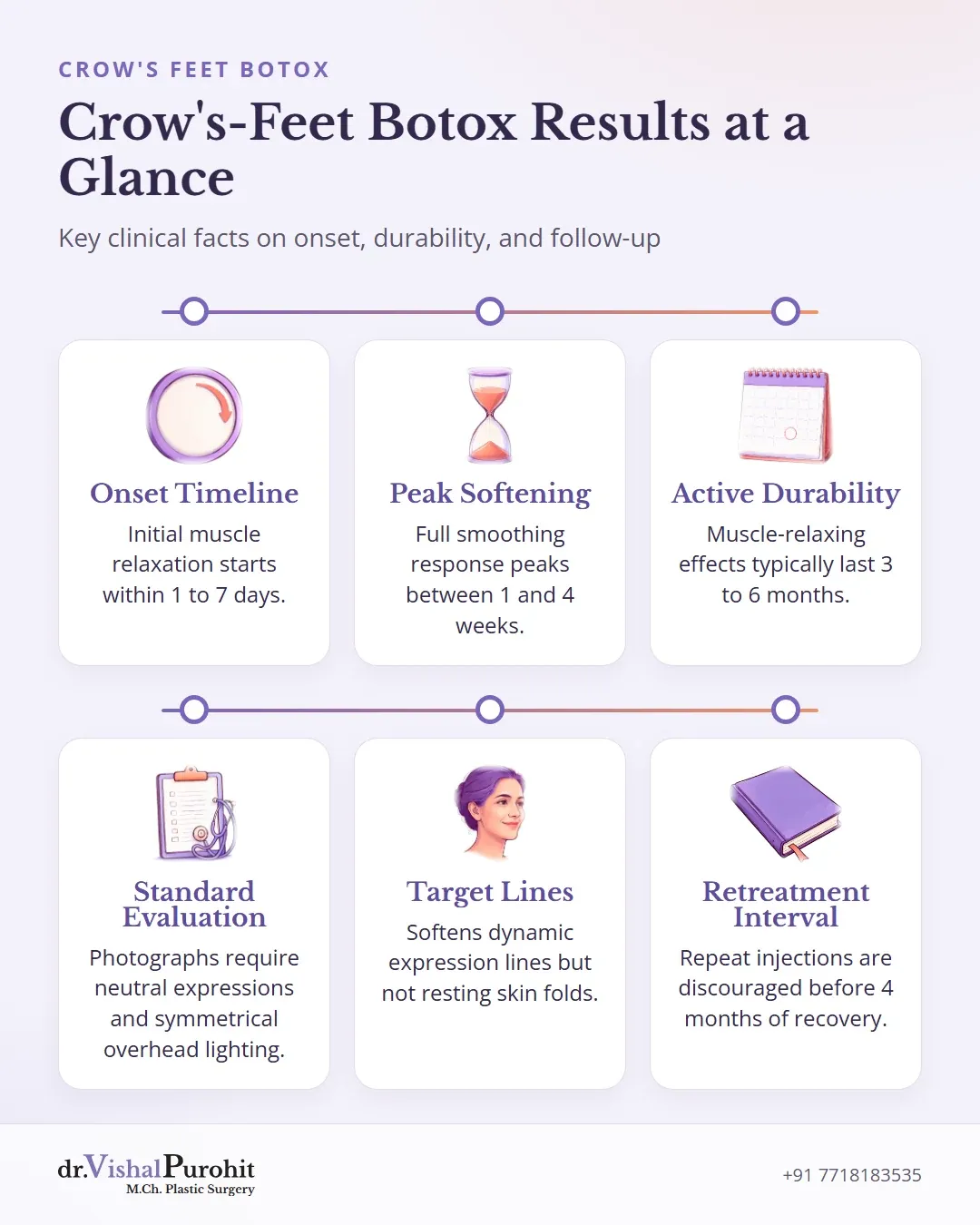
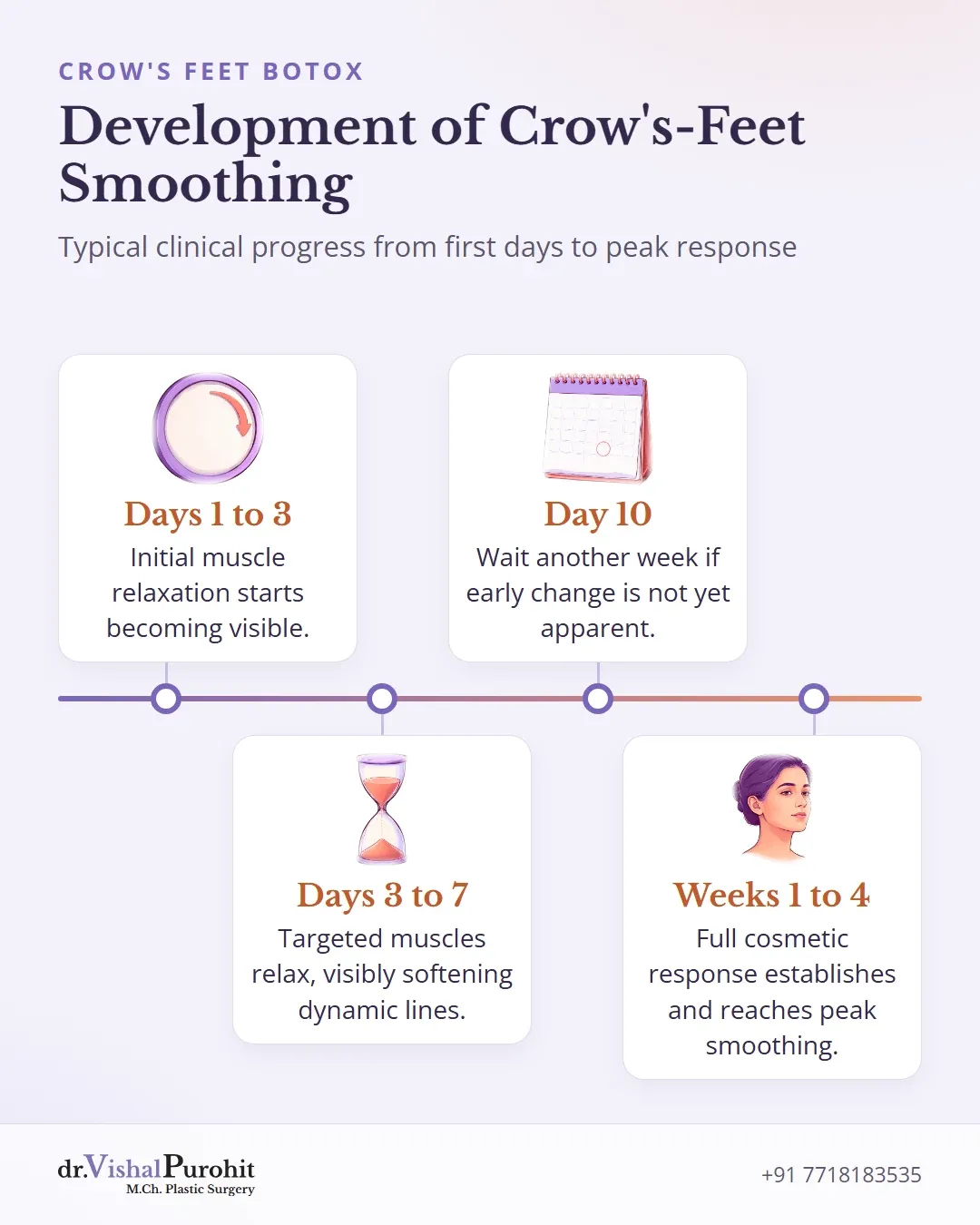
Botulinum toxin does not smooth wrinkles immediately upon injection. The clinical effects of botulinum toxin generally begin to appear within one to three days1, though neurotoxins typically demonstrate an effect between 3 and 7 days post-injection2. Within the first week of treatment, patients usually notice the targeted muscles starting to relax, leading to a visible softening of dynamic lines34.
Key points
- Botulinum toxin begins working gradually over several days rather than smoothing wrinkles immediately.
- Visible muscle relaxation typically starts within the first week and peaks between one and four weeks.
- Patients should allow sufficient time for the treatment to establish fully before evaluating results.
Because individual response times naturally vary between two and nine days5, initial changes should not be judged prematurely. The overall clinical response continues to evolve, with effects peaking between one and four weeks after administration1. If no visible change is observed after three days, published guidance advises reassuring the patient and waiting another week before assessing the outcome2.
Allowing adequate time for the neural blockade to establish fully is essential before evaluating the initial cosmetic result12. At that point, the extent of muscle softening and wrinkle improvement can be assessed accurately.
Realistic Durability Ranges and Individual Variation
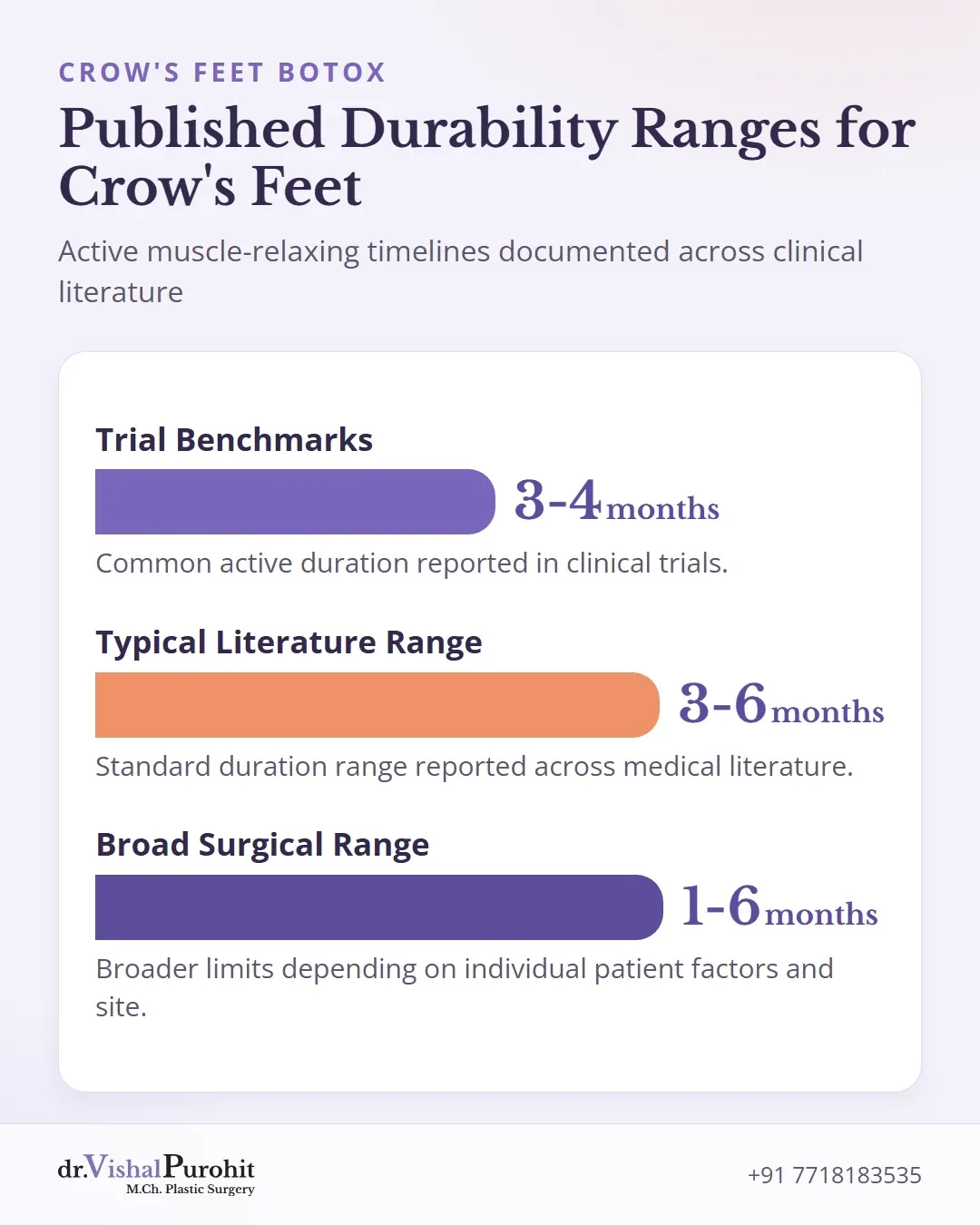
Published medical literature indicates that the muscle-relaxing effect of botulinum toxin type A typically lasts between 3 and 6 months3, with common clinical trial benchmarks noting an active duration of 3 to 4 months67. General surgical texts also record broader ranges from 1 to 6 months depending on the patient and site8.
These published generic figures provide helpful reference benchmarks rather than a fixed timeline for every person. The clinical effect does not depend on the continuous presence of the medicine at the nerve terminal, but on the time needed for nerve sprouts to restore functional connections at the motor endplate6. Nerve sprout growth begins around 28 days post-injection, with recovery completing at roughly 90 days6.
Dr. Purohit’s note: At his practice, Dr. Vishal Purohit considers the specific onset and duration of effect for each patient as an individual matter decided at the consultation.
For some individuals, lines soften noticeably, whereas others may see little change34.
Reviewing Results Under Standardized Lighting

In Dr. Vishal Purohit’s practice, clinical photographs are kept strictly for treatment records and are never shared publicly. Systematic clinical evaluation depends on comparing unedited baseline photographs taken under identical, standardized conditions910.
Self-evaluations made on phone screens or in angled mirrors frequently introduce misleading distortion. Credible assessments require consistent, symmetrical overhead lighting to properly show facial lines and contours, whereas camera-mounted flash should be avoided because it fills in and obscures natural skin creases10.
Standardized clinical photography protocols photograph patients maintaining a neutral head position and identical expressions at baseline and follow-up9. Evaluating crow’s feet requires documenting the lateral canthal region both at rest and during matching facial animation, such as smiling or squinting, which repeatedly contract the underlying orbicularis oculi muscle91112.
Persistent Creases and Reassessment Decisions

Crow’s-feet injections target dynamic motion by acting on the underlying lateral orbicularis oculi muscle13. In clinical evaluation, periocular lines are classified into dynamic wrinkles that appear with facial expression and static creases that remain present at rest14.
Key points
- Crow’s-feet injections target dynamic wrinkles rather than fixed static creases.
- Persistent lines require careful clinical reassessment before considering secondary dosing.
- Choosing no additional treatment remains an entirely valid clinical decision.
When lines persist following treatment, a thoughtful clinical re-examination is necessary rather than automatic top-up dosing. Additional botulinum neurotoxin is designed to alter muscular contraction rather than correct structural skin folds13. Non-muscular structural folds or etched static lines do not smooth out simply by administering more neuromodulator.
For patients in Jaipur, Dr. Vishal Purohit assesses remaining lines during follow-up to differentiate dynamic activity from resting skin folds. His specific top-up policy and review visit timing are decided at the consultation.
During this reassessment, the clinician evaluates whether further intervention is medically appropriate or if remaining creases reflect fixed skin changes. Choosing no additional treatment is always an acceptable option. Any decision regarding secondary dosing depends entirely on individual anatomical needs and movement patterns identified during physical evaluation.
Gradual Return of Movement and Repeat Sessions
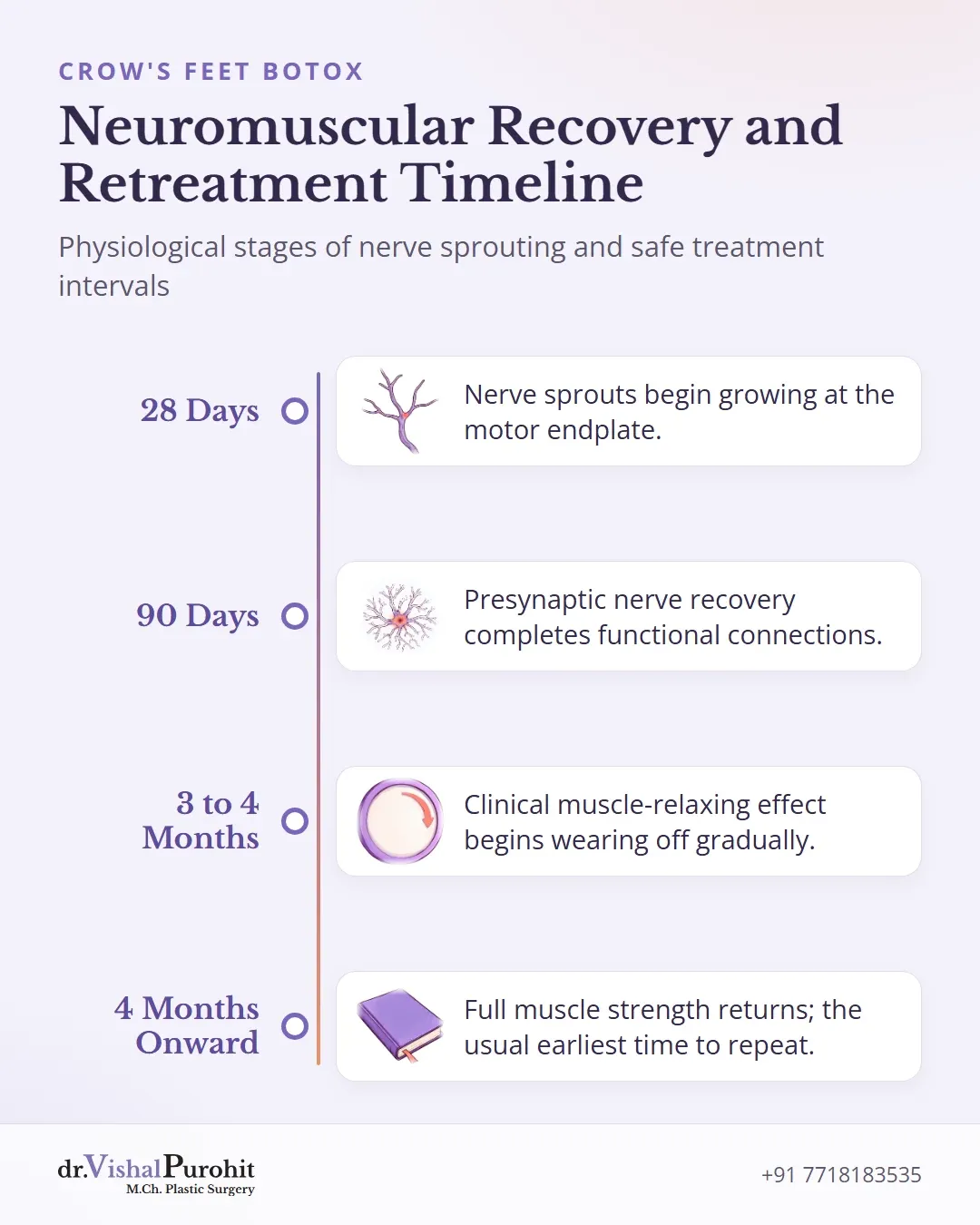
The smoothing effect of Botox on lateral canthal lines is temporary. Muscle action gradually returns as the presynaptic nerve terminal recovers neuromuscular transmission, which literature associates with the regeneration of SNAP-2515. As the underlying orbicularis oculi resumes full activity, the overlying skin lines return toward their baseline state rather than worsening.
In published reports, the clinical effect of botulinum toxin type A typically begins to wear off around 3 to 4 months15, with muscle strength returning at 4 months16. Clinical texts discourage repeat injections before 4 months1617. Long-term studies of repeated treatments note that safety profiles remain consistent and dosing remains stable over time18.
Repeat sessions should be planned conservatively, avoiding unscientific claims of lasting prevention. Choosing not to proceed with further injections remains a valid option at any point. Regular evaluation ensures treatment intervals respect tissue recovery rather than adhering to rigid schedules.
Clinical Evaluation of Crow’s-Feet Botox in Jaipur
Evaluating periocular lines requires careful clinical examination rather than self-assessment in angled mirrors. Detailed information about lateral canthal treatments is outlined under Crow’s Feet Botox in Jaipur. Common patient inquiries regarding timelines, evaluation steps, and anatomical differences are addressed in the Crow’s Feet Botox FAQs. Consultation allows individuals to discuss treatment expectations calmly and decide whether non-surgical intervention matches their personal anatomical goals.
This is educational information, not medical advice.