
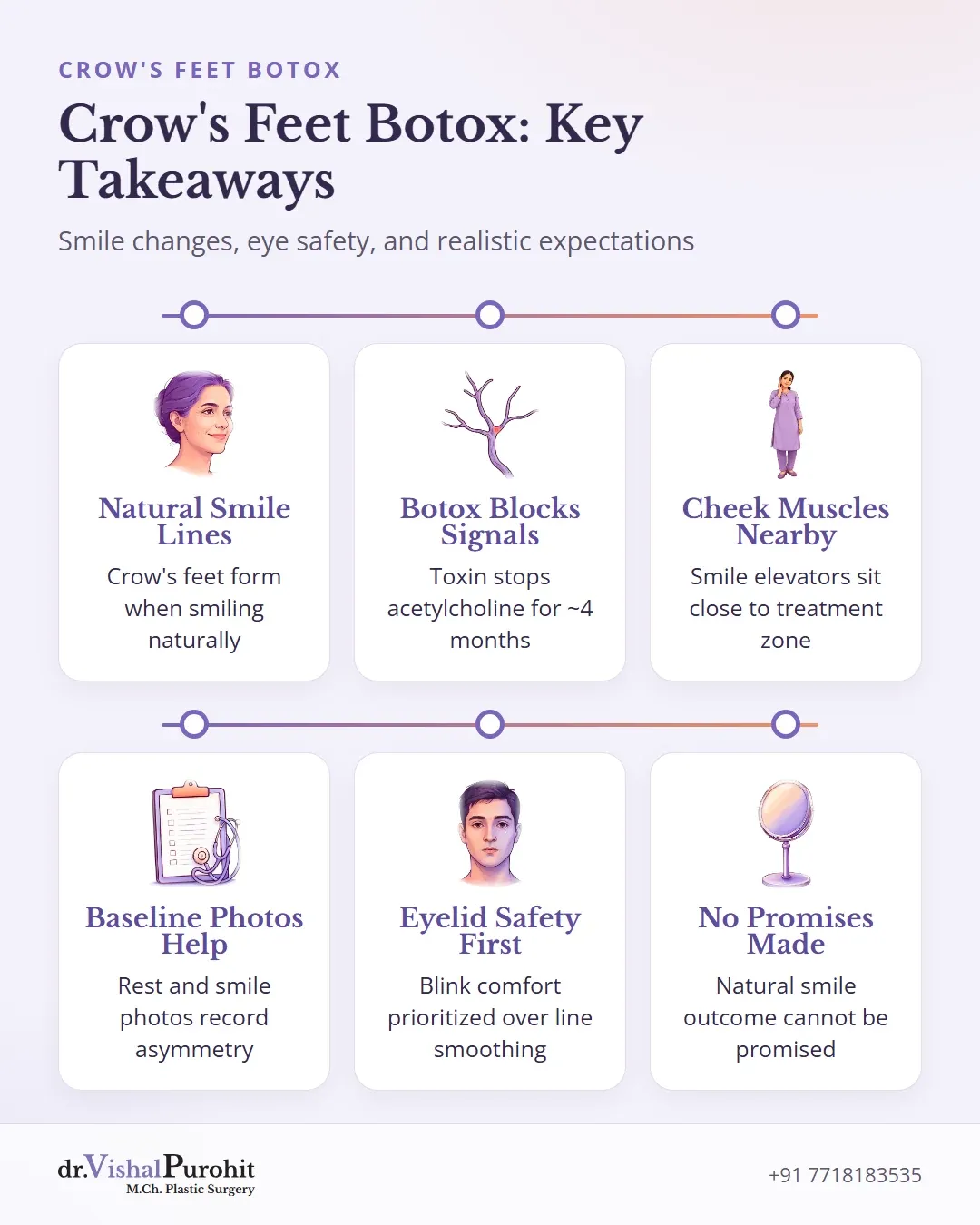
Crinkling around the outer eye corners occurs naturally when smiling, engaging muscles that lift the cheeks and express genuine emotion. When botulinum toxin type A is introduced, it temporarily reduces muscle contraction to soften dynamic creases at rest.
Understanding facial animation helps patients weigh dynamic expression against line smoothing. Exploring Crow’s Feet When Smiling vs Resting Lines: What Botox Can Change outlines these movement patterns and clarifies why complete loss of movement is not the clinical aim.
Eye Crinkling During Natural Facial Expression
A Normal Smile Movement
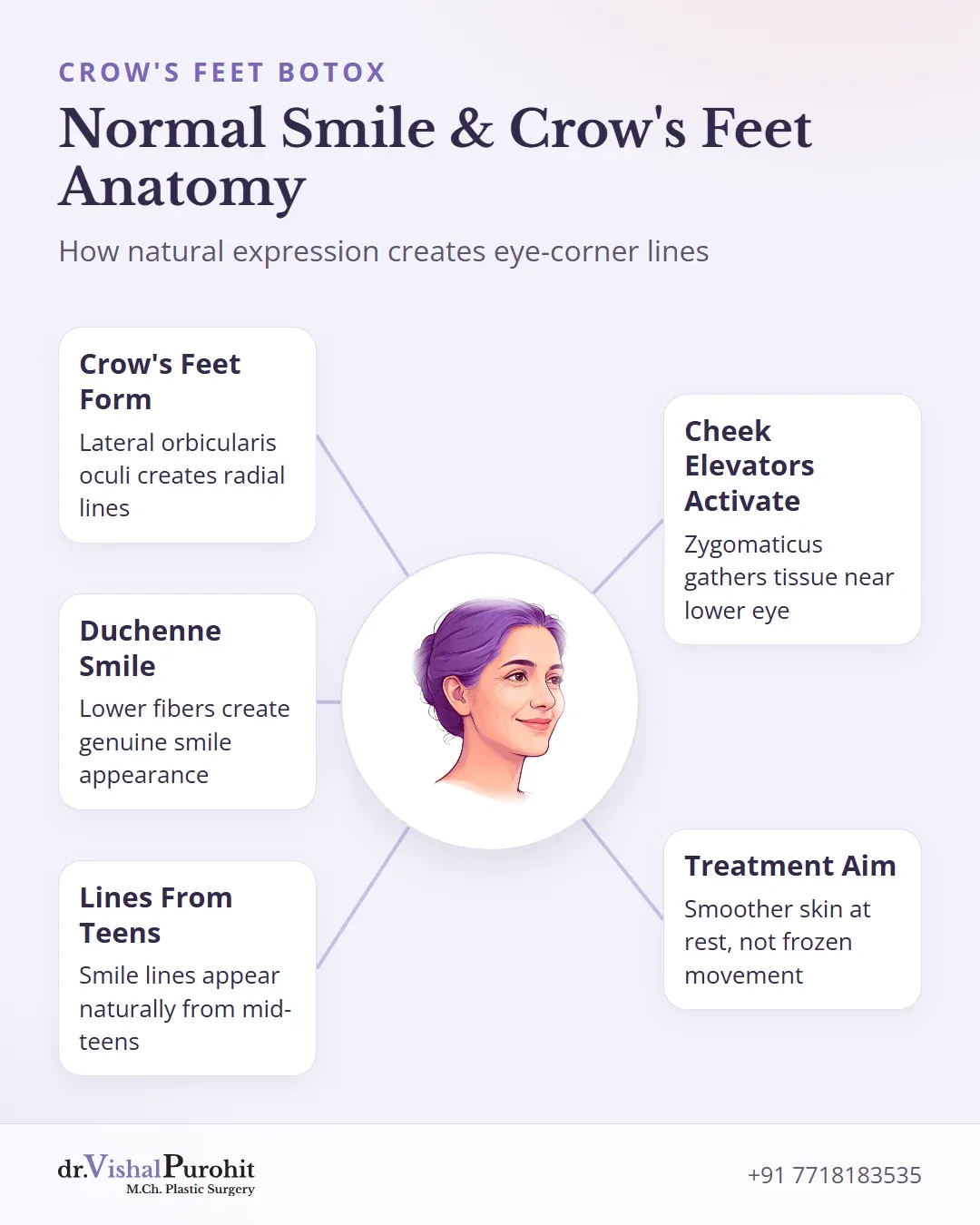
Crinkling at the outer corners of the eyes is part of a natural smile. Contraction of the lateral orbicularis oculi causes the radially oriented lines known as crow’s feet or smile lines1. At the lower part of these lines, the same muscle contributes to a sincere-appearing Duchenne smile1.
Lines that appear only on smiling occur naturally from the mid-teenage years and reflect a positive emotional connection rather than age2.
Setting Expectations
Understanding this normal movement helps set expectations before treatment alters dynamic facial movement.
Smiling also recruits cheek-lifting muscles, which gather tissue near the lower and outer eye and can be mistaken for orbicularis oculi contraction3.
The literature advises caution against overtreating the lower crow’s feet, because the orbicularis oculi there contributes to a sincere-appearing smile1.
In the orbital area, the aim described for botulinum toxin type A is smoother skin at rest rather than complete loss of movement3. A thorough explanation of this response is described as a way to reduce confusion and set expectations appropriately3.
How Targeted Muscle Relaxation Affects Movement
At the nerve ending
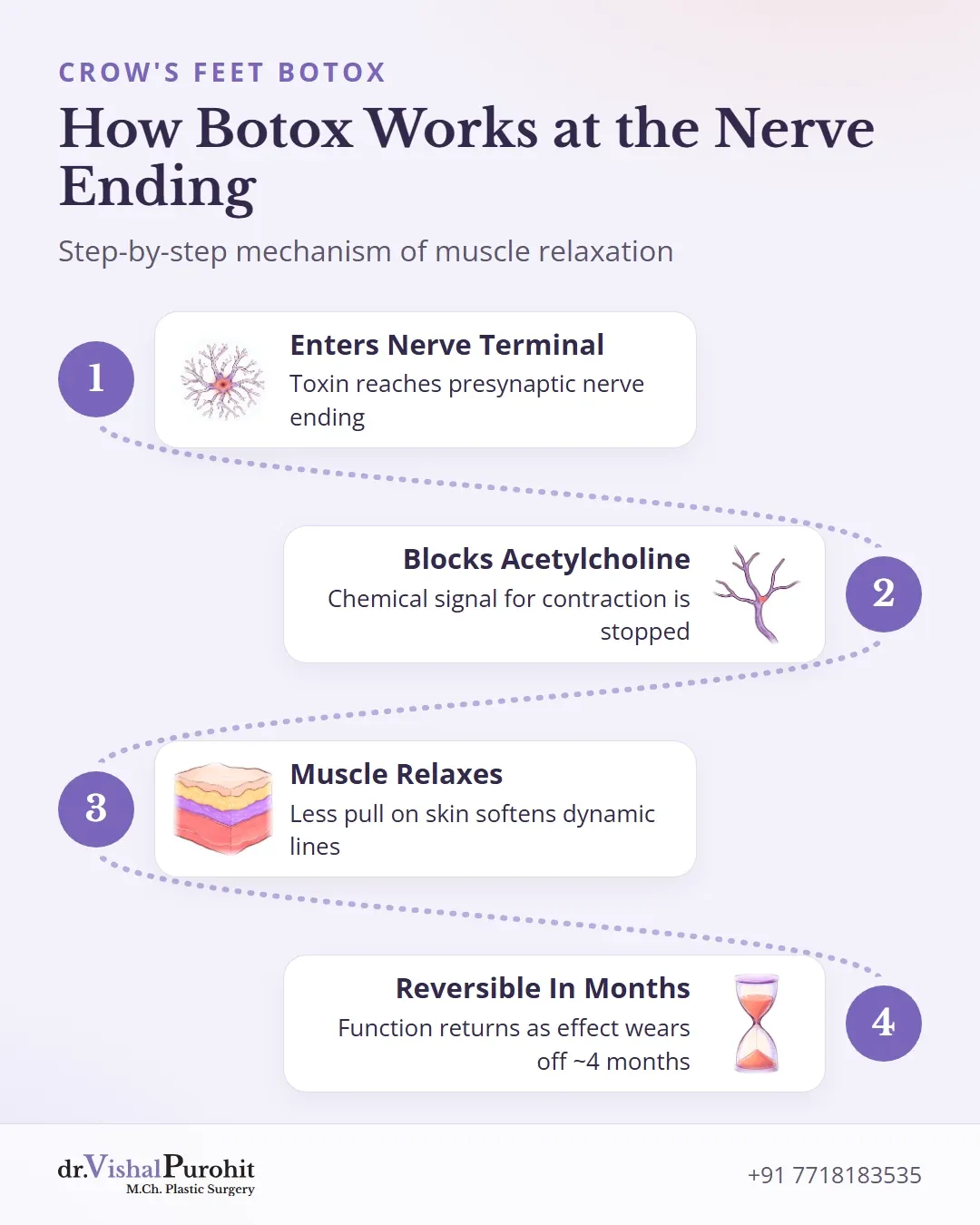
Botulinum toxin acts at the neuromuscular junction, where it enters the presynaptic nerve terminal1. There it blocks the release of acetylcholine, the chemical signal that prompts a muscle to contract14. With less acetylcholine available, muscle contraction is inhibited1.
The change is reversible, and muscle function recovers as the effect wears off14. These are general pharmacology findings, not a prediction of one person’s response.
What changes in the outer eye
In the mimetic muscles of the face, this reduced activity lowers the muscle’s pull on the skin5. Dynamic lines produced by repeated movement can then look softer5. Effective neuromuscular blockade persists for approximately four months, allowing an adjustment of facial mimicry6.
This is a temporary effect rather than a lasting change56.
The evidence used in this section covers muscle movement only; it does not describe sensory changes in the skin at the outer eye.
Proximity to Cheek Elevators and Smile Symmetry
The anatomical overlap
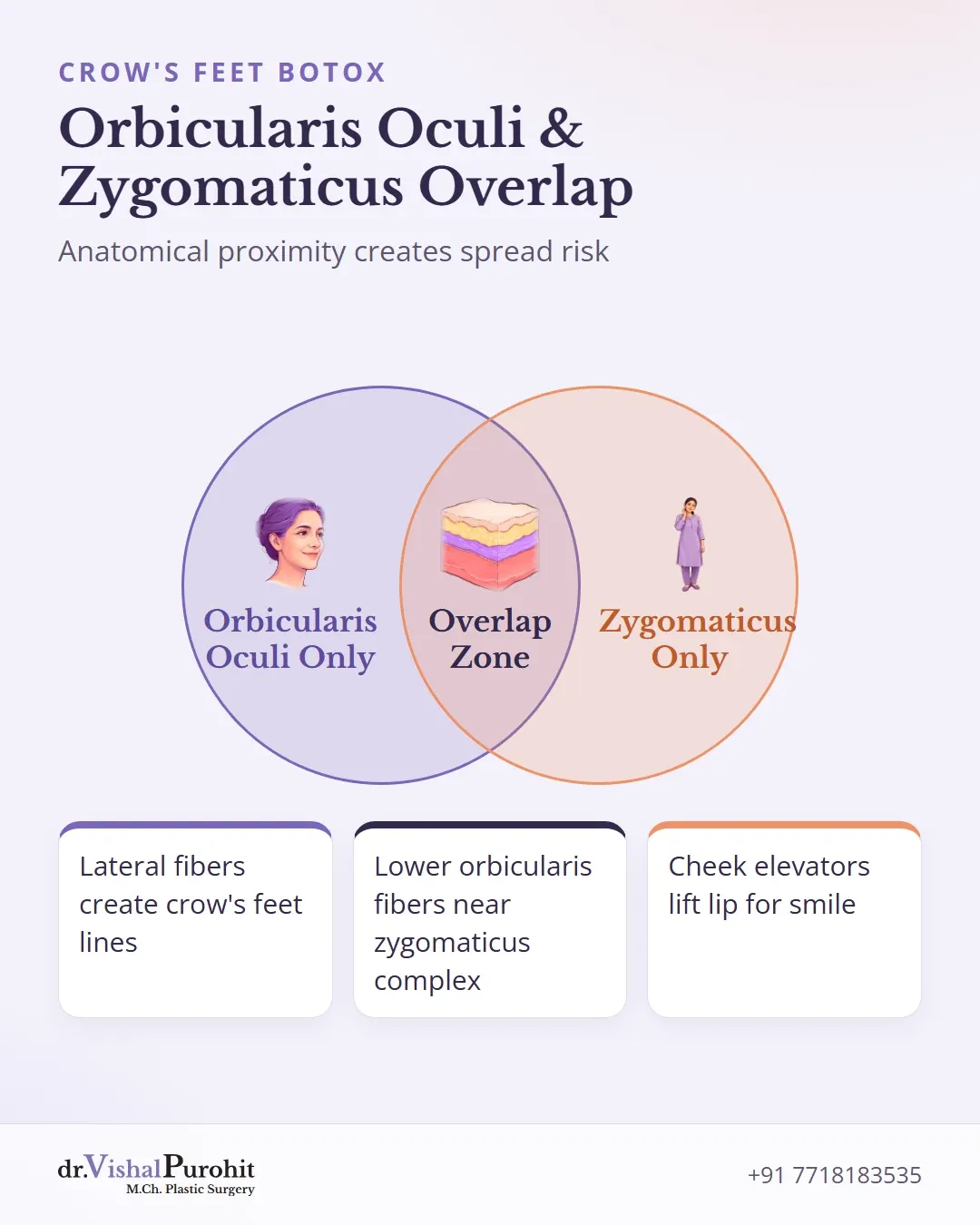
The lower lateral fibers of the orbicularis oculi lie close to the zygomaticus muscle complex7. This complex acts as a lip elevator8. The zygomaticus major also lies deep to the inferior fibers of the orbicularis9. Because these muscles overlap, the cheek’s smile muscles sit near the area treated for lines at the outer eye corners10.
What spread can cause

If Botox spreads to the zygomaticus major or minor during treatment of lateral canthal lines, cheek elevation may be temporarily reduced, a change described as cheek ptosis7. Smile asymmetry can occur when toxin weakens the zygomaticus muscles or related midface elevators11. Crooked smiles have also been reported when periocular treatment for crow’s feet affects the zygomaticus major12. Mild cheek ptosis is generally managed with observation and reassurance until neuromuscular function recovers7.
Before treatment
Individual assessment of facial anatomy and patterns of dynamic lines is helpful before treatment13.
Dr. Purohit’s note: Dr. Vishal Purohit is an M.Ch. plastic surgeon in Jaipur who offers Botox for crow’s feet as a non-surgical treatment.
Baseline Photography and Asymmetry Documentation
What is recorded
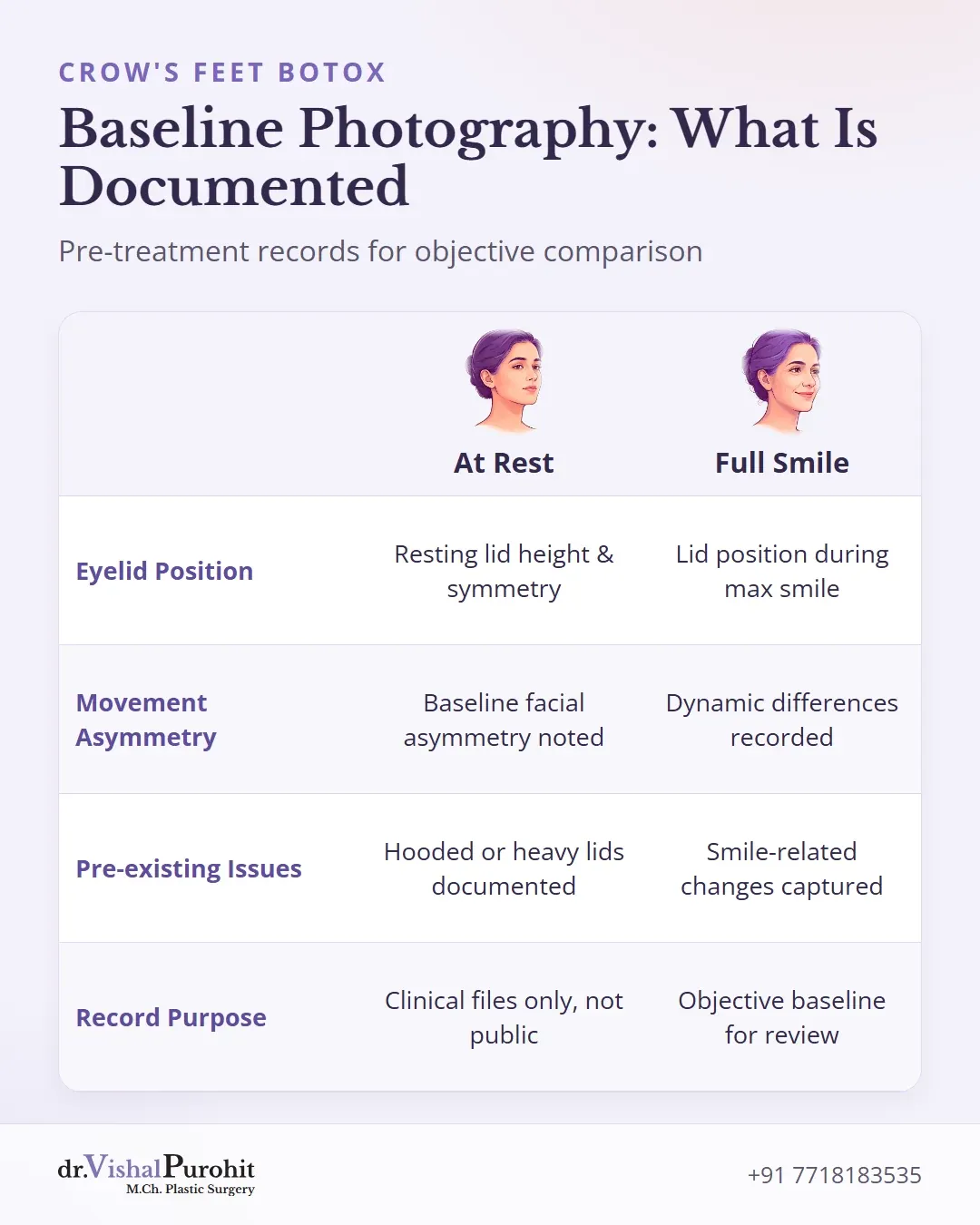
Baseline photographs at rest and during a full smile are commonly taken; at his practice, clinical photographs are used for treatment records only. They record the position and movement of both eyelids, including any asymmetry or difference in movement that is already present. The images are used for treatment records only and are not shown publicly.
Key points
- Baseline photographs capture eyelid position, movement, and pre-existing asymmetry both at rest and in motion.
- Literature recommends pre-treatment images for every patient to document starting conditions objectively.
- These confidential clinical records serve as a clear reference to evaluate any changes after treatment.
What the literature adds
Pre-treatment photographs are recommended for every patient before botulinum toxin type A treatment and should be retained in the patient record14. They document pre-existing issues unrelated to treatment. In the example given, pre-treatment images record lid position before the effects of botulinum toxin type A and can either support a complaint of hooded, heavy lids or show that the finding was already present14. Nearly all patients have some degree of asymmetrical action of the facial musculature, and observing the face in motion is part of assessment15.
Why it matters
The aim is objective documentation of physical differences that exist before any intervention, so later change can be reviewed against a known starting point14.
Unwanted Muscle Weakness and Eyelid Position Changes
When the effect reaches nearby muscles
Botox for crow’s feet is placed in the lateral orbicularis oculi, the muscle behind the crease11. The visible line is only the surface sign of a deeper dynamic system, and an injection that chases the line can overweaken the palpebral orbicularis, spread toward orbital or extraocular structures, or disturb tear-film dynamics11. Case reports after lateral canthal treatment describe orbicularis oculi dysfunction and eye irritation in the weeks following injection16.
Key points
- Injections around crow’s feet can spread beyond the target muscle and disrupt blink mechanics or tear-film dynamics.
- Pre-treatment assessment of eyelid position and laxity helps avoid complications such as lagophthalmos or ectropion.
- Protecting natural eyelid function and ocular comfort always takes priority over aesthetic line reduction.
What can change at the eyelid margin
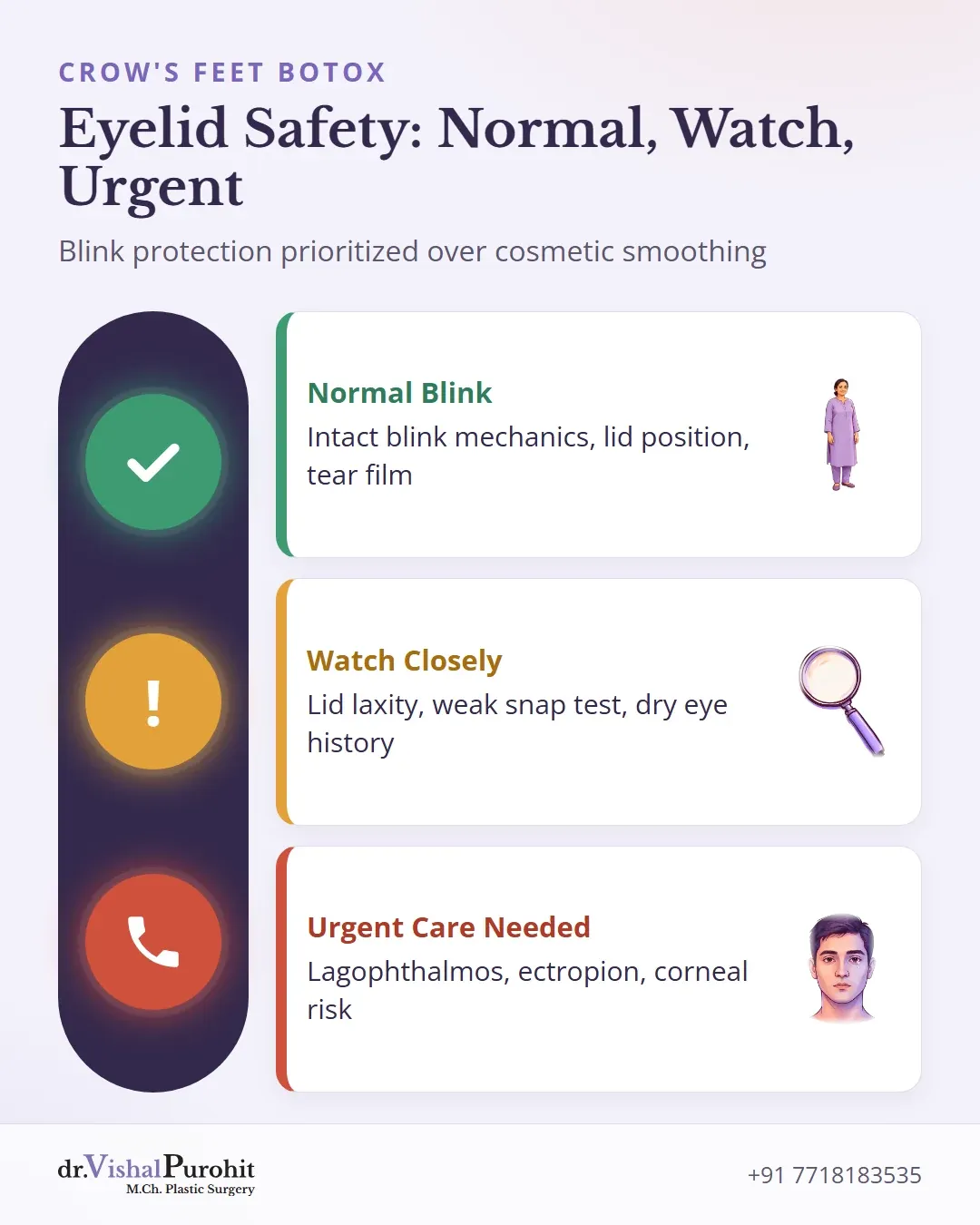
When orbicularis oculi function is reduced beyond the intended target, changes may appear in the lower eyelid’s resting position or in blink mechanics1116. Published guidance describes assessment before injection for existing eyelid or brow ptosis, periocular asymmetry, a weak lower-lid snap test and a history of dry eyes17. Where significant lagophthalmos occurs, ectropion can follow, raising the risk of chronic keratitis or corneal ulceration; urgent ophthalmological evaluation is then warranted16.
Comfort before smoothing
At his practice in Jaipur, natural eyelid comfort and blink protection take priority over cosmetic smoothing. Where eyelid laxity, ocular-surface disease or eyelid malposition is present, these are addressed before any elective intervention18.
Softer Results Without Promises About Expression
Softening While Keeping Animation
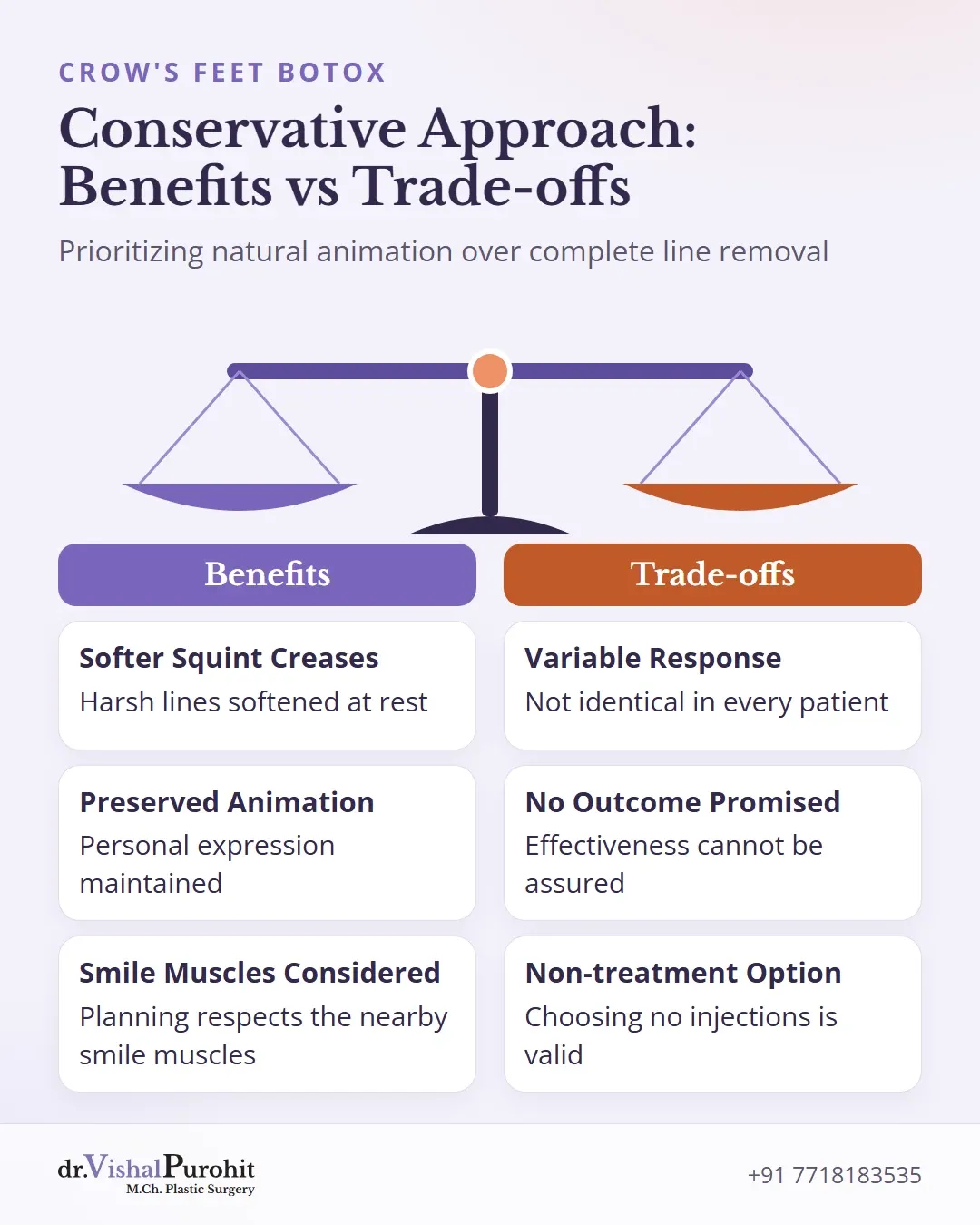
A conservative approach aims to soften harsh squint creases while preserving personal animation. Technique descriptions note care to avoid the zygomaticus major muscle, which can cause unwanted smile abnormalities19. The response is not identical in every patient20.
What Cannot Be Promised
No clinic can promise an uncompromised natural smile or eye contour; consent information lists asymmetry, incomplete improvement of wrinkles, temporary drooping of the eyelid and the need for additional treatment among the risks21. Response and duration vary between patients, and some people do not respond20.
Consent guidance notes that treatment may produce complete paralysis or only lessening of muscle movement, and that effectiveness cannot be assured2122.
Choosing No Treatment
Choosing no injections remains a valid decision21. Dr.Whether to treat, and how conservatively, is decided at the consultation.
Facial Movement and Botox Consultations in Jaipur
Balancing wrinkle reduction with personal facial animation requires a thorough anatomical assessment. Dr. Vishal Purohit evaluates dynamic lines and eyelid mechanics individually, prioritizing blink protection and comfort over complete line eradication. To understand procedure details, review Crow’s Feet Botox in Jaipur or read Crow’s Feet Botox FAQs for common treatment questions.
This is educational information, not medical advice.