Breast Augmentation Scar Care: A Comprehensive Guide to Incision Healing and Fading
Most breast augmentation scars take 12 to 18 months to fully heal. Your incisions are permanent, but they will change over time. They usually turn from red or pink into thin, pale lines that blend with your skin.
Precise stitching and good aftercare help make these marks less visible.
Dr. Vishal Purohit is a highly experienced M.Ch. Plastic Surgeon. He believes great results come from both surgical skill and patient care. He uses advanced methods to reduce skin tension for the best look.
If you want breast augmentation in Jaipur, it helps to know how healing works. This is the first step toward reaching your goals.
A natural look depends on both the surgery and your body’s healing. Every person’s skin reacts differently.
Following a custom care plan can greatly reduce the look of scars. This lets you focus on your beauty and confidence.
Understanding Breast Augmentation Incision Locations
Your surgeon picks the best incision sites for breast augmentation for your body and goals. This choice affects incision site visibility. This means how easy it is to see the scar after you heal.
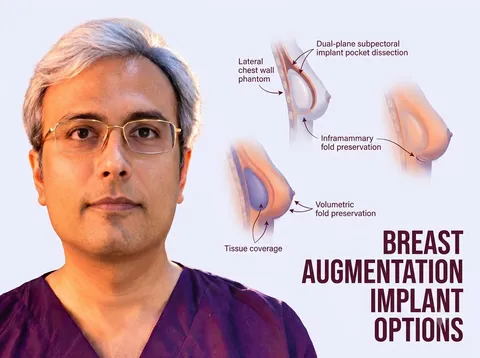
Common locations include:
- Inframammary Fold: This cut goes in the natural crease under your breast. It is usually 4 cm long and “located slightly lateral to the nipple-areola complex (NAC)’s inferior projection on the inframammary fold” inframammary fold1.
- Periareolar: This cut goes around the edge of your nipple. The periareolar incision is typically “placed in the lower half of the areola” to keep it hidden.
- Transaxillary: This cut goes in your armpit. This method uses a skin crease so the mark will “not be visible when the patient stands with her hands on her waist.”
The Biological Timeline of Scar Maturation
Your skin follows a set path to heal after surgery. Knowing your recovery timeline after breast augmentation helps you know what to expect.
The healing process has three main steps:
- Inflammatory Phase: This starts right after surgery. Your body sends white blood cells to stop bleeding and fight germs. You will see redness and swelling.
- Proliferative Phase: Your body builds new tissue and collagen. This creates a bridge of skin across the cut. You will see a deep pinkness from new blood vessels.
- Remodeling Phase: This is the longest stage. Your body replaces early collagen with stronger tissue. This is the primary fading period where the scar flattens and turns pale.
Your scars get their final look when the remodeling phase ends. This usually takes 12 to 18 months after your procedure.
The Role of Surgical Closure Techniques in Scar Minimization
Dr. Purohit uses his M.Ch. Plastic Surgery expertise to make your scars less visible. He focuses on a tension-free closure. This means he does not pull the skin tight when sewing it.
This method stops the scar from stretching. It also prevents the mark from getting wider over time.
He uses precision suturing to line up the skin edges perfectly. He also uses internal sutures to support deep tissue.
This is like a four-layer wound closure technique2 where a “running barbed suture is passed between the thoracic fascia” and other deep layers. Fixing the deep tissue first lets the top skin heal without stress.
Closing the skin in layers helps create a flatter, thinner mark. These special stitches dissolve on their own as you heal.
This attention to detail gives you a natural look. It helps you feel more confident.
Post-Surgical Topical Interventions for Optimal Healing
After your cuts close, the right skincare helps your marks fade. Follow the Kalpana Aesthetics aftercare protocol to use the right products at the right time.
Use the correct topical ointments to keep your skin hydrated. This stops your scar from getting hard or itchy.
Silicone gels and silicone sheets are the best ways to flatten scars. They act like a protective seal for your skin.
Use this guide to manage your skin treatments during recovery:
| Treatment Type | Best Use Case | Primary Benefit | When to Start | | :— | :— | :— | :
Learn how surgical pocket planes affect tension in our review of over vs under the muscle implant placement.
| | Silicone Sheets | Flat, linear scars | Flattens the scar and reduces redness | Once incisions are fully closed | | Silicone Gels | Areas with movement | Creates a flexible, invisible barrier | Once incisions are fully closed | | Topical Ointments | Dry or flaky skin | Keeps skin soft and supple | As directed by your surgeon | | Skin Closure Systems | Initial wound sealing | Creates a water-resistant barrier3 | Immediately after surgery |
Identifying Abnormal Scarring: Hypertrophic and Keloid Risks
Most people heal with a thin, pale line. Some patients develop abnormal scarring instead. This happens when your body makes too much fibrous tissue.
This tissue is a tough protein. It builds up while you heal.
Hypertrophic scars are one common type. These are raised, red marks. They stay inside the edges of your original cut.
These scars often flatten on their own. This can take several years.
Keloids are different and more permanent. These are thick growths. They spread past the original incision site.
Your skin type and genetics affect your risk. People with darker skin tones often get keloids more often.
You should know the risks and potential complications of your surgery. Your surgeon can help you manage these risks.
They will look at your skin’s history. Early treatment can stop a scar from growing too large.
Frequently Asked Questions
What is the best scar care routine after breast augmentation surgery?
The gold-standard scar regimen consists of 100% medical-grade silicone gel or sheeting applied twice daily for 12 weeks, coupled with gentle circular scar massage and daily SPF 50+ protection, supervised by Dr. Vishal Purohit in Jaipur. Silicone therapy starts at week 2 to 3 once incisions are fully sealed. As an M.Ch plastic surgeon, Dr. Purohit customizes topical scar formulations to match Indian skin types.
How does a breast augmentation scar evolve over the 12-month healing timeline?
Incisions progress through inflammatory (weeks 1-6), proliferative (months 2-6), and maturation phases (months 6-18) under Dr. Vishal Purohit’s clinical monitoring in Jaipur. The scar naturally peaks in redness and firmness around month 3 before gradually softening, flattening, and fading to a discreet silver-white line by month 12. Dr. Purohit evaluates scar maturity during regular follow-up visits.
Where are breast augmentation incisions positioned to remain invisible?
Incisions measuring just 3.5 to 4 cm are placed directly in the inframammary fold crease beneath the breast, where the natural breast projection completely conceals the scar, expertly executed by Dr. Vishal Purohit in Jaipur. Even in revealing swimwear or underwire bras, the scar remains hidden. As an M.Ch. plastic surgeon, Dr. Purohit uses meticulous subcuticular suturing to avoid external track marks.
Can laser scar revision improve thick or dark breast incisions?
Yes, in-clinic fractional CO2 laser, pulsed-dye laser, and micro-needling can significantly accelerate scar fading and smooth texture if thickening occurs, performed by Dr. Vishal Purohit in Jaipur. These laser therapies stimulate collagen realignment within the upper dermis. Dr. Purohit provides comprehensive scar refinement treatments at Kalpana Aesthetics for optimal cosmetic blending.
Your Path to Beautiful Results
Great results come from two things. You need a precise surgery and good care at home.
Your surgeon sets the foundation by closing the skin. Your daily treatments ensure the best finish.
Professional check-ups are the only way to track your healing. Dr. Vishal Purohit at Kalpana Aesthetics provides expert oversight to ensure your skin heals beautifully.
Ready for a personalized plan? Book a consultation today. Let’s discuss a customized scar management strategy for your body.
If you would like to discuss your condition or book a consultation, contact Dr. Vishal Purohit in Jaipur at +91-7718183535. Our specialist team is here to guide you through every step of your care. For the full picture, explore our complete guide to breast augmentation in Jaipur or learn more about our surgical suite for breast augmentation in Jaipur.