Risks and Complications of Breast Augmentation: A Comprehensive Clinical Guide by Dr. Vishal Purohit
Breast augmentation is safe in experienced hands, but every implant carries real risks — most often capsular contracture, implant rupture or leakage, and very rarely BIA-ALCL — and you need to know how to spot each one.
Awareness is not meant to alarm you. It helps you catch changes early and act quickly. Dr. Vishal Purohit (M.Ch. Plastic Surgery), at Kalpana Aesthetics, Jaipur Hospital, Tonk Road, Jaipur, counsels every patient on these exact risks and builds a lifelong follow-up plan around them, so care does not end at discharge.
Explore our breast augmentation in Jaipur to see how safety protocols run through every step.
How do different types of breast implant complications manifest and how are they managed?
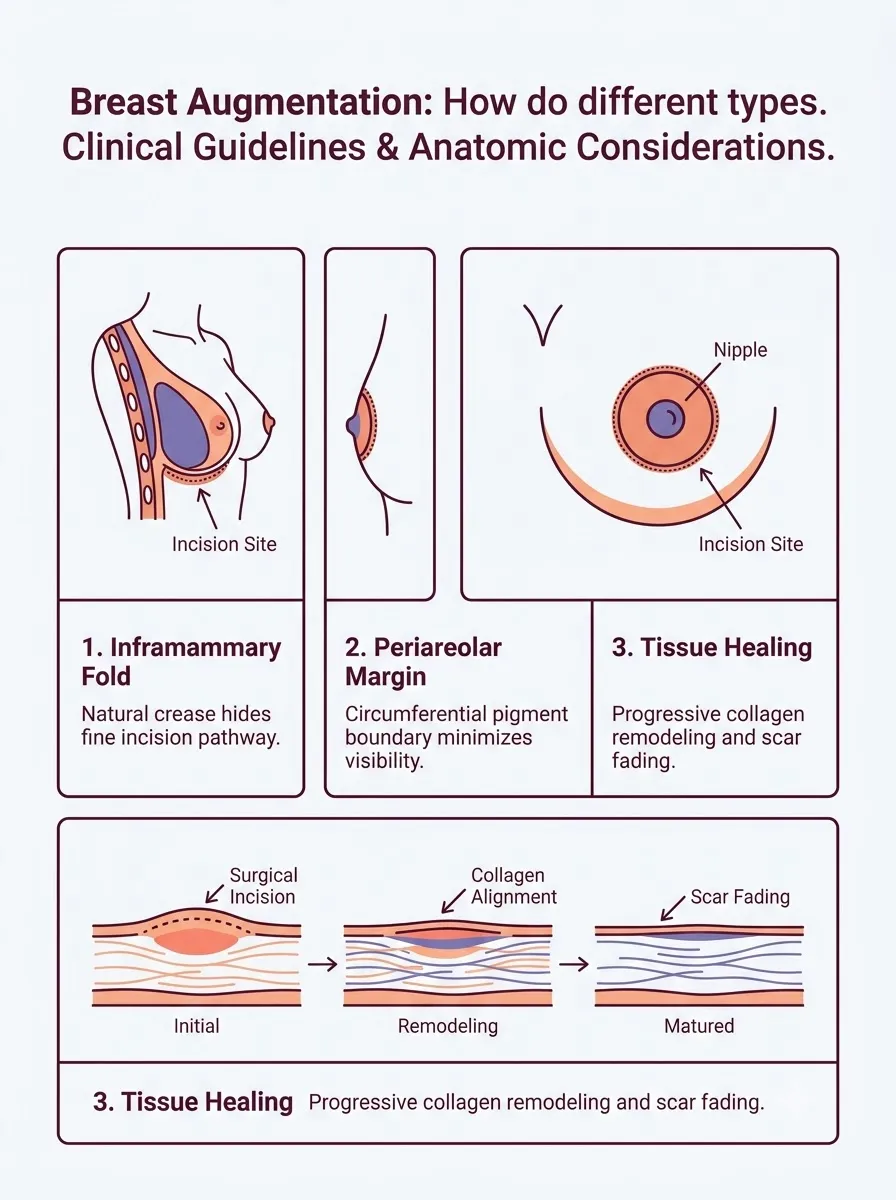
Safety & Complication Benchmark: In modern accredited plastic surgery with Keller Funnel no-touch insertion, capsular contracture rates are below 1.5% and rupture rates are under 1% per decade. BIA-ALCL is virtually non-existent with modern smooth and nanotextured implants.
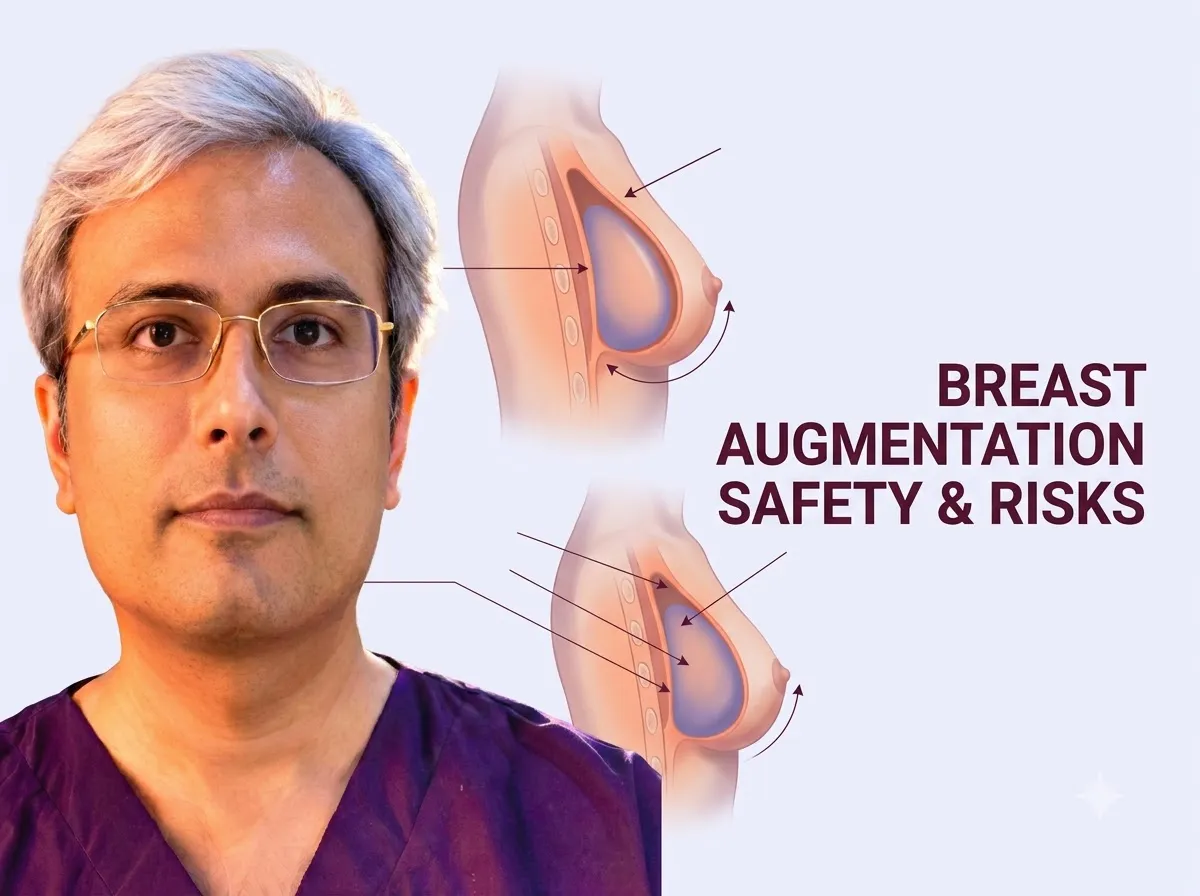
Think in layers: the scar capsule that forms around the implant, the implant shell itself, and — rarely — the immune response to textured surfaces. Each layer has its own warning signs and treatments.
Understanding Capsular Contracture: Causes and Symptoms
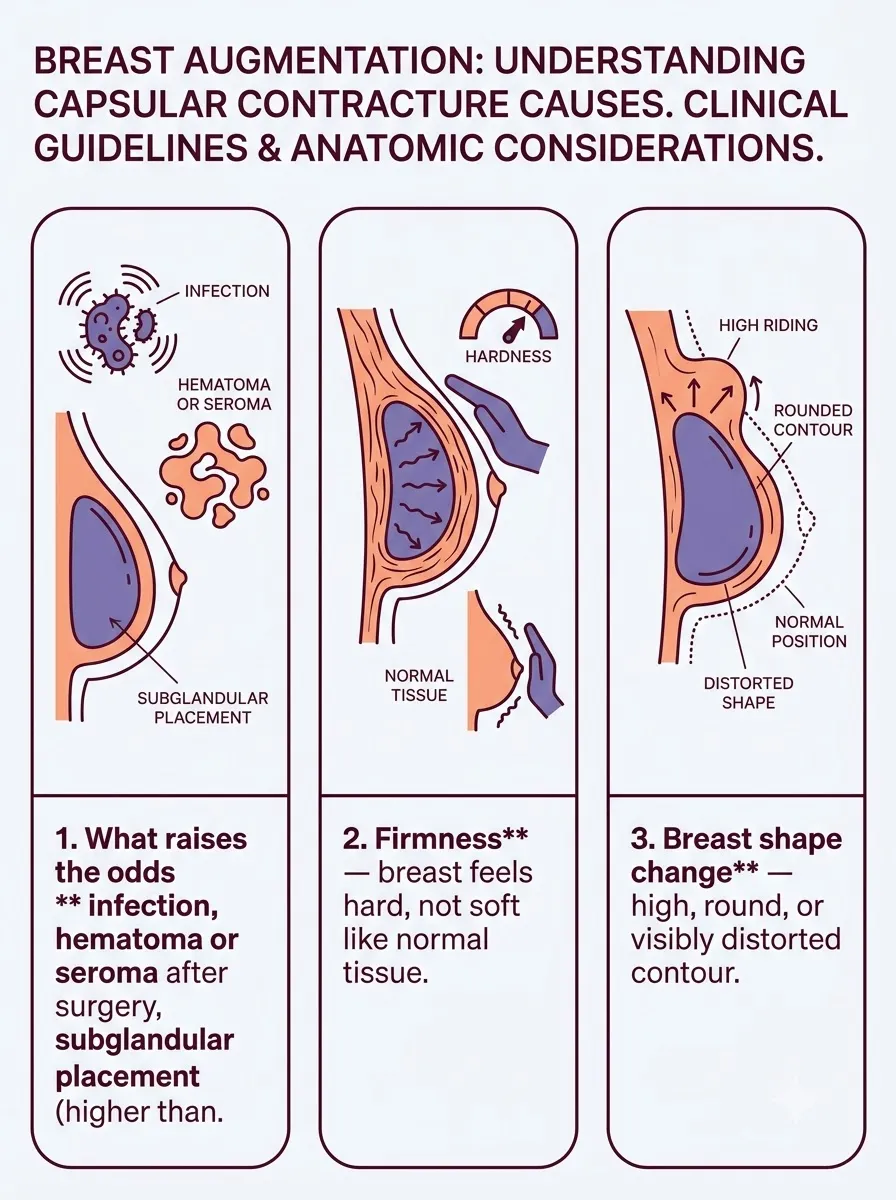
Capsular contracture is the most common late postoperative complication. After surgery, your body forms a thin fibrous tissue envelope around the implant. When that capsule tightens, it creates implant hardening that feels firm and can distort shape. Research summarises that “The most common late complication of breast augmentation surgery is capsular contracture (11). The scar tissue or capsule that can form around the implant may tighten and squeeze the implant”1 (“The most common late complication of breast augmentation surgery is capsular contracture (11). The scar tissue or capsule that can form around the implant may tighten and squeeze the implant leading to breast pain”). Related work explains why feel changes: “The capsular contracture creates excessive firmness of the breast; as the capsule develops, the surface area of the prosthesis is decreased until it reaches a spherical shape”2.
Learn more in our deep dive on Understanding Capsular Contracture and discuss prevention at your consultation.
What raises the odds: infection, hematoma or seroma after surgery, subglandular placement (higher than submuscular), and simply time — risk climbs year over year.
1. Identifying Symptoms of Contracture
Use the Baker scale — grades 3 and 4 mean trouble:
- Firmness — breast feels hard, not soft like normal tissue.
- Breast shape change — high, round, or visibly distorted contour.
- Displacement — implant sits too high or looks misshapen on movement.
Clinicians ask: “Does the breast feel as soft as a normal breast?’. If the patient says it feels firm then it is either grades 3 or 4”3.
2. Management and Treatment Options at Kalpana Aesthetics
- Early massage and support garments — when indicated, gentle implant displacement massage4 and a bandeau can keep the pocket soft (“We recommend a bandeau or tape only if there is concern about superior implant displacement”).
- Surgical options — capsulectomy or capsulotomy with implant exchange for Baker 3/4, often switching to submuscular plane or adding acellular dermal matrix in recurrent cases.
- Prevention at surgery — meticulous hemostasis, no-touch technique, and drain care lower capsule drivers.
Implant Rupture vs. Leakage: Critical Differences
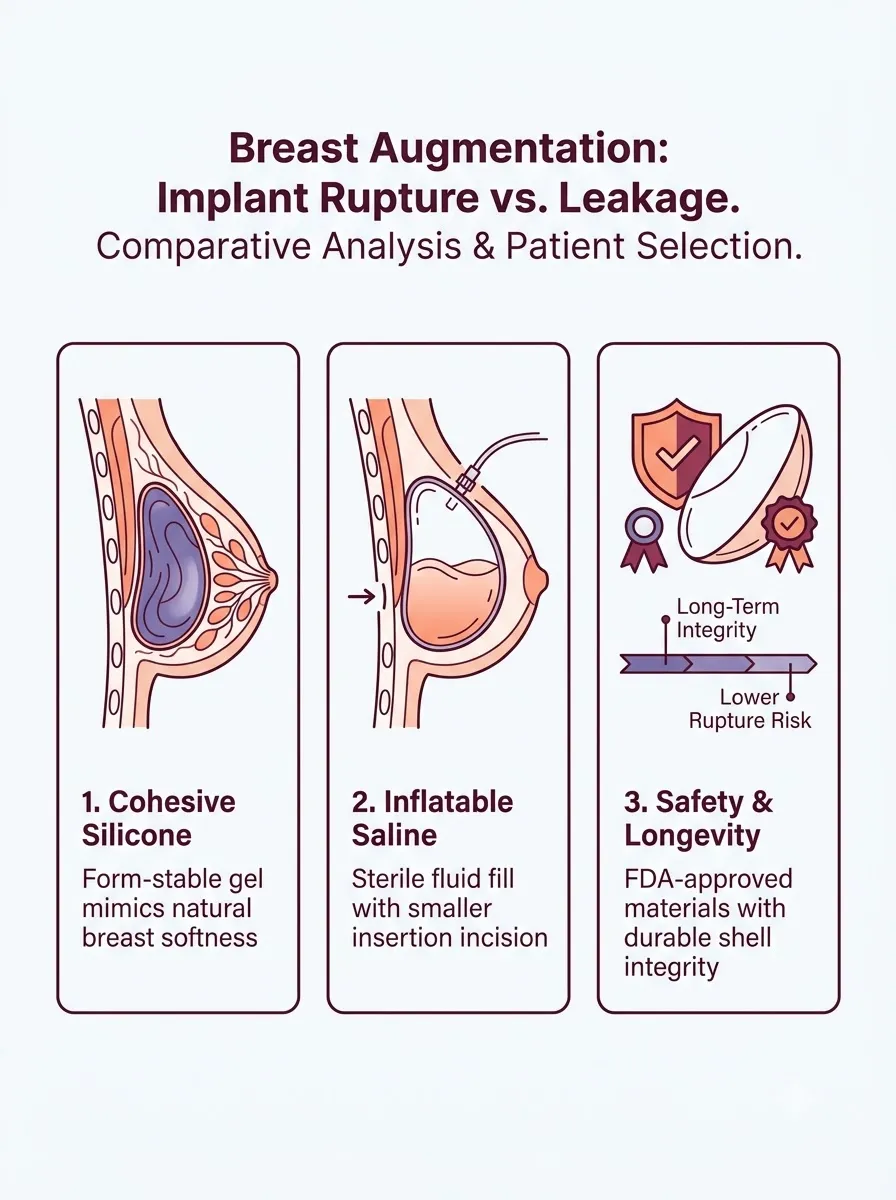
| Feature | Saline leak | Silicone silent rupture | Silicone gel bleed |
|---|---|---|---|
| Speed | Rapid saline leak with visible deflation as saline is absorbed | Often no size change; shell breaks but gel stays inside capsule | Slow seepage through an intact shell |
| Detection | You notice loss of implant integrity in days | Needs MRI — mammogram misses most silent cases | Usually undetected even on MRI |
| What to do | Replace the deflated implant surgically | Most surgeons advise removal if gel escapes the capsule | Observe unless fluid collects heavily |
Key imaging clues help you understand the difference: “Since 1992 the percentage of saline-filled implants is increasing due to the controversy”5 and the primary downside remains deflation (“Since 1992 the percentage of saline-filled implants is increasing due to the controversy raised by the potential of silicone-induced side effects. The primary disadvantage of saline-filled implants, however, is their tendency to leak”), while for silicone, “As with most man-made devices, breast implants will eventually wear out. In the case of saline implants, a small hole may develop”6 captures long-term durability — saline degrades to saline loss, silicone to contained gel (“As with most man-made devices, breast implants will eventually wear out. In the case of saline implants, a small hole may develop in the silicone shell and the implant will deflate”).
Know the specifics on how to spot a silicone leak between MRIs, and ask Dr. Purohit about recommended screening intervals.
BIA-ALCL: Recognizing Rare Systemic Warning Signs
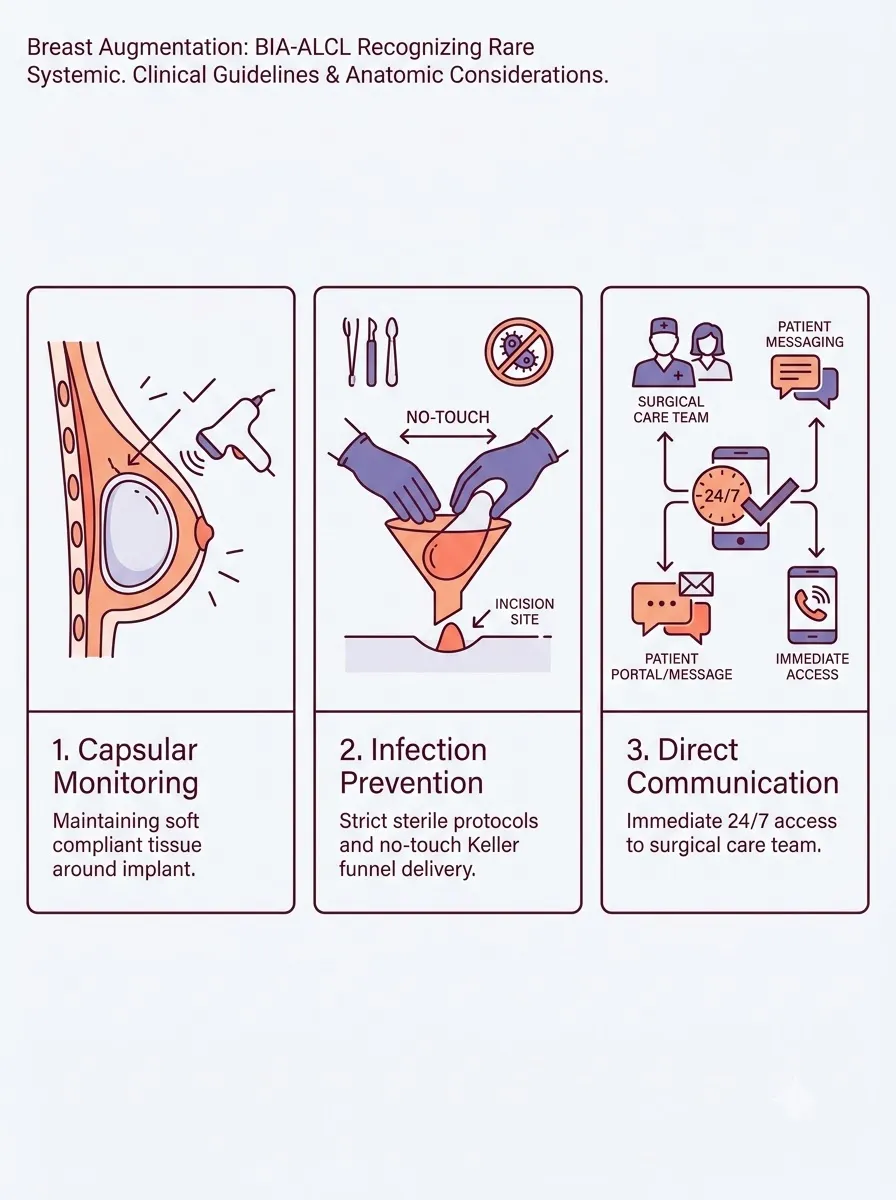
BIA-ALCL — Anaplastic Large Cell Lymphoma — is not breast cancer. It is a rare lymphoma linked most often to textured implants, usually presenting years later as seroma or late-onset swelling on one side. Fluid builds around the implant, sometimes with a mass or pain. The literature notes this is “A relatively newly described complication of breast implantation is the development of breast implant associated anaplastic large cell lymphoma (BIA ALC”7 (“A relatively newly described complication of breast implantation is the development of breast implant associated anaplastic large cell lymphoma (BIA ALC”), underscoring why new, delayed swelling needs urgent evaluation.
At Kalpana Aesthetics we use smooth implants for most augmentations and discuss texture only when anatomy truly demands it. Any new one-sided swelling after 1 year deserves a same-week clinic visit, ultrasound, and fluid analysis.
Acute Surgical Site Complications and Recovery Risks
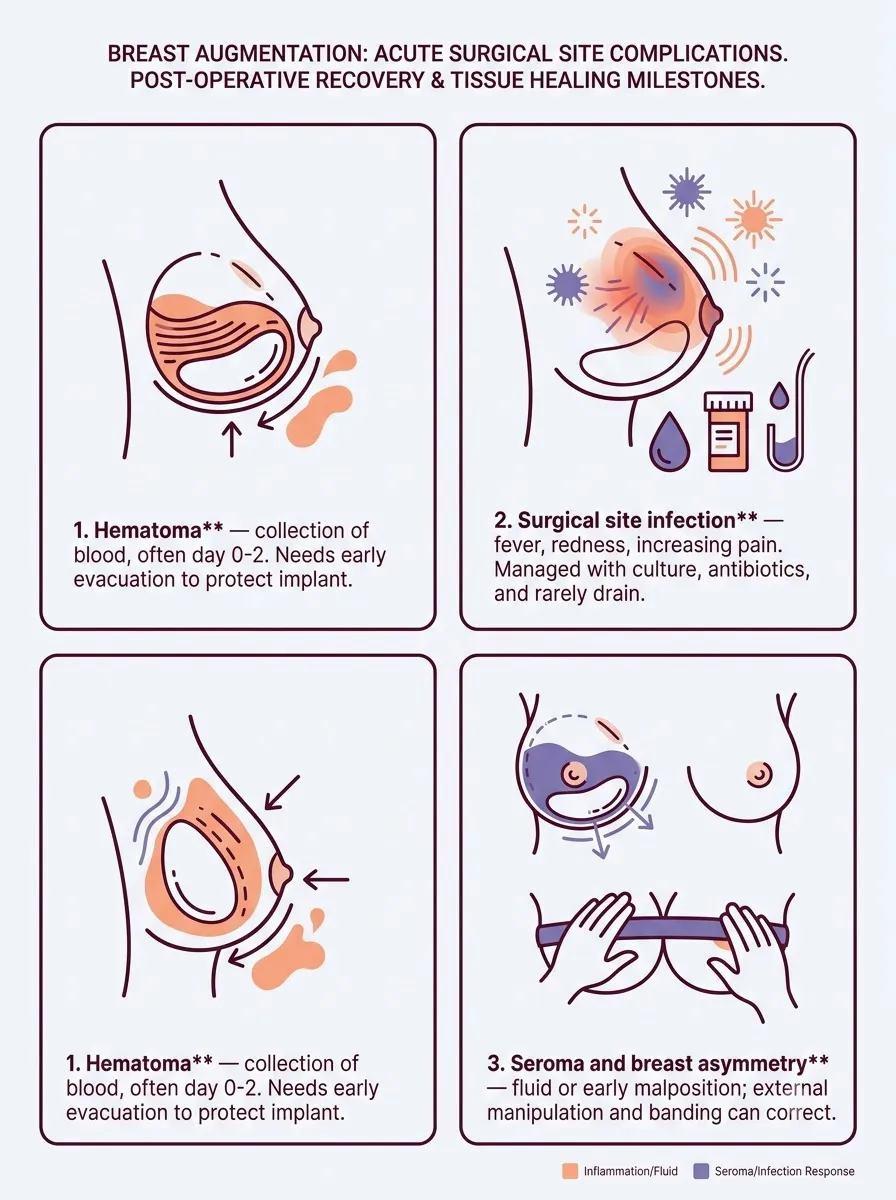
Early risks share roots with any surgery. Studies report that rare postoperative complications8 include hematoma and displacement (“Complications of this operation are rare and are essentially the same as those for any breast augmentation procedure”). Separately, a large review notes that “A recent database study of complications in aesthetic breast procedures has revolutionized our ability to assess complications after these surgeries”9, finding notably low event rates when protocols are followed.
- Hematoma — collection of blood, often day 0-2. Needs early evacuation to protect implant.
- Surgical site infection — fever, redness, increasing pain. Managed with culture, antibiotics, and rarely drain or implant salvage.
- Seroma and breast asymmetry — fluid or early malposition; external manipulation and banding can correct early displacement.
Obesity, smoking, and poor drain care raise these odds — all reasons we optimise you before surgery and see you closely in week one.
Comparing Implant-Specific Risk Profiles
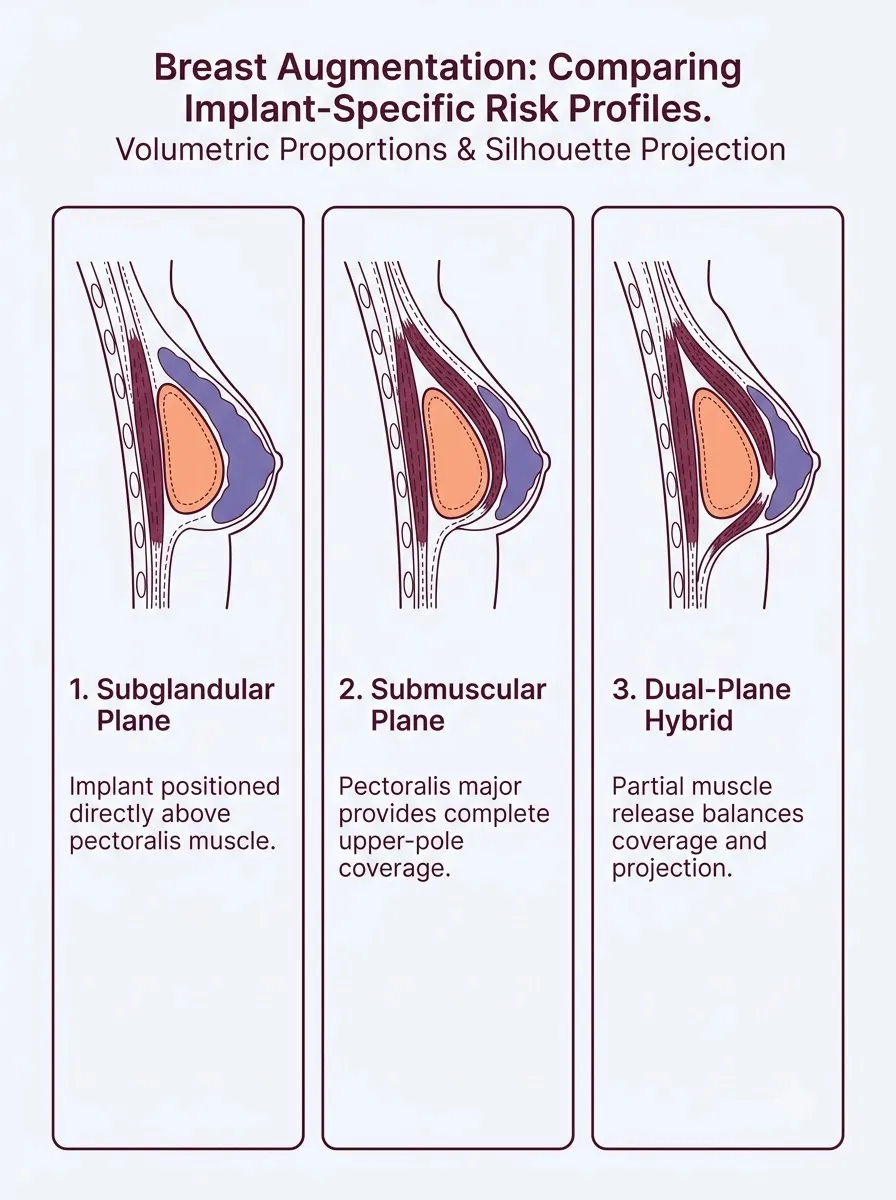
| Implant choice | Contracture | Rupture / leak pattern | Why it matters |
|---|---|---|---|
| Saline, smooth | 8-41% over 10 years (literature range) | Obvious deflation, easy detection | Replacement is obvious and timely |
| Silicone, 5th-gen cohesive (cohesive gel / gummy bear) | Lower with modern shells | Silent; needs MRI surveillance | Better shape hold, needs imaging plan |
| Textured surface | Slightly lower contracture in some series | Same shell risk + rare BIA-ALCL link | Reserved for selected anatomies only |
Modern 5th-generation shells improve durability because “The fifth-generation cohesive gel also known as ‘gummy bear’ devices represent high-strength, highly cohesive silicone gel”10 with better fill retention (“The fifth-generation cohesive gel also known as ‘gummy bear’ devices represent high-strength, highly cohesive silicone gel with lower rates of capsular contracture”), while rupture surveillance still follows the rule that “Many of the complications of breast implantation are likely to occur shortly after the procedure”11 — so early follow-up matters as much as late imaging (“Many of the complications of breast implantation are likely to occur shortly after the procedure and would therefore be managed by a surgeon”).
For help choosing, see our comparison of Saline vs. Silicone with personalised sizing at your visit.
For acute post-operative red flags requiring immediate evaluation, read when to call your surgeon after breast augmentation.
Frequently Asked Questions
What are the recognized clinical risks associated with breast augmentation?
Recognized clinical risks include capsular contracture (1.5-2%), temporary swelling, bruising, implant rupture (<1%), minor asymmetry, and temporary nipple sensation changes, documented by Dr. Vishal Purohit in Jaipur. Severe complications like hematoma or infection remain under 0.5% in accredited surgical suites. As an M.Ch plastic surgeon, Dr. Purohit follows strict 14-point sterile protocols to minimize complications.
What is capsular contracture and how does Dr. Vishal Purohit prevent it?
Capsular contracture occurs when the body’s natural collagen capsule around the implant thickens and contracts, making the breast feel firm or painful, explains Dr. Vishal Purohit in Jaipur. Dr. Purohit prevents this through Keller Funnel ‘no-touch’ insertion, triple-antibiotic pocket irrigation, dual-plane placement, and meticulous hemostasis, keeping contracture rates below 1.5%. Dr. Purohit monitors capsule softness during all follow-ups.
What are the warning signs of Breast Implant-Associated ALCL (BIA-ALCL)?
BIA-ALCL is an exceedingly rare T-cell lymphoma linked historically to coarse macro-textured implants, presenting as sudden late fluid swelling (seroma) around the implant 7 to 10 years after surgery, clarifies Dr. Vishal Purohit in Jaipur. Dr. Purohit exclusively uses smooth and nanotextured implants, which carry zero reported risk of BIA-ALCL. As an M.Ch. plastic surgeon, Dr. Purohit prioritizes internationally proven implant safety.
What should I do if I notice sudden asymmetric pain or swelling in one breast?
Contact Dr. Vishal Purohit in Jaipur at +91-7718183535 immediately if you experience sudden unilateral breast swelling, redness, high fever, or severe localized pain. Dr. Purohit provides 24/7 clinical emergency coverage and will perform an urgent in-clinic ultrasound evaluation. Prompt professional assessment ensures patient safety and protects long-term aesthetic outcomes.
If you would like to discuss your condition or book a consultation, contact Dr. Vishal Purohit in Jaipur at +91-7718183535. Our specialist team is here to guide you through every step of your care. For the full picture, explore our complete guide to breast augmentation in Jaipur or learn more about our surgical suite for breast augmentation in Jaipur.