
Heavy eyelids and a drooping upper face can arise from descending brow tissues, redundant lid skin, or dynamic muscular pull around the eyes. Understanding hooded eyes, low brows or drooping eyelid before Botox helps distinguish between eyelid problems and brow descent before considering any intervention.
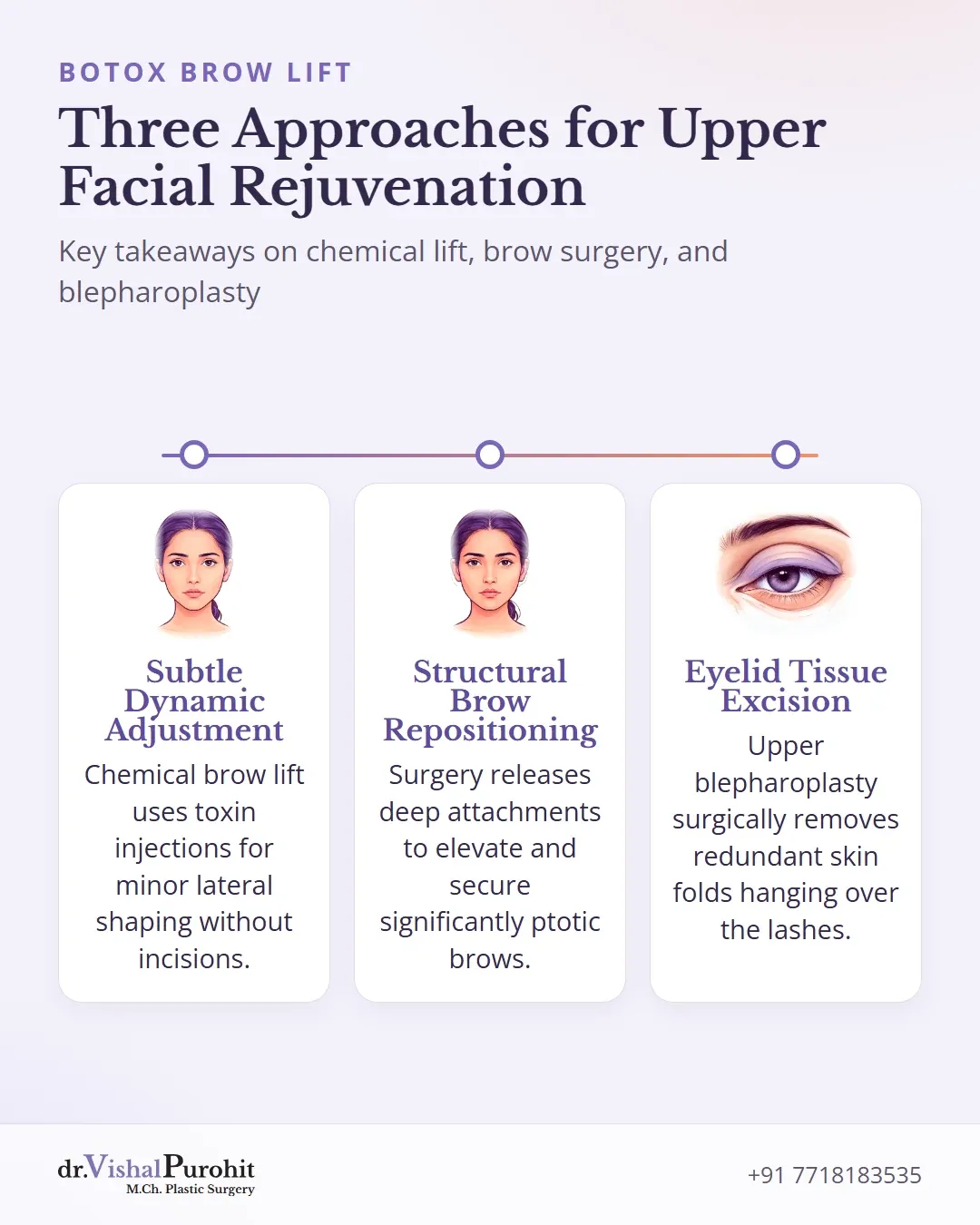
A chemical brow lift offers a subtle adjustment using botulinum toxin type A without surgical incisions. In contrast, structural descent or significant skin excess requires surgical evaluation to determine whether brow repositioning or eyelid tissue excision is appropriate.
When Modest Dynamic Adjustment Meets the Goal
A non-surgical option for minor shaping
A chemical brow lift uses botulinum toxin type A as a non-surgical injection treatment123. It may suit adults who want a minor change in eyebrow shape and a subtle lift of the outer brow rather than a surgical correction123. The lift is described as subtle compared with surgery, and careful selection matters because not every patient responds well14.
What the evidence describes
The approach relies on dynamic muscle relaxation. Relaxing selected brow depressor muscles, including the superolateral fibers of the orbicularis oculi, can soften the pull that lowers the lateral brow13. In some patients with a downturned or ptotic lateral brow, partial correction may be possible5. Excessive brow droop, hooding or lid ptosis may need surgical intervention4.
Because it is an office-based injection rather than an operation, it offers an option without surgical incisions12.
Dr. Purohit’s note: Dr. Vishal Purohit, M.Ch. plastic surgeon in Jaipur, offers Botox as a non-surgical treatment.
Brow Surgery Addresses Structural Descent
When significant brow ptosis is the main complaint, a brow lift is indicated6. Forehead wrinkles in these patients may come from compensatory frontalis activity to raise the drooping brow, and treating only with Botox can worsen the descent6.
Key points
- A brow lift corrects structural brow descent when ptosis is the primary issue.
- Treating compensatory forehead wrinkles with Botox alone can worsen brow drooping.
- Surgical approaches are chosen to balance exposure, lift height, and scar placement.
What the Operation Changes
In the endoscopic technique, periosteal attachments and the procerus and corrugator muscle attachments at the orbital rim are released, and the brow is then lifted and secured to fixation devices placed in the cranium7. The open coronal approach gives wide exposure for brow mobilization, lysis of adhesions and muscle excision8. Brow position should be set before upper eyelid blepharoplasty is performed9.
Matching Technique to Anatomy
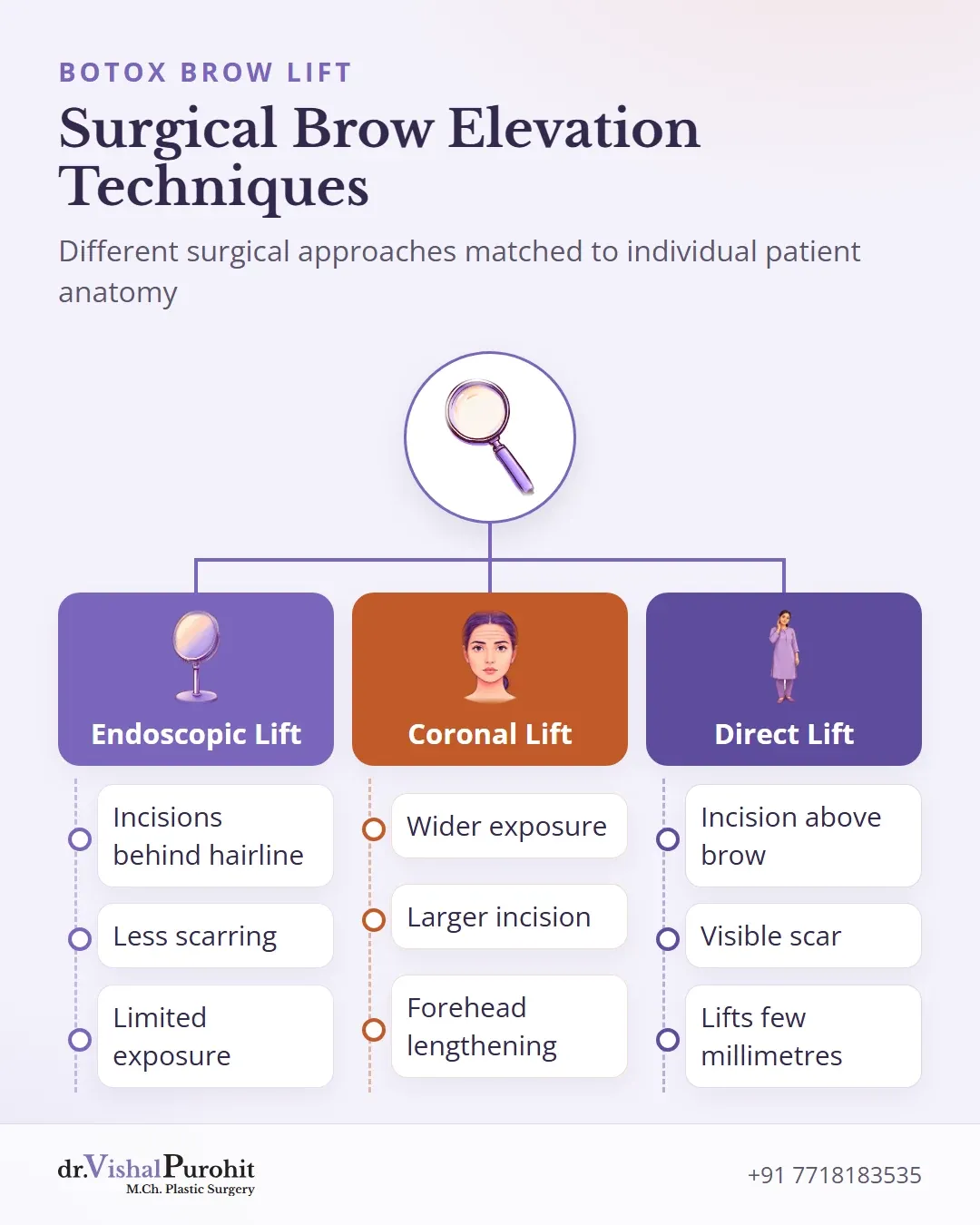
- Endoscopic lift: incisions behind the hairline, less scarring and sensory loss, but limited exposure78.
- Coronal lift: wider exposure, a larger incision with possible sensory change and scar8; it can lengthen the forehead and is unsuitable for a high hairline9.
- Direct lift: an incision above the eyebrow that may leave a visible scar2; it lifts only a few millimetres and is not indicated for severe brow ptosis9.
Whether a brow lift or Botox suits a patient is decided at consultation with Dr. Vishal Purohit in Jaipur.
Upper Blepharoplasty Removes Redundant Skin
Upper eyelid blepharoplasty is an operation, not an injection. It removes excess eyelid skin, with or without prolapsed fat, to improve visual function and the appearance of heavy, tired eyelids10. Mild laxity may be managed with non-surgical options in selected patients, while surgery is used for moderate-to-severe dermatochalasis11. Brow position is assessed separately, because brow ptosis can look like excess eyelid skin11. When the eyebrows sit correctly, the operation can be limited to removing skin and modelling fat without lifting the brow12.
What is removed
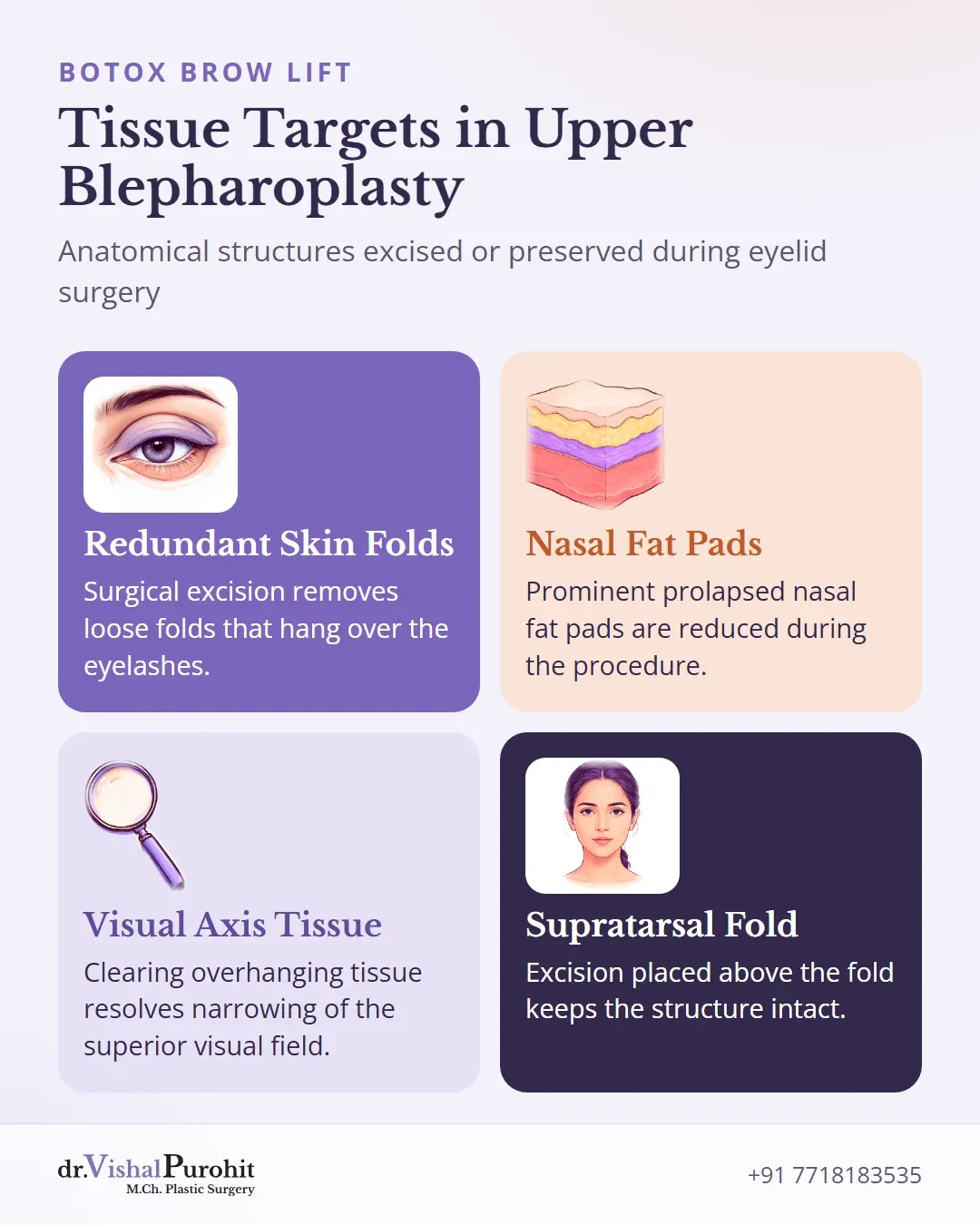
- Redundant skin folds that hang over the lashes1012
- Prolapsed fat, with prominent nasal fat pads reduced and central fat usually preserved11
- Tissue overhanging the visual axis, which can narrow the superior visual field10
Keeping the fold defined
When only skin is excised, the excision is placed above the supratarsal fold and leaves that structure intact, which retains most of the definition of an existing lid fold13. Planning is individual, based on tissue laxity, brow position and patient expectations11.
Specialist Referral for Eyelid Margin Ptosis
Distinguishing a toxin effect from true ptosis
Upper eyelid ptosis is one of the recognised suboptimal outcomes when treating the frown complex, and spread of botulinum toxin type A into the levator aponeurosis is described as a cause14. A drooping lid margin is assessed on its own terms: the literature records how much of the iris the upper lid obscures, and the marginal reflex distance from the corneal light reflex to the lid margin15. Botulinum toxin–induced blepharoptosis is treated as a separate problem with its own prevention and therapeutic options16.
Key points
- Upper eyelid ptosis can occur from botulinum toxin spreading into the levator aponeurosis.
- True ptosis is evaluated using eyelid margin measurements rather than treating it merely as a toxin side effect.
- Appropriate diagnosis ensures timely referral for specialised oculoplastic surgical repair when indicated.
When oculoplastic repair is the described route
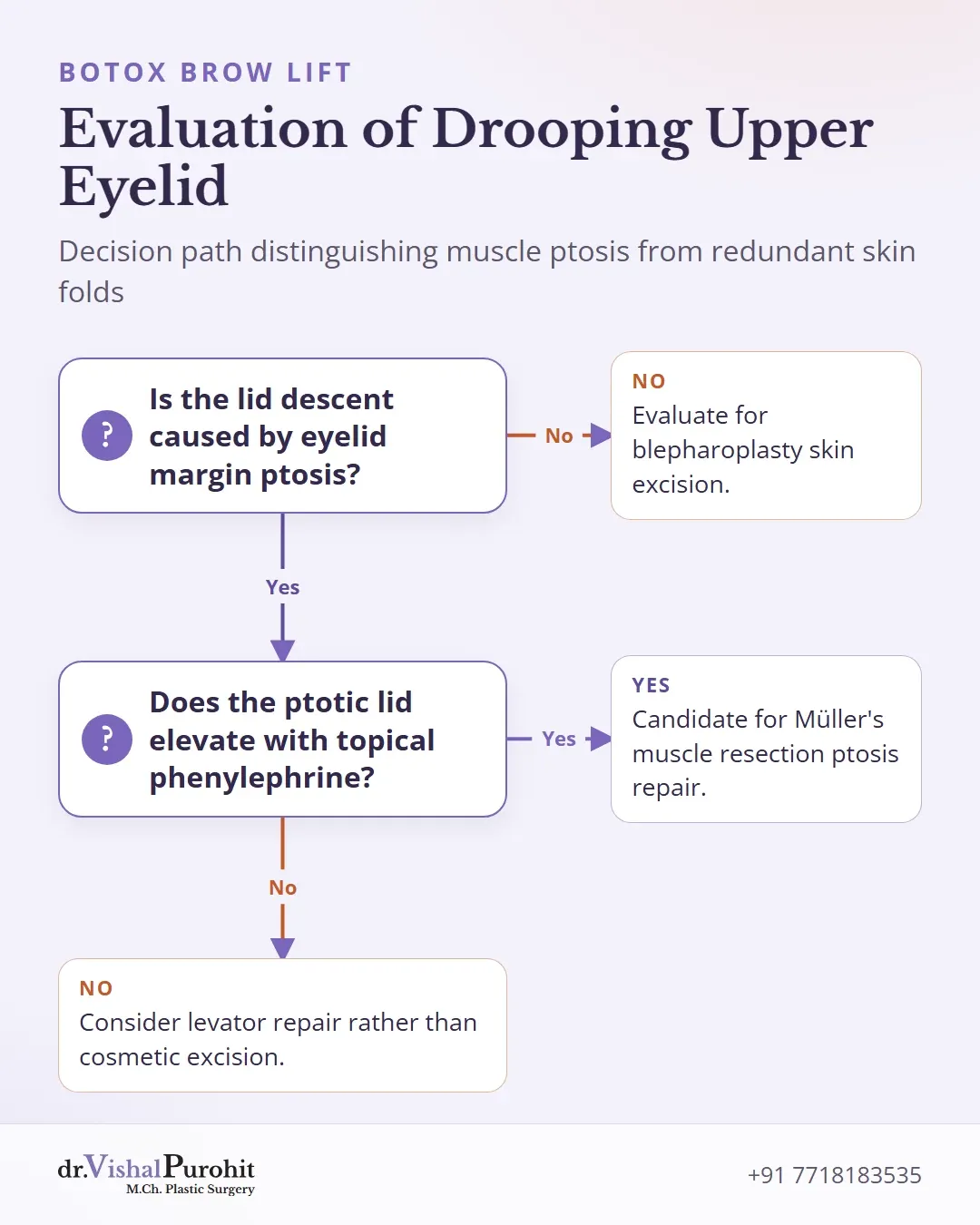
When a ptotic lid elevates with topical phenylephrine, the patient is considered an ideal candidate for Müller’s muscle resection ptosis repair16. Evidence for using phenylephrine to reverse toxin-related ptosis remains sparse, including its dosing and efficacy16. The correction described for such a lid is surgical, by levator or oculoplastic repair rather than cosmetic skin excision16.
Making this distinction allows the patient to be referred to the appropriate specialist instead of continuing cosmetic treatment.
Comparing Recovery Durability Risks and Inaction
Recovery and duration
A Botox brow lift is a non-surgical injection treatment. The likely recovery and duration in Dr. Purohit’s practice are decided at the consultation.
Surgical risks and healing
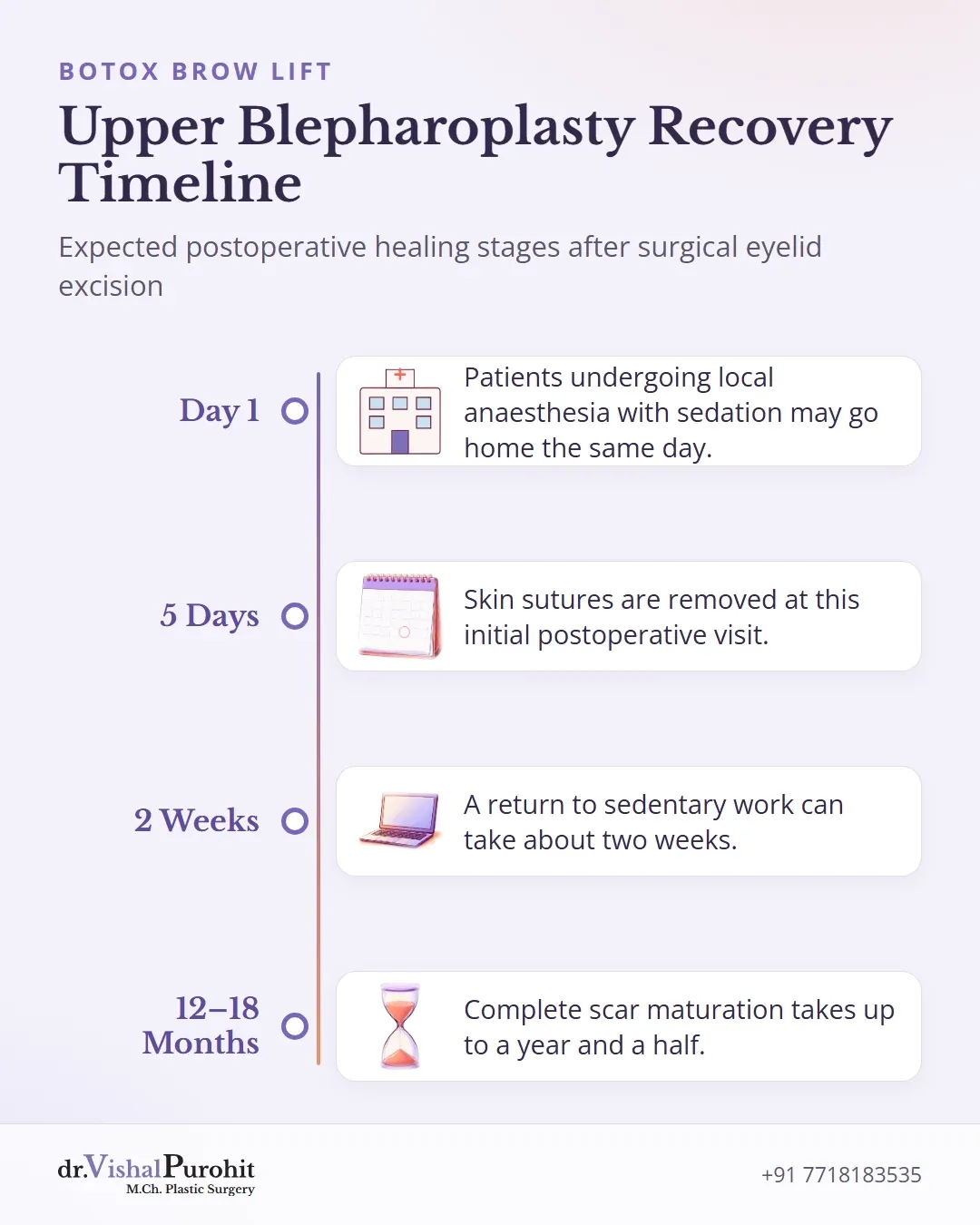
Blepharoplasty involves surgical excision17. It may be done under general anaesthesia, which carries risks such as DVT, PE and chest infection17. Under local anaesthesia with sedation, patients may go home the same day17. A return to sedentary work can take about two weeks, sutures are removed at five days, and scar maturation may take 12–18 months17. Retro-orbital haematoma is rare, at approximately 1 in 40,000, and can cause blindness if untreated17. Blepharoplasty complications may be temporary, lasting days to weeks, or last longer and require medical or surgical treatment18.
Choosing no procedure
Choosing no cosmetic procedure is always a safe and valid clinical path. No one should feel pressure based on age or appearance. Whether to have treatment, and which option, is decided at the consultation with Dr. Purohit.
Brow and Eyelid Consultations in Jaipur
Deciding between dynamic adjustment and surgical correction depends on anatomical assessment, brow position, and patient expectations. Learn more about non-surgical options through Botox Brow Lift in Jaipur or review treatment questions in Botox Brow Lift FAQs. Dr. Vishal Purohit, M.Ch. plastic surgeon, evaluates whether an injection or surgery aligns with individual goals. Choosing no procedure remains a safe, valid option, and consultations can be arranged by calling or messaging +91 7718183535.
This is educational information, not medical advice.