When to Call Your Surgeon: Warning Signs After Breast Augmentation Surgery
Recovering from breast augmentation helps you feel more confident. Some swelling, bruising, and soreness are normal as you heal.
However, you must know the difference between normal pain and real danger. Catching these warning signs early keeps you safe and protects your results.
Immediate Red Flags: Contact Your Surgeon Right Away If You Experience:
- High Fever: A temperature over 101°F (38.3°C) or chills.
- Asymmetry Change: One breast suddenly looks much different in size or shape than the other.
- Severe Pain: Pain that gets worse even with medicine or feels sharp and sudden.
- Skin Changes: Too much redness, heat, or strange fluid leaking from your cuts.
- Respiratory Issues: Trouble breathing or sudden pain in your chest.
Expert guidance is the best way to ensure a smooth recovery. Dr. Vishal Purohit (M.Ch. Plastic Surgery) is a specialist in breast augmentation in Jaipur.
He focuses on his patients’ needs. He combines medical precision with a commitment to your health and self-esteem.
Immediate Medical Emergencies: Cardiovascular and Respiratory Red Flags
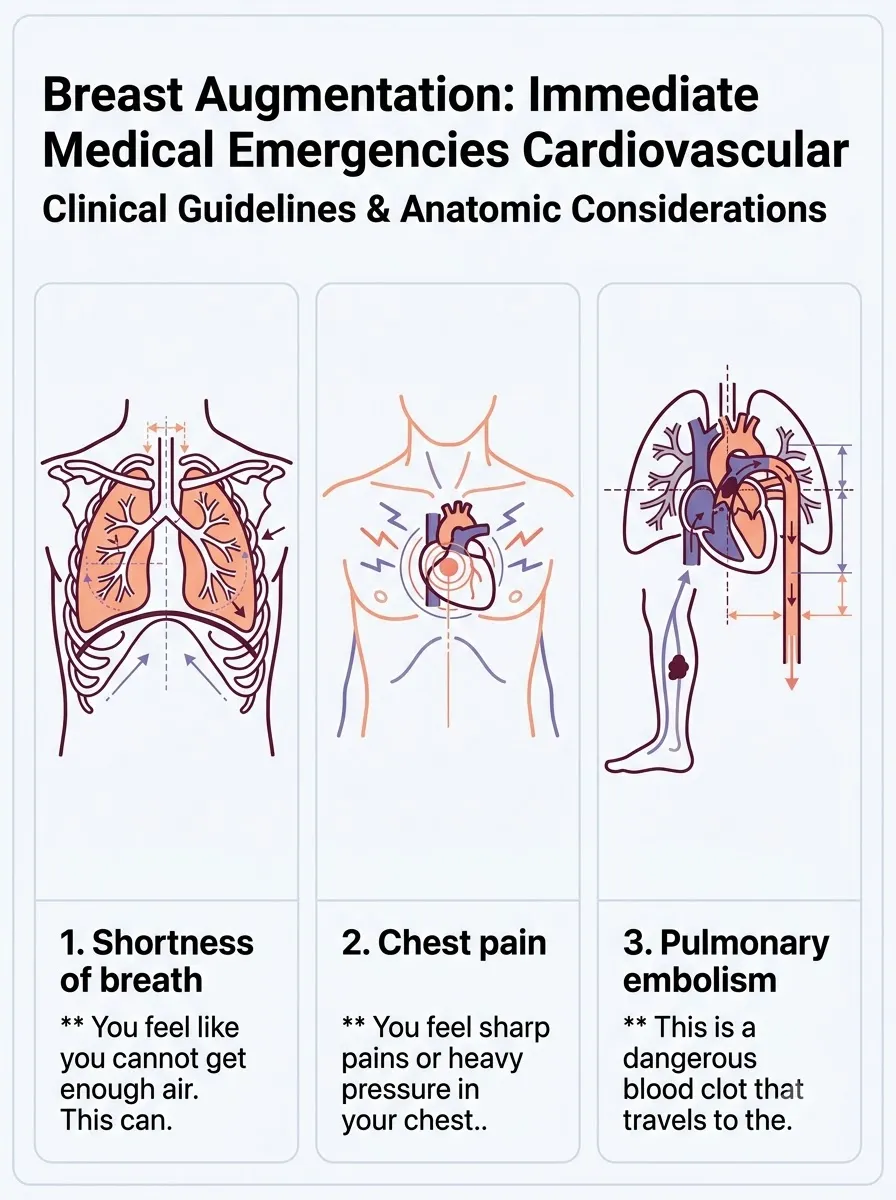
Some problems after surgery can be life-threatening. These issues affect your heart and lungs.
You may need an emergency intervention. This means you need immediate medical care to save your life.
Call 911 or go to the nearest emergency room if you notice these signs:
- Shortness of breath: You feel like you cannot get enough air. This can happen suddenly or get worse over a few hours.
- Chest pain: You feel sharp pains or heavy pressure in your chest. This often feels worse when you take a deep breath.
- Pulmonary embolism: This is a dangerous blood clot that travels to the lungs. You need instant care to prevent permanent damage.
Identifying Post-Operative Infection Indicators

Bacteria can enter your body after surgery and cause an infection. A surgical site infection happens when germs grow near your cuts or implants.
If you don’t treat this, it can cause systemic complications. These are serious health problems that affect your whole body.
Finding a problem early means you may not have to remove your implants. Watch for erythema, which is just a medical word for skin redness.
You should also watch for a low-grade fever. This is when your body temperature rises slightly.
Call your doctor right away if you see purulent discharge. This is thick, pus-like fluid leaking from your incisions.
These signs are part of the risks and potential complications of this procedure.
Some infections are hard to spot. This happens because bacteria can form a coating on the implant.
“bacterial coatings become effectively embedded on the implant itself” (doi.org/10.1177/1090820X11417428), which makes them hard to treat with normal medicine.
Act fast to keep your recovery on track.
Recognizing Acute Fluid Accumulation: Hematoma and Seroma
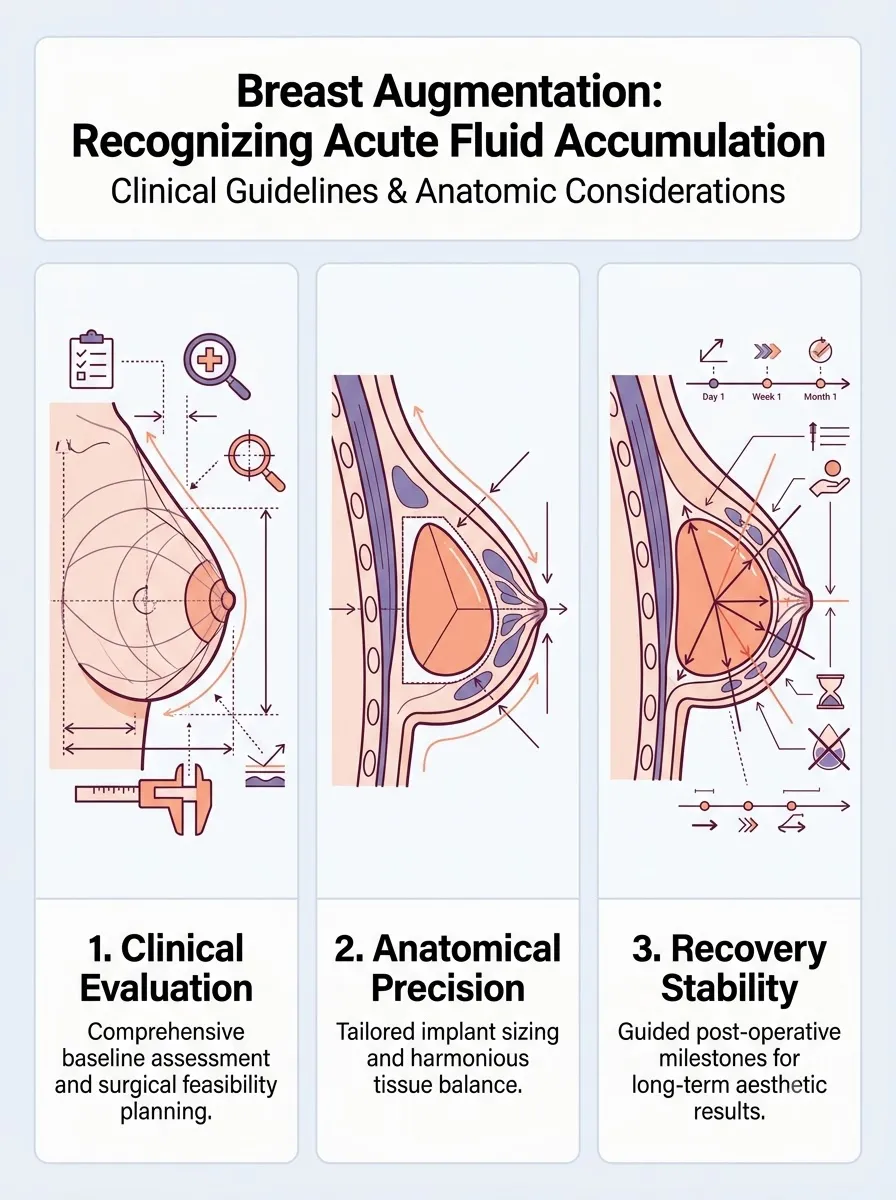
It is normal to have some swelling after surgery. This is called edema. It is just fluid building up in your tissues.
Some fluid collections are not normal. These can be dangerous and need medical care.
Sudden swelling in one breast is a warning sign. You need to know the difference between normal healing and a problem. Asymmetric swelling means one side looks much larger than the other.
Use this table to know when to call your surgeon:
| Condition | What it is | Warning Signs | Action Needed |
|---|---|---|---|
| Hematoma | A collection of blood under the skin. | Rapid growth of the breast, tight skin, and bruising. | Call your surgeon immediately. |
| Seroma | A buildup of clear bodily fluid around the implant. | A soft, fluid-filled lump or a feeling of fullness. | Contact your doctor for drainage. |
| Tissue Necrosis | When skin or tissue dies due to lack of blood. | Skin turning black, grey, or dark purple. | Urgent medical evaluation is required. |
Structural Warning Signs: Implant Displacement and Rupture
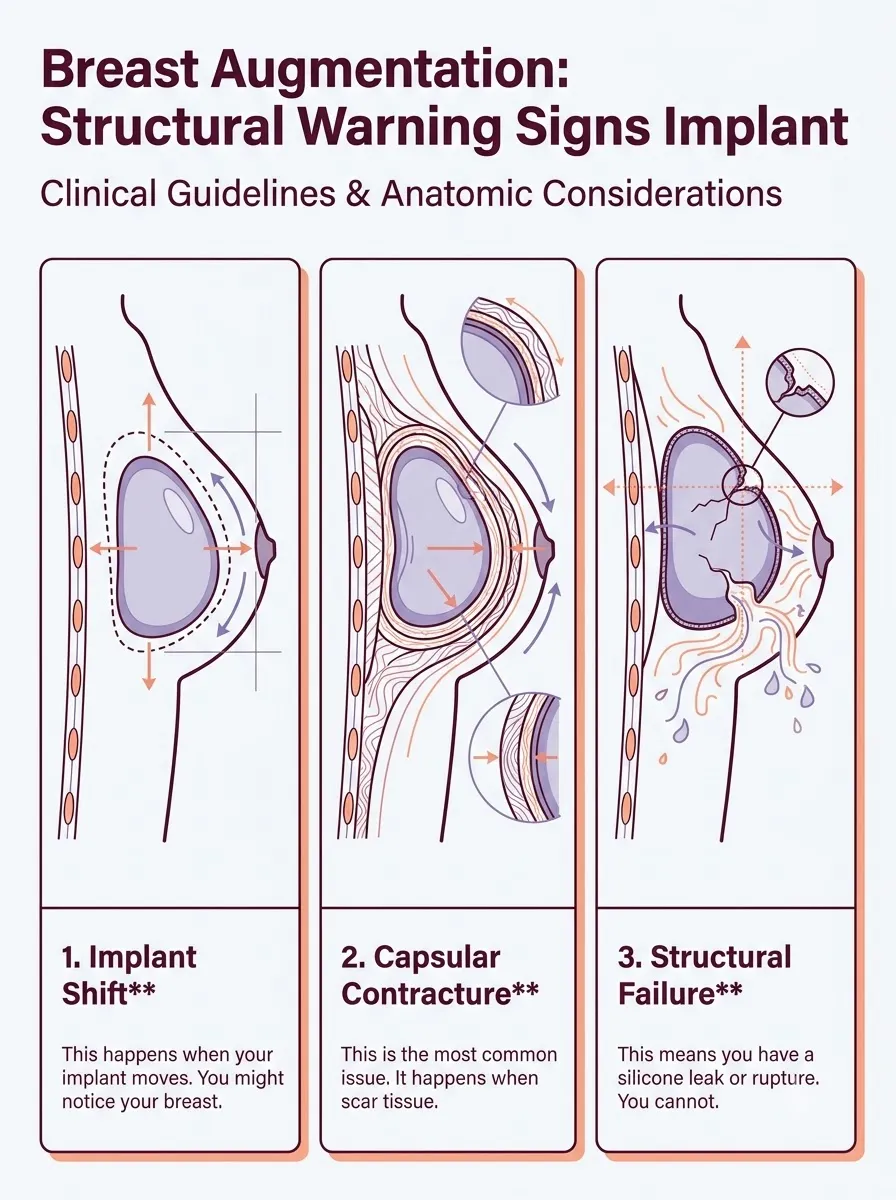
Your implants need to stay in one place to look natural. Sometimes the implant or the skin around it changes. Watch for these physical warning signs to keep your results looking great.
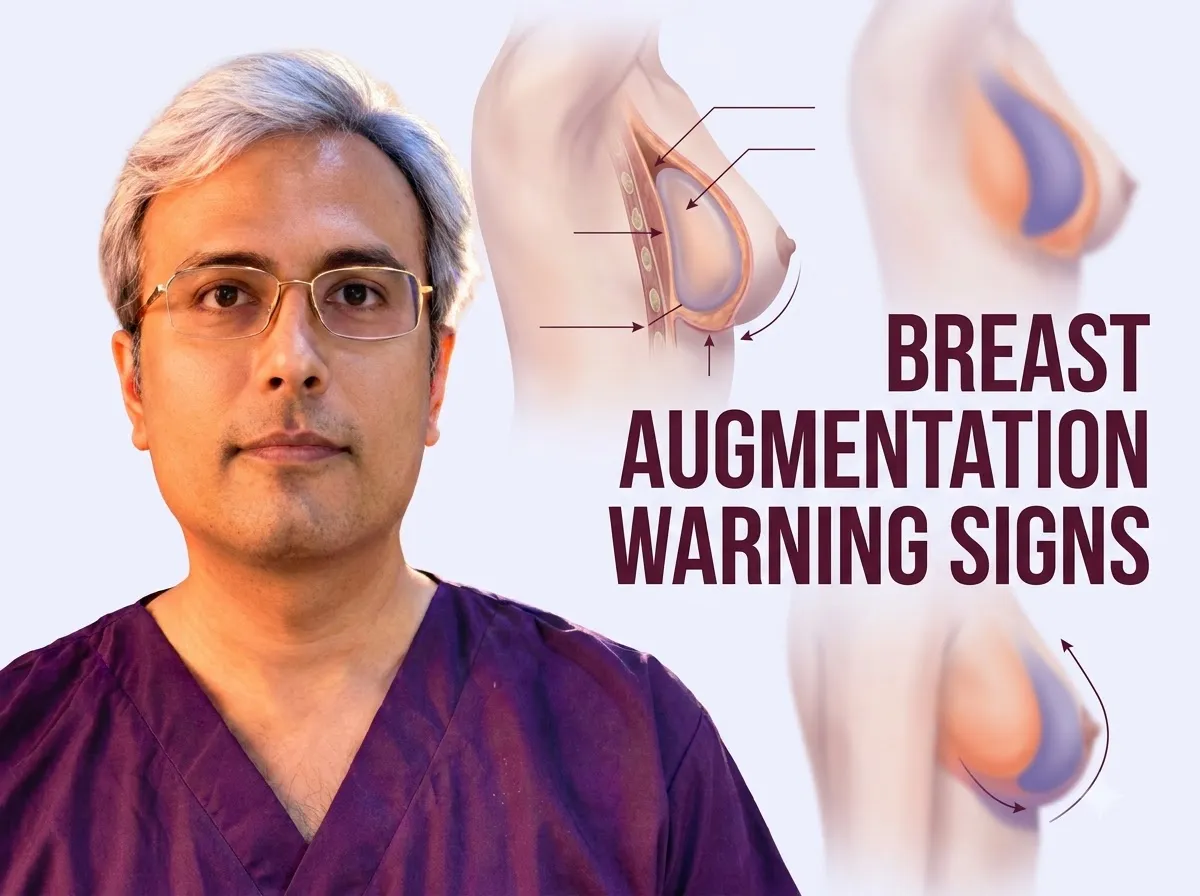
- Implant Shift: This happens when your implant moves. You might notice your breast changes shape.
- Capsular Contracture: This is the most common issue. It happens when scar tissue tightens around the implant. It is diagnosed clinically (“Capsular contracture is the most common complication of breast augmentation, which can occur over time and is diagnosed clinically”). Your breast may feel firm or look different.
- Structural Failure: This means you have a silicone leak or rupture. You cannot always feel a leak. Some cases involve an extracapsular rupture90032-3) (“a rupture of both the elastomer shell and the fibrous capsule, with silicone xtending into the breast tissue”).
- Texture Changes: Your breast might feel hard or look odd. This could be a sign of a problem. However, a bulge is often an unreliable sign (“a bulge or herniation of the implant is an unreliable sign of implant rupture”).
Call your surgeon if you notice any of these changes. They can use scans to see if there is a real problem.
Monitoring Incision Integrity: Wound Dehiscence Markers
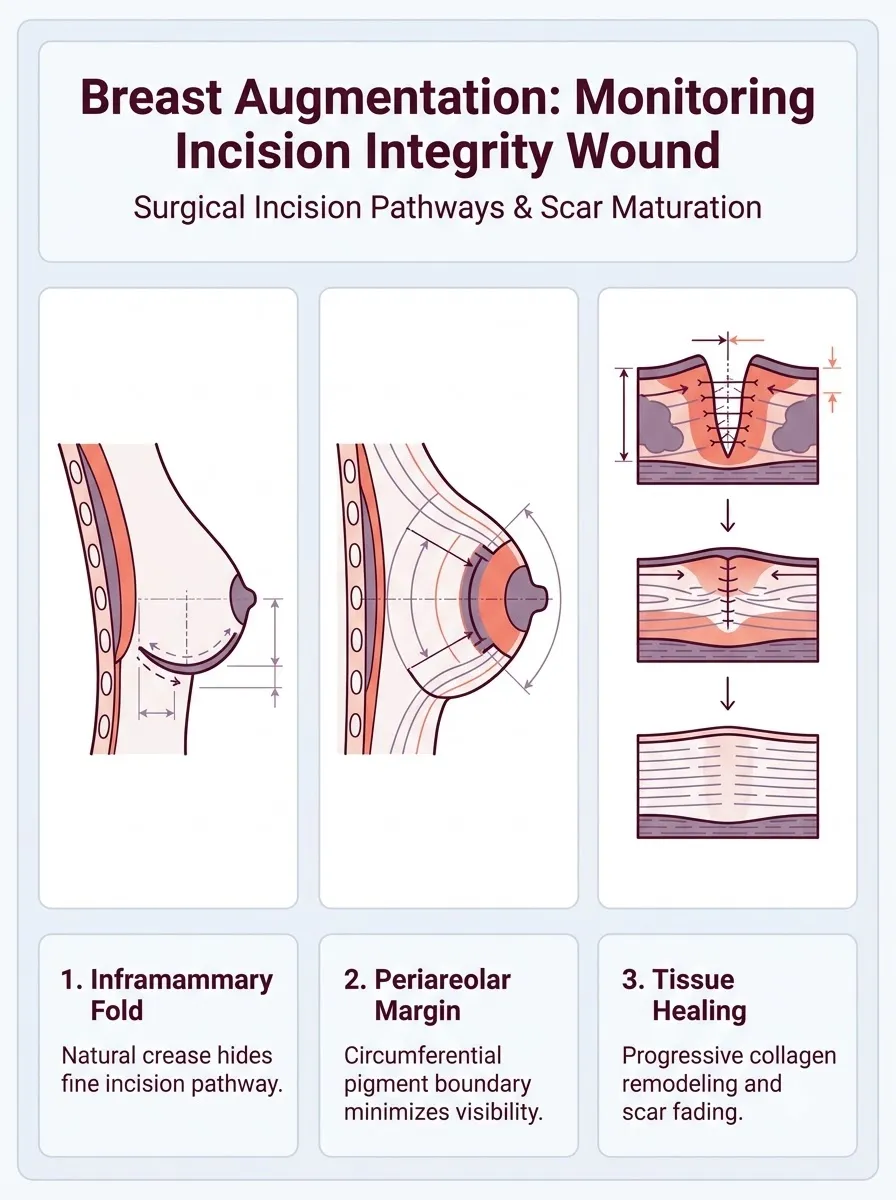
Your skin must stay closed to help the healing process. This is how your body fixes itself after surgery. Check your breast augmentation incision sites every day.
Wound dehiscence is the medical term for when a surgical cut opens back up. You may see an incision line opening where the skin edges do not touch. This happens because of tension or infection.
Watch for any fluid leaking from the cut. It might look like blood, pus, or clear liquid. Call your surgeon right away if you see a gap or new drainage.
Frequently Asked Questions
What are the critical warning signs after breast augmentation requiring immediate contact?
Contact Dr. Vishal Purohit in Jaipur at +91-7718183535 immediately if you experience sudden unilateral breast enlargement (indicating hematoma), spreading red warmth, fever exceeding 100.4°F, foul drainage from incisions, or shortness of breath. While mild bilateral swelling and soreness are normal, sudden acute asymmetry requires prompt evaluation. As an M.Ch plastic surgeon, Dr. Purohit provides 24/7 emergency clinical access.
What are the symptoms of a post-operative hematoma (blood collection)?
A hematoma presents as sudden, painful swelling of one breast within the first 24 to 72 hours, causing the affected breast to feel tight, enlarged, and significantly firmer than the other, explains Dr. Vishal Purohit in Jaipur. Dr. Purohit conducts immediate in-clinic evacuation and hemostatic control to protect the implant pocket. Dr. Purohit’s meticulous electrocautery techniques keep hematoma rates below 0.5%.
How can I differentiate normal post-op healing from a surgical infection?
Normal healing involves mild bilateral tightness, faint pink incision edges, and clear straw-colored fluid, whereas an infection produces spreading redness extending past 2 cm, localized heat, worsening throbbing pain beyond 72 hours, and cloudy drainage, clarifies Dr. Vishal Purohit in Jaipur. Early antibiotic intervention easily resolves minor infections. As an M.Ch. plastic surgeon, Dr. Purohit monitors all healing sites vigilantly.
What should I do if I feel a sharp shooting pain or electrical twinge in my breast?
Sharp shooting twinges, fleeting electrical sensations, and itching are normal, benign markers of regenerating sensory cutaneous nerves as tissue swelling subsides, reassures Dr. Vishal Purohit in Jaipur. These sensations typically peak between weeks 3 and 8 and fade spontaneously. If pain is constant, severe, or accompanied by localized swelling, Dr. Purohit conducts an in-clinic evaluation for complete peace of mind.