
Under-eye shadows and bags do not all come from the same structure. Weakness of the orbital septum may let orbital fat pads push forward, while a true tear trough groove follows the way orbital fat herniates and the orbicularis oculi muscle attaches. In other faces the concern is volume loss as midfacial soft tissue descends.
Because the cause varies, the two treatments work differently. Hyaluronic acid filler adds volume beneath the soft tissues to soften the hollow groove, while lower blepharoplasty releases and repositions fat pads, repairs the septum and trims redundant skin. Understanding this distinction is the starting point, and Under-Eye Fillers: Hollows, Dark Circles or Eye Bags? explains when adding volume suits a face.
Structural Anatomy of Hollows Bags and Lax Skin
Three different structures
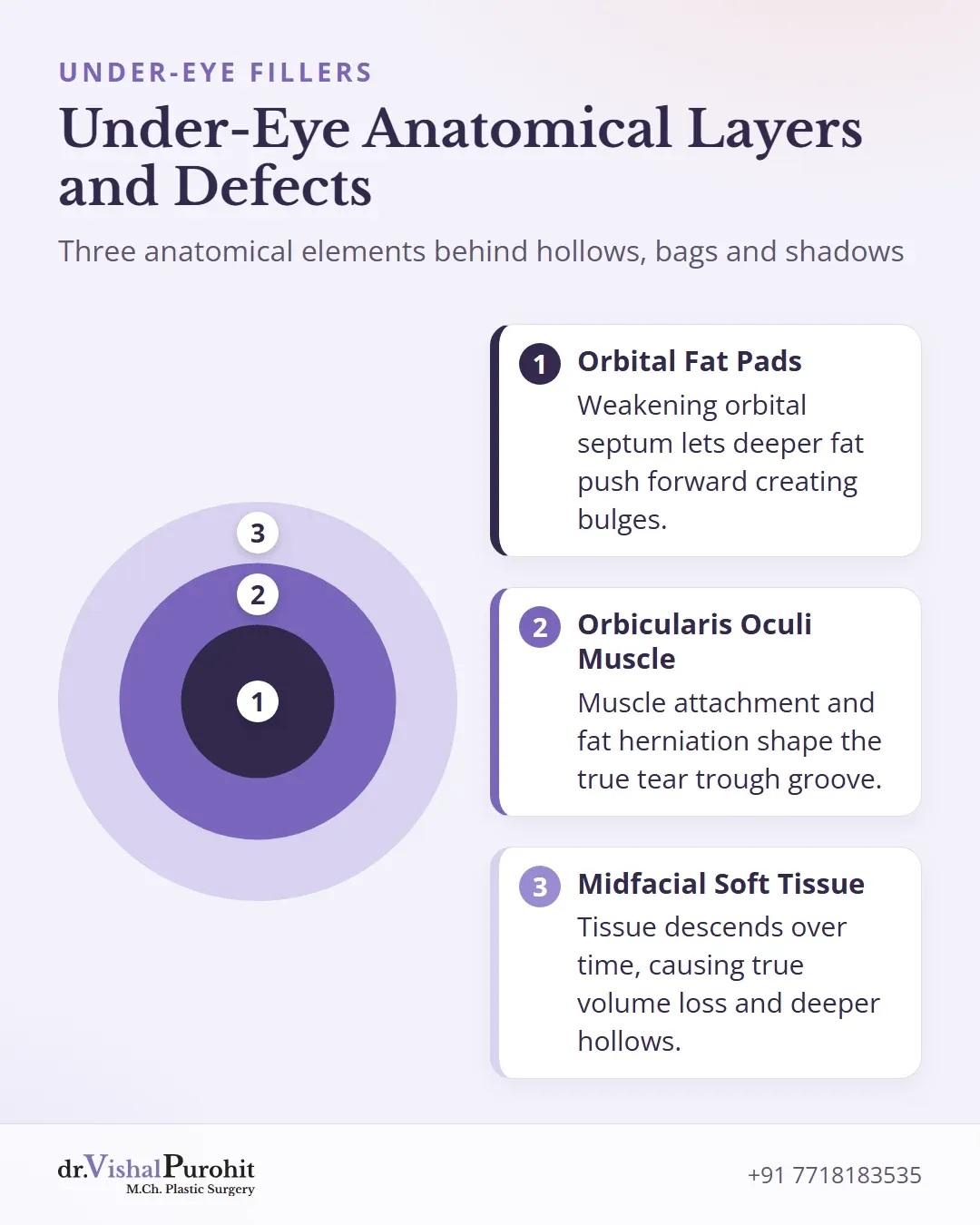
Under-eye complaints usually come from distinct anatomic elements. Weakening of the orbital septum may allow orbital fat pads to herniate forward, creating a visible bulge of the lower lid1. The tear trough groove is also shaped by orbital fat herniation and the way the orbicularis oculi muscle attaches2. In other cases the concern is true volume loss, as midfacial soft tissue descends over time and the groove deepens3.
What each treatment addresses
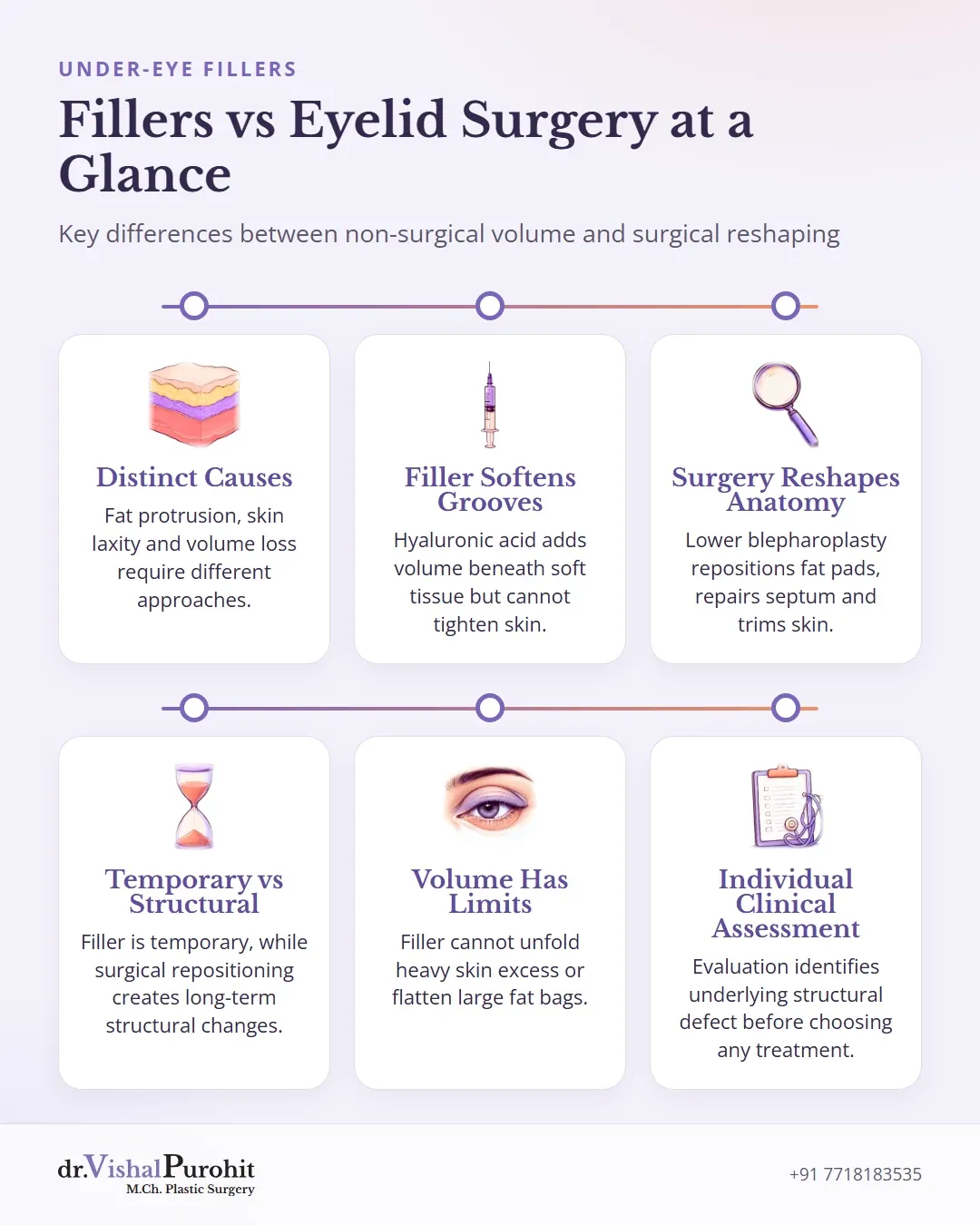
Hyaluronic acid (HA) filler adds volume beneath the soft tissues to soften the hollow groove between the lower eyelid and the cheek3. Lower blepharoplasty works differently: it releases and repositions the fat pads, repairs or resets the septum, and trims redundant skin14.
Why assessment matters
Not every contour problem is volume loss. Where a skin fold drapes across the area, adding volume alone will not create the desired result5. A clinical evaluation clarifies which structural defect drives the visible concern, and filler suits only some under-eye concerns.
Dr. Purohit’s note: At his practice in Jaipur, Dr. Purohit decides the appropriate approach case by case.
Trade-Offs in Downtime Longevity and Invasiveness
The filler route
Tear trough filler is a non-surgical clinic procedure: hyaluronic acid filler is placed to soften the hollow groove between the lower eyelid and the cheek. Swelling is usually limited to the injection sites, and variable but subtle edema is not uncommon, resolving by two to three weeks6. The material is temporary7, so the area needs periodic reassessment over time.
Key points
- Tear trough filler offers a non-surgical option with temporary results, requiring periodic reassessment.
- Lower blepharoplasty involves surgical incisions and operative recovery, but delivers durable structural changes.
- The right approach depends on individual anatomical concerns, procedural risks, and personal recovery preferences.
The surgical route
Lower blepharoplasty is an operation. Published options include transconjunctival and percutaneous lower blepharoplasty8, so it involves surgical incisions and a planned period of operative recovery. The trade-off is durability: filler is temporary7, while the repositioning carried out during surgery is a structural change aimed at a smoother lid–cheek junction910.
Balancing the choice
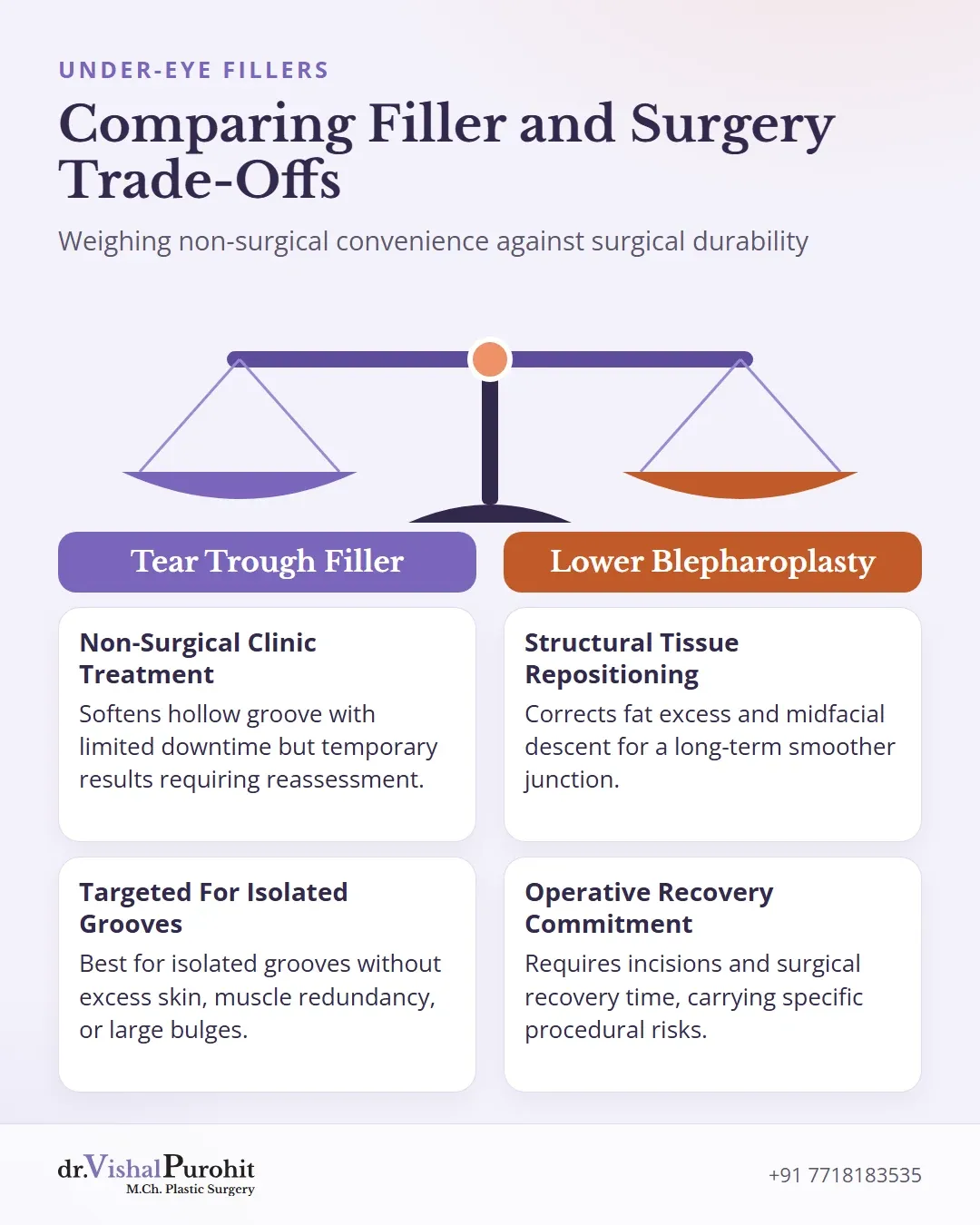
Reported filler complications include lower eyelid edema, under-correction and bulging8, and the Tyndall effect, a blue tint or surface irregularity over the thin skin6. Surgery is aimed at more advanced changes such as fat excess and midfacial descent, while an isolated groove without fat, skin or muscle excess may suit filler instead9. Neither option suits everyone: the decision balances procedural risks, healing commitments and lifestyle preferences, and is settled at the consultation.
What Dermal Filler Cannot Achieve Alone
Where volume stops working
Hyaluronic acid filler adds volume to soften a hollow groove; it does not tighten loose eyelid skin. Volume under the concavity may improve minor skin redundancy, but with more significant redundancy it will not unfold the excess skin, and surgery is needed for an optimal result11. Redundant orbicularis oculi muscle contributes to malar festoons12, which are cascading hammocks of skin and muscle below the infraorbital rim13; these are addressed with surgical approaches rather than injection14. Severe lower lid laxity also has to be evaluated before any treatment, because aggressive treatment can lead to significant lid complications15.
Key points
- Hyaluronic acid filler restores lost volume but cannot tighten significant loose skin or festoons.
- Large herniated fat bags cannot be flattened with filler alone and may require surgical lower blepharoplasty.
- Overfilling around fat bulges risks impairing lymphatic drainage and creating an unnatural, heavy lower lid.
Prominent fat bags
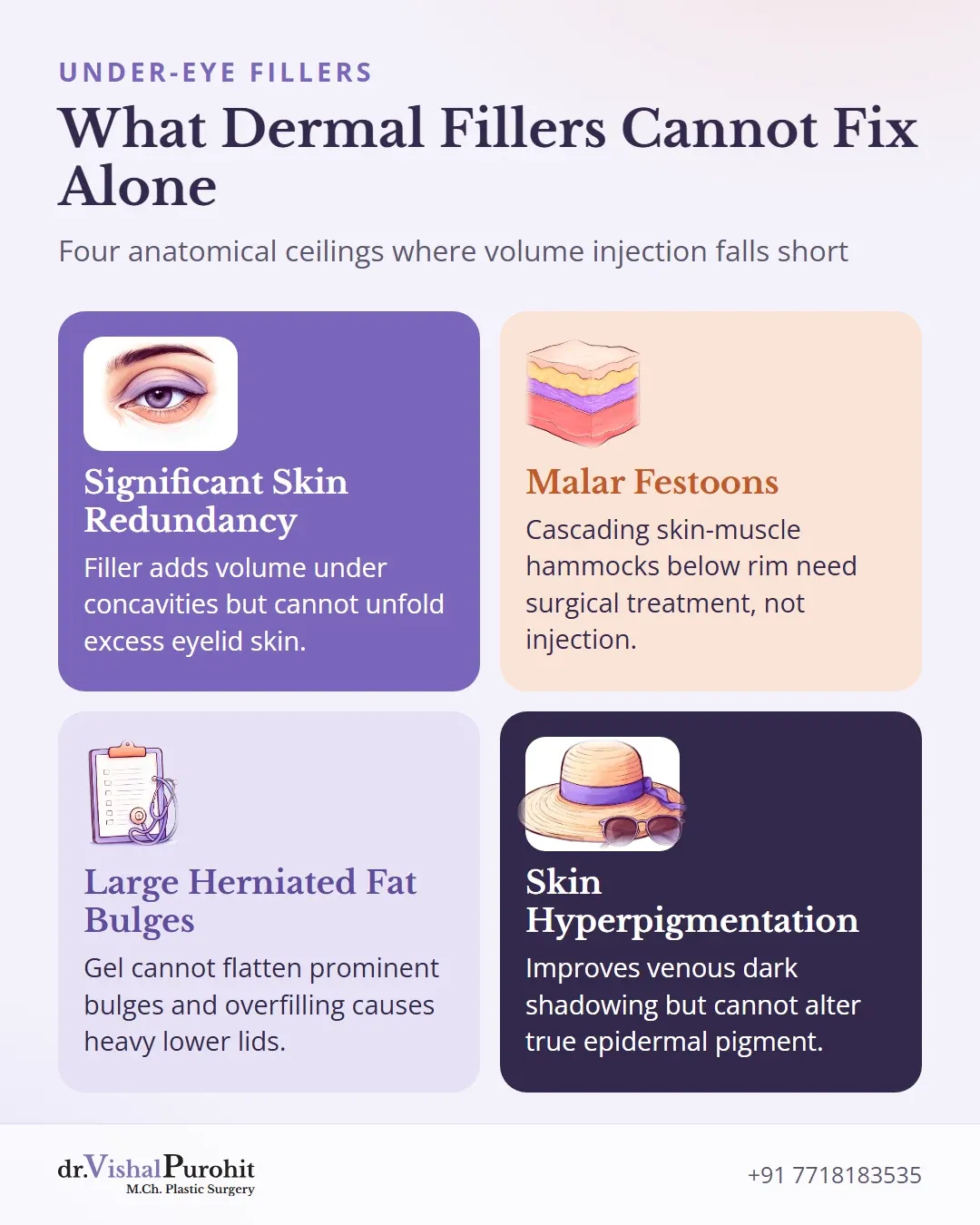
Filler cannot flatten a large herniated fat bulge. With very significant pseudoherniated lower lid fat, filling the groove below may reduce shadowing but fall short of a smooth contour from lid to cheek, and the result may require lower blepharoplasty11. Adding more gel around the bulge instead can leave a heavy, unnatural lower lid: large injection volumes may impede lymphatic drainage and cause malar edema16, and filler can conceal fat prolapse that becomes visible again once the gel is dissolved8.
Recognising these anatomical ceilings helps prevent overfilling.
Surgical Boundaries and Long Term Structural Changes
Surgery changes the native tissue
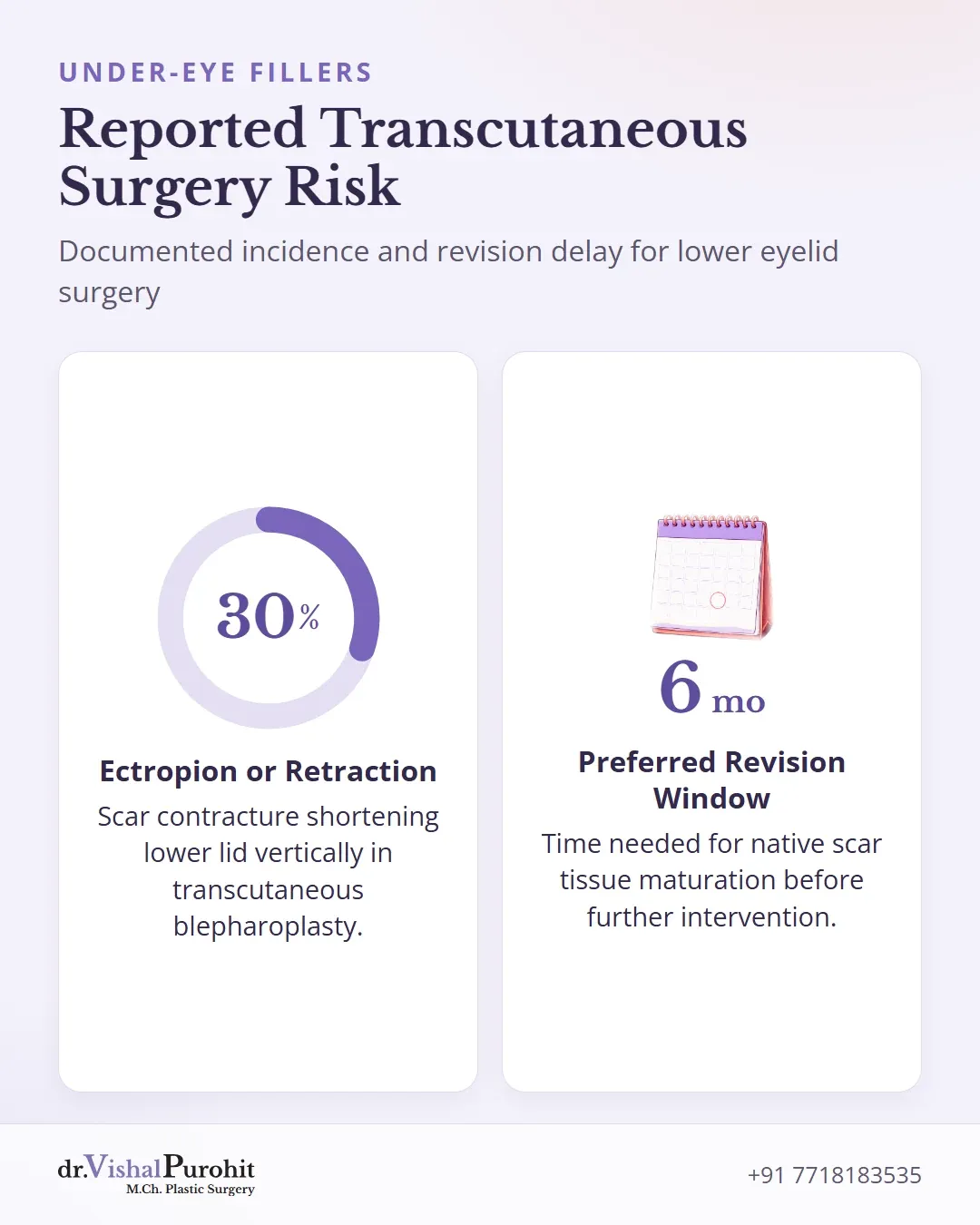
Lower eyelid surgery works on the tissues themselves: skin, muscle and fat are resected, and healing proceeds through scar formation that can shorten the lid vertically17. The change lasts, and so does the healing timeline — revision is usually delayed at least a few months, preferably six18. With the transcutaneous approach, ectropion and retraction can occur in up to 30% of cases19.
Risks that are specific to the operation
- Scar retraction or ectropion of the lower lid, which may need later correction1718
- Hollowing of the lower lid when too much fat is removed, which may need volume replacement20
- Tear trough irregularity, prolonged swelling or granuloma after fat repositioning21
What surgery does not correct
An individual assessment decides
Management options include observation, transconjunctival or percutaneous lower blepharoplasty8. A lid tethered after surgery may need operative release18. Patients with prominent eyes without bony support face a higher risk of ectropion and dry eye after surgery19. Whether operative release or fat repositioning (transposition) suits a person is decided by an individualized surgical assessment.
Questions to Bring to an Eyelid Consultation
What is making the shadow?

Visible under-eye shadows do not all share one cause. Before selecting a treatment, clarify:
Filler suits only some under-eye concerns. Thick, smooth skin responds better than thin, wrinkled or inelastic skin, and marked laxity may lead to excess product use22. Filler can improve shadowing from venous blood but will not improve eyelid skin hyperpigmentation22. Hyperpigmentation can create an illusion of trough depth22.
What will recovery involve?
Injection reactions such as redness, swelling, bruising and tenderness are usually mild to moderate and settle within a few days23.
What about revision, or no treatment?
Realistic recovery, possible revision steps and the choice of no intervention are worth discussing before treatment. In one under-eye filler study, the possibility of further management was discussed with patients before treatment8.
For Dr. Purohit, aftercare, review timing, revision and touch-up plans are decided at the consultation.
Planning Under-Eye Treatment in Jaipur
Under-eye hollows, fat bags and lax skin need different answers, and the choice between filler and surgery follows the anatomy rather than a trend. Patients considering treatment can review Under-Eye Fillers in Jaipur for the non-surgical option, and the Under-Eye Fillers FAQs cover common questions. Dr. Vishal Purohit, M.Ch. plastic surgeon, assesses each person at the consultation and explains what each option can and cannot achieve. Choosing no treatment remains a valid option.
This is educational information, not medical advice.