
Hyaluronic acid dermal filler is often used to soften hollow grooves beneath the lower eyelids, but the delicate tissue can sometimes display unexpected reactions. Temporary swelling and bruising are common early milestones, yet persistent fullness or contour distortion can arise weeks or months later.
Patients seeking clarity on whether their puffiness stems from fluid retention or anatomical variation can review Under-Eye Fillers: Hollows, Dark Circles or Eye Bags? to understand their suitability. Careful clinical assessment helps distinguish temporary product expansion from deeper structural tissue changes.
Routine Healing and Immediate Recovery Milestones
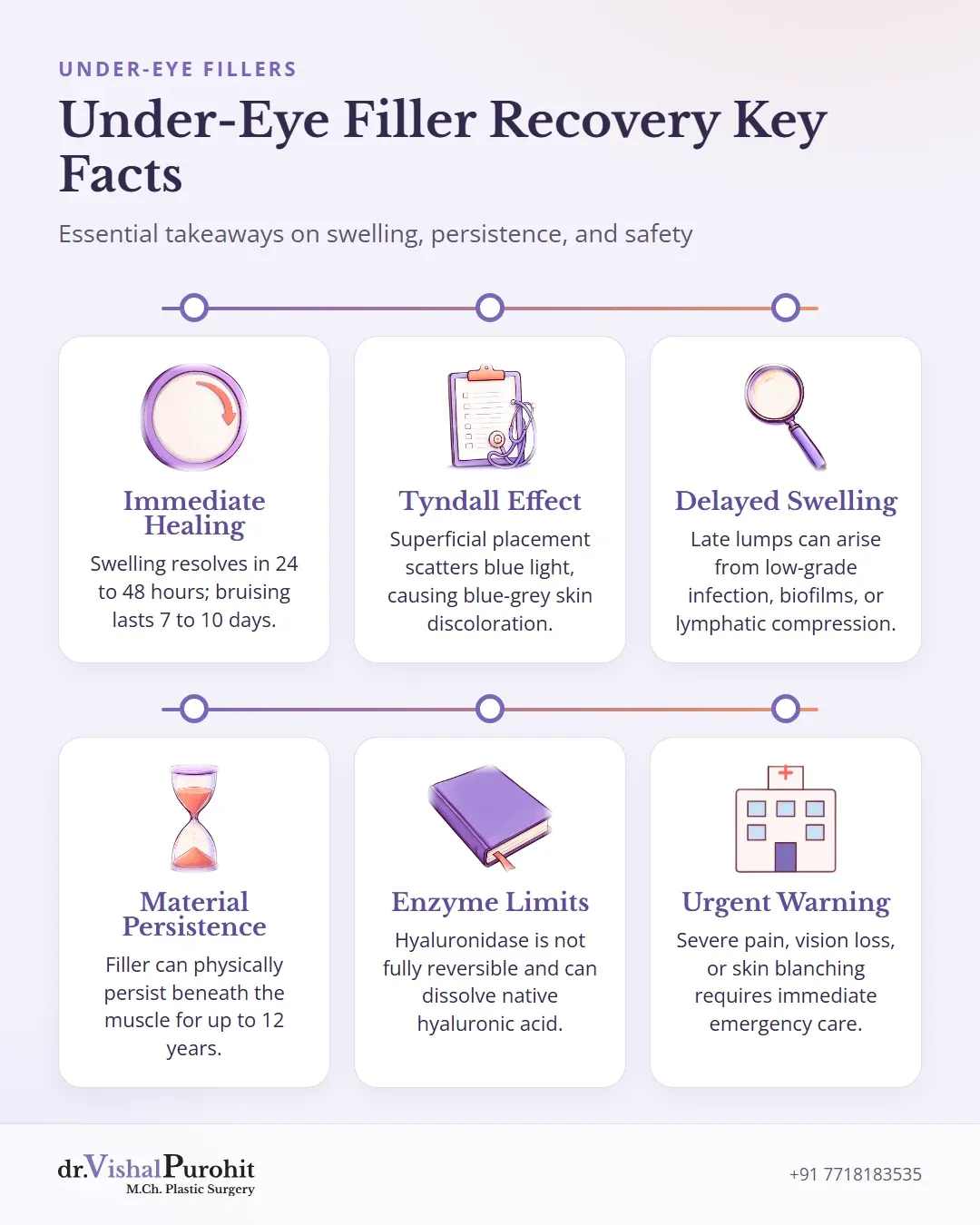
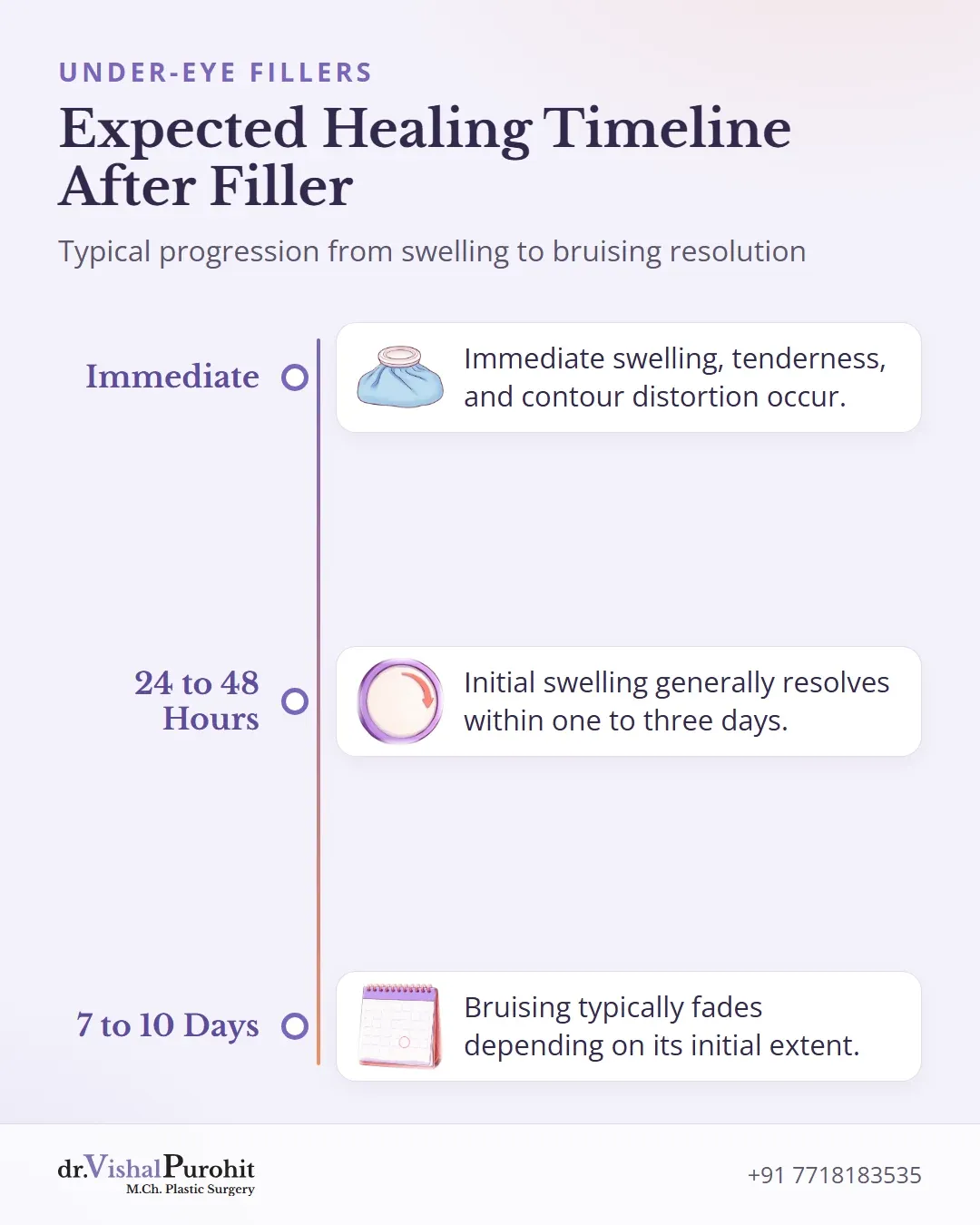
Early swelling, erythema, tenderness, and bruising frequently occur after lower eyelid dermal filler injections1. Because hyaluronic acid is hydrophilic, immediate swelling is often seen2, which temporarily alters and distorts the local cosmetic contour3. Rather than expecting zero downtime, patients should plan a recovery buffer into their social and work schedules.
Literature indicates that swelling generally resolves within 24 to 48 hours2 or one to three days1, though swelling and bruising vary between individuals2. Bruising may last 7 to 10 days depending on its extent1. Soft, wrapped ice packs applied after treatment can help minimize both swelling and bruising1.
Key precautions during the early recovery period include:
- Avoid self-directed aggressive massage of the lower eyelid area.
- Do not pause or adjust any regular prescription medicines without medical guidance.
- Follow individualized recovery instructions.
Dr. Purohit’s note: Specific aftercare rules for Dr. Vishal Purohit’s practice are decided at the consultation.
Patients should monitor their recovery closely. If severe pain, vision changes, or skin discoloration occur, prompt medical evaluation is necessary rather than waiting for normal healing milestones.
Delayed Swelling Lumps and the Tyndall Effect
Persistent skin discoloration or firm lumps weeks after under-eye hyaluronic acid filler may indicate superficial placement or delayed swelling34.
The Tyndall Effect
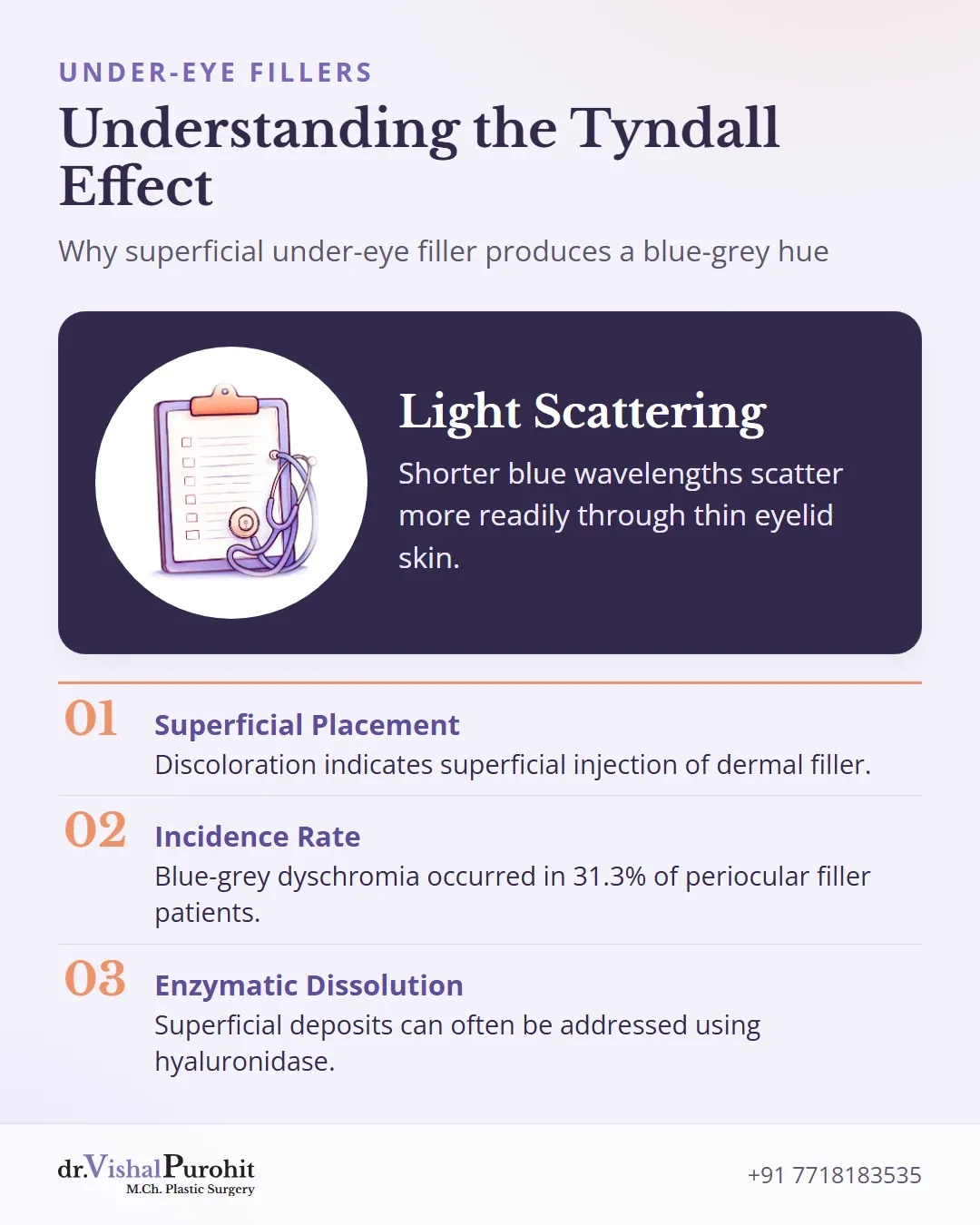
Superficial injection of hyaluronic acid dermal filler can cause light scattering45. Because shorter wavelengths of light, such as blue light at 400 nm, scatter more readily than longer wavelengths, a bluish or blue-grey hue appears across thin eyelid skin467. Long-term study data show blue-grey dyschromia occurred in 31.3% of periocular filler patients, though 90% of observed complications were mild3. When present, unwanted superficial filler deposits can often be addressed using hyaluronidase356.
Delayed Lumps and Swelling

Lumps appearing weeks to months after treatment require medical evaluation rather than assuming harmless water retention38:
- Delayed nodules may reflect low-grade infection, biofilm formation, or immune responses to the filler material89.
- Late-onset swelling can involve veno-lymphatic compression from the product3.
- Firm or inflammatory swellings should be assessed by a qualified doctor before interventions such as hyaluronidase are considered58.
Careful professional review ensures that changes in skin hue or late-onset masses are accurately diagnosed and managed358.
Material Persistence and Repeat Treatment Decisions
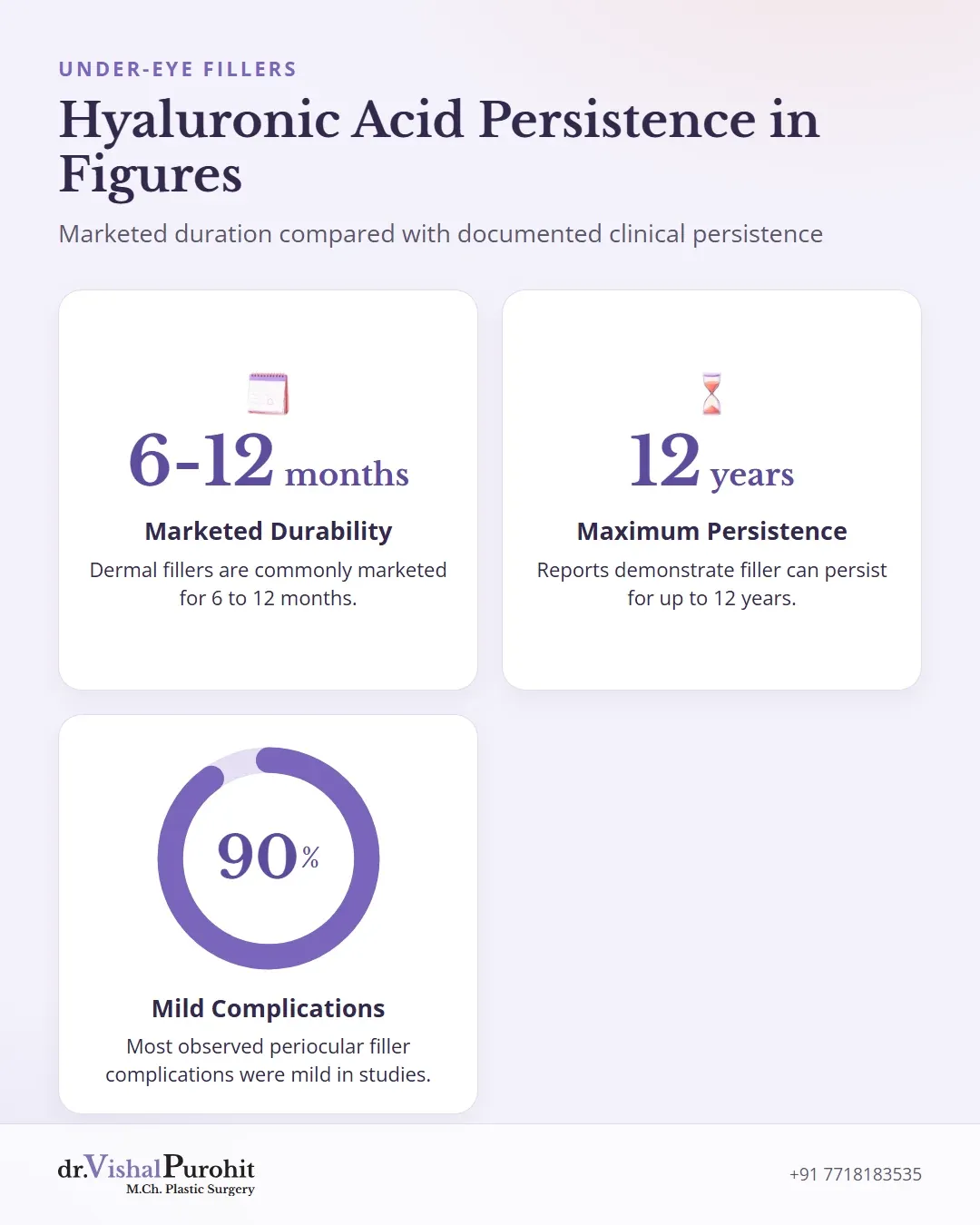
A cosmetic result may soften over months even when significant hyaluronic acid remains intact beneath the orbicularis muscle. Although dermal fillers are often marketed for 6 to 12 months of durability, clinical reports demonstrate that product can persist for up to 12 years due to isovolumetric degradation10.
Periorbital aging involves progressive changes across bone, ligament, muscle, fat, and skin11. As tissue laxity develops and light patterns shift over time, an under-eye hollow may appear to return without proving that the previous product has disappeared.
Before introducing any extra volume, persistent material requires careful evaluation:
- Injected hyaluronic acid continues to bind water, which can contribute to delayed fluid accumulation and contour irregularities in thin lower eyelid tissue1012.
- Adding extra filler over retained material risks overfilling, bulging, or late-onset edema101213.
- An in-person clinical assessment determines whether visible hollows stem from product depletion or natural anatomical changes11.
Stopping treatment or choosing no further injection remains an entirely valid choice for every patient.
Technique Myths and Hyaluronidase Limitations
Using a blunt microcannula can reduce tissue trauma, bruising, and swelling during tear trough treatment14. However, it does not eliminate the possibility of inadvertent vascular injury or occlusion14. Additionally, mechanical instruments cannot prevent late lymphatic fluid retention or prolonged swelling around the delicate lower eyelid anatomy1516.
Myth: Blunt microcannulas eliminate vascular occlusion and swelling risks completely.
Fact: A cannula cannot eliminate the possibility of inadvertent vascular injury or occlusion14, nor prevent late lymphatic fluid retention around delicate lower eyelid anatomy1516.
Myth: Hyaluronidase completely and instantaneously reverses filler without affecting natural tissue.
Fact: The procedure is never fully reversible in every situation, and because its enzymatic action is nonspecific, it may dissolve surrounding native hyaluronic acid alongside the injected material16.
Hyaluronidase Realities
Hyaluronic acid dermal filler can often be dissolved when necessary by injecting an enzyme called hyaluronidase1617. Nevertheless, correction has clear clinical limitations:
- The procedure is never fully reversible in every situation, and it does not offer guaranteed or instantaneous tissue recovery16.
- Because its enzymatic action is nonspecific, it may dissolve surrounding native hyaluronic acid alongside the injected material16.
- Unpredictable persistence, tissue irregularities, or persistent contour changes can still occur1516.
Urgent Warning Signs

Vascular compromise is an acute medical emergency18. Any patient experiencing the following symptoms requires immediate emergency medical evaluation rather than waiting:
Assessment Pathways for Acquired Contour Problems
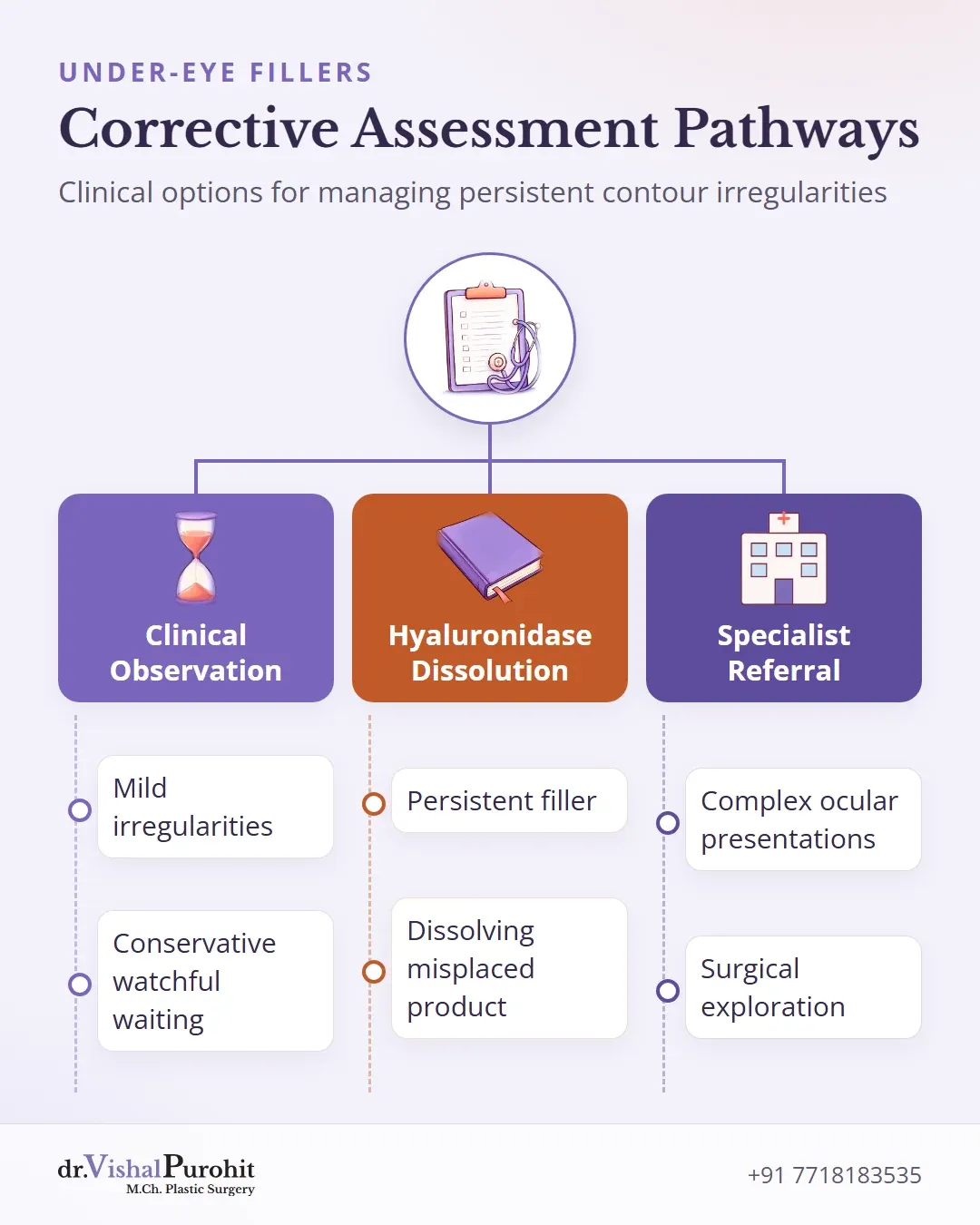
Managing persistent contour irregularity begins with a structured clinical evaluation. A complete history maps how long symptoms have persisted, details of prior products injected, and clinical evaluation of soft tissue mobility. Hyaluronic acid filler can persist and migrate to distant sites months or years after injection, presenting with swelling or masses that mimic other orbital pathology21.
Potential corrective pathways include:
Clinical observation
Mild irregularities may simply be monitored when conservative watchful waiting is appropriate.
Dr. Vishal Purohit assesses contour problems individually. Because his specific corrective protocol on this point is not confirmed yet, the appropriate pathway is decided at the consultation. Any treatment plan depends on the injected material, its exact location, and whether conservative management is sufficient21.
Consulting Dr. Vishal Purohit for Under-Eye Filler Concerns in Jaipur
Evaluating persistent contour changes, delayed swelling, or unnatural fullness requires careful medical examination. Dr. Vishal Purohit, M.Ch. plastic surgeon, assesses each patient individually to evaluate tissue health, product history, and natural periorbital anatomy. To explore non-surgical options, review details on Under-Eye Fillers in Jaipur and browse the Under-Eye Fillers FAQs. Because corrective protocols are decided at the consultation, an in-person assessment identifies whether watchful waiting, dissolving, or referral is indicated. Choosing no treatment remains a valid decision.
This is educational information, not medical advice.