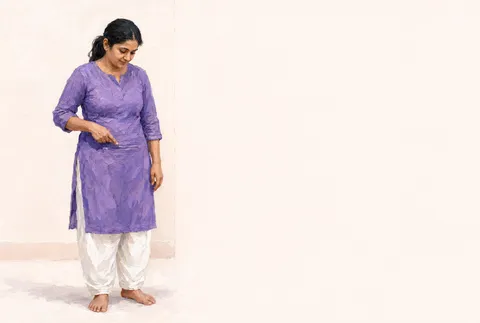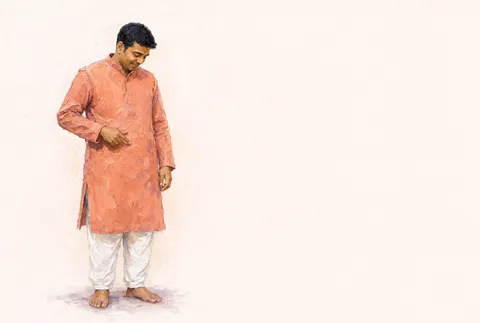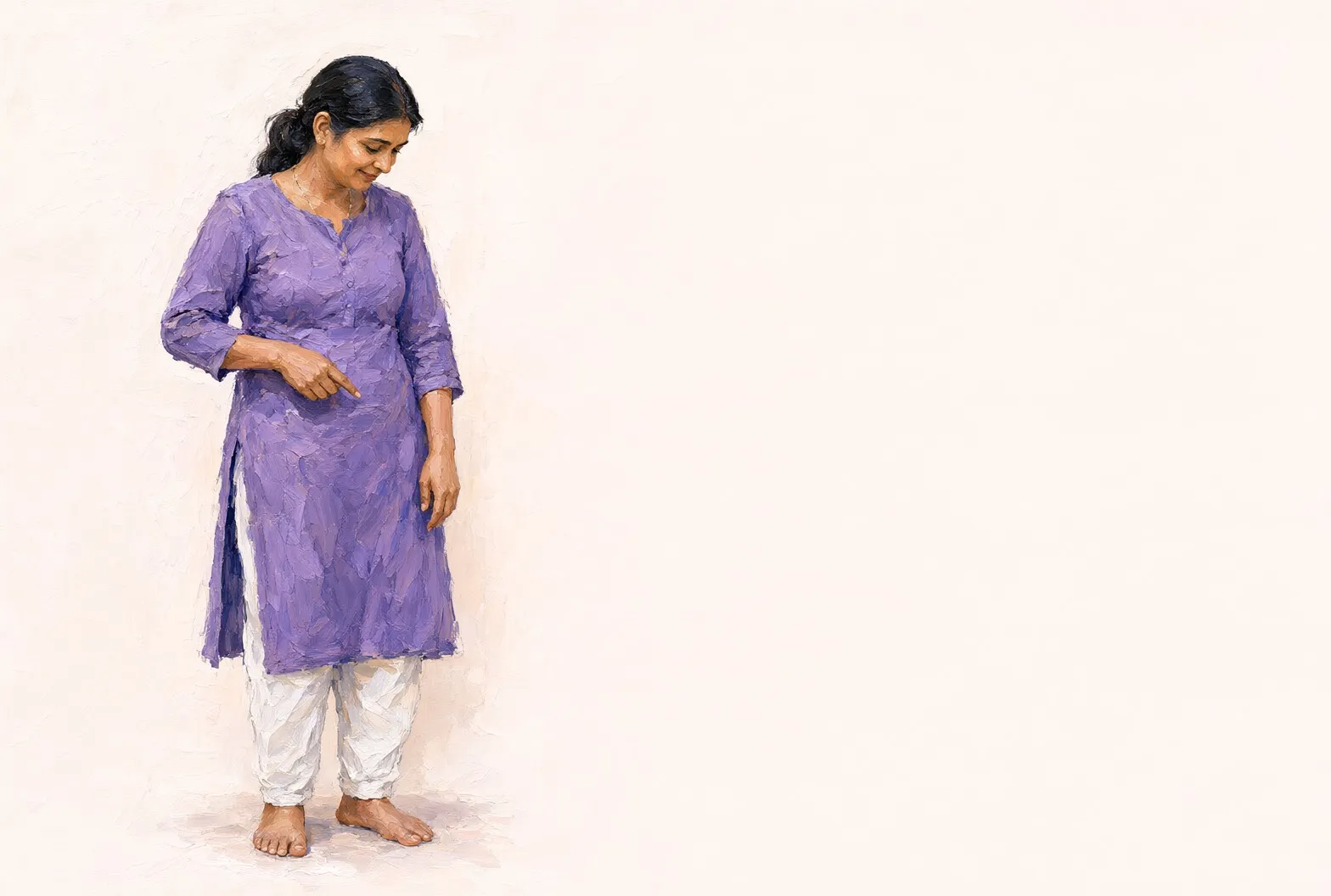
A full tummy tuck removes loose skin and fat from the lower abdomen and draws the remaining skin down over repaired muscles. The navel stays on its stalk while the skin around it moves, so it is freed, marked in a new position and fixed there. In Dr. Purohit’s practice, the navel is never removed in a tummy tuck (abdominoplasty). This is why the navel needs its own planning during a full tummy tuck.
In a mini tummy tuck, he leaves the navel in place while removing a smaller amount of lower skin. The comparison of mini and full tummy tucks explains how the operations differ.
Why the Navel Has to Move
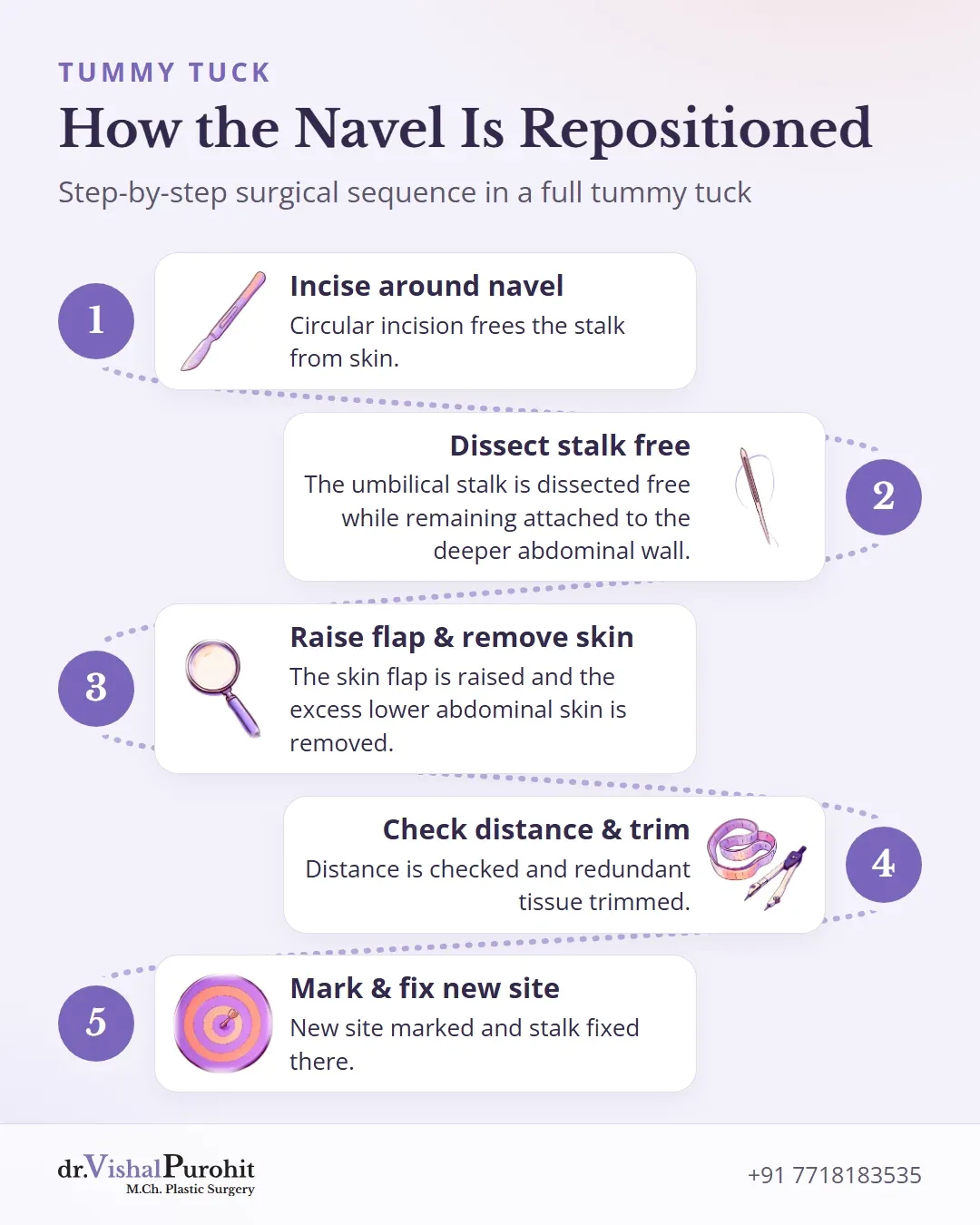
A full tummy tuck removes loose skin and fat from the lower abdomen and draws the remaining skin downwards over the repaired muscles.
The navel does not travel with that skin. It stays on its stalk, the cord that holds it to the abdominal wall, while the skin around it is pulled down.
Freeing the stalk
The surgeon makes a circular incision around the navel and dissects the umbilical stalk free, leaving it attached deeper in the abdominal wall. The skin flap is then raised and the excess lower skin removed.
Marking and fixing
With the skin drawn down, the distance between the upper resection line and the navel is checked and redundant tissue trimmed.
The new site is marked and confirmed, an opening is made, and the stalk is fixed to the anterior rectus sheath there. Position is judged against fixed anatomical landmarks, and the correct location matters for the cosmetic result.
A mini tummy tuck removes a smaller amount of lower skin and usually does not relocate the navel.
In Dr. Purohit’s practice
Dr. Purohit’s practice follows these principles:
Dr. Purohit’s note: The navel is always repositioned in a full tummy tuck. In a mini tummy tuck, the navel is left in place, and in an abdominoplasty the navel is never removed.

Shaping a Natural-Looking Navel
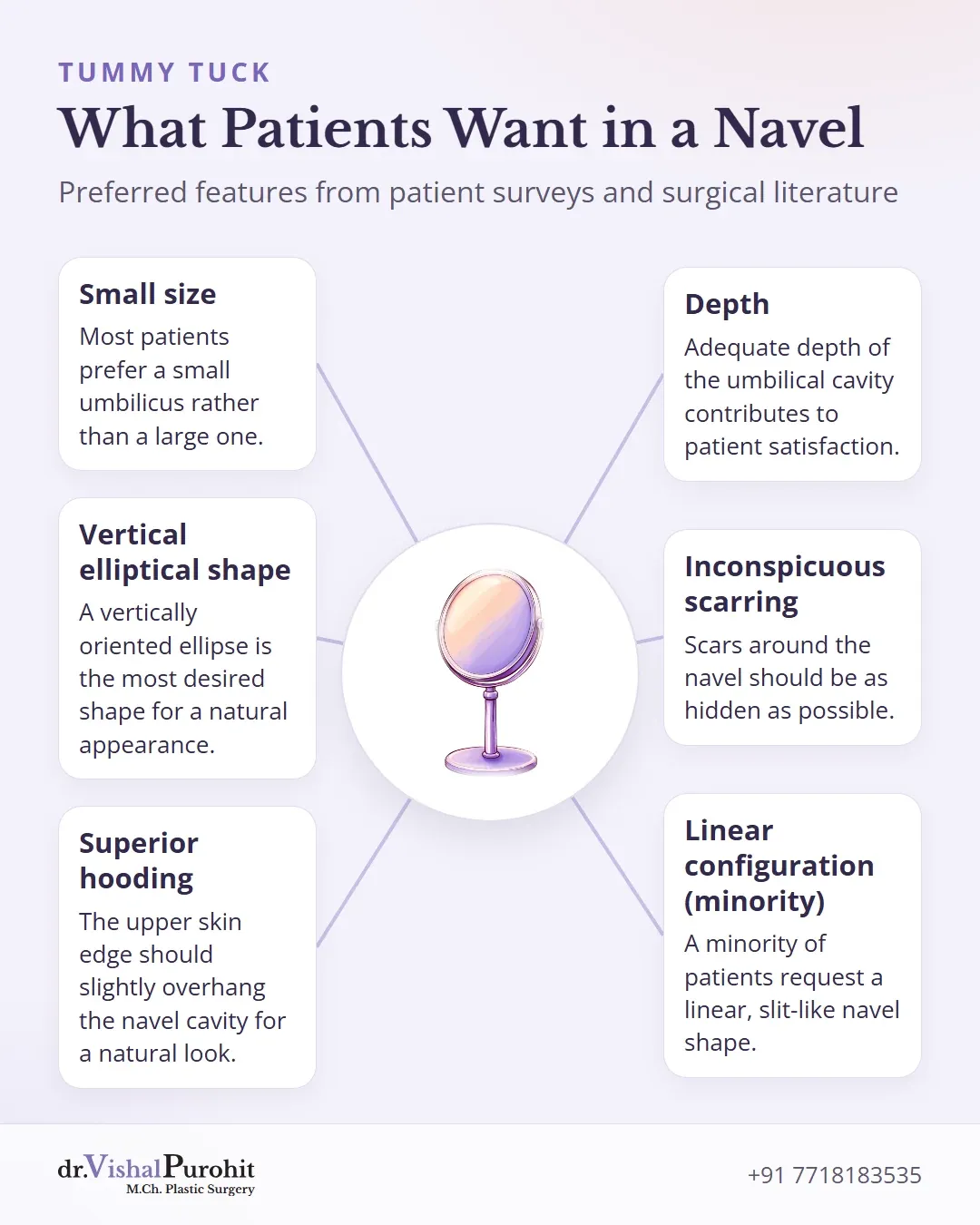
What patients usually want
Location, size, shape and depth all influence how a navel looks.
Key points
- Most patients prefer a small, vertically elliptical navel with superior hooding.
- Multiple surgical techniques exist, but no single method promises a specific final shape.
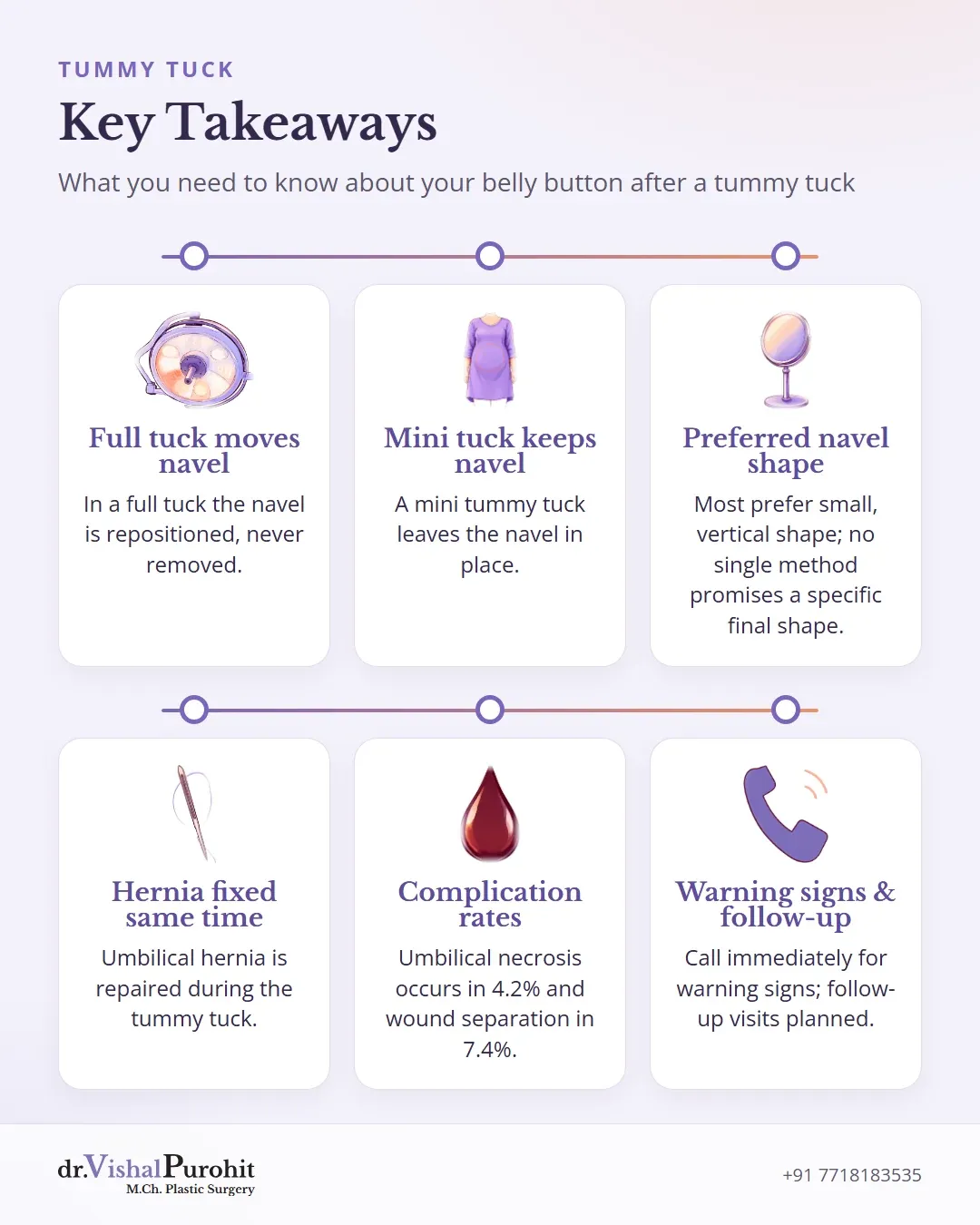
- In a full tummy tuck, the navel is always repositioned, never removed.
In one review, most patients wanted a naturally appearing umbilicus that was small, vertically elliptical and showed superior hooding, while a minority asked for a linear configuration. Depth and inconspicuous scarring also affected satisfaction.
Techniques described in the literature
Historic incisions in the abdominal flap used several distinct patterns:
- Round
- Vertical linear
- U-shaped
- V-shaped
- Inverted U
- Inverted V
Later reports describe:
- An in-continuity umbilical inset, placing the umbilicus in its native position and defatting the flap above the stalk to emulate a natural navel.
- Anchoring the umbilical stalk at several points and shortening the umbilical island to create depth and prevent protrusion.
- A neo-umbilicoplasty with vertical flaps, reported as easy to perform and reproducible, with a low incidence of complications in the authors’ series.
Deeper fixation at the superior position enhanced superior hooding but could leave visible scars. In one bikini-shaped technique, the final geometry varied between longitudinal and rounded navels, which the authors attributed to skin elasticity, muscle tone and physical activity.
A retrospective single-centre series without a comparison group limits how far such results can be generalised.
Dr. Purohit’s approach
In a full tummy tuck, Dr. Purohit always repositions the navel. In an abdominoplasty it is never removed. No single technique can promise one particular final shape.
Umbilical Hernia

An umbilical hernia that is found during a tummy tuck is repaired in the same operation. This is Dr. Purohit’s practice in Jaipur.
Writing on abdominoplasty, surgeons note that umbilical hernias are common in women after childbirth or laparoscopic procedures, and that patients coming for abdominoplasty assessment are often found on examination to have one.
The same chapter advises that anyone assessed for abdominoplasty should be examined for an umbilical hernia, so repair can be discussed beforehand. It also notes the risk of bowel incarceration, particularly when the hernia is already painful.
Fitting the Repair Into the Operation
Access depends on the type of tummy tuck. In a full abdominoplasty the hernia is reached after the lower abdominal skin has been raised, and it is repaired from inside the abdomen to avoid over-dissecting the umbilicus and to preserve its blood supply.
In a mini abdominoplasty, any trapped omentum is carefully freed from the sac and the fascial opening is closed.
A Known Risk
If the blood supply to the navel is disturbed, umbilical necrosis can occur; in the worst case the whole umbilicus may die and revision surgery may be needed.

Healing and Care

Problems described in the literature
The umbilicus is separated from the surrounding skin during a tummy tuck, so its blood supply can be affected. In the worst case the whole umbilicus can die, and revision surgery may later be needed.
Key points
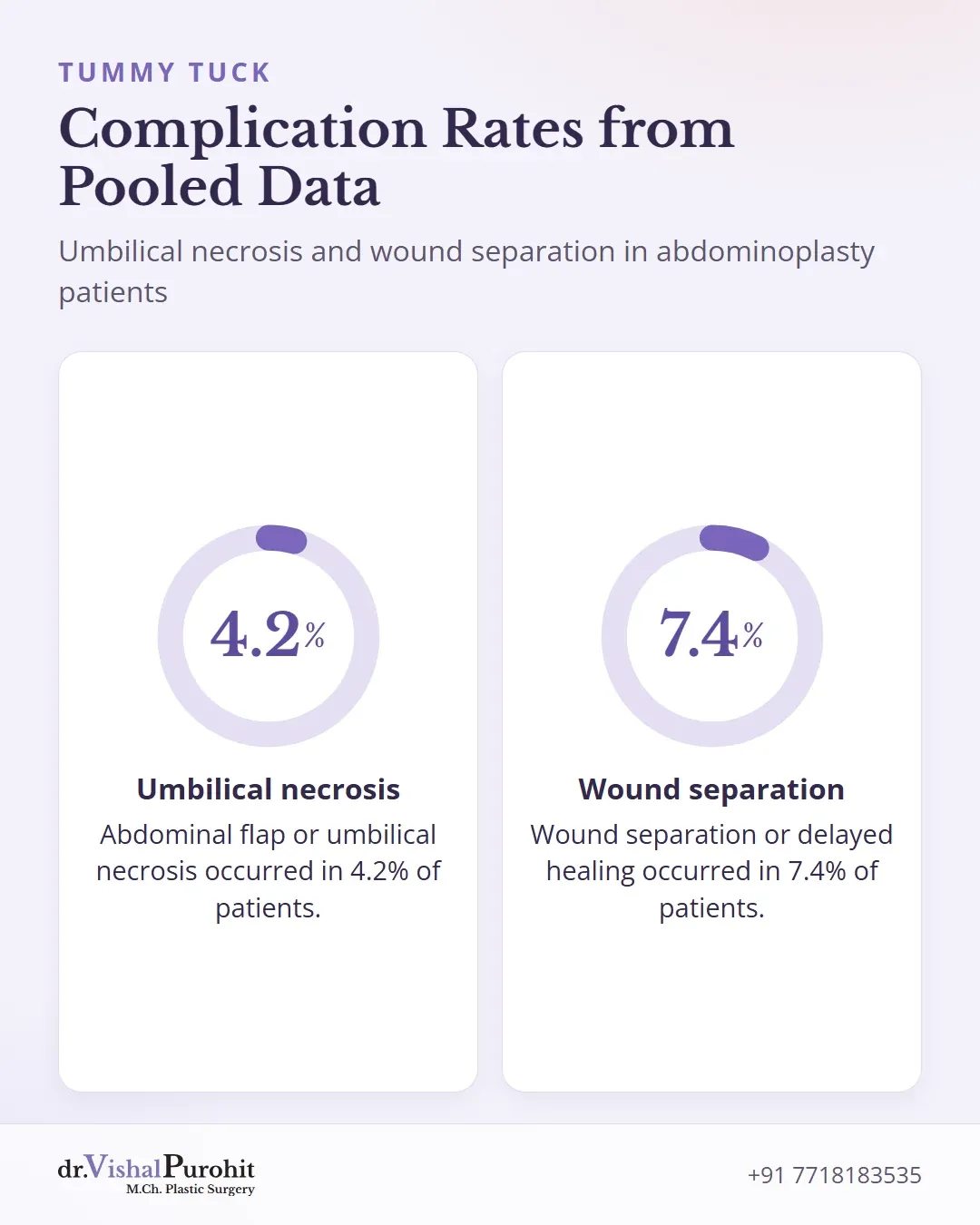
- Umbilical necrosis occurs in 4.2% of abdominoplasty patients and wound separation in 7.4% (pooled analysis).
- Warning signs requiring immediate call include fever, spreading redness, increasing pain or swelling, pus, breathlessness, calf pain, and cloudy drain fluid.
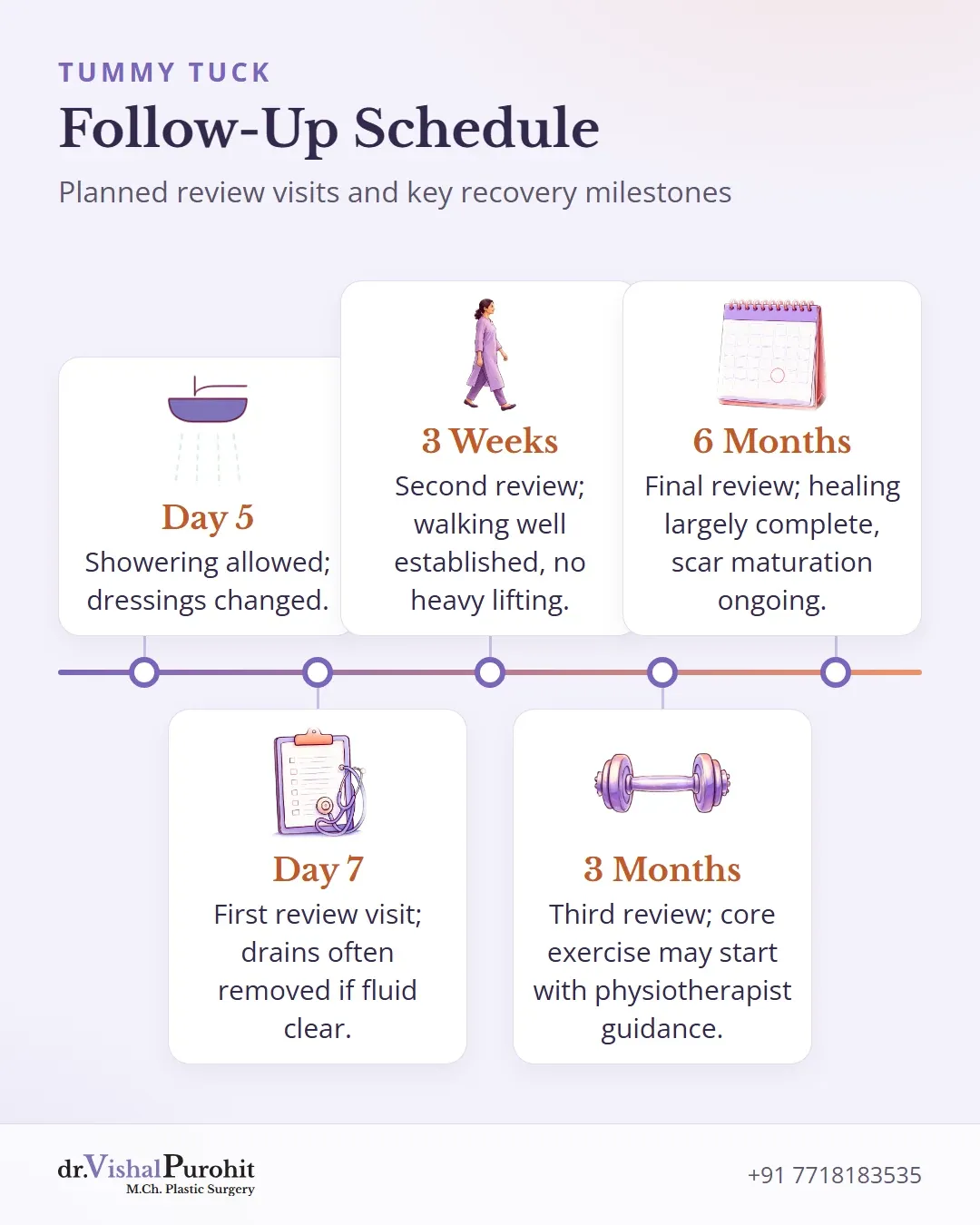
- Healing is monitored at review visits around day 7, 3 weeks, 3 months, and 6 months; showering allowed from day 5, walking starts 24–48 hours after surgery.
Umbilical necrosis and wound separation are described as rare but distressing complications. In a pooled analysis, abdominal flap or umbilical necrosis occurred in 4.2% (95% CI 2.5–7.0%) of abdominoplasty patients and wound separation or delayed healing in 7.4% (95% CI 5.3–10.1%).
The lower central part of the incision is the area most prone to healing problems.
Warning signs
Dr. Purohit asks patients to call +91 7718183535 at once for:
- fever
- spreading redness
- increasing pain or swelling on one side
- pus or a bad smell from the wound
- breathlessness or chest pain, which are emergencies
- calf pain or swelling
- cloudy drain fluid
Reviews, not a fixed home routine
His practice organises healing around review visits at about day 7, 3 weeks, 3 months and 6 months, with individual discharge contact instructions rather than round-the-clock availability. Silicone gel or sheets are not needed routinely. Planned wound care means returning to his team in Jaipur.
Some reviews may be done by video when clinically appropriate, but examination, dressings, drains, stitches and any concerning finding may need in-person care.
Showering is allowed from day 5 after surgery, when the dressings are changed. Drains are removed one day after the fluid turns clear and straw-coloured. Ankle movements start as soon as the anaesthesia wears off, and walking starts 24 to 48 hours after surgery.
In the first weeks, a western-style commode is advised rather than an Indian squat toilet, and hot-water bags or heating pads must not be used on numb skin. He advises a normal mixed diet with plenty of water, avoiding dehydration and protein-poor food.
For lifting, there is no fixed kilogram limit; patients avoid any weight that tightens the abdominal muscles until heavy lifting is allowed, and a return to core exercise after the 2-month review is guided by a physiotherapist.
The Navel in a Mini Tummy Tuck
In a full tummy tuck he always repositions the navel. The comparison of mini and full tummy tucks sets out the rest of the difference.
What the literature describes
A mini tummy tuck uses an incision below the underwear or bikini line and removes less skin from the lower tummy than a standard abdominoplasty. A review describes the umbilicus in mini-abdominoplasty as intact or “floating”.
An umbilical float involves a specific sequence:
- Skin attached navel stays attached to skin stretched down
- Muscle detached detached from the deeper muscle layer
- Moved downward shifts down together with the skin
- Resown sewn back onto muscle in a new position
It is used when little skin needs removing from the lower tummy and there is only slight slackness above the navel.
Limits of the mini operation
The same review lists potential shortcomings of mini-abdominoplasty:
- Distortion of the umbilicus
- Failure to treat the area above the navel
Results of the short-scar technique are limited to the lower abdominal wall. They are described as optimal when there is no herniation or diastasis of the rectus muscles above the umbilical stalk.
In his own practice, the navel is never removed in any tummy tuck.

Tummy Tuck Belly Button Care in Jaipur
Patients considering surgery can review what is involved with a tummy tuck in Jaipur, which sets out the operations available. A consultation is the place to discuss the navel, any hernia and the review plan.
The team can also explain recovery and warning signs, while the planning questions and timeline address common surgical details. A tummy tuck is body contouring, not weight loss, and the aim is a natural-looking result rather than a set shape.
This is educational information, not medical advice.