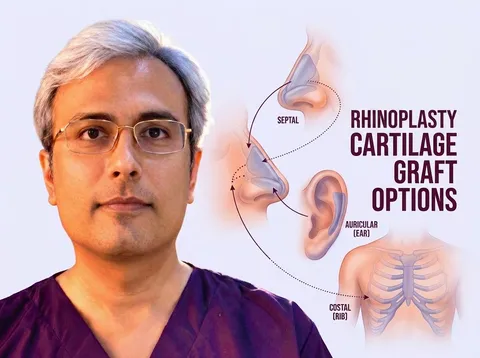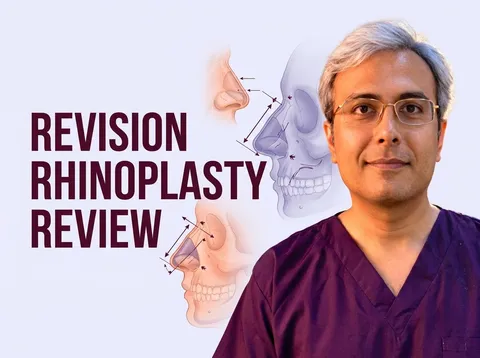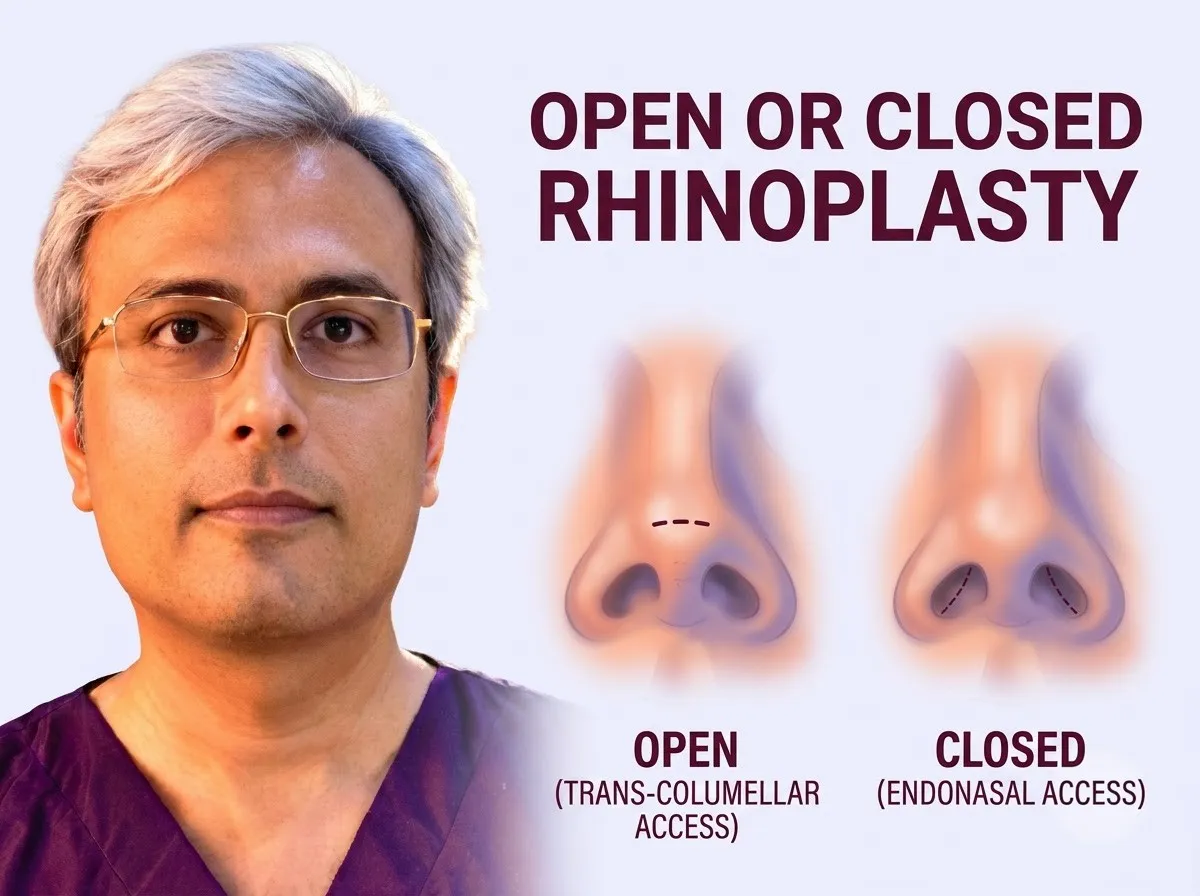
Nasal reshaping can be performed through internal incisions alone or with an added external cut across the columella. Each surgical route provides distinct exposure of the underlying bone and cartilage framework.
During consultations for rhinoplasty in Jaipur, Dr. Vishal Purohit evaluates each patient’s structural anatomy to determine whether an open or closed approach offers the most appropriate surgical exposure.
Surgical choice depends on specific anatomical goals, such as whether a patient needs cartilage grafts for structural support or isolated contouring of the nasal dorsum.
Two Ways In
Rhinoplasty can be performed using either a closed or an open approach. Dr. Vishal Purohit uses both techniques depending on anatomical requirements and surgical goals.
Closed Rhinoplasty
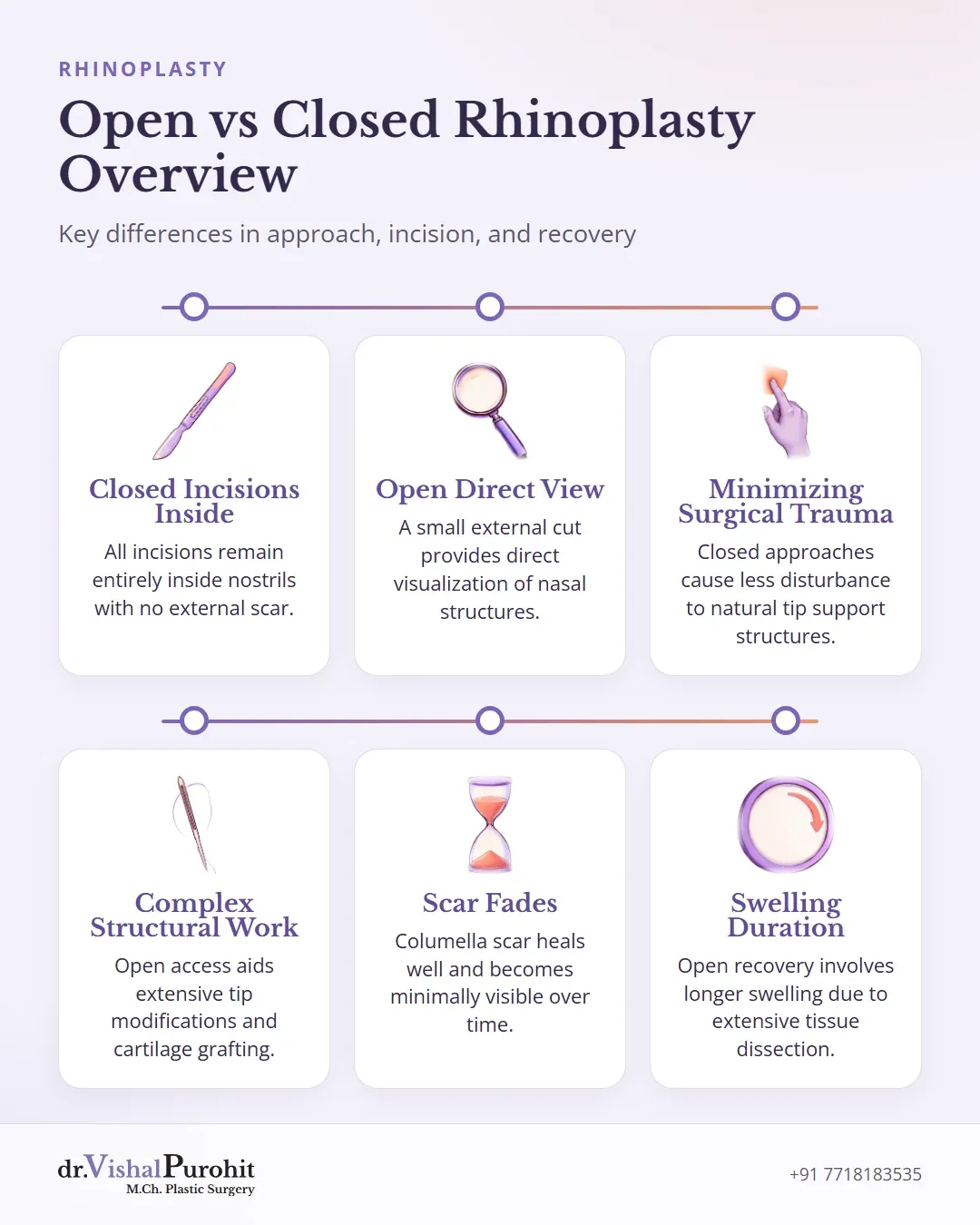
In a closed (endonasal) rhinoplasty, all surgical incisions are placed entirely inside the nostrils1. Because these incisions remain internal, there is no visible external scar on the nose123. The technique preserves natural soft tissue attachments1 and causes less disruption to blood supply and lymphatics, which may lead to reduced postoperative oedema234. However, it provides limited exposure of underlying nasal structures12.
Open Rhinoplasty
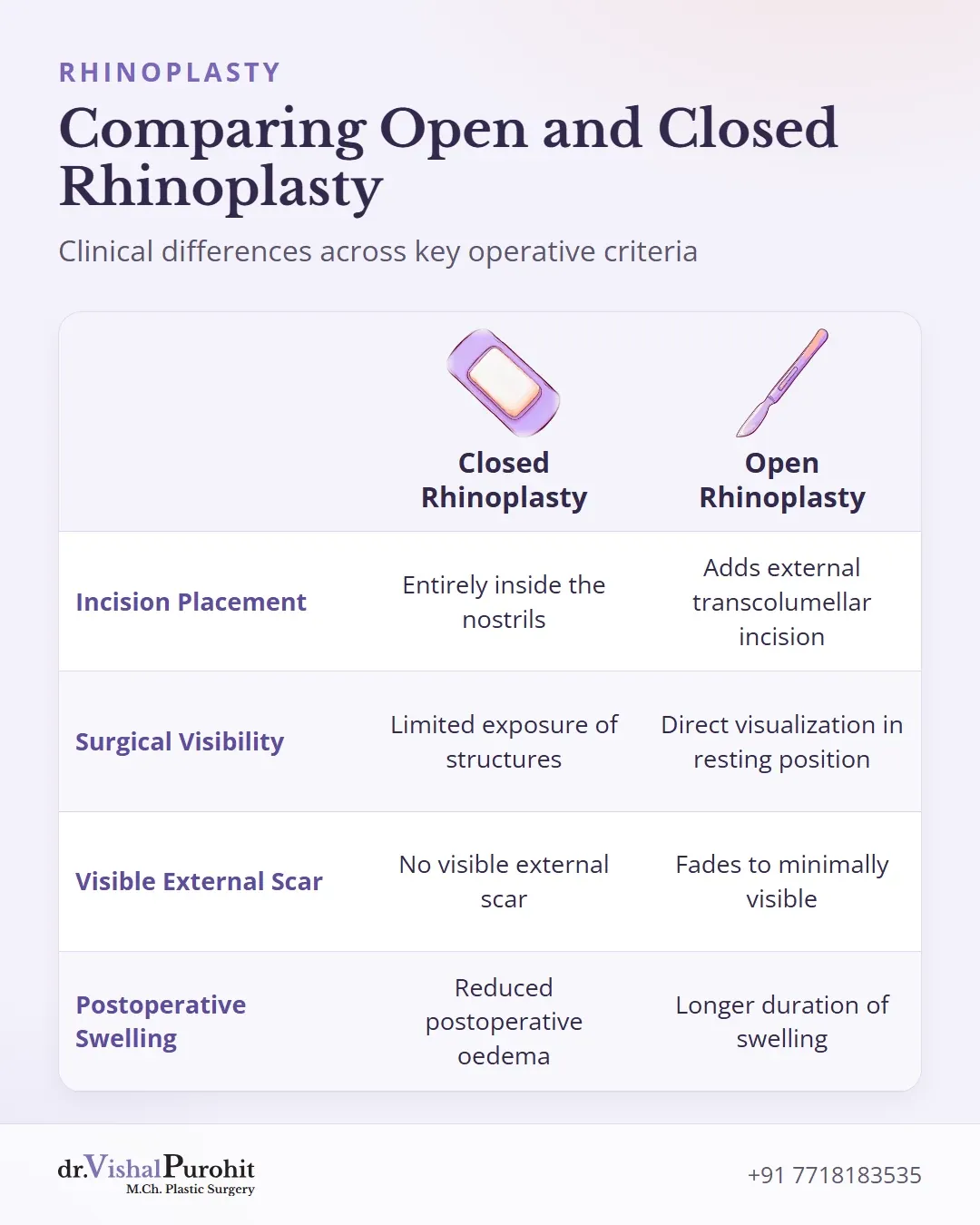
Open rhinoplasty adds an external transcolumellar incision across the skin bridge between the nostrils, joining the internal incisions made on both sides567.
Dr. Purohit’s note: Dr. Purohit uses an inverted-V or stair-step incision across the columella for open access.
This approach involves an external incision about 4 to 5 mm long5. Placing the incision across the columella allows the surgeon to directly visualize the cartilaginous framework and manipulate nasal tissues in their natural resting position8. When meticulously closed, the external transcolumellar scar is rarely a source of aesthetic complaint and typically becomes nearly invisible after prolonged healing4.
Dr. Purohit Uses Both
In his practice, Dr. Vishal Purohit performs both open and closed rhinoplasty. When an open approach is required, he gains access through an inverted-V or stair-step incision across the columella.
How the Surgical Plan Decides the Approach
Surgical literature notes that no single approach accommodates every operative requirement9. The choice between open and closed techniques is determined primarily by the patient’s nasal anatomy, the specific corrections planned, and the degree of exposure needed101112.
For simpler adjustments—such as minor revisions or limited contouring where the nasal tip is already symmetric—an endonasal approach may be selected to avoid unnecessary external incisions1014.
What Decides the Approach
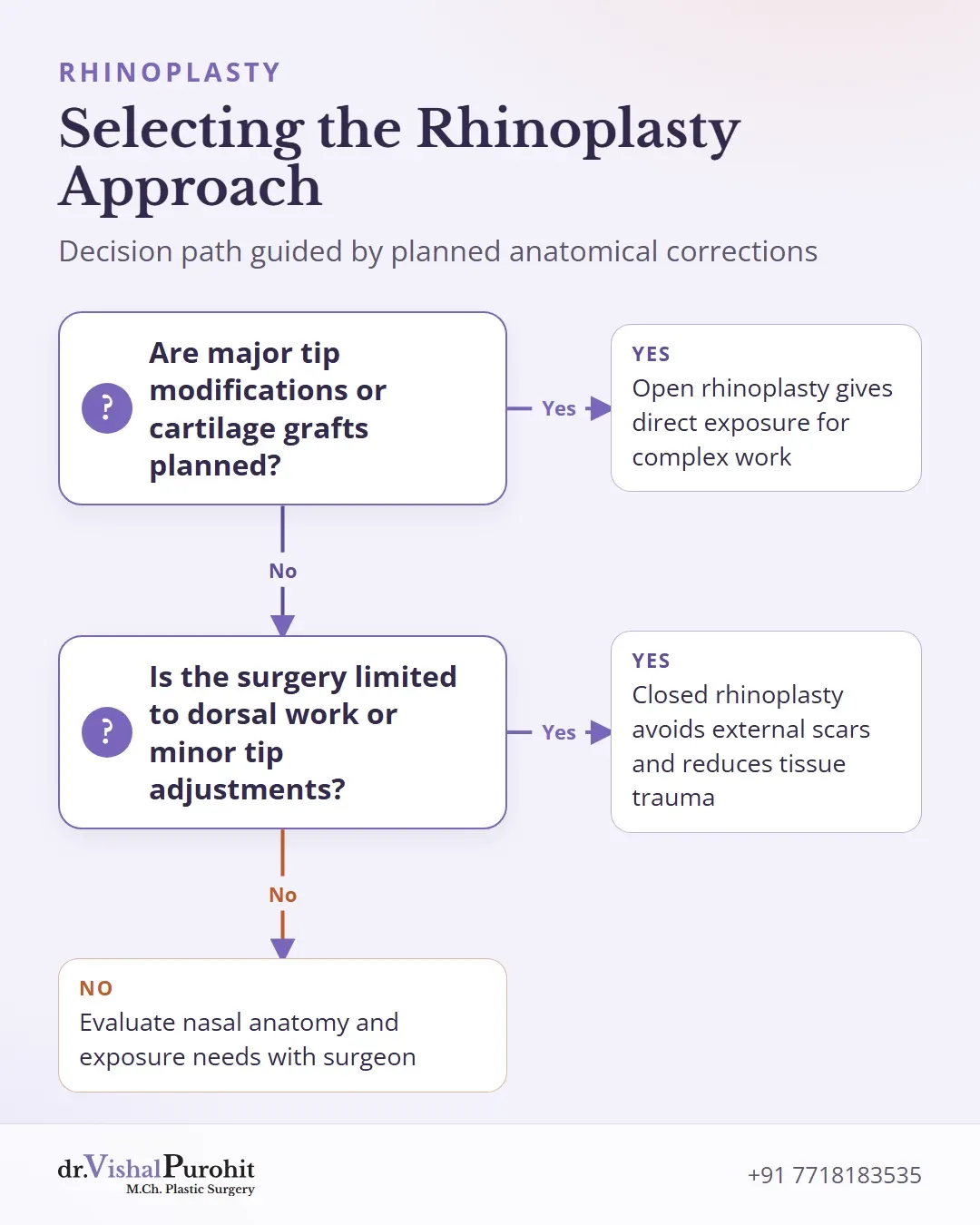
The choice between open and closed rhinoplasty depends on the planned anatomical changes. Dr. Vishal Purohit uses both techniques, selecting the approach based on whether direct structural exposure or limited adjustment is required. When an open technique is chosen, access is created through an inverted-V or stair-step incision across the columella.
Key points
- Neither open nor closed rhinoplasty is universally superior for every patient.
- Open rhinoplasty offers direct visualization for extensive tip reshaping, grafting, and revision cases.
- Closed rhinoplasty avoids external columellar incisions, minimizing dissection and reducing postoperative swelling.
Surgical literature demonstrates that neither approach is a universal winner15. Instead, specific surgical requirements guide the selection:
- Open rhinoplasty is favored when extensive tip modification, cartilage grafting, or secondary revision is necessary. It provides direct visualization, maximizing accurate diagnosis, precise graft placement, and optimal suturing16. Placing spreader grafts or securing columellar struts for tip support is also more straightforward with open exposure17. While some surgeons use open access for all secondary and post-traumatic procedures18, it carries trade-offs, including increased and more prolonged postoperative oedema and loss of natural tip support17.
- Closed rhinoplasty may suit limited bridge work, isolated deformities of the dorsum, or minor tip modifications18. By avoiding external columellar incisions, the endonasal route requires less operative dissection, lowers the likelihood of weakening tip support, and reduces postoperative oedema15. Certain dorsal contouring maneuvers, including crushed cartilage grafts placed into small pockets, can also be handled well through closed access19.
The Columella Scar
In open rhinoplasty, the surgeon accesses nasal structures through a transcolumellar incision made across the skin bridge separating the nostrils2021. This external mark is often cited as the main concern for patients considering an open approach rather than a closed technique2022.
Healing and Visibility
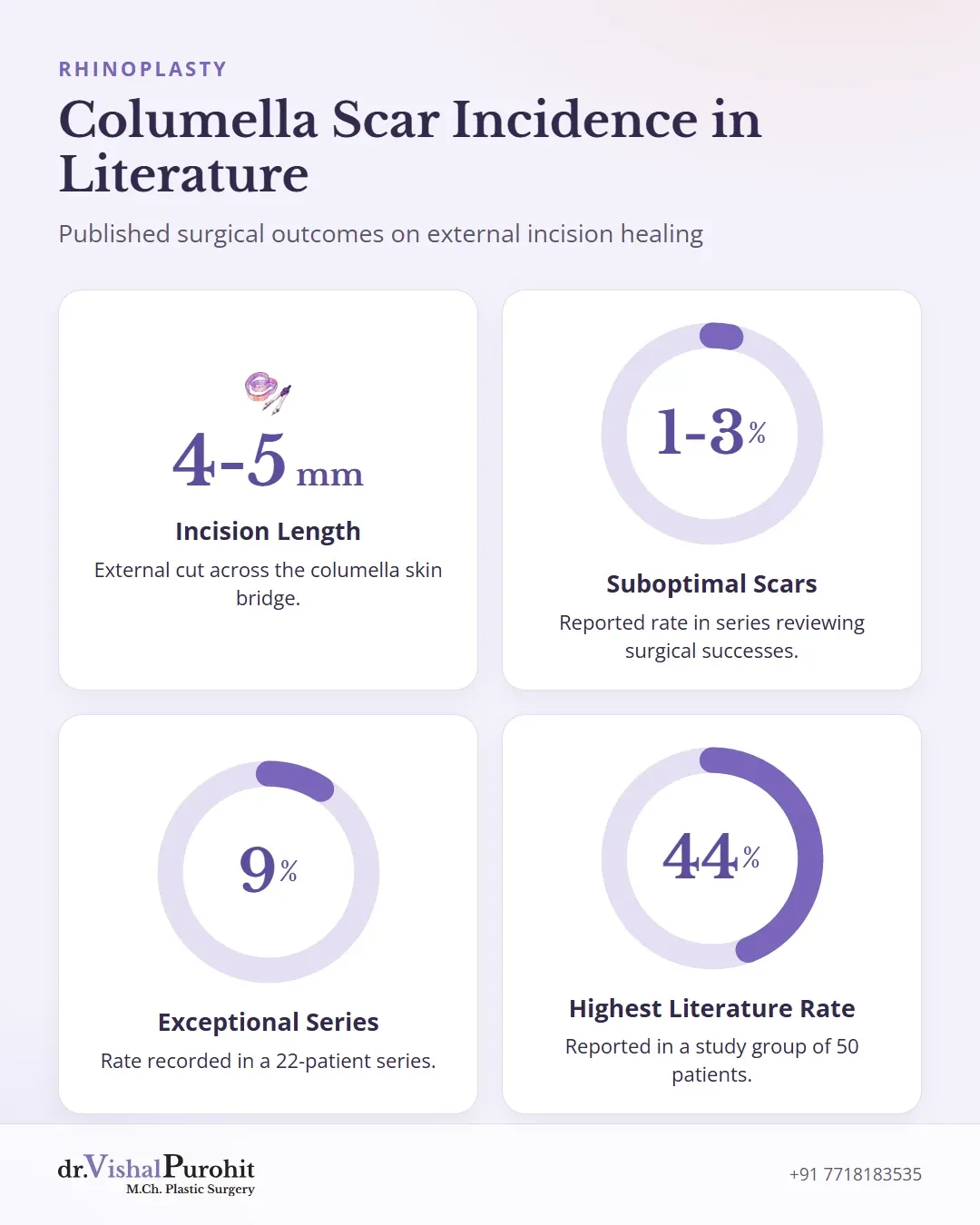
When properly planned, executed, and closed, the resulting scar fades over time and is typically minimally visible at conversational distance2223. While the mark can often be detected on close examination, it rarely causes concern to patients24.
Healing varies among individuals. Reported surgical outcomes in literature show:
- Suboptimal or objectionable scars occurred in 1% to 3% of patients in several surgical series reviewing successes25.
- Exceptional reports in literature noted higher rates, including 9% in a 22-patient series and 44% in a group of 50 patients25.
- Rarely, localized soft-tissue thickening or margin irregularities require secondary surgical correction26.
Incision Care and Suture Removal
In his practice, Dr. Vishal Purohit uses an inverted-V or stair-step incision across the columella for open access. Stitches are removed between day 7 and day 10 as part of scheduled postoperative follow-up.
Swelling Depends on More Than the Label
The surgical route influences initial fluid retention, but the degree of structural work is the primary factor.
What the Evidence Shows
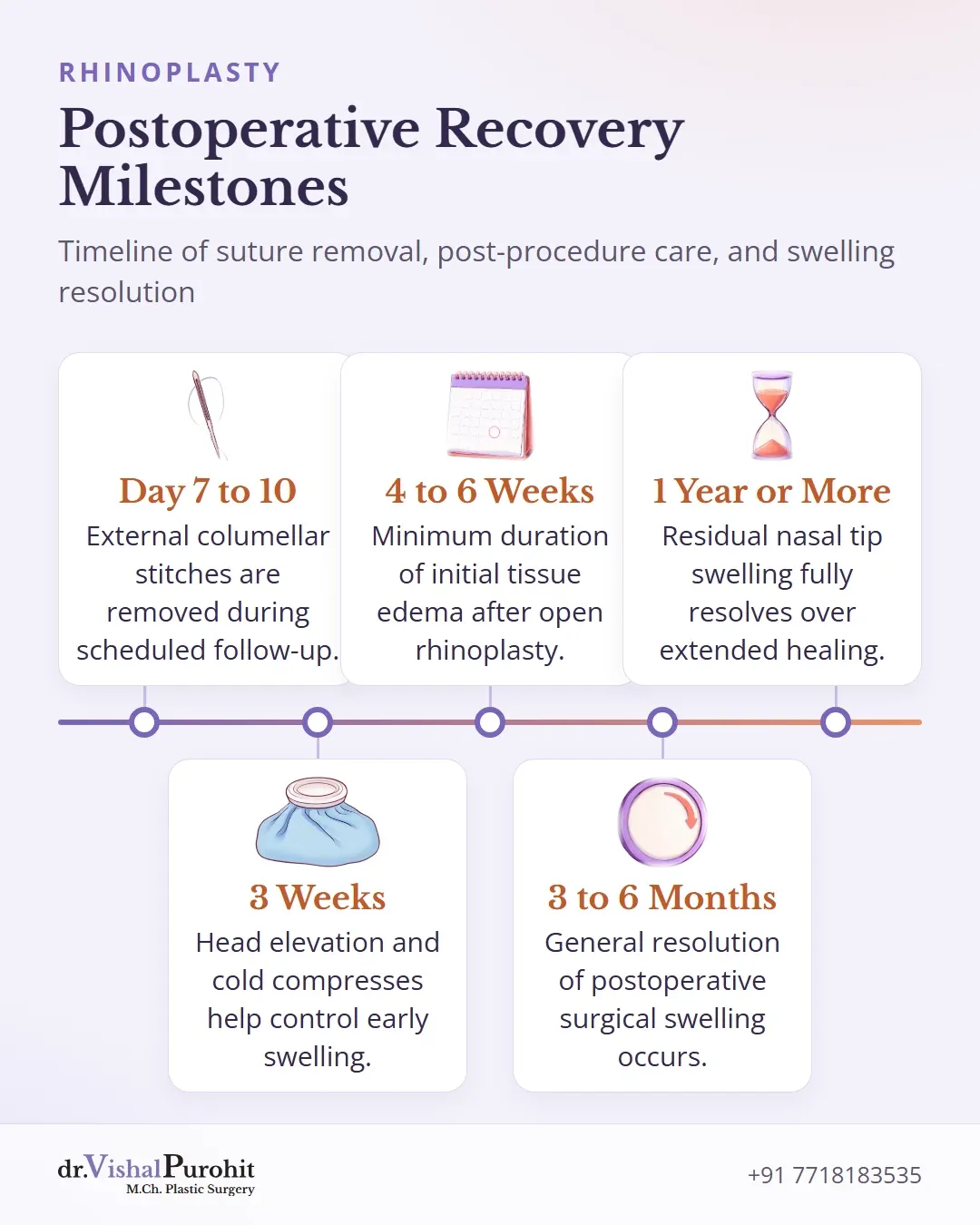
Endonasal access involves limited dissection, which spares vascular and lymphatic channels and tends to produce less postoperative oedema234272829. In contrast, open rhinoplasty requires extensive dissection and tip degloving, leading to a longer duration of swelling272829.
Literature findings indicate:
- Edema after an open procedure typically lasts for a minimum of 4 to 6 weeks30, with general resolution reported over 3 to 6 months2931.
- Nasal tip oedema resolves over a prolonged period of up to a year or more30.
- Skin thickness alters recovery rates; patients with thin nasal skin experience faster oedema reduction than those with thick skin30.
Extent of Surgical Work
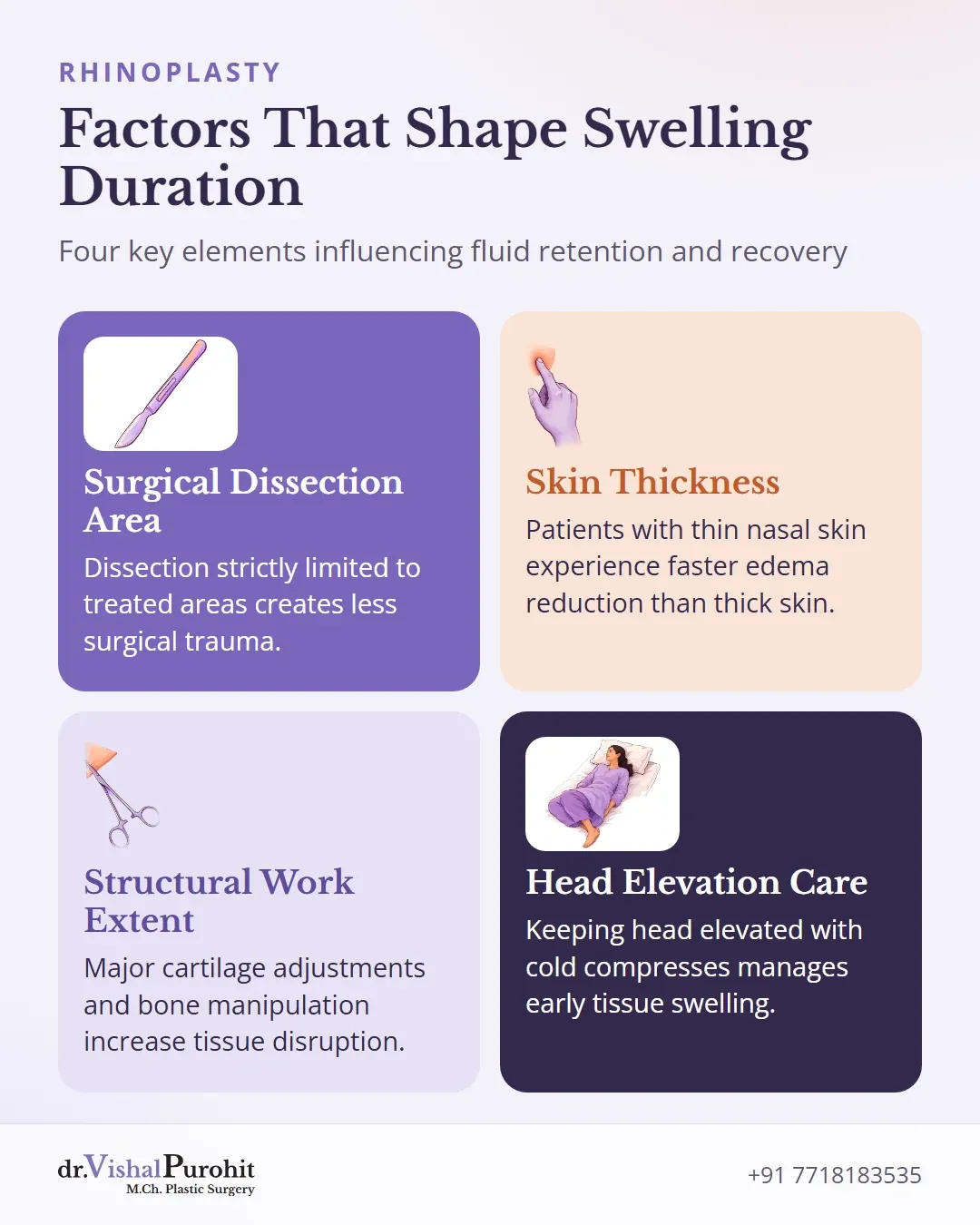
The amount of structural modification dictates tissue response more than the external incision alone. Dissection limited strictly to the treated area generates less surgical trauma than complete tip degloving2832. Major cartilage adjustments, bone manipulation, or complex revision work increase tissue disruption regardless of access32829.
Dr. Vishal Purohit advises post-procedure care for 3 weeks, including keeping the head elevated and using cold compresses, to manage swelling.
Consultation for Rhinoplasty in Jaipur
Selecting between an open and closed approach requires evaluating individual nasal anatomy, tip support, and surgical goals. For detailed information on surgical planning, candidacy, and recovery timelines, explore rhinoplasty in Jaipur. You can also read answers to common questions about procedural preparation and post-operative care in the rhinoplasty FAQs.
This is educational information, not medical advice.