
Botox injection into the masseter muscle weakens contractile strength to achieve lower facial contouring. While muscle reduction slims the lower face, patients frequently report functional adjustments such as reduced bite force or dietary fatigue during the initial treatment weeks.
A precise baseline examination remains essential before proceeding. Through careful Wide Jaw: Muscle, Bone, Fat and Asymmetry Assessment, an M.Ch. plastic surgeon evaluates underlying skeletal structure, dynamic muscle volume, and soft-tissue balance to anticipate functional responses accurately.
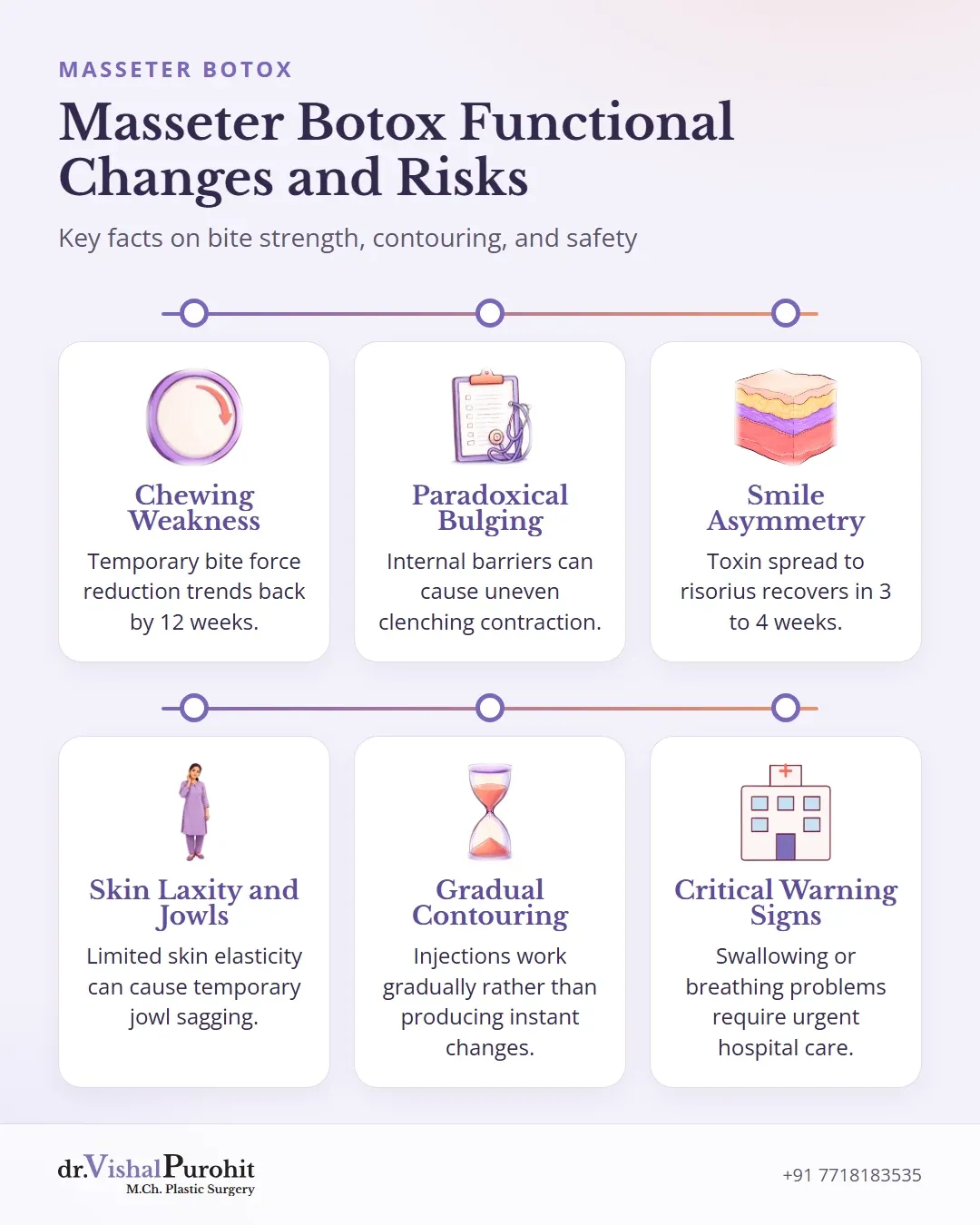
Chewing Fatigue and Dietary Texture Changes
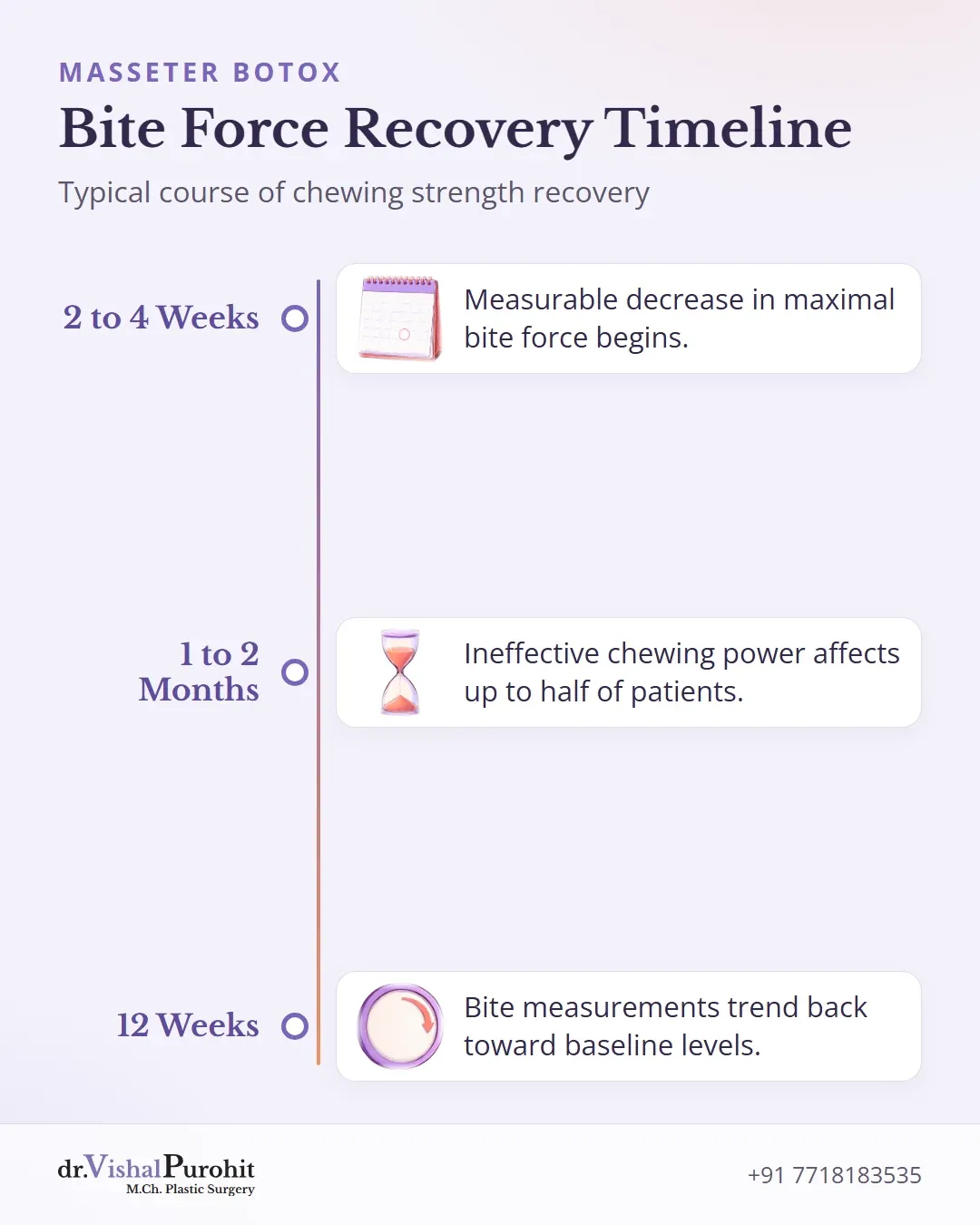
Botox injection into the masseter muscle temporarily weakens its contractile strength, which can alter normal mastication1. In clinical studies, patients frequently experience a temporary reduction in bite force and chewing power123. A measurable decrease in maximal bite force occurs at 2, 4, and 8 weeks following injection, with measurements trending back toward baseline by 12 weeks1. Ineffective masticatory power is documented in up to 50% of patients around 1 to 2 months post-treatment as a direct consequence of muscle relaxation and disuse4.
This functional change reflects localized muscle weakening rather than widespread impairment. The reduction in bite force is relieved over time as adjacent muscles of mastication compensate4. Routine, everyday oral functions remain preserved: ordinary eating is manageable as the side effects remain transient, and normal conversational speech is typically maintained, though transient speech disturbances have been reported in up to 16% of study participants12.
Paradoxical Bulging During Clenching
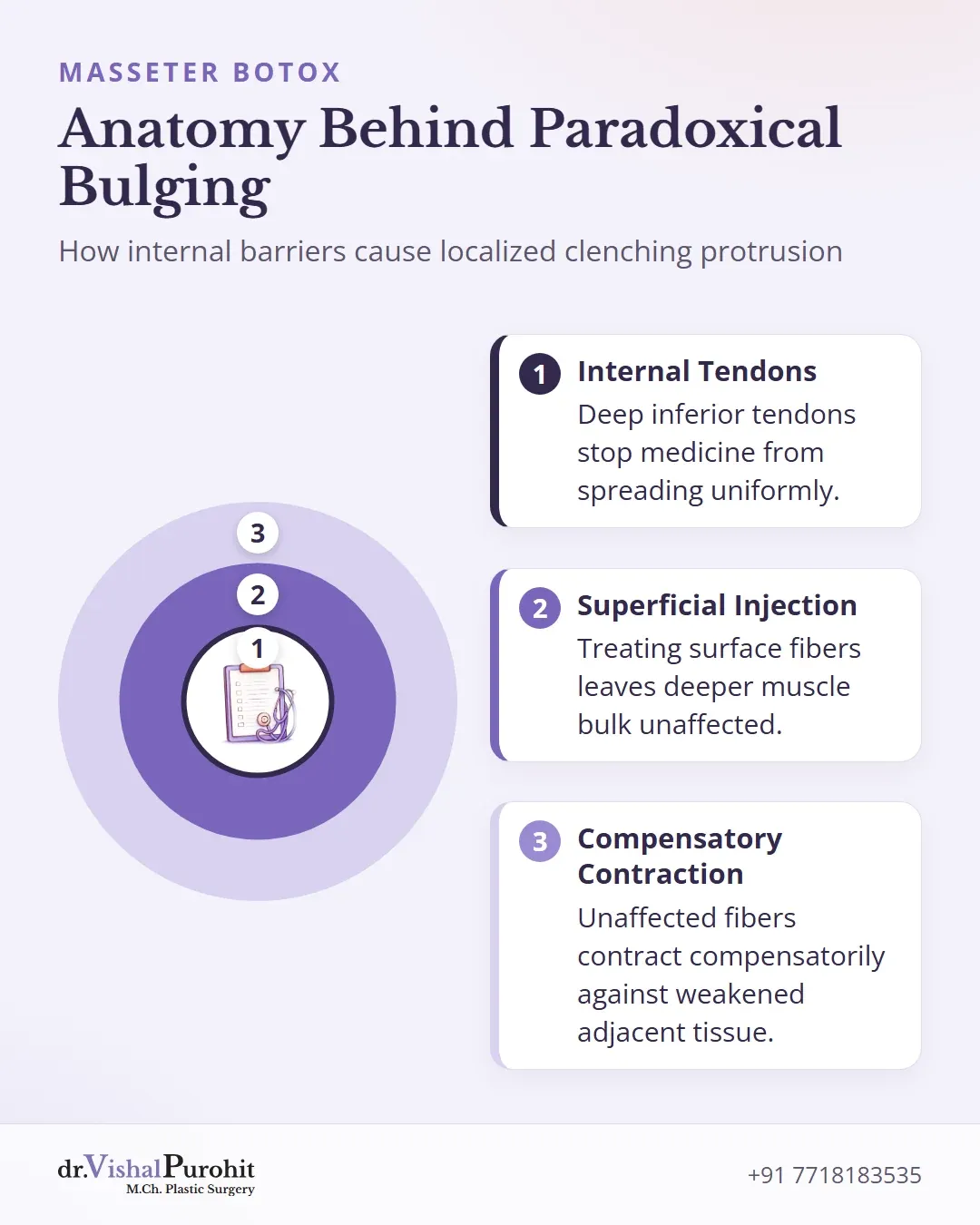
Paradoxical masseteric bulging is a recognized complication characterized by a focal protrusion appearing when clenching the jaw firmly5. This occurs when parts of the muscle relax unevenly rather than contracting in a balanced manner5.
Internal aponeurotic structures within the muscle, such as deep inferior tendons, can act as diffusion barriers that stop the injected medicine from spreading uniformly between different muscle layers56. Consequently, unaffected muscle fibers may contract compensatorily against weakened adjacent tissue, causing localized swelling or a visible bulge upon biting down56. Bulging has also been reported when injections are limited to superficial fibers without sufficiently treating deeper muscle bulk7.
Patients who notice a localized bulge during forceful clenching should avoid panicked self-manipulation or vigorous rubbing of the jaw. Instead, a prompt clinical evaluation by an M.Ch. plastic surgeon is recommended to assess the dynamic muscle anatomy5. Targeted evaluation allows the treating doctor to identify untreated functional compartments and decide on precise clinical management5.
Smile Asymmetry and Risorius Muscle Weakness
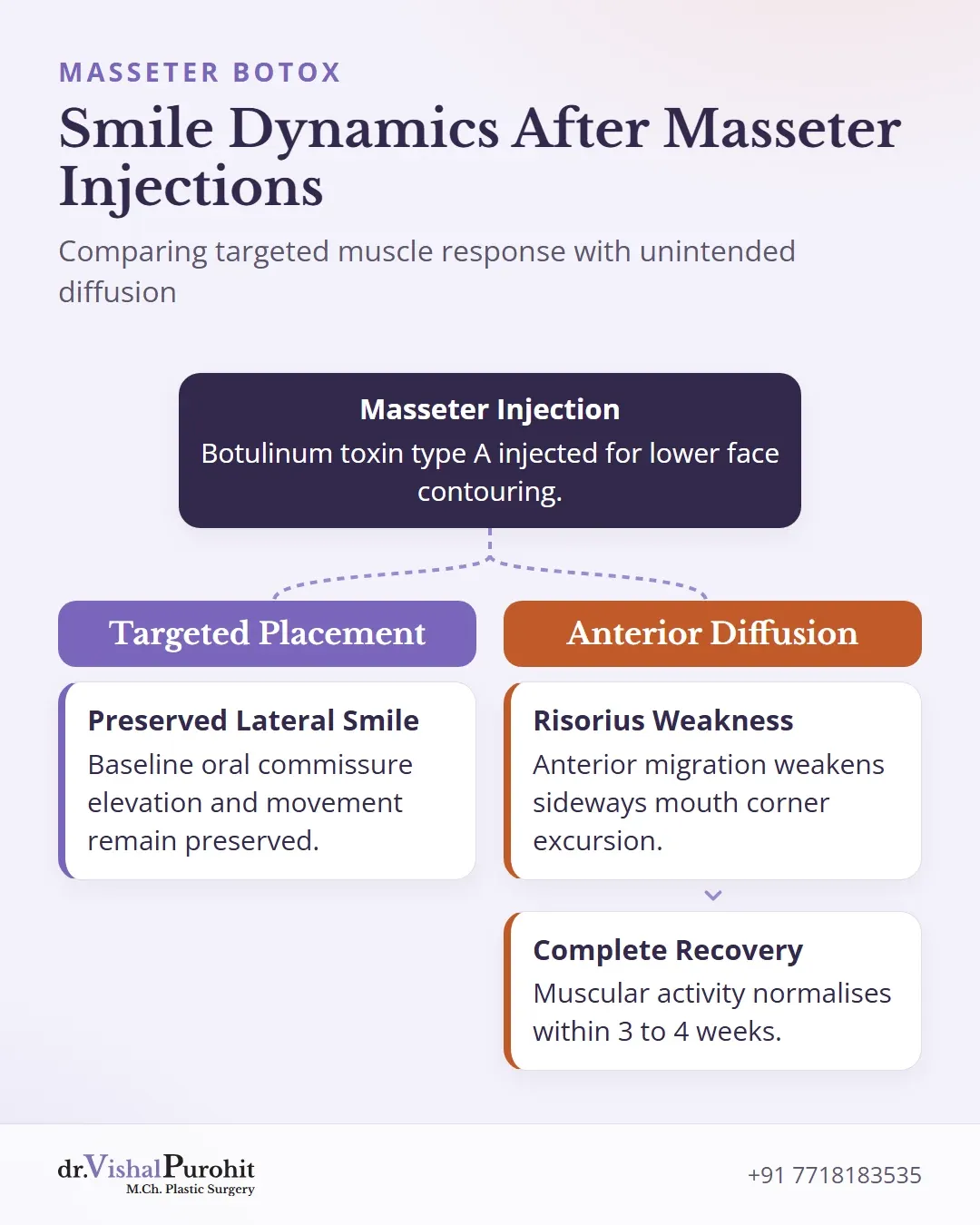
During masseter injection for lower face contouring, botulinum toxin type A can occasionally migrate beyond the targeted area. If the toxin diffuses anteriorly toward the adjacent risorius muscle, it can weaken the muscle fibers responsible for pulling the mouth corner sideways8910. Patients may notice a reduced lateral excursion of the oral commissure, leading to a restricted or asymmetrical smile89.
In clinical literature, this complication typically manifests when patients feel unable to smile as broadly as before treatment9. When unintended risorius diffusion occurs, the resulting crooked smile is temporary, with published reports indicating recovery within 3 to 4 weeks as muscular activity normalises89.
Prompt clinical documentation remains essential whenever smile irregularities appear. Baseline smile symmetry varies naturally, as individuals often exhibit minor pre-existing differences in oral commissure elevation or vertical frame alignment during animation11.
Dr. Purohit’s note: In Dr. Vishal Purohit’s practice in Jaipur, clinical photographs are taken strictly for treatment records and never displayed publicly.
Detailed assessment ensures that baseline variations are clearly distinguished from any new, temporary movement limitations caused by local toxin spread.
Pre-existing Skin Laxity, Jowls and Cheek Hollowing
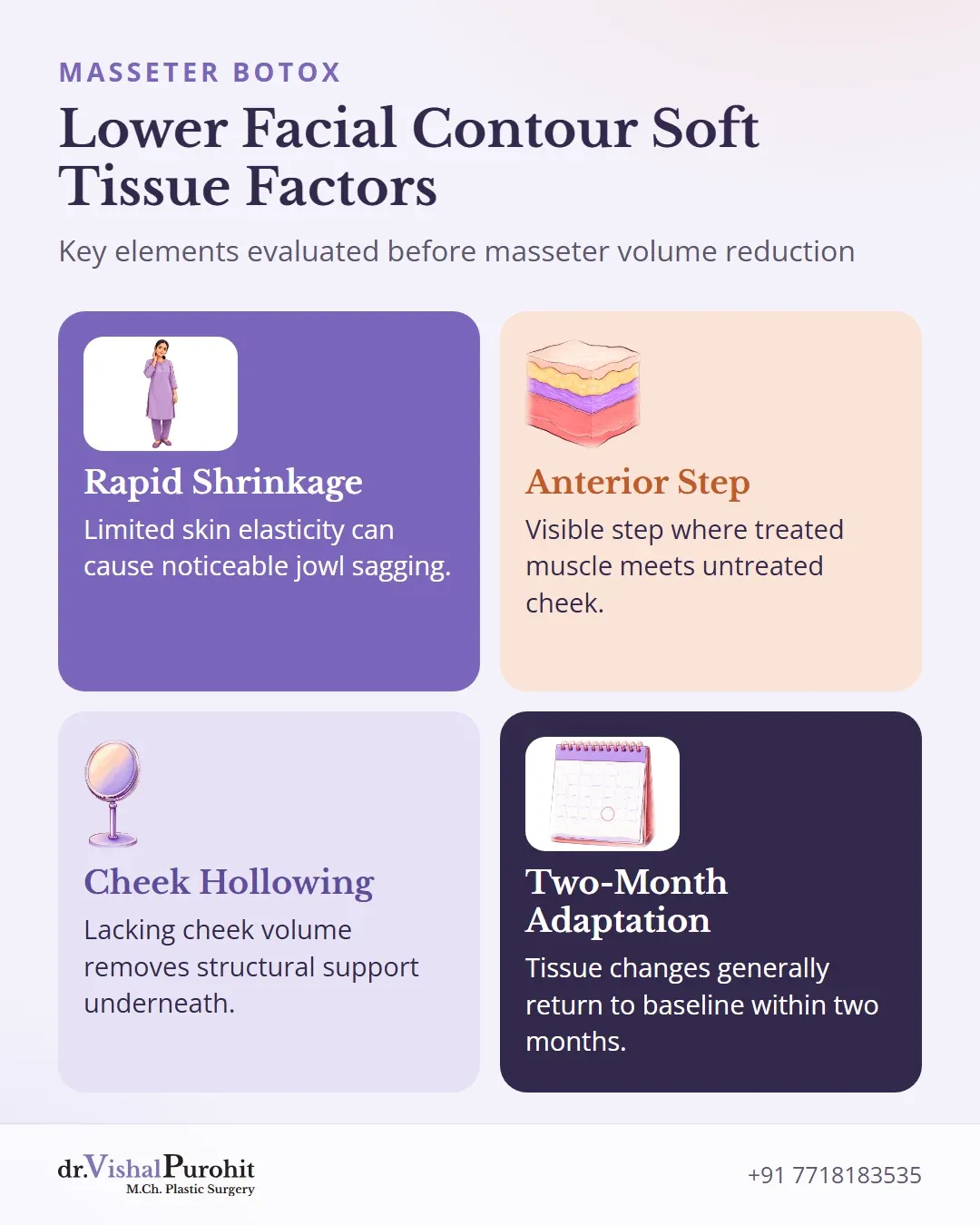
When Botox reduces masseter muscle thickness, the overlying soft tissues must adapt to a smaller muscular framework. If the muscle shrinks rapidly and the skin cannot follow due to limited elasticity, jowl sagging may become noticeable12. A visible step can also develop at the anterior border of the masseter where treated muscle meets untreated cheek12. In published observation, older individuals are more prone to poor skin tone that can exacerbate jowls, though these changes generally return to baseline within two months after injection13.
Key points
- Masseter reduction can temporarily reveal jowl sagging or surface unevenness if skin elasticity is limited.
- Pre-existing lateral cheek hollowness can appear more prominent after muscle volume decreases.
- A detailed assessment of baseline skin elasticity, fat distribution, and bone structure helps identify risk factors before treatment.
Pre-existing hollows above the lower jawline can also become more noticeable. When an individual already lacks lateral cheek volume, masseter reduction removes structural support underneath, giving the appearance that the cheek sank or creating a gaunt face during muscle atrophy1213. High placement of injections increases this hollow appearance12.
At his practice in Jaipur, Dr. Vishal Purohit conducts an individual clinical assessment to check baseline skin elasticity, fat distribution, and bone structure before treatment.
Recovery Realities and Emergency Warning Signs
Botox injections into the masseter muscle do not produce an instant change. The medication works gradually on the muscle tissue, so patients must observe their progress calmly over time rather than expecting immediate contouring. Most common side effects around the injection points remain mild, localized, and temporary8.
Key points
- Masseter Botox produces gradual contouring rather than immediate results.
- Most injection-site side effects remain mild, localized, and temporary.
- Systemic symptoms like breathing or swallowing difficulties require emergency medical attention.
Critical Warning Signs

While distant spread of botulinum toxin is uncommon in cosmetic practice14, it can lead to severe complications8. Spread beyond the target area may cause generalized muscle weakness or affect distant muscle groups8.
Seek emergency medical care at once if any of the following symptoms develop after treatment:
- Difficulty breathing or respiratory compromise814
- Difficulty swallowing (dysphagia)814
- Speech disturbances or difficulty speaking (dysarthria)814
- Progressive or generalized muscle weakness8
- Double vision (diplopia) or drooping eyelids815
Swallowing and breathing problems can become life-threatening and require immediate hospital evaluation rather than waiting to see if they resolve1416. Any patient noticing systemic changes or breathing trouble must access urgent emergency medical attention without delay14.
Clinical Consultation for Masseter Contouring in Jaipur
Individual anatomical assessment helps determine whether lower facial widening stems from masseter bulk, skeletal width, or soft-tissue volume. For personalized guidance on facial slimming, patients can explore Masseter Botox in Jaipur to understand treatment scope and clinical expectations. For additional details regarding muscle recovery, temporary chewing fatigue, and procedural safety, review Masseter Botox FAQs or arrange an evaluation by contacting +91 7718183535.
This is educational information, not medical advice.