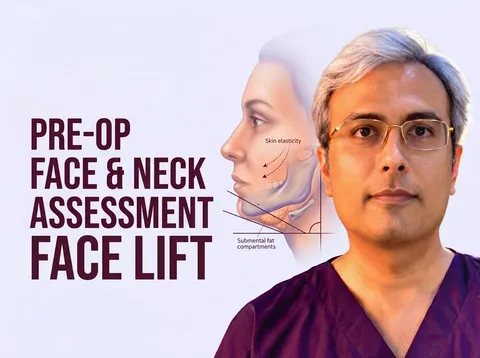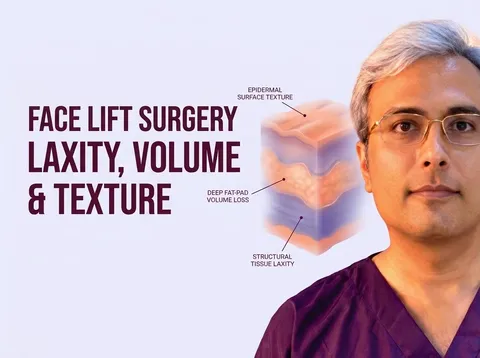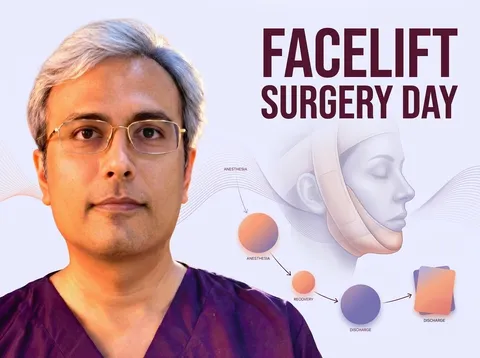
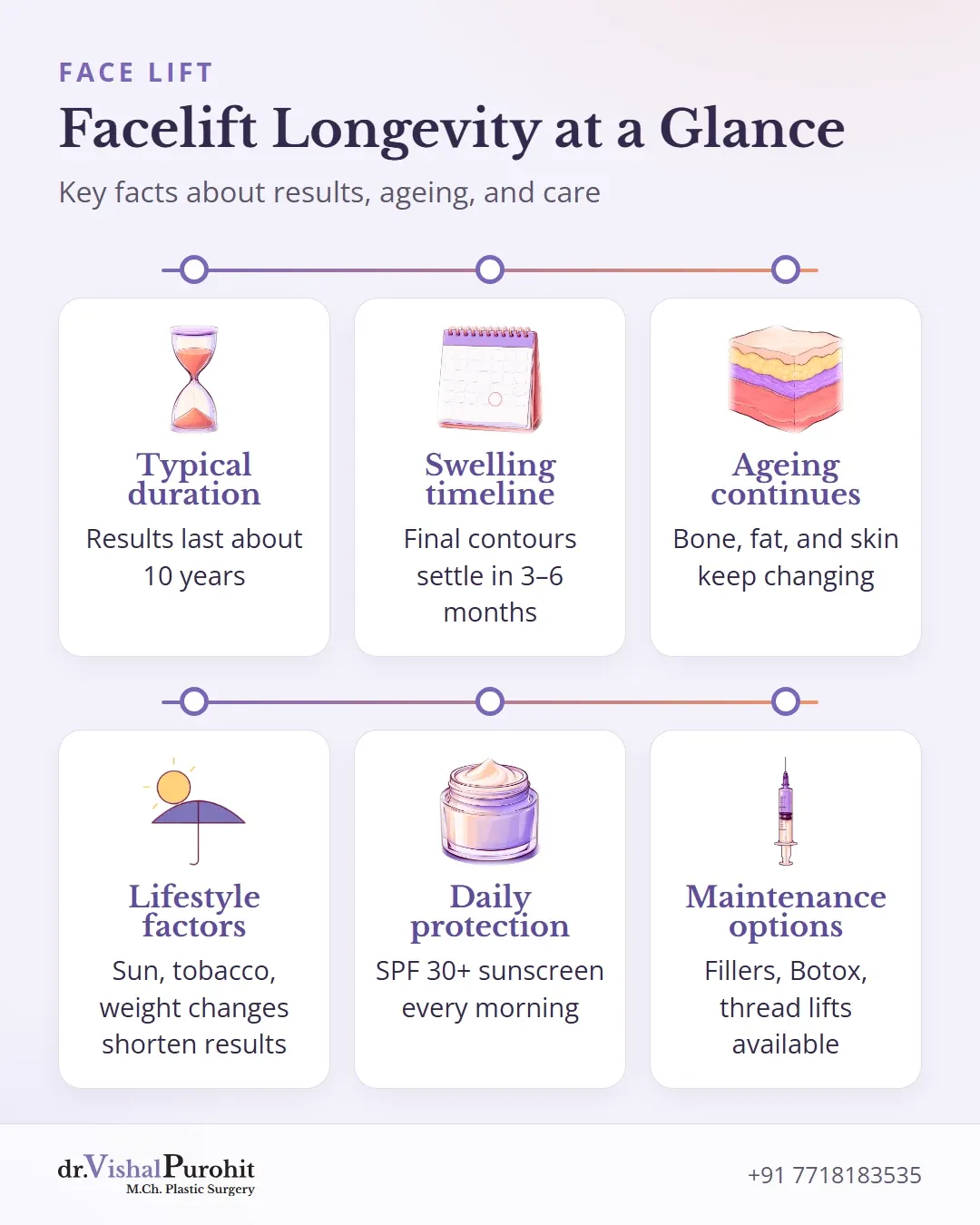
Considering facial surgery involves understanding both the immediate recovery and how long changes endure. In Jaipur, M.Ch. plastic surgeon Dr. Vishal Purohit explains that surgical repositioning resets structural layers, yet biological time continues. Evaluating outcomes too early often misleads patients, as residual swelling takes several months to settle fully.
When planning facelift surgery in Jaipur, Dr. Vishal Purohit advises patients that while structural repositioning addresses deeper laxity, the natural aging process of skin and tissue continues over time.
Patients weighing their options can review Facelift or a Different Approach? Laxity, Volume Loss and Skin Texture to understand structural boundaries. While a surgical lift refines sagging jowls and neck contours, ongoing tissue ageing and lifestyle factors influence long-term appearance.
Early Swelling Can Mislead You
The Natural Settling Timeline
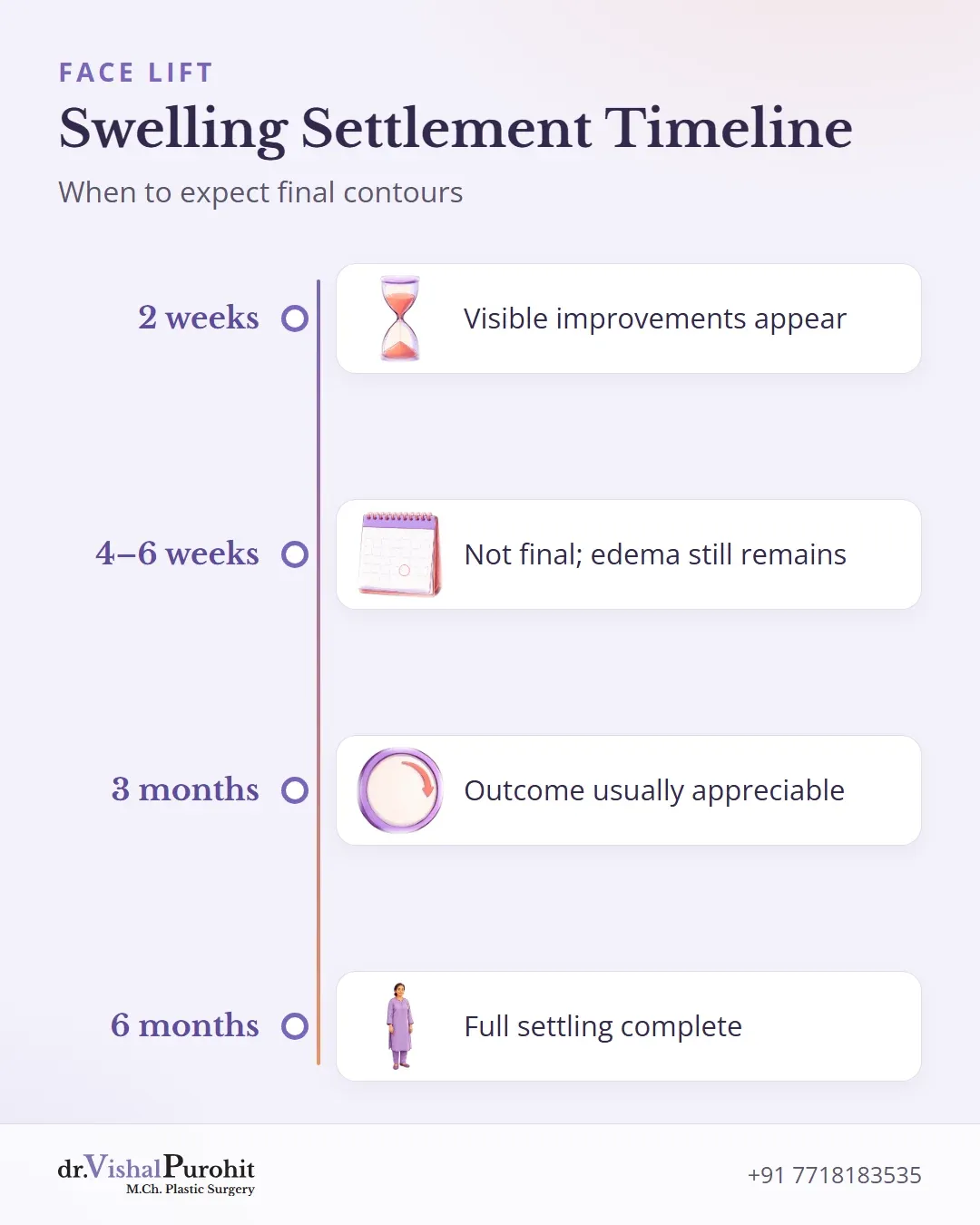
Following a facelift, postoperative swelling and tissue changes temporarily alter facial appearance. Evaluating facial contours too early can create false impressions or undue concern. While noticeable improvements become visible within a few weeks of surgery, the surgical literature notes that the actual outcome can usually be appreciated between 3 and 6 months postoperatively1.
Dr. Purohit’s note: In his practice in Jaipur, Dr. Vishal Purohit advises patients that numbness and temporary facial weakness usually last from a few weeks to about 2 months, during which time tissues continue to heal.
Why Early Judgement Misleads
Edema resolves gradually rather than all at once:
Residual Edema
In the initial weeks, residual fluid masks underlying anatomical definition and can distort contours12.
Premature Conclusions
A result should not be judged as final at 4 to 6 weeks, because edema remains present even if the surface appears settled2.
Later Stability
Full resolution of swelling continues over several months, with minimal additional changes expected once complete settling occurs2.
If unexpected changes arise, such as sudden one-sided swelling, breathing difficulty, or facial weakness, Dr. Purohit instructs patients to call the surgical team immediately on +91 7718183535. Allowing tissues sufficient time to heal prevents mistaking normal surgical swelling for the final aesthetic result12.
What Changes and What Stays the Same
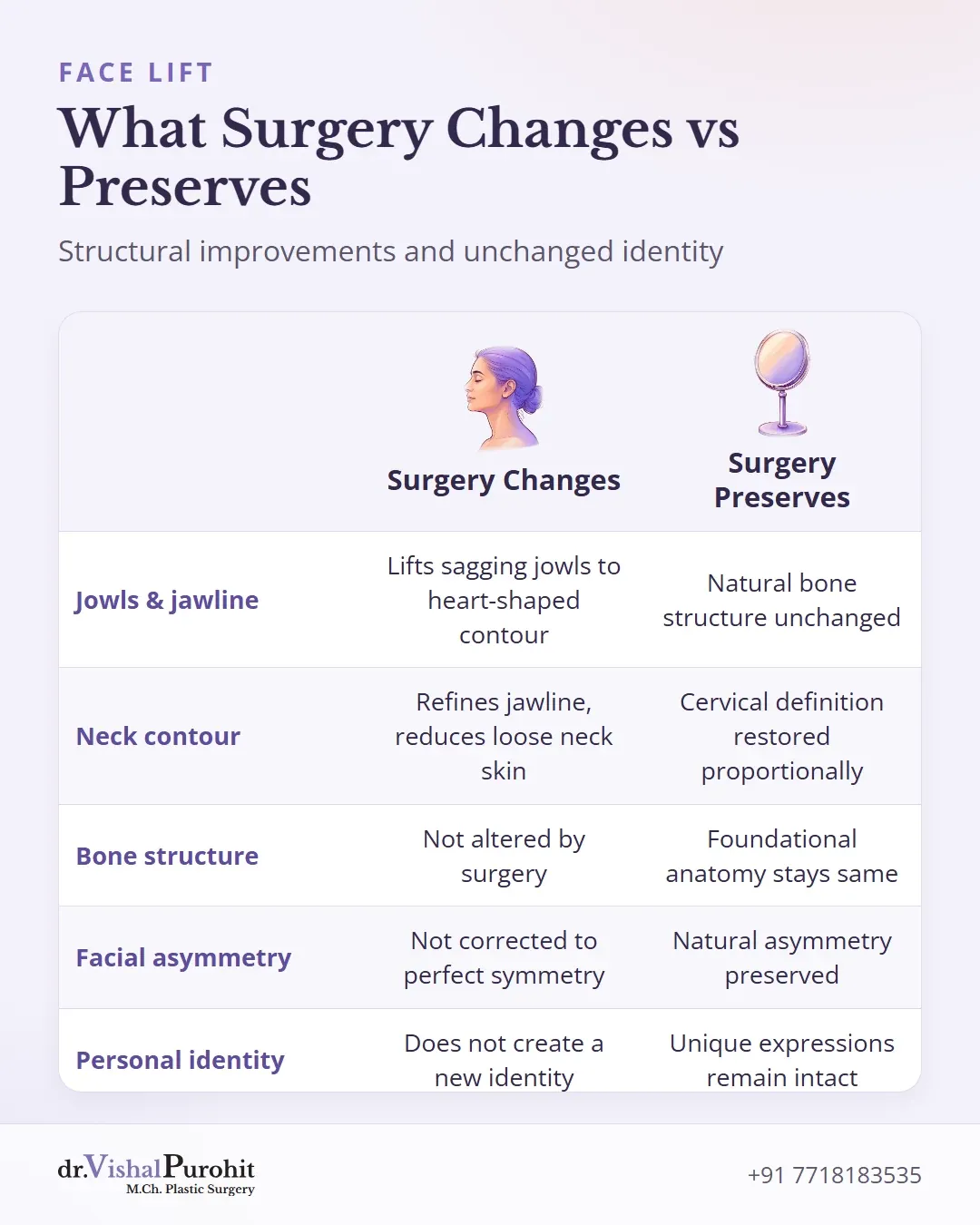
A facelift primarily targets the structural changes that occur in the lower face and neck over time34. Understanding the boundaries of the procedure helps set clear and practical expectations for surgical recovery and long-term results.
Key points
- A facelift restores structural contours in the lower face and neck, including the jowls and jawline.
- The procedure preserves foundational bone structure, natural expressions, and inherent facial asymmetry.
- Surgical adjustments refresh facial balance for about a decade while natural ageing continues.
What the Surgery Restores
Ageing leads to skin laxity, descending fat compartments, and weakening neck muscles, which cause jowls and blunt the jawline56. In Dr. Vishal Purohit’s practice in Jaipur, surgery focuses on SMAS plication and suspension, combined with cervicofacial platysmaplasty when the neck requires contouring.
Surgical repositioning produces specific structural changes:
- It lifts sagging jowls back into position, transitioning a widened lower face toward a tapered, heart-shaped contour36.
- It refines the jawline and reduces loose, redundant skin along the neck34.
- It restores cervical definition without distorting surrounding anatomical proportions37.
While these adjustments refresh facial balance, Dr. Purohit explains to patients that results typically endure for about a decade, during which normal physiological ageing continues.
What Remains Unchanged
Surgery does not recreate a new identity or alter foundational anatomy. It cannot turn an individual into someone else or erase underlying facial dynamics8.
- Personal features: Bone structure, unique proportions, and personal expressions remain intact89.
- Inherent asymmetry: Every human face is naturally asymmetric91011. Precise left-to-right symmetry is neither a realistic nor a desirable outcome, as forcing absolute symmetry creates unnatural results10.
- Natural identity: The procedure refreshes the lower contours while preserving the distinctive individuality of the patient’s face810.
How Long the Lift Lasts
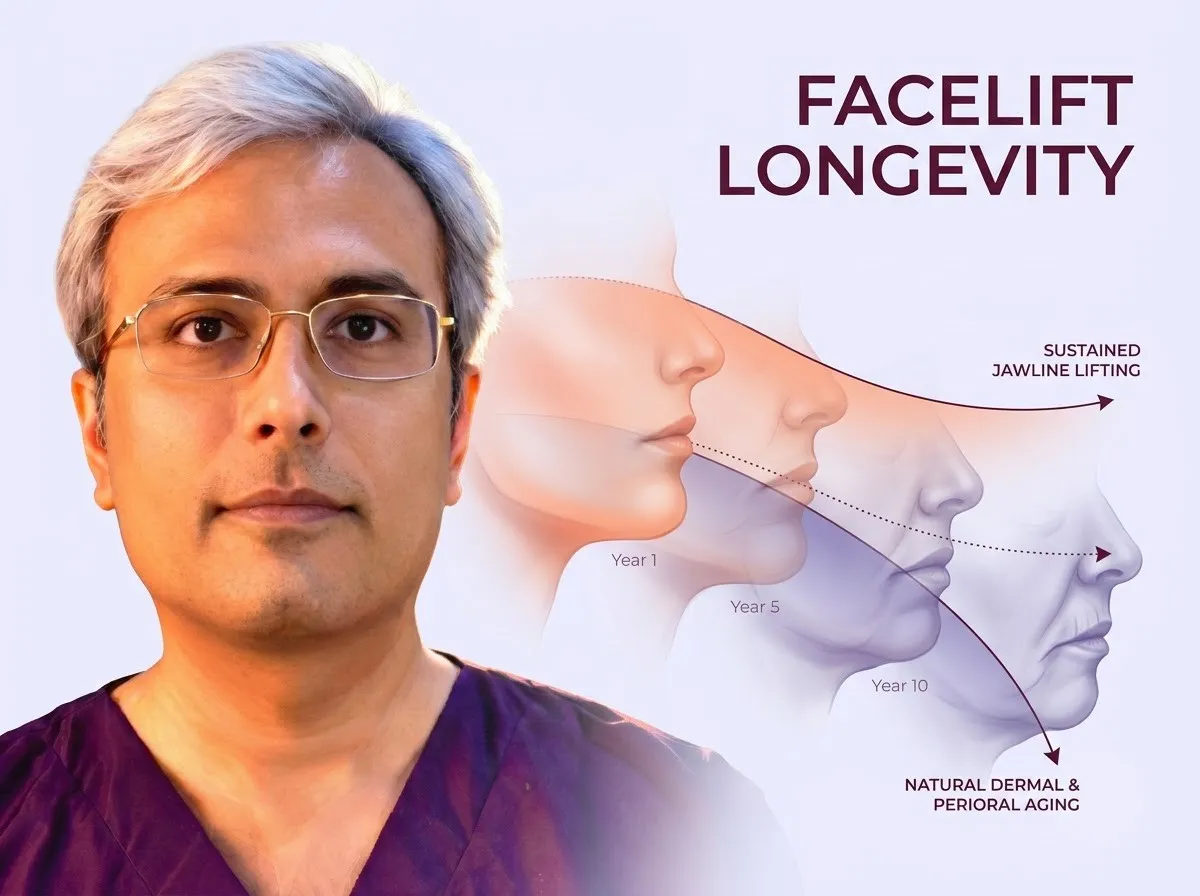
In his plastic surgery practice in Jaipur, Dr. Vishal Purohit explains to patients that the natural ageing of the face continues after surgery. Surgical repositioning resets facial tissues, but the operation does not stop biological time.
Key points
- Facelift surgery resets facial tissues for long-lasting improvement, but natural biological ageing continues.
- Longevity depends on baseline age, genetics, skin quality, operative technique, and postoperative maintenance.
- Outcomes vary widely across clinical studies, enduring anywhere from a few years up to 15 years.
Factors That Influence Longevity
Surgical literature notes that a facelift provides predictable, long-lasting improvement rather than a permanent change1213. The duration of surgical outcomes varies according to several key elements:
- The patient’s baseline age, genetics, and structural skin quality121314
- The specific operative technique performed121314
- How well tissues are maintained and protected from damage after surgery121314
While surgeons reposition structural layers, biological factors remain beyond surgical control121314.
Findings in Surgical Literature
Published clinical studies report considerable variation in how long a face lift endures. A well-executed cervicofacial rhytidectomy incorporating platysmaplasty and superficial musculoaponeurotic system (SMAS) intervention can last until an individual seeks revision surgery121314. In certain clinical reports, outcomes may extend to 15 years, whereas other patients demonstrate visible tissue changes only a few years after surgery121314.
Surgical durability also relates to baseline tissue laxity. One clinical series observed that outcomes tend to be more durable in patients undergoing surgery in their 50s—persisting up to 15 years—compared to patients in their late 60s and 70s with advanced facial ageing, where results typically endure for 7 to 8 years15. Although structural correction remains noticeable over time, patients continue to age along a natural trajectory from their adjusted postoperative baseline16.
The Face Keeps Ageing
A facelift repositions deeper tissues and tightens loose skin, but it does not stop the natural biological ageing of the underlying tissues1718. Dr. Vishal Purohit tells patients in Jaipur that the natural ageing of the face continues even after surgery.
Continuing Changes in Bone, Fat, and Skin
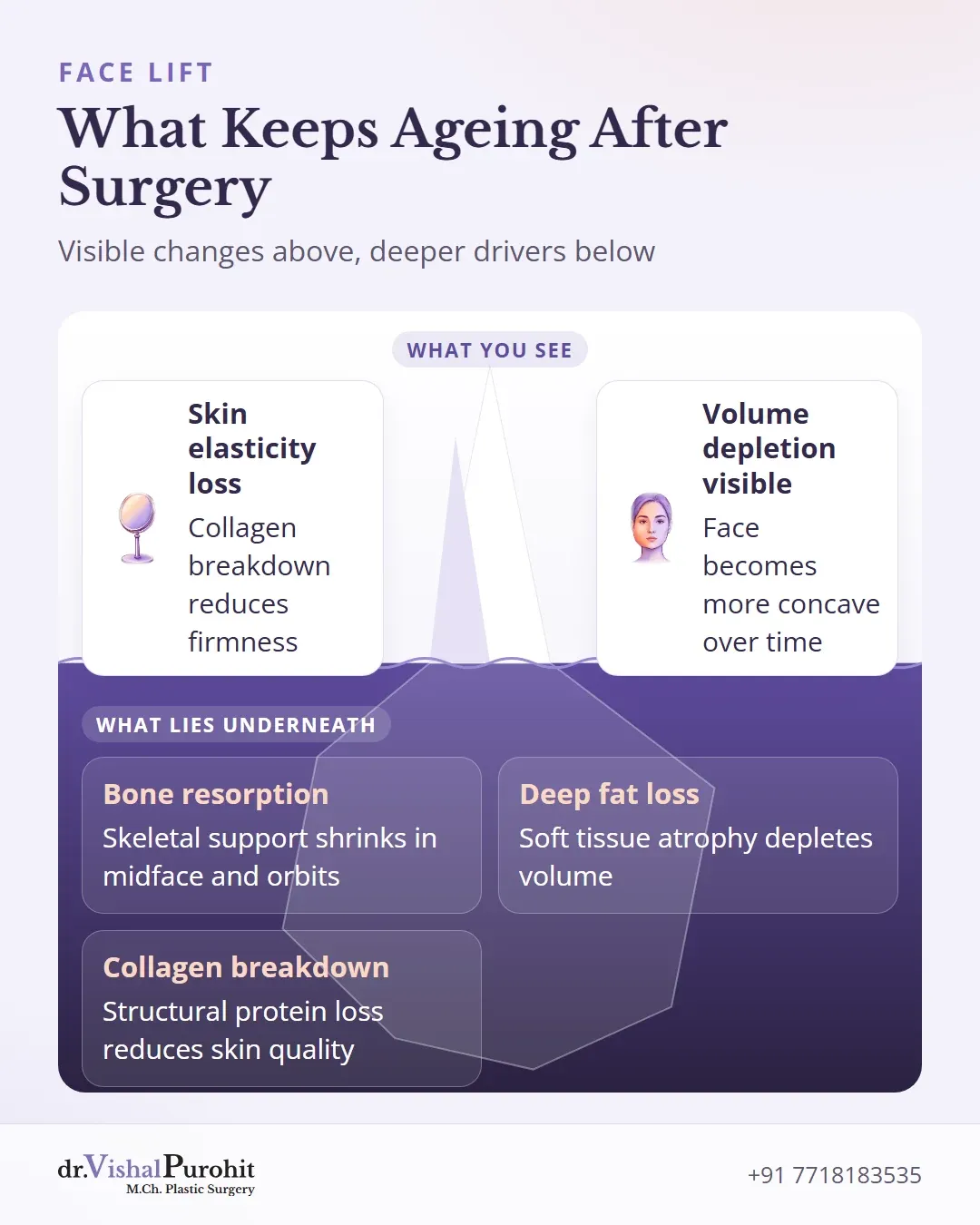
Even after surgery, structural changes across all facial layers progress over the years:
- Bone resorption and skeletal loss continue, reducing the underlying structural support of the midface and orbits1920.
- Soft tissue atrophy and the loss of deep facial fat lead to volume depletion, causing the face to become more concave over time181920.
- Skin loses elasticity and quality due to intrinsic cellular senescence and structural protein breakdown171820.
Because surgical lifting alone cannot address deep volume deflation, volume restoration using soft tissue fillers or fat grafting is often considered as a separate measure171821.
Factors That Shorten Result Longevity
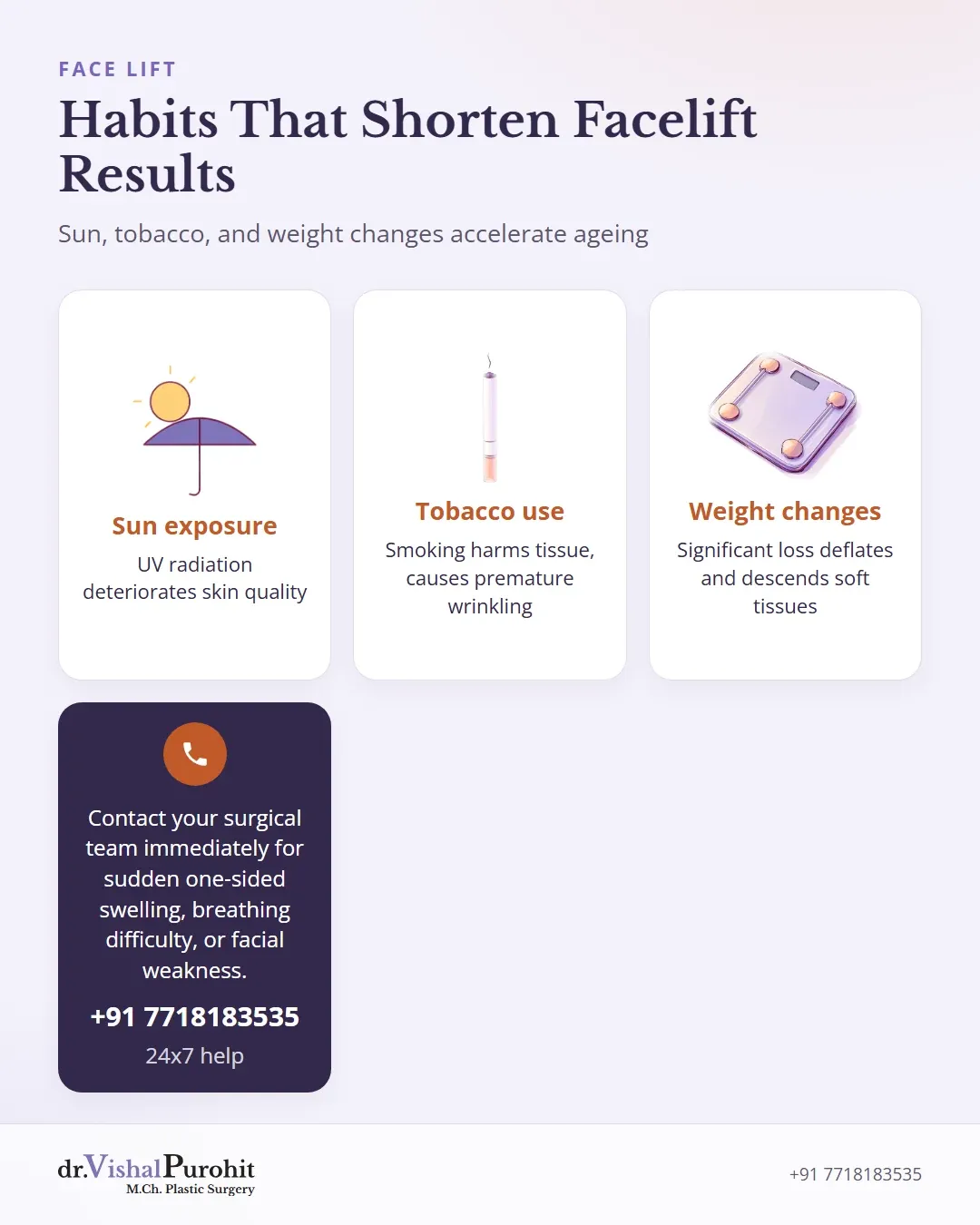
How long a face lift lasts varies considerably between individuals1314. Natural ageing cannot be halted131417, but certain extrinsic lifestyle factors accelerate tissue breakdown and lead to earlier postsurgical changes:
- Sun exposure: Ultraviolet radiation and environmental exposure deteriorate skin quality and speed up visible facial ageing1720.
- Tobacco use: Smoking harms tissue quality and contributes to premature wrinkling and skin laxity2022.
- Weight changes: Significant weight loss mimics facial ageing through the deflation and descent of soft tissues, worsening facial hollows and folds19.
Protecting Your Skin Afterwards
Surgical repositioning restores facial contours, but natural skin ageing continues over time. Protecting the skin helps preserve tissue health, though it cannot ensure how long surgical results endure.
Everyday Protection and Care
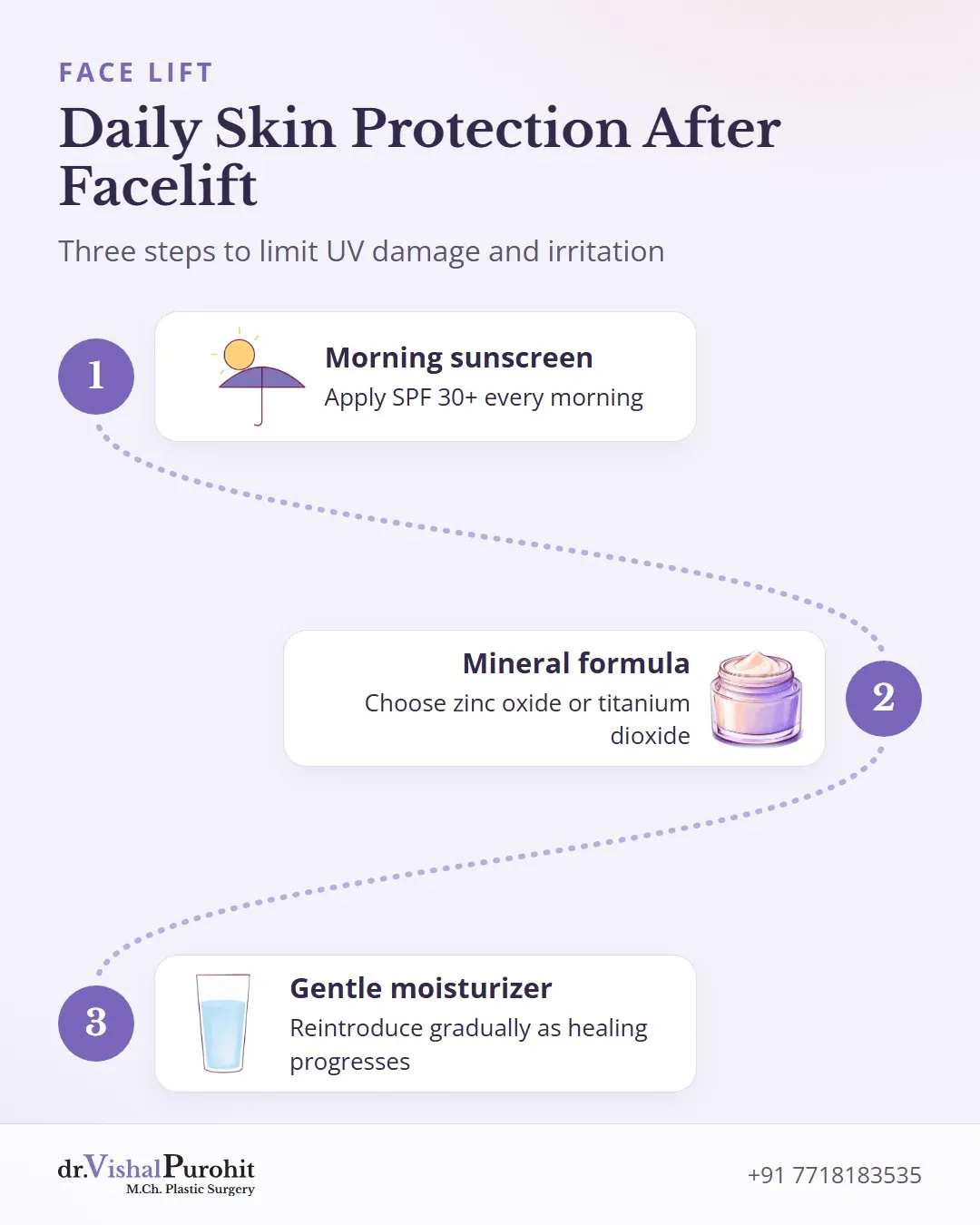
Sun exposure is a primary cause of ongoing skin changes, causing structural damage to dermal collagen2324. Postoperative care literature emphasizes protecting the skin surface following surgery:
- Daily morning photoprotection using a sunscreen with SPF 30 or higher helps limit ultraviolet damage2526.
- Mineral formulations containing physical blockers such as zinc oxide or titanium dioxide are less irritating to healing tissues2728.
- Gentle moisturizers and topical agents can be reintroduced gradually as healing progresses, provided skin irritation does not occur28.
Non-Surgical Maintenance Options
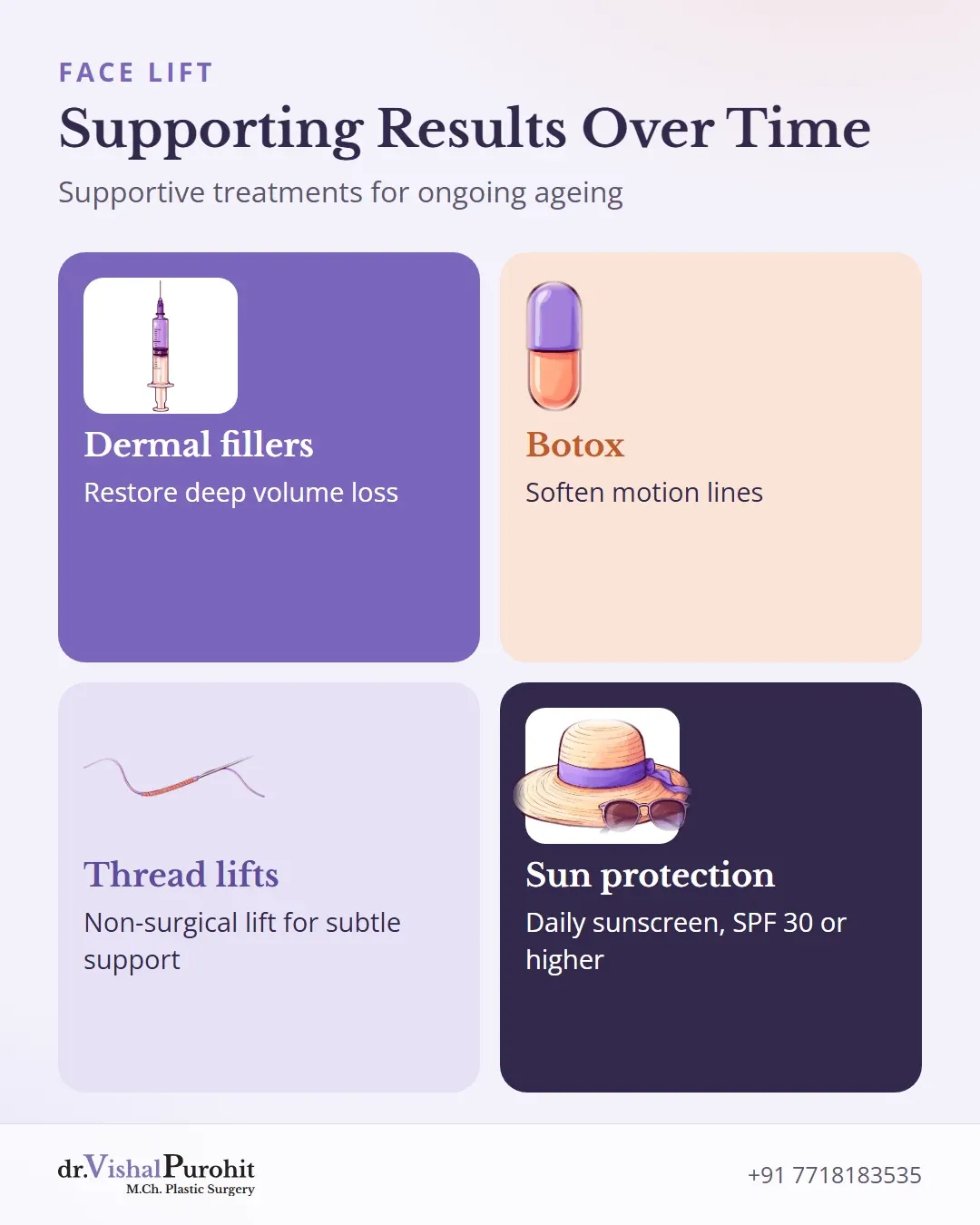
When skin surface changes or subtle volume shifts appear over the years, non-surgical treatments can address concerns that surgery does not alter. Dr. Vishal Purohit offers dermal fillers, Botox, and thread lifts as non-surgical maintenance options in Jaipur. Resurfacing procedures and laser treatments are not offered. Non-surgical alternatives provide supportive maintenance for facial tissues while natural ageing proceeds.
Planning Long-Term Facial Rejuvenation in Jaipur
Understanding structural boundaries and the natural healing timeline allows patients to approach facial surgery with realistic expectations. To explore operative techniques, hospital care, and personalised guidance, learn more about facelift surgery in Jaipur. For detailed answers regarding tissue longevity, recovery milestones, and maintenance treatments, browse the facelift FAQs before consulting M.Ch. plastic surgeon Dr. Vishal Purohit.
This is educational information, not medical advice.