
In short
- Built from 1025 screened studies: off-midline closure is preferred; midline closure should be avoided.
- Small disease has several literature options; silent pits need no preventive treatment.
- Teens are managed as adults; drains are case-by-case; blue dye is not essential.
Who this page is for
Pilonidal sinus is a frequently observed disease in young adult males. Advice online varies wildly. Guidelines cut through that noise with graded evidence.
This page summarises the European Society of Coloproctology (ESCP) 2024 guideline for pilonidal disease. It suits patients comparing surgeons, parents of teens, and readers who want evidence behind the plan.
For the American counterpart, read the ASCRS 2019 guideline summary. For a side-by-side view, see ASCRS vs ESCP compared.
How the review was built
Guideline panels do not vote on opinion. They screen literature by set rules. ESCP reviewers screened 1025 studies for this update.
Cohorts of 50 or more patients carried the weight. Small case reports counted less. This size filter steadies the conclusions.
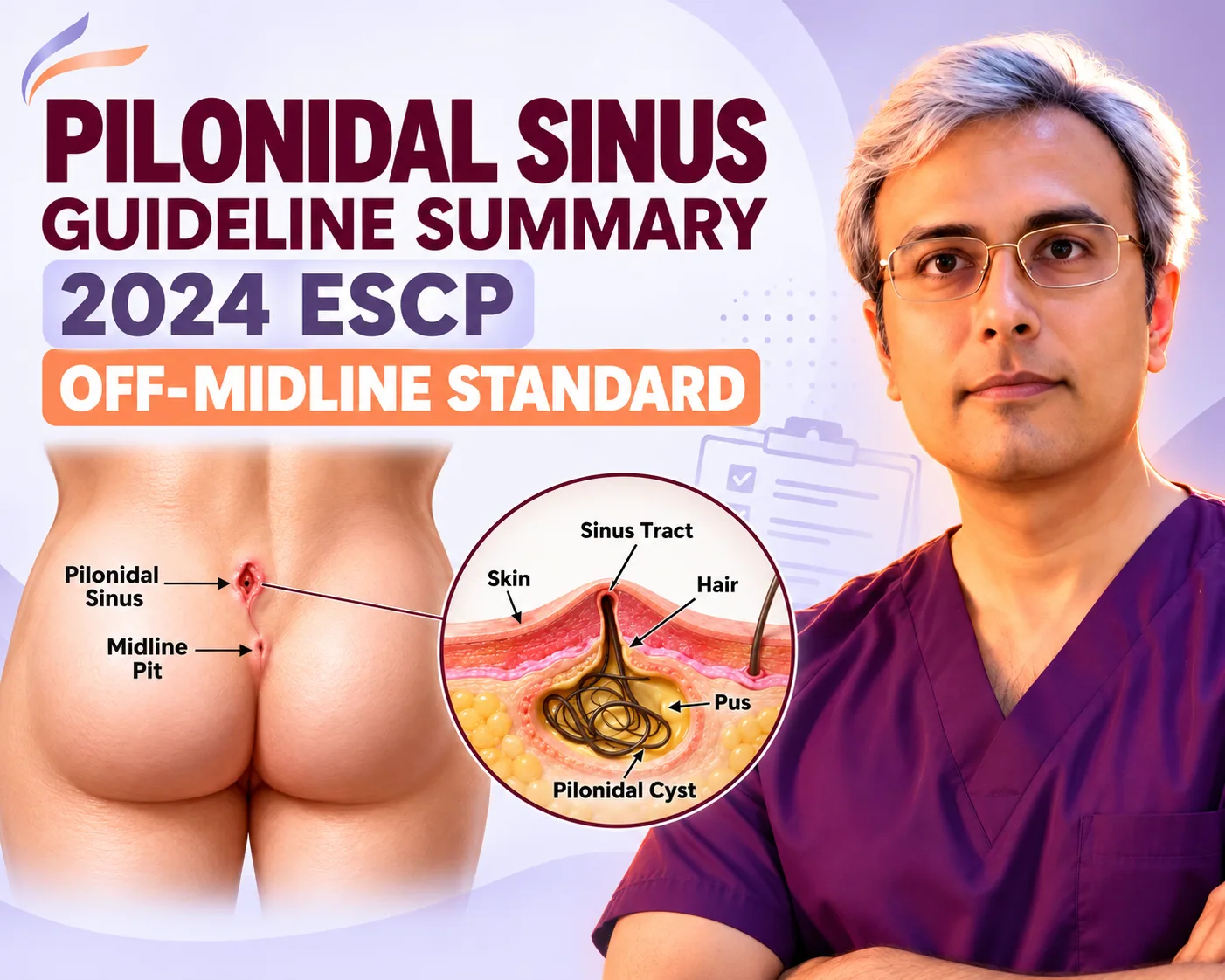
The headline result is clear. Off-midline closure is preferred for definitive surgery. Midline closure is to be avoided. The cleft midline is moist, high-rub skin — wounds there fail more and scar worse.
What “off-midline” means in practice:
- Scar position — the final line sits 1 to 2 cm to one side of the cleft.
- Flap designs — Limberg, Karydakis, and related asymmetric closures all qualify.
- Avoided — direct midline stitching and wide open healing as first choice.
This clinic’s practice lines up with that direction. The Limberg flap performed here is an off-midline standard operation.
Methods still have limits. Many pilonidal trials are small or single-centre. Follow-up lengths differ. The guideline grades each claim so readers see what is firm and what is thin.
Evidence grading works like a label. Strong claims rest on consistent cohorts. Weak claims rest on few or mixed studies. The off-midline direction earns its weight from repeated cohort agreement, not one loud trial.
Older practice leaned on midline closure and open healing. Both left scars in the worst skin zone. The 2024 review moved the standard firmly aside the midline. That shift is the single most useful takeaway for patients comparing surgeons.
Options for small disease
Not every sinus needs a flap. Small, limited tracts have lighter options in the guideline. Each suits narrow disease with few branches.
The guideline lists these options for limited disease:
| Option | What it does | Status here |
|---|---|---|
| Pit-picking | Removes pits through tiny cuts | Literature context |
| EPSiT | Scope-guided cleaning from inside | Literature context |
| Fibrin glue | Seals the tract with biologic glue | Literature context |
| Phenol use | Chemical treatment of the tract lining | Literature context |
| Laser | Heat-seals the tract from inside | Literature context |
One “no” matters as much. No preventive treatment is advised for pits with no symptoms. Quiet pits get watched, not cut. Hygiene and hair control suffice until symptoms appear.
Acute abscesses follow a staged path. Drainage comes first. Definitive closure waits for calm tissue. Rushing a flap into hot infection raises failure risk.
The staged order runs in three steps. First, urgent drainage releases pus and pain — often under local anaesthesia. Second, the field rests for weeks while swelling and redness settle. Third, the surgeon maps calm tracts and books the off-midline flap.
Chronic discharging disease skips the emergency step. The tract map leads straight to flap planning. Probe mapping draws each branch. Selective scans confirm deep or repeat paths. Then the flap design matches the map.
Danger signs under any plan
- Rapid painful swelling with fever — needs urgent drainage, not a routine flap date
- Spreading redness, red streaks, or foul heavy discharge
- Repeat bursts from the same spot despite antibiotics
Teens, drains, and dye
Three practical points close the summary. Each answers a frequent consult question.
First, adolescents are managed as adults. No separate teen protocol exists. The same off-midline standard applies. Growth does not change the cleft mechanics that drive disease.
Second, drains are individualised. No blanket rule forces a drain in every flap. Surgeons place one when fluid risk warrants it — wide flaps, deep gaps, or oozing fields. Removal follows output, often within 24 to 72 hours.
Third, dye is not essential. Blue dye injected to trace tracts adds little in most hands. Careful probe mapping plus selective scans draws the truer map.
How to use this at your visit:
- Ask the position — will my scar sit off the midline, and how far aside?
- Ask the match — why does this flap fit my pit map and not another?
- Ask the drain plan — will I have one, and what decides removal day?
Straight answers to these three mark a guideline-aware plan. Vague answers deserve a second opinion.
Readers often ask how ESCP 2024 differs from ASCRS 2019. Both agree on the core: avoid the midline, drain abscesses first, and tailor the method to the disease. ESCP 2024 goes further with its large 1025-study screen and firmer off-midline wording. The two documents pull in the same direction — aside the cleft, never down its middle.
Recommendations also sort by disease stage, which the table below condenses:
| Stage | Guideline direction |
|---|---|
| Silent pits | Watch; no preventive procedure |
| Acute abscess | Drain first, plan flap later |
| Limited chronic tracts | Small-incision options in literature |
| Wide or repeat tracts | Off-midline flap closure |
Hair control deserves its own question at the visit. Ask when trimming resumes and when clinic-based laser fits. Guidelines tie lasting results to keeping loose hair out of the cleft long after sealing.
Work and school planning matter too. Ask how many days to rest, when sitting resumes, and when sport restarts. A plan with dates beats a plan with hopes — healing follows a timeline the surgeon should state plainly.
Key figures from published series
- The ESCP 2024 panel screened 1025 studies, weighting cohorts of 50 or more patients — the method backbone of the off-midline standard.
- Core direction: off-midline closure preferred; midline closure to be avoided; no preventive treatment for pits with no symptoms.
- Non-pilonidal figures sometimes attached to this topic (for example, abdominoplasty complication rates) are omitted here — every number above concerns pilonidal disease or its guideline method.
What Dr. Vishal Purohit does in Jaipur
Dr. Vishal Purohit treats pilonidal sinus disease in Jaipur. His practice follows the guideline’s core direction: definitive Limberg and Karydakis off-midline flap surgery, with abscess drainage staged first when infection is acute.
Phenol, SiLaC laser, EPSiT/endoscopic, pit-picking, Bascom, Dufourmentel, Z-plasty, and fibrin glue are not offered at this clinic. They appear in this summary only as guideline-listed literature context for limited disease.
Consultations map the tracts, place the scar off-midline, individualise the drain, and skip routine dye — each step traceable to the ESCP 2024 line. This is educational information, not medical advice.