
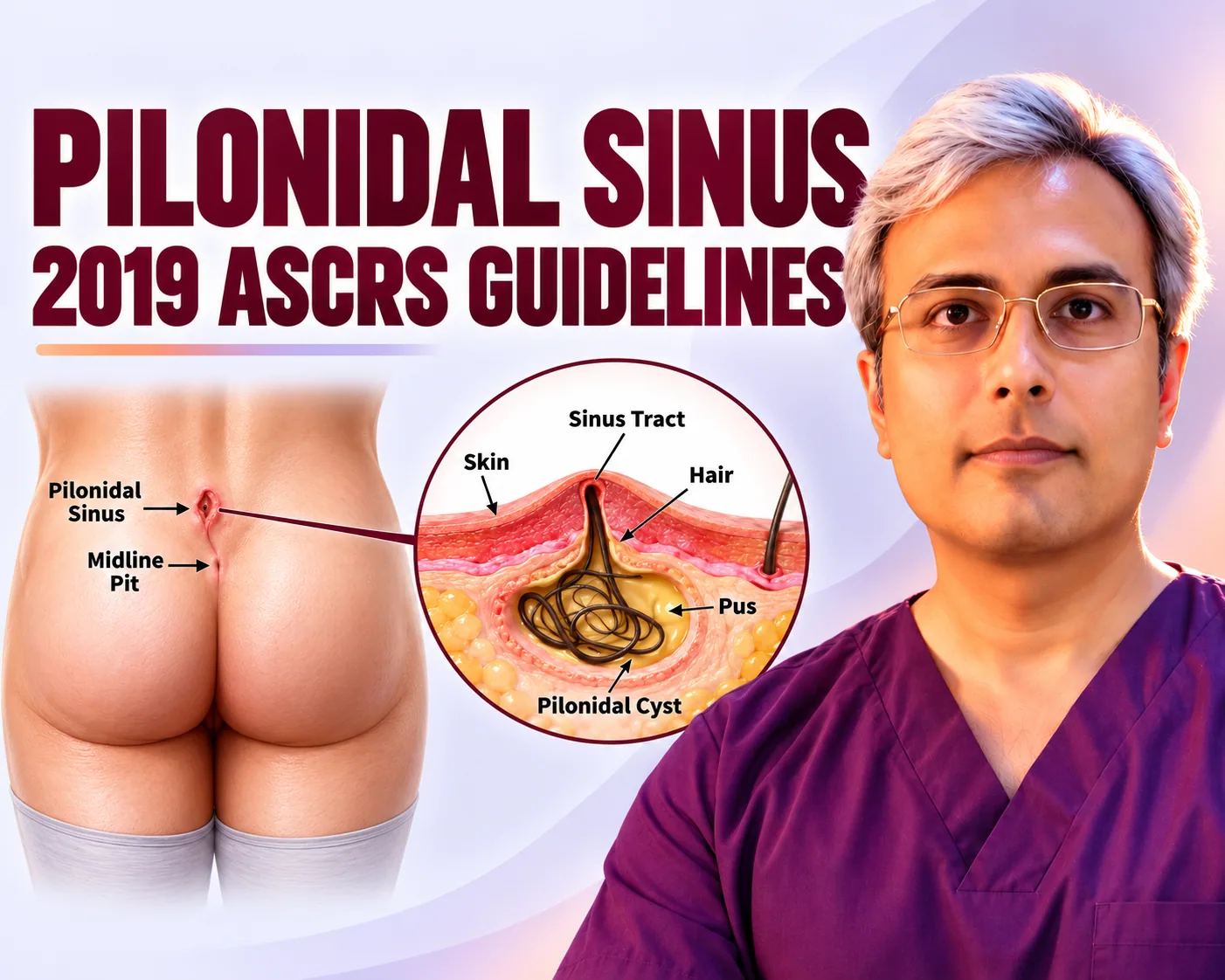
In short
- ASCRS 2019 is the best-known American pilonidal guideline, built from 115 sources with GRADE strength labels.
- Strong advice: drain abscesses at once, consider crystallized phenol in suitable tracts, use flaps for complex disease.
- Cautious advice: glue, scopes, routine antibiotics, drains, and hair removal were left to judgment — and ESCP 2024 now updates parts of the picture.
What this guideline is and who it helps
ASCRS stands for the American Society of Colon and Rectal Surgeons. In 2019 it published a clinical practice guideline for pilonidal disease — a rulebook that sorts treatments by proof strength.
Pilonidal disease itself is a frequently seen condition in young adult males, traditionally treated by surgery with growing use of smaller interventions. A guideline matters here because the option list is long and the proof behind each option is uneven. It helps four groups:
- Acute abscess — urgent drainage and next steps
- First-time chronic disease — limited pits versus wide tracts
- Complex and repeat disease — after failed earlier surgery
- Wound support — drains, antibiotics, and hair care around surgery
Patients can use it too. When a surgeon cites a recommendation, ask for its strength label — it tells you whether the proof is firm or close-call. The ASCRS versus ESCP comparison shows where this American rulebook and the newer European one agree.
Surgeons use the guideline differently from patients. A surgeon reads it to standardise choices across cases — when to drain, when to offer phenol, when to commit to a flap. A patient reads it to test a proposed plan: does my case sit on a strong branch or a judgment-call branch, and what alternatives did the surgeon weigh?
How the guideline was made
The panel gathered 115 references — trials, series, and reviews — and graded each recommendation with GRADE (a system that labels advice as strong or weak). Strong (1B) means most patients gain clearly; weak (2B) means the balance is close and anatomy decides.
Guidelines age. Major surgical guidelines are normally revisited every 3 to 5 years, so ASCRS 2019 is now overdue for refresh — and the ESCP 2024 summary carries five more years of trials. The recency rule is simple: shared points stand on either citation; split points follow the newer data.
The GRADE letters deserve a plain reading. The number (1 or 2) states strength — how clearly benefits beat harms. The letter (A, B, or C) states evidence quality — how much the panel trusts the underlying studies. A 1B tag, common in this guideline, means a strong steer built on moderate-quality evidence: act on it, but keep clinical judgment switched on.
Strong advice: drainage, phenol option, flaps
Three strong (1B) positions anchor the guideline. First, abscess drainage at once — no waiting, no antibiotics-only trial. Second, crystallized phenol as an option in suitable chronic tracts, based on the evidence of that time. Third, flaps for complex or repeat disease instead of midline closure.
Drainage-first deserves emphasis because it shapes every abscess case. The cut sits off the midline, the cavity is emptied and washed, and definitive repair waits 6 to 12 weeks until tissue calms. Operating a flap through active infection raises failure risk — the strong label reflects how firmly the evidence backs staging.
Phenol needs honest framing. It is described in guidelines as a tract option with repeat sessions — it is not offered at this clinic. The flap branch is: off-midline closure that flattens the cleft and moves the scar out of the moist midline.
Suitability decides phenol results. Narrow, unbranched tracts respond better than wide branching networks, and most protocols plan repeat sittings weeks apart rather than a single shot. Because the evidence window was still maturing in 2019, the guideline tied its strong label to careful patient selection — a caveat ESCP 2024 later sharpened into a more guarded ranking.
The flap position rests on a simple mechanism. Midline wounds sit in a deep, moist, shearing groove; off-midline scars sit on drier, flatter skin. That geometry explains why complex and repeat cases — wide tracts, scarred tissue, failed earlier closures — do better with flaps, and why the guideline holds this line strongly rather than weakly.
Cautious advice: glue, scopes, antibiotics, drains, hair
Weak (2B) recommendations cover fibrin glue, endoscopic approaches, and case-by-case antibiotics and drains. The table below puts the two tiers side by side.
| Topic | Strong advice | Cautious (judgment-call) advice |
|---|---|---|
| Abscess | Drain at once, off-midline | Antibiotics only for cellulitis or body-wide signs |
| Chronic tracts | Crystallized phenol as an option | Fibrin glue in selected cases |
| Complex disease | Off-midline flap closure | Endoscopic approaches in selected cases |
| Support care | — | Drains by flap size; hair care after healing |
Weak does not mean wrong — it means the surgeon must match the tool to the anatomy. Pre-operative shaving, for instance, looked favourable to ASCRS but lacked hard outcome proof, a gap ESCP 2024 later confirmed.
Antibiotics show the judgment-call pattern clearly. A simple drained abscess in a healthy adult gains little from a routine course, since drugs cannot reach locked-in pus. Spreading redness, diabetes, weak immunity, or body-wide signs flip the balance — and the guideline leaves that flip to the treating surgeon, not a fixed rule.
Drains follow the same logic. Small flaps with little dead space may manage without one; wide flaps with a lifted plane need suction until output falls and thins. Naming a removal cut-off — often around 10 to 20 mL per 24 hours — turns a habit into a measurable decision.
Hair care rounds out the cautious list. Keeping the healed cleft clear of hair is sensible upkeep, and post-healing options such as laser hair removal appear in the literature as after-healing support — described here as published context, not a clinic service. No single hair method carries proven cure-level evidence, so it stays advice rather than prescription.
Limits of the 2019 snapshot
No guideline freezes truth; each one photographs the evidence of its year. The 2019 photo predates several closure trials and the fuller minimal-incision literature that ESCP 2024 later absorbed. Rankings built on the older photo therefore carry wider uncertainty than their labels suggest.
Pilonidal disease itself complicates proof. It strikes mostly young adults, follow-up stretches over years, and return of disease is the endpoint that matters — yet short series report early healing as success. Reading any 2019 figure thus needs the same discipline: endpoint, group size, and follow-up first, headline rate second.
Key figures from published series
- The ASCRS 2019 summary brief cites reported rates of 3%, 15%, 80%, and 100% across different endpoints (each endpoint as published) — read every figure with its original outcome measure, group size, and follow-up.
- Short series undercount return of disease, so five-year follow-up is the meaningful yardstick when comparing options.
What Dr. Vishal Purohit does in Jaipur
Dr. Vishal Purohit, an M.Ch plastic surgeon, maps every pilonidal case in Jaipur against this guideline’s strength labels — drainage first for abscess, off-midline flap for complex disease, selective antibiotics and measured drains throughout.
The clinic performs only Limberg and Karydakis flap surgery plus abscess drainage. Phenol, laser, endoscopic, glue, pit-picking, and Bascom options are discussed purely as published guideline literature, never as clinic services. At consultation the surgeon explains which branch of the guideline each patient sits on, and why.
Patients can put the summary to work with three questions: which strength label sits behind my recommended step, what alternative the guideline lists for my branch, and what newer evidence changes since 2019. A surgeon who answers all three plainly is practising guideline-based care, not preference-based care.
This is educational information, not medical advice.