
Evaluating eyebrow elevation after botulinum toxin type A takes patience because muscle relaxation unfolds gradually over several days. The treatment subtly alters dynamic balance rather than repositioning structural tissues permanently. Reviewing Botox Brow Lift Results: Realistic Eyebrow Shape and Lift helps illustrate what subtle changes look like.
Immediate inspection right after injection does not reflect the ultimate outcome. Peak muscle response develops over one to two weeks, making early photographic assessment essential for measuring true brow height.
The Gradual Development of Neuromodulator Effects
Following an injection of botulinum toxin type A, aesthetic change does not appear immediately. Immediate post-treatment inspection does not show the final aesthetic outcome because the neurotoxin requires time to bind, enter nerve terminals, and halt muscle contraction12.
Key points
- Neuromodulator effects develop gradually over several days rather than appearing immediately.
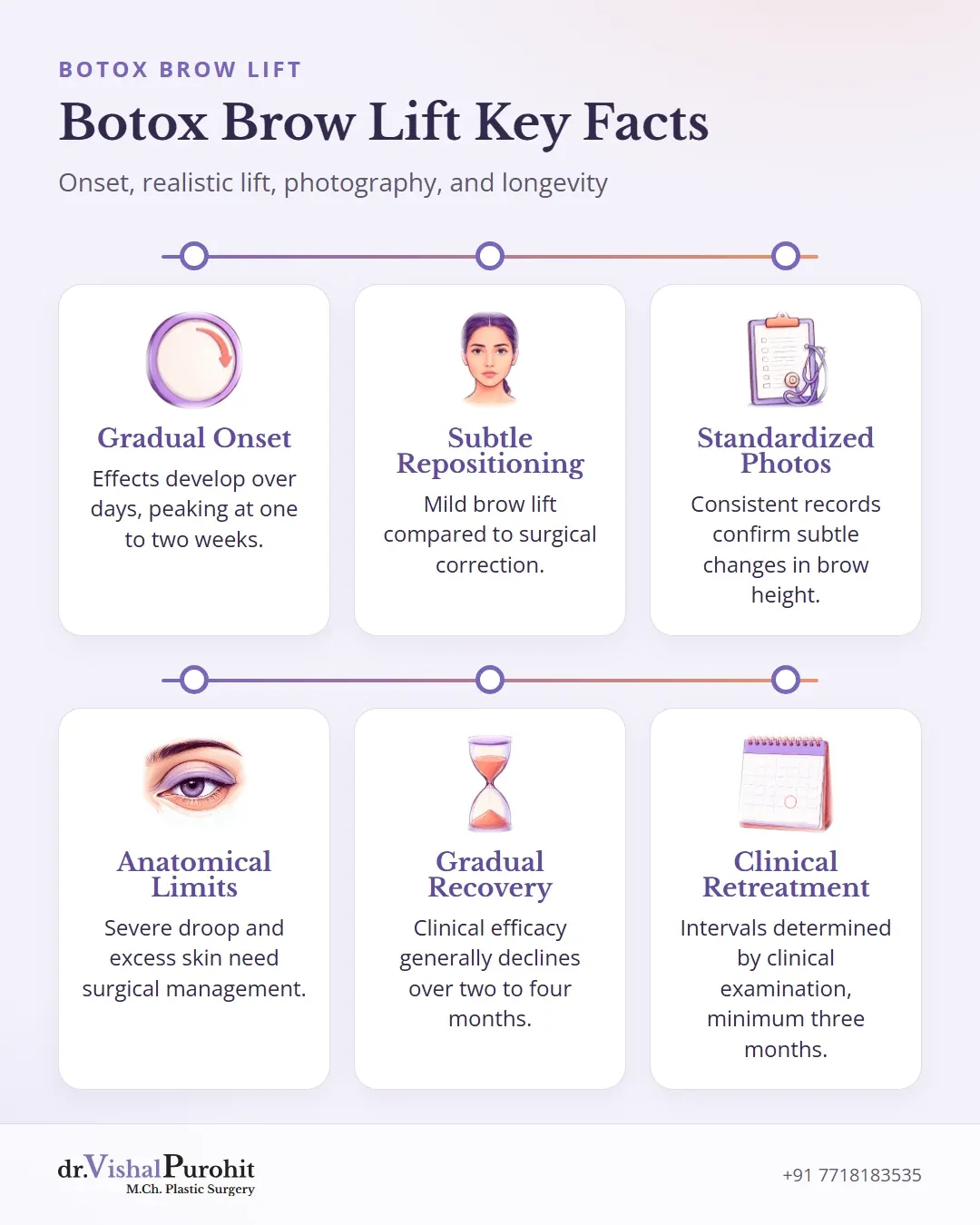
- Chemical denervation begins within one to three days, and the clinical response peaks at one to two weeks.
- Early assessment immediately after injection does not reflect the final brow position or aesthetic outcome.
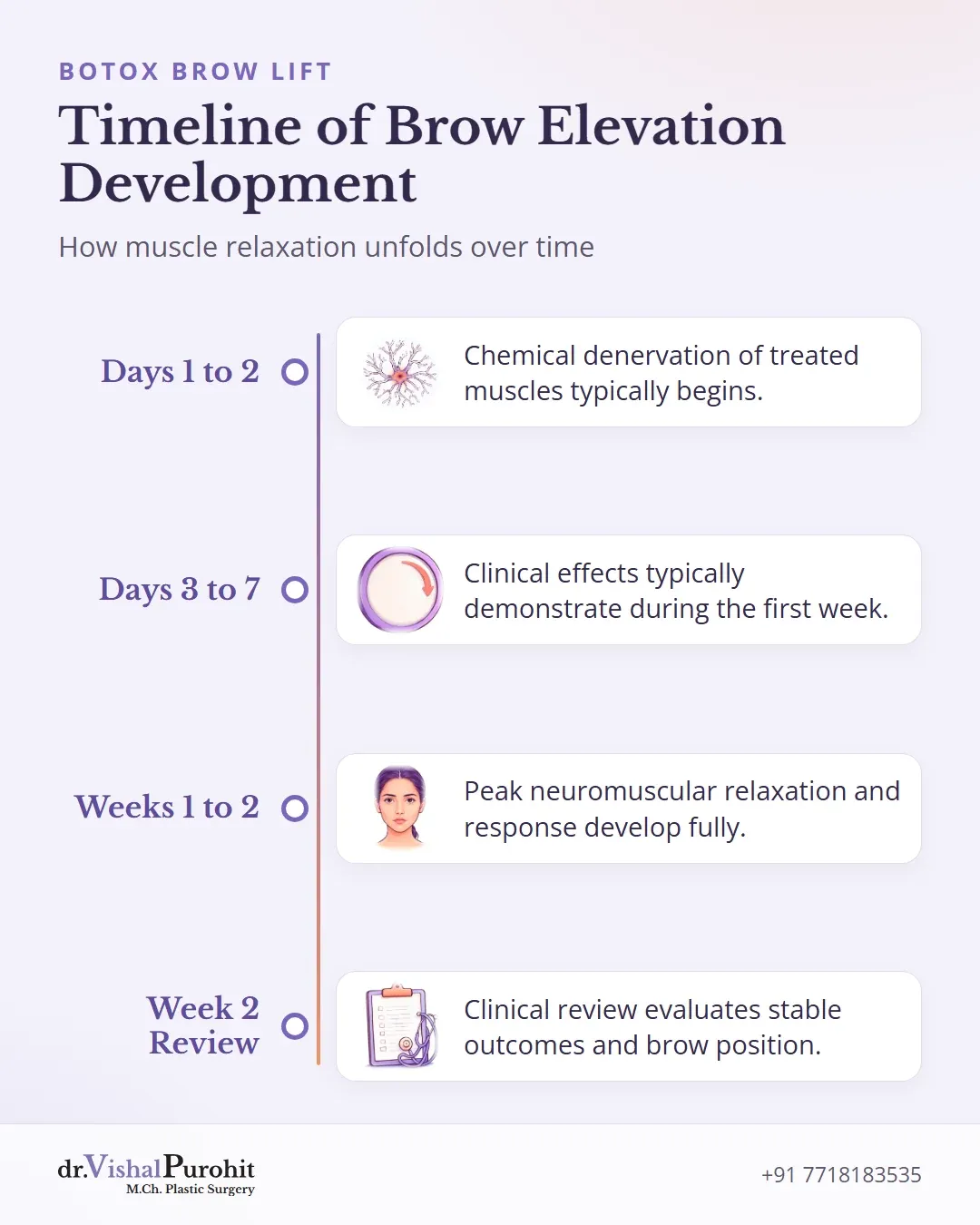
In clinical literature, the physiological onset of action unfolds over several days rather than occurring right away:
- Chemical denervation of treated muscles typically begins one to two days following injection3, with early action often delayed for 1 to 3 days while the toxin is internalized and cleaved1. Other texts note clinical effects typically demonstrating between 3 and 7 days post-injection4.
- Neuromuscular relaxation increases in intensity during the first week3.
- The response peaks at 1 to 2 weeks post-treatment1.
Because of this gradual progression, early evaluation right after treatment cannot reflect the ultimate brow position. If no visible improvement is observed after 3 days, clinical literature advises reassuring the patient and reassessing in another week rather than intervening prematurely4.
Why Generalized Toxin Duration Cannot Predict Brow Elevation
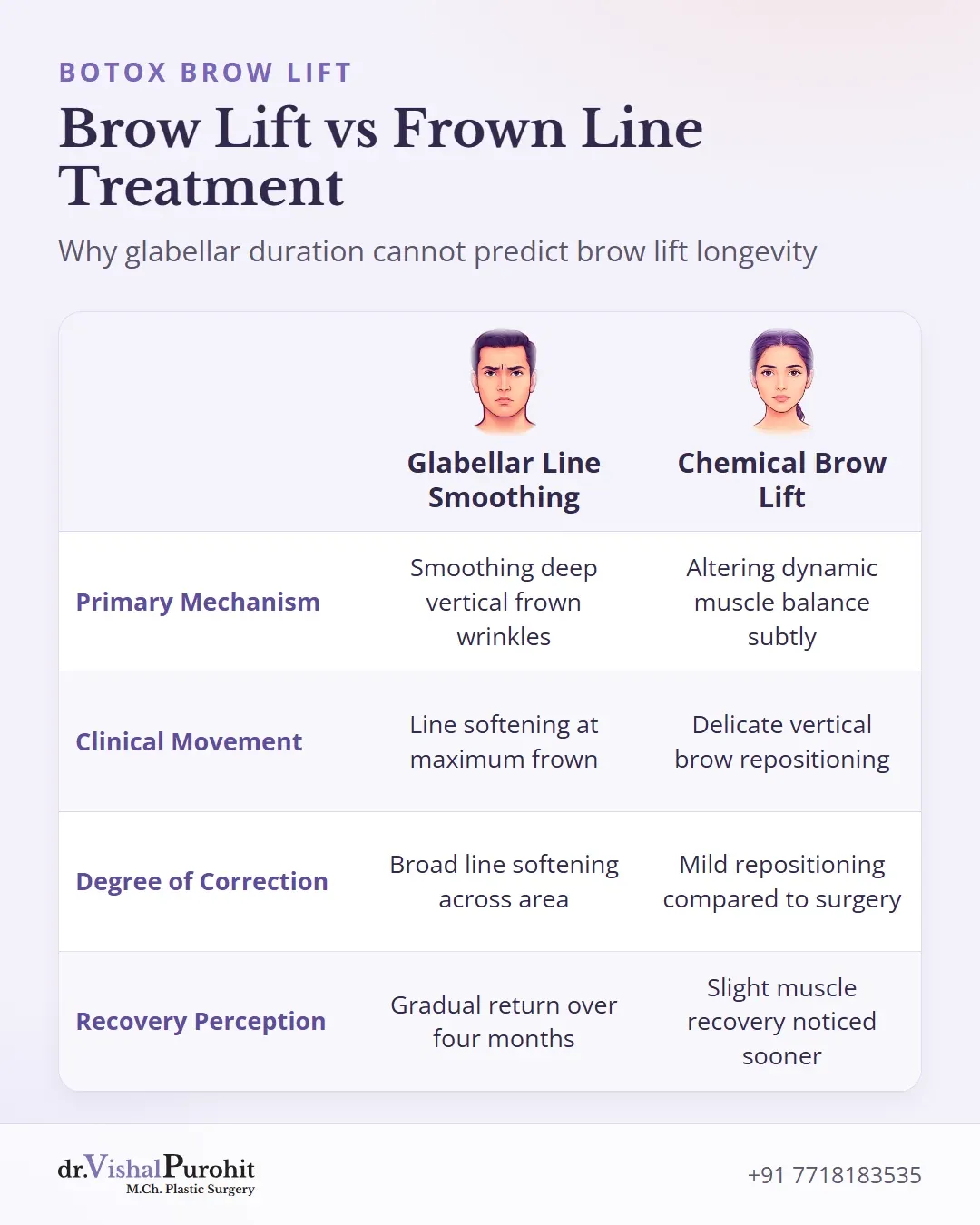
Product labels and clinical trials for vertical frown lines often describe results lasting up to 4 months5 or general facial effects lasting 3 to 6 months6. However, these figures reflect the smoothing of broad glabellar wrinkles rather than delicate eyebrow repositioning.
Eyebrow elevation depends on altering dynamic muscle balance7. Injecting the superolateral orbicularis oculi allows frontalis activity to provide subtle elevation8, but the correction remains temporary and requires repeat treatments over time7.
Several clinical realities distinguish brow repositioning from standard line reduction:
- Glabellar trials measure the softening of deep vertical lines at rest and maximum frown5, which does not translate directly to vertical lift.
- Frontal skin quality and tissue thickness influence visible longevity over a 4-month period9.
- Subtle chemical lifting provides mild repositioning compared to surgical methods78, meaning slight muscle recovery becomes noticeable sooner.
Dr. Purohit’s note: In his practice, Dr. Vishal Purohit assesses facial movement individually. The expected duration for each patient is decided at the consultation.
Reviewing Standardized Photographs with Your Clinician

Assessing brow elevation requires comparing standardized photographs taken under identical lighting and neutral facial expressions with the doctor. Standardized imaging forms an essential part of assessing clinical or cosmetic improvement after aesthetic care, helping clinicians evaluate results accurately and counsel patients10.
Formal, standardized photographs are taken at the first consultation under clear consent11. In Dr. Vishal Purohit’s practice, clinical photographs are kept strictly for confidential treatment records and are never displayed publicly.
Reviewing these objective visual records side by side with the clinician helps confirm subtle changes in brow height:
- Pre-treatment and follow-up images document baseline anatomy and post-procedure eyebrow position1011.
- Consistent lighting and positioning prevent deceptive shadows or camera angles from altering perceived eyebrow elevation.
- Literature recommends arranging a clinical review two weeks after botulinum toxin treatment, when muscle-relaxing effects are visible and stable, to evaluate cosmetic outcomes and dynamic lines12.
Managing Partial Responses and Structural Limitations
When eyebrow elevation appears minimal after treatment, the underlying cause often involves structural tissue descent rather than inadequate medication action. The lift achieved by botulinum toxin type A remains subtle when compared to surgical correction8. In clinical evaluations, not every individual responds equally to non-surgical intervention13.
Key points
- Minimal brow lift after treatment often stems from structural tissue descent rather than medication failure.
- Severe brow droop, skin redundancy, and eyelid hooding frequently limit the results achievable with injectables.
- Anatomical evaluation determines whether surgical approaches are required instead of repeated injections.
Anatomical Factors and Tissue Redundancy
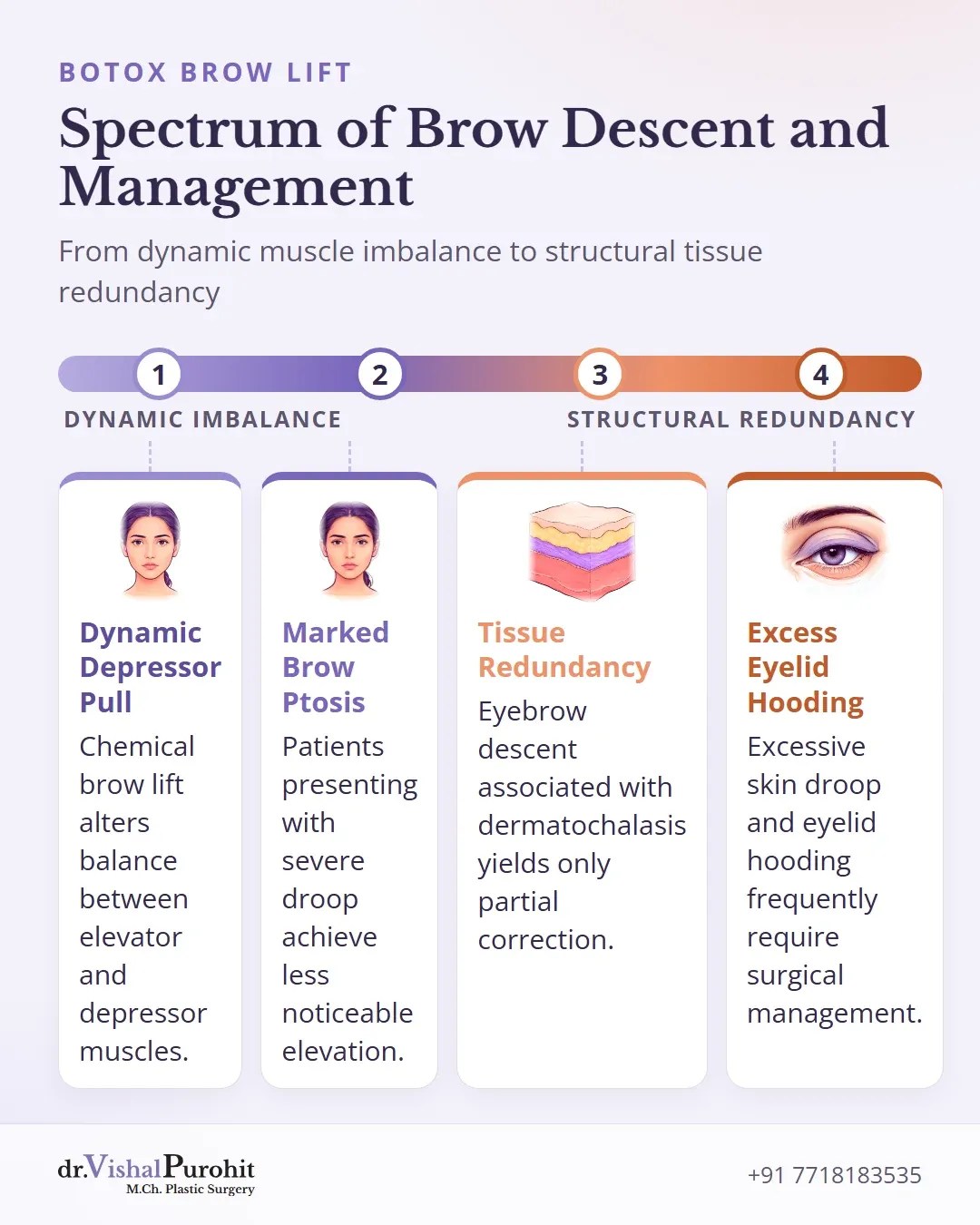
A chemical brow lift relies on the balance between elevator and depressor muscles13. Physical tissue characteristics often define the true threshold of movement:
- Patients presenting with severe brow droop or marked brow ptosis are less likely to achieve noticeable elevation from a neuromodulator1314.
- Eyebrow descent associated with dermatochalasis or substantial tissue redundancy may yield only partial correction15.
- Excessive skin droop, eyelid hooding, or lid ptosis frequently require surgical management rather than additional injectables13.
Recognizing these physical limitations prevents unnecessary repeated injections when the response is restricted by anatomy rather than dosing. In his practice, Dr. Vishal Purohit focuses on evidence-based plastic surgery and anatomical precision to ensure procedures address realistic anatomical boundaries. For pronounced tissue excess, structural evaluation helps determine whether non-surgical options remain appropriate.
Natural Return of Muscle Movement and Retreatment Planning
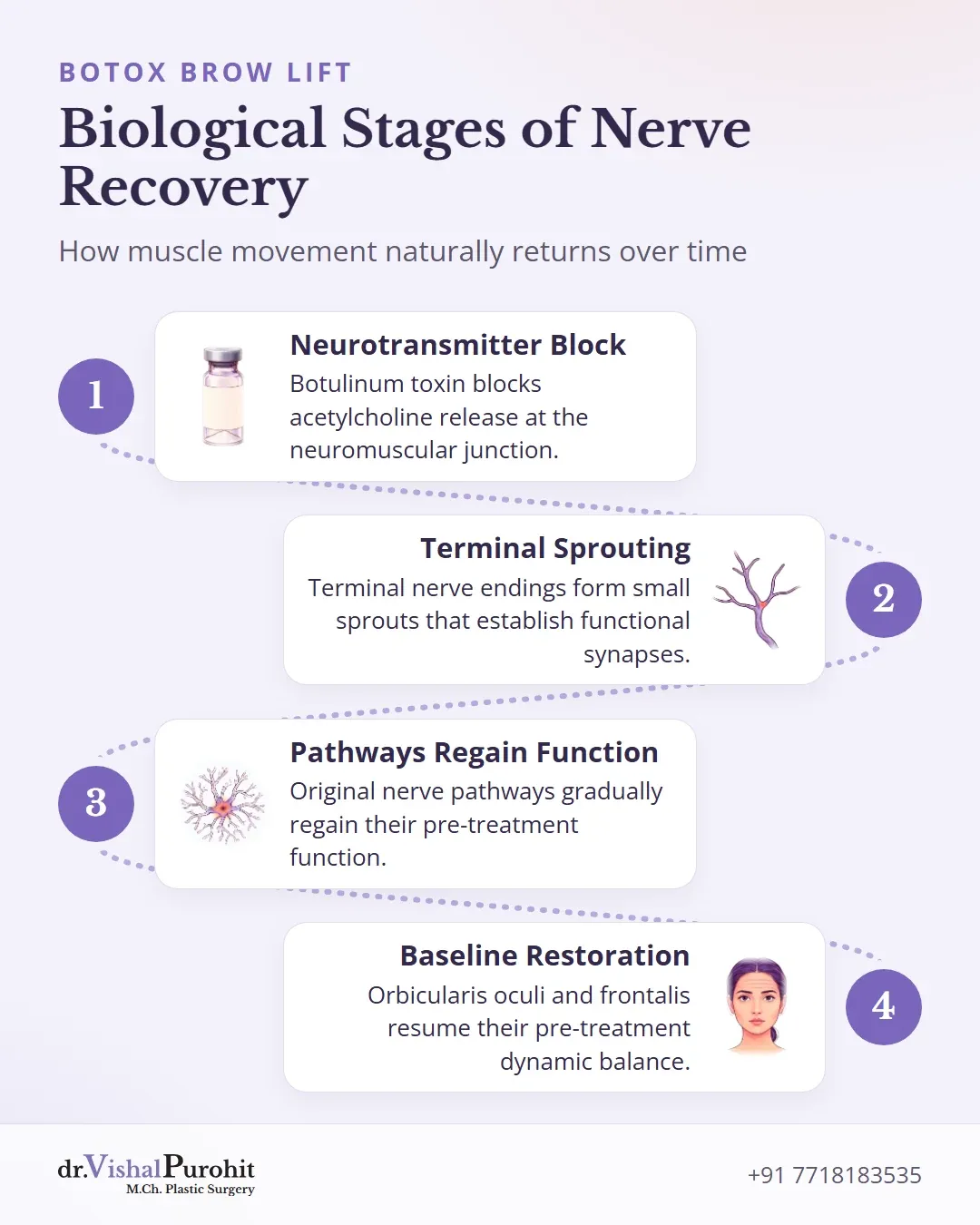
Botulinum toxin temporarily diminishes muscle activity by blocking acetylcholine release at the neuromuscular junction16. As recovery begins, terminal nerve endings form small sprouts that establish functional synapses to release acetylcholine1617. Eventually, original nerve pathways regain function, leading to a gradual restoration of baseline muscle contraction17.
Clinical efficacy generally declines over two to four months as nerve impulse transmission recovers1819.
Planning Further Sessions
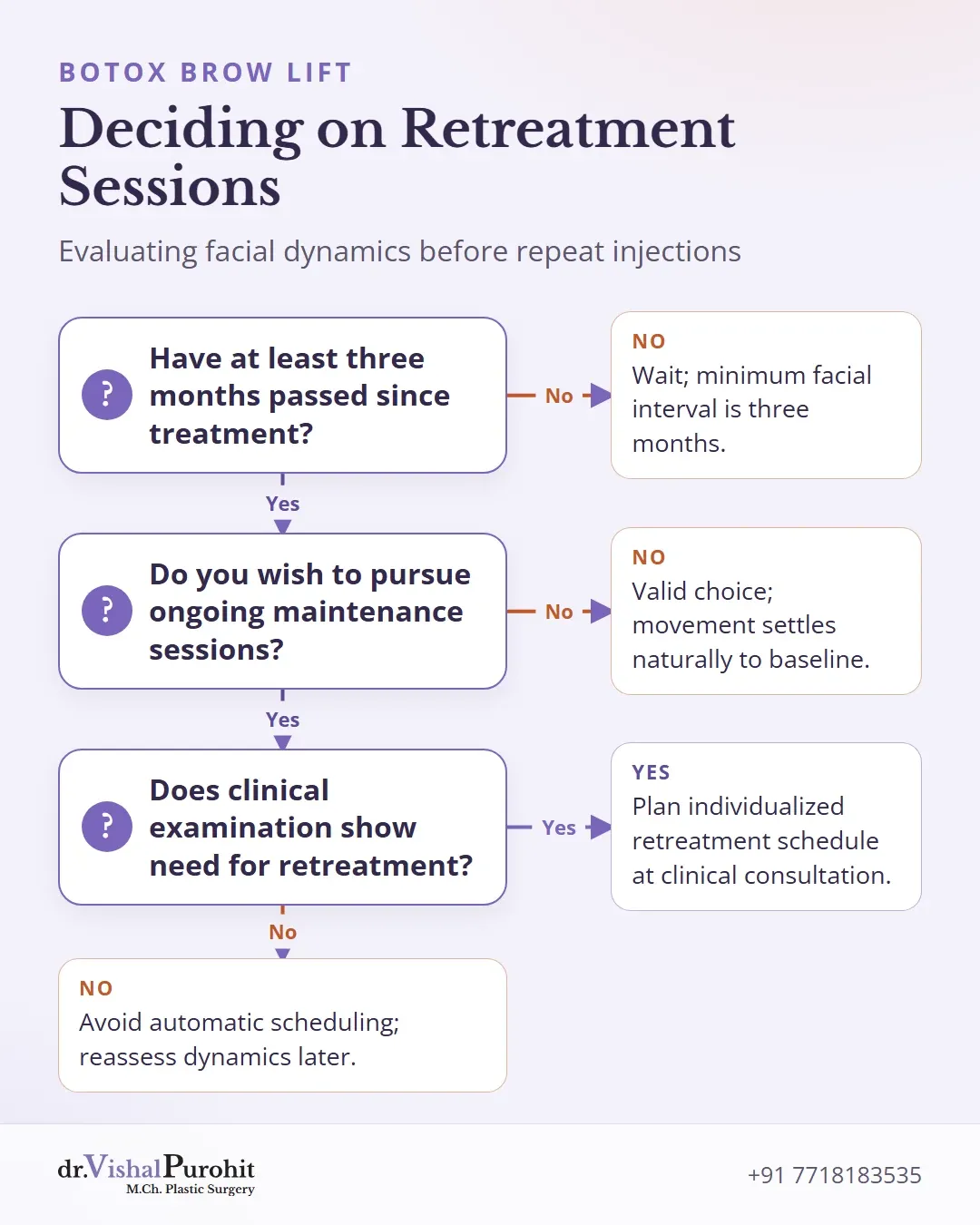
Rather than relying on pre-scheduled top-up appointments, clinical assessment is recommended before repeating treatment:
- Retreatment intervals should be determined through direct clinical examination rather than automatic scheduling20.
- Minimum intervals between facial toxin applications should not be shorter than three months19.
- Choosing no further treatment is always a valid choice, leaving facial movement to settle naturally.
Dr. Vishal Purohit evaluates facial dynamics individually. His specific retreatment schedule and top-up policies are not fixed in advance and are decided at the consultation.
Clinical Consultations for Brow Rejuvenation in Jaipur
Understanding muscle dynamics and structural limitations ensures realistic expectations from non-surgical brow elevation. Detailed anatomical assessment helps distinguish between dynamic descent and excess skin that requires surgical correction. To discuss personalized treatment options, review Botox Brow Lift in Jaipur and explore answers to common concerns in the Botox Brow Lift FAQs. Direct inquiries and appointments can be arranged by contacting Dr. Purohit’s practice by phone or WhatsApp at +91 7718183535.
This is educational information, not medical advice.