
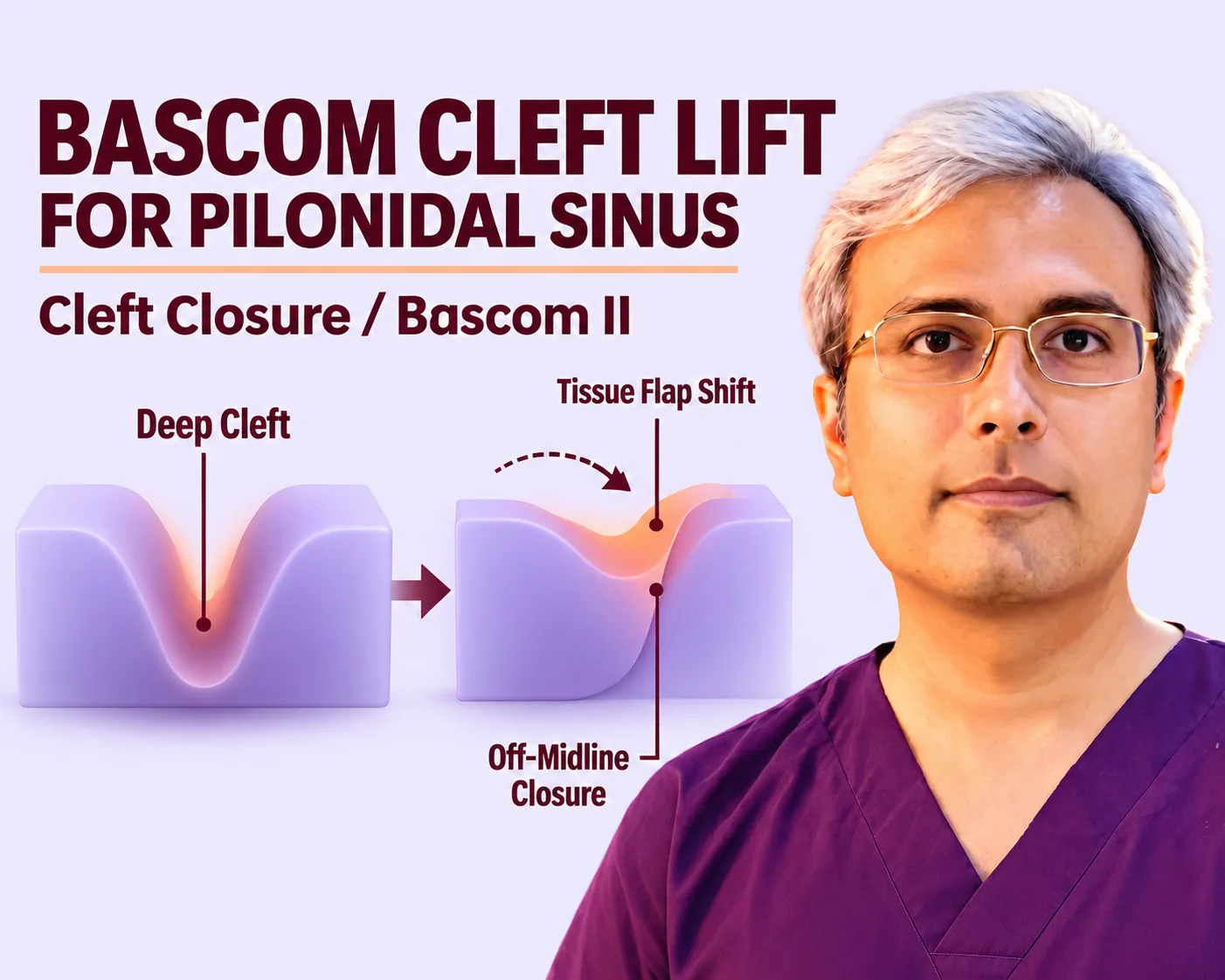
In short
- The cleft lift (Bascom II) removes diseased skin, fills the cleft with folded fat, and closes skin off the midline.
- A large-centre series reports success above 98% in hard repeat cases — a top-end expert-hands result.
- This clinic does not offer it. Dr. Purohit performs Limberg and Karydakis flaps, which share the same flattening logic.
What the cleft lift is and who reads this
The Bascom cleft lift — also called Bascom II or cleft closure — treats pilonidal disease by reshaping the cleft itself rather than just removing the tract. Diseased skin goes, living skin shifts across, and the deep groove becomes shallow.
Pilonidal disease is a stubborn (recalcitrant) condition with real suffering behind it — repeat abscesses, chronic discharge, and time off work or study. Operations that only remove the tract while leaving a deep moist groove invite the same hair-trapping cycle back, which is why reshaping techniques like the cleft lift were developed.
This page serves two readers: patients comparing named operations before choosing a surgeon, and revision cases researching options after failed surgery elsewhere. For the operations actually offered in Jaipur, read the Limberg flap page and the Karydakis flap page — and why plastic-surgery planning matters for fold-shaped wounds.
A naming note first. “Bascom” covers two different operations: pit-picking (Bascom I), a minimal office procedure for early pits, and the cleft lift (Bascom II), the full reshaping operation described here. Mixing them up is a common consultation error — always check which Bascom a quote or success rate refers to.
Step 1: contact mapping and the cut line
Surgery starts with the buttocks pressed together. Where skin touches skin marks the contact zone — the friction area that must be flattened. The cut line is drawn as an asymmetric, shallow oval set off-centre, so the final scar lands outside the moist midline.
Mapping decides the design:
- Scarred skin, pits, and side openings all join the side to be removed
- The flap side is kept whole enough to slide without stretch
- Depth stays shallow — diseased skin and tracts go; healthy deep fat stays
The marking visit often happens days before surgery, with the patient standing and then bending, so the surgeon sees how the contact zone shifts with posture. A design that looks off-centre on the table must sit correctly in daily life — which is why experienced surgeons mark awake, mobile patients rather than only the draped figure on the table.
Step 2: sliding living skin and folding deep fat
A full-thickness skin flap (skin plus its fat layer) is lifted on one side and slid across the defect. Beneath it, deep buttock fat is stitched in folds — a technique called plication — to fill the hollow.
The fat fold does two jobs:
- Kills dead space that would otherwise pool serum under the skin join
- Lifts the cleft floor for good so the filled groove runs shallow, not deep
Shallow is the whole point. A flat, dry cleft traps less hair than a deep, moist one — the same logic behind every off-midline flap.
Keeping the flap full-thickness protects its blood supply. Thin skin flaps starve at the edges; a flap carried with its fat layer brings its own vessels along. This is standard plastic-surgery craft, and it explains why the cleft lift sits naturally in plastic and reconstructive hands rather than as a quick excision.
Step 3: closing to the side over a drain
Skin is closed at the cleft edge — never in the midline depths — over a closed-suction drain. The drain stops the raised flap lifting off its bed in the first days and comes out once measured 24-hour output falls low, often below about 10 to 20 mL.
Edge placement is deliberate geometry. A midline scar sits in the deepest, moistest, highest-shear line of the cleft; an edge scar sits on flatter, drier skin that moves less. Every off-midline operation — cleft lift, Limberg, or Karydakis — exploits this same difference, which is why the three share results more than their cut shapes suggest.
Most reported patients walk the same day, return to desk work in 2 to 3 weeks, and resume full sport by 6 to 8 weeks — milestones shared with Limberg and Karydakis recovery.
Drain care mirrors other flap drains: keep the bulb flat, log daily output, and watch for bright-red refills or abrupt blockage with new swelling. Sitting stays brief and cushioned in the first fortnight, and the scar is kept clean and dry until the surgeon confirms sealing at review visits.
Abscess-stage patients follow the same staged rule as every other flap candidate. An active collection is drained first through an off-midline cut, and reshaping waits 6 to 12 weeks until redness and discharge settle. No reshaping operation — cleft lift, Limberg, or Karydakis — belongs in infected tissue.
Who the cleft lift suits best
Literature points to two groups gaining most: deep-cleft patients whose anatomy keeps re-trapping hair, and repeat-disease patients whose midline is too scarred for another midline attempt. Both share one trait — the problem is the cleft shape as much as the tract, so reshaping pays off.
It suits least where disease is minimal: a few quiet pits without branching may not need a reshaping operation at all. Matching operation size to disease size is the real skill — the biggest named procedure is not the best answer for the smallest disease.
What published series report
A large single-centre series in complex and repeat disease reports success above 98% in expert hands — the highest published ceiling for any named pilonidal operation. Smaller procedural reports (including a 30-patient series) describe technique details rather than comparative proof; no head-to-head trial ranks the cleft lift against Limberg or Karydakis flaps.
Read the ceiling as a ceiling. A 98%-plus figure from a high-volume expert centre shows what the operation can achieve — not what every setting averages. Patients comparing surgeons should therefore ask about case volume and follow-up length alongside any quoted rate, since short follow-up undercounts return of disease everywhere.
Key figures from published series
- Large single-centre cleft-lift series in complex and repeat disease: success above 98% (Bascom cleft-lift literature, endpoint as published).
- A 30-patient procedural series (ResearchGate-listed Bascom report) and small Limberg (n=2) and Dufourmentel notes (0.1% and 28.5% for separately defined endpoints) are single-tool series, not head-to-head trials.
What Dr. Vishal Purohit does in Jaipur
Dr. Vishal Purohit, an M.Ch plastic surgeon, does not perform the Bascom cleft lift in Jaipur. He performs Limberg and Karydakis off-midline flaps, which share the cleft lift’s core logic — remove the disease, flatten the cleft, close off the midline — and suit most cleft shapes seen in clinic.
The reasoning is practical: regular use of a matched flap beats rare use of any single named technique. Revision cases after cleft lifts done elsewhere are mapped for scarring and tracts, then offered Limberg or Karydakis salvage reconstruction where tissue allows. No phenol, laser, or endoscopic shortcuts are offered.
Counselling stays comparative and honest. Patients who arrive asking for a cleft lift by name hear what it does well, where its best figures come from, and which flap shape their own cleft maps to — then receive a named written plan. The goal is the flattest lasting cleft for that body, not loyalty to any one eponym.
This is educational information, not medical advice.