
Marionette lines emerge from the corners of the mouth and extend down toward the jawline. Because lower facial creases share overlapping areas with smile lines, reviewing Fillers for Smile Lines: Why Nasolabial Folds Need Assessment helps clarify how distinct structural regions demand separate clinical evaluations.
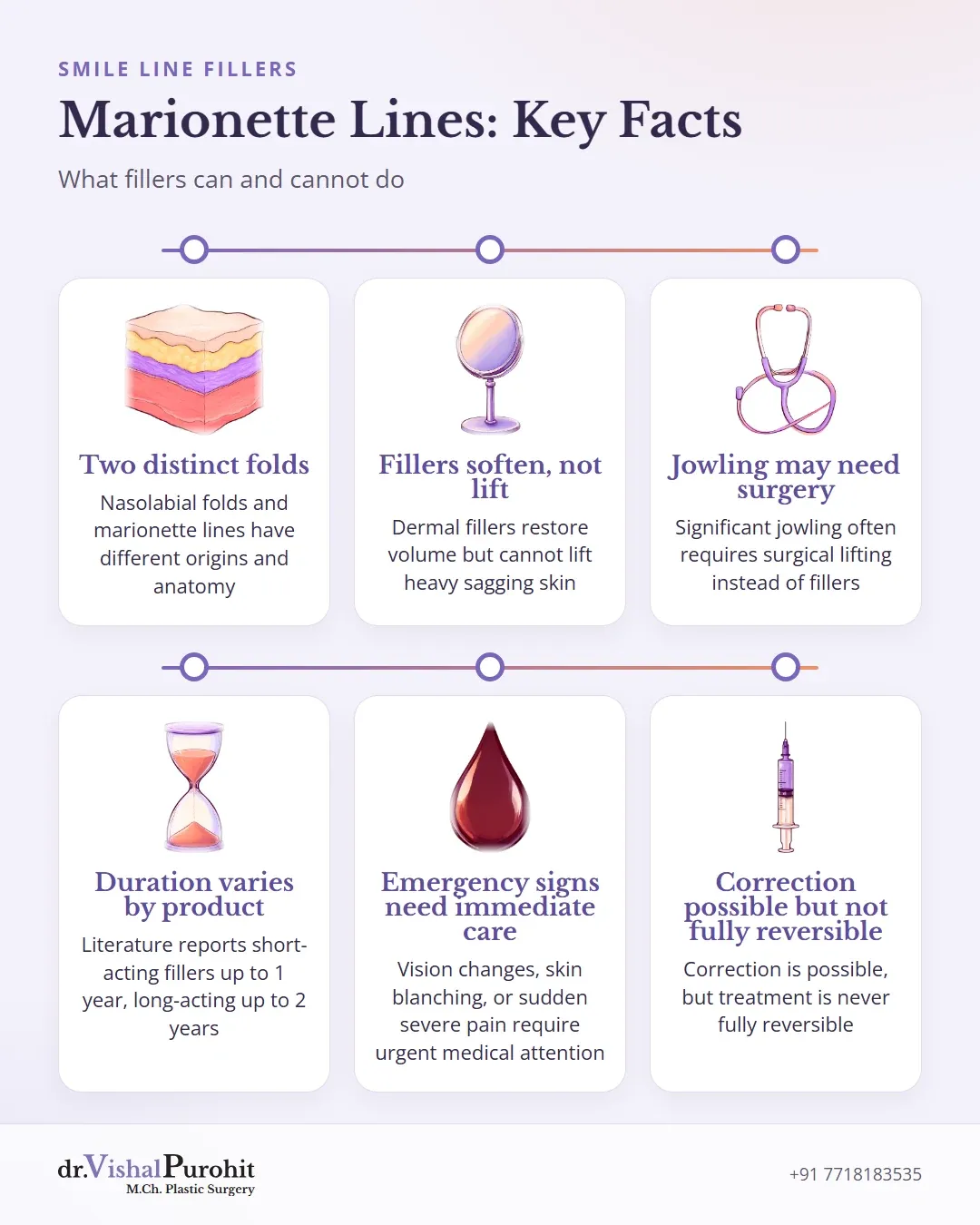
Non-surgical dermal filler softens localized hollows and downturned mouth corners by providing soft tissue support. However, dermal filler expands tissue outward rather than lifting heavy skin, making individualized assessment essential before any treatment is planned.
Nasolabial Folds Versus Marionette Lines
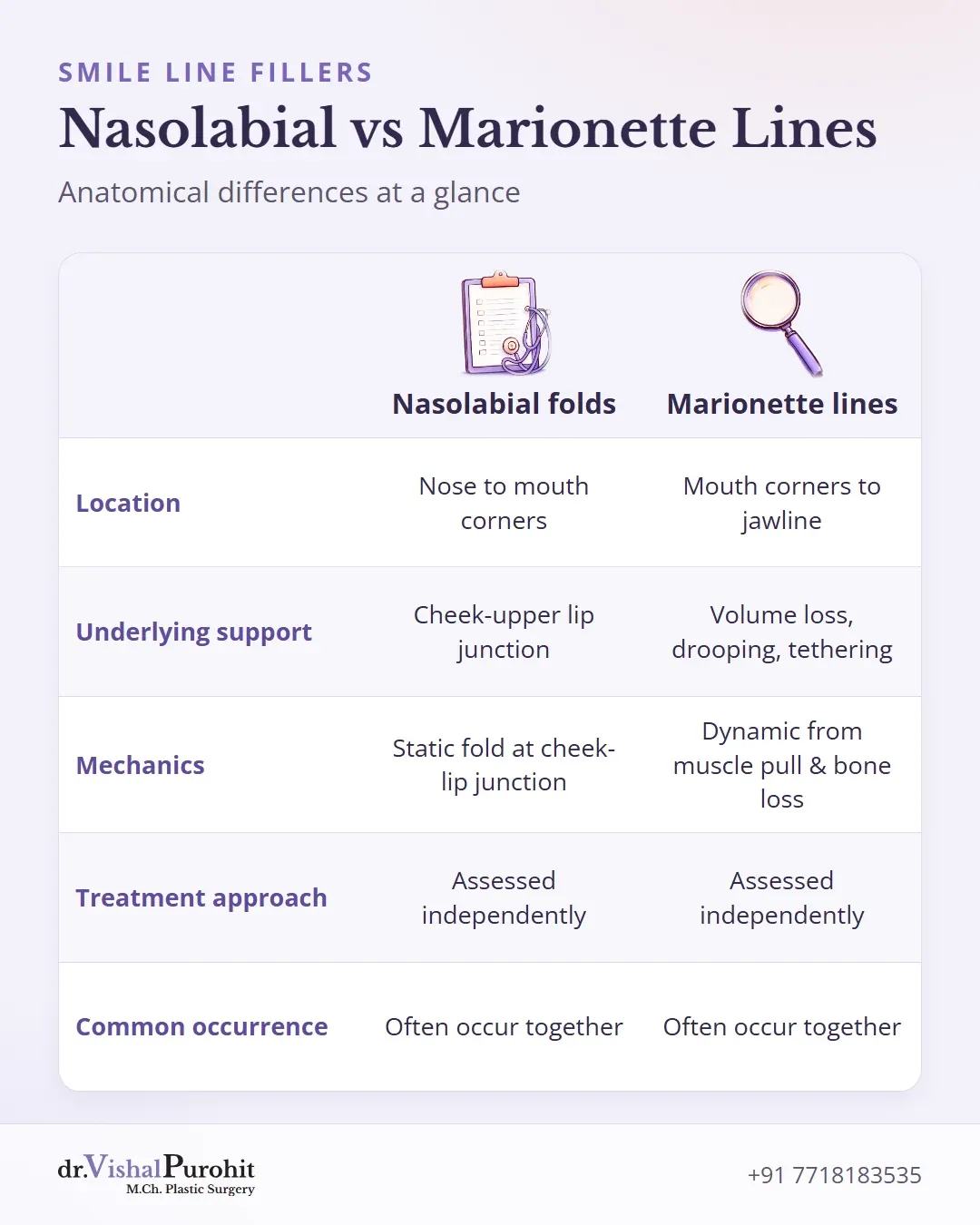
Nasolabial folds and marionette lines represent two anatomically distinct lower facial concerns1. Nasolabial folds run from the sides of the nose down to the corners of the mouth12. In contrast, marionette lines, or melomental folds, originate at the oral commissures and extend downwards toward the mandibular margin and jawline13.
Clarifying which crease is being pointed to during evaluation ensures the correct anatomical territory is addressed. The two regions differ in their underlying support and mechanics:
Nasolabial Folds
- Track the junction between the cheek and upper lip2.
Both folds frequently occur together in the aging face4. However, addressing one crease while ignoring the other can distort the natural balance of facial features4.
Dr. Purohit’s note: Dr. Vishal Purohit examines each region independently during the consultation rather than assuming a single combined treatment package.
Each fold presents unique structural demands that require distinct clinical evaluation before any dermal filler procedure is planned.
Volume Loss Versus Progressive Jowling
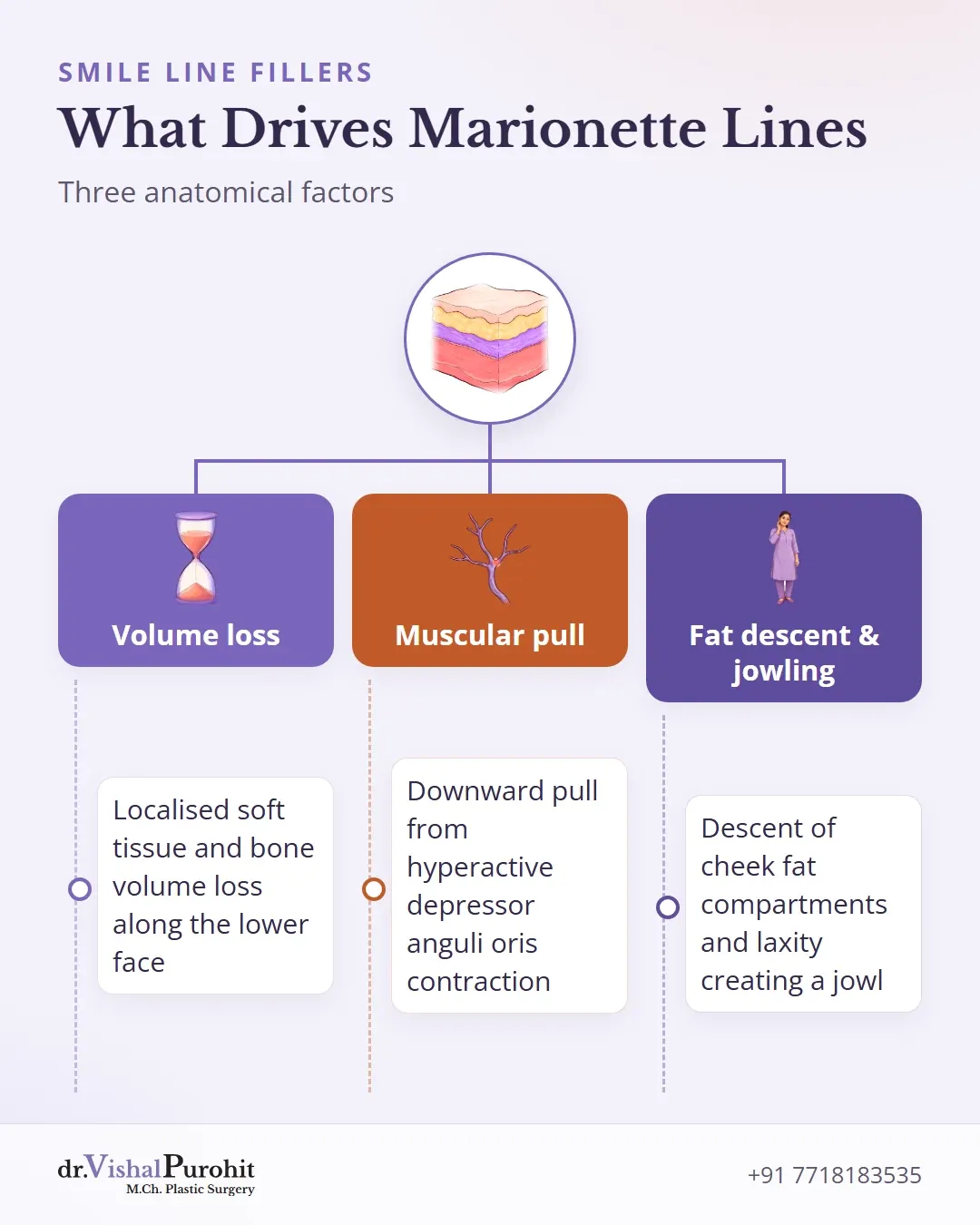
Creases extending downward from the oral commissures can arise from distinct anatomical factors:
- Localised soft tissue and bone volume loss along the lower face567.
- Downward muscular pull from hyperactive depressor anguli oris contraction56.
- Descent or redistribution of cheek fat compartments and laxity creating a jowl568.
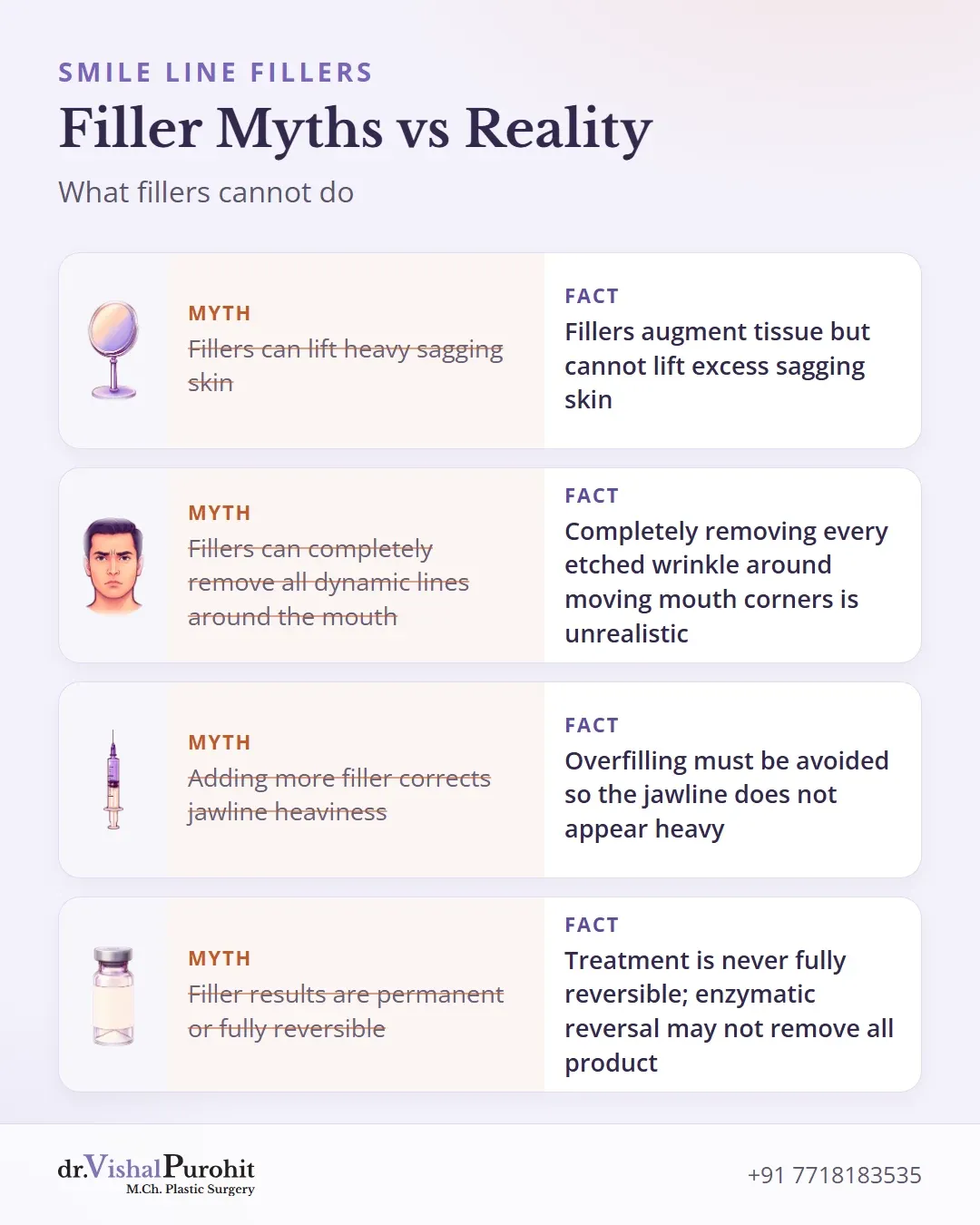
When substantial skin laxity and heavy, descending jowls dominate lower-face aging, simply adding dermal filler into the fold can weigh down the jawline or worsen lower-face heaviness8910. Dermal filler provides soft tissue augmentation rather than lifting excess sagging skin7910.
During assessment in Jaipur, Dr. Vishal Purohit evaluates whether the crease stems primarily from discrete volume deficits or structural soft-tissue descent. For individuals presenting with significant jowling, choosing no treatment remains a completely valid outcome, while others may consider surgical options for structural support10. Any treatment approach is individualized and decided at the consultation.
Possible Improvement and Treatment Limits
Dermal filler injections can help restore support to the lateral lower lip, improve downturned oral commissures, and soften prominent folds that extend toward the jaw11. Clinical reports also describe a pronounced reduction in shadowing across the marionette area12.
However, non-surgical filler treatment has distinct anatomical boundaries:
- Tissue support: Fillers can provide structural support and soften hollows, but they cannot lift heavy loose skin or address significant sagging folds1113. Overfilling must also be avoided so the jawline does not appear heavy12.
- Dynamic lines: Completely removing every etched wrinkle around moving mouth corners is unrealistic. Marionette folds develop from a combination of soft tissue volume loss, mandibular bone resorption, reduced skin elasticity, dermal atrophy, buccal descent, and hyperdynamic lower facial musculature11.
Whether dermal fillers are suitable for an individual patient, or if another surgical approach is required, is decided at the consultation with Dr. Vishal Purohit. Specific injection techniques and product choices are also evaluated and decided at the consultation.
When a Lifting Approach Fits Better
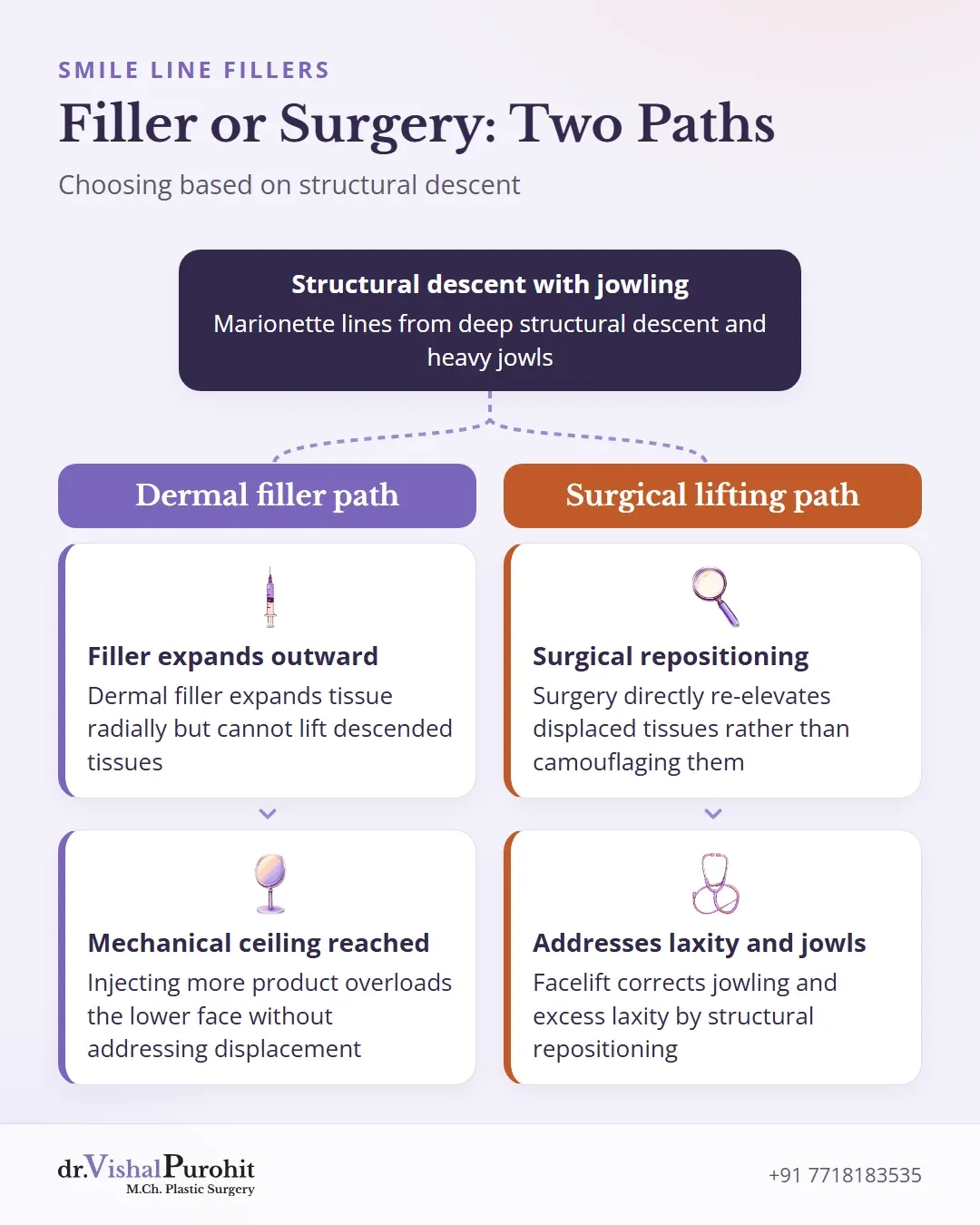
When marionette lines stem primarily from deeper structural descent, lower facial sagging, or prominent jowling, non-surgical dermal fillers reach a clear mechanical ceiling. In aesthetic surgery literature, fillers expand tissue radially in an outward direction rather than lifting the face vertically14. Attempting to overcome pronounced sagging solely by injecting more product can overload the lower face without addressing the underlying anatomical displacement.
Key points
- Fillers expand tissue outwards rather than lifting vertically, reaching limits when pronounced sagging is present.
- Surgical repositioning re-elevates descended tissues to address prominent jowls and excess skin laxity directly.
- The right treatment approach depends on an individualized evaluation of facial anatomy and aesthetic goals.
In situations where tissue laxity and heavy jowls predominate, surgical repositioning provides a more appropriate mechanical answer15,14. A surgical procedure such as a facelift directly addresses jowling and excess laxity by re-elevating descended tissues rather than attempting to camouflage them through tissue expansion15,16.
Whether a patient is better suited for dermal fillers, a surgical lifting procedure, or another approach is not a predetermined formula. In Dr. Vishal Purohit’s practice, the appropriate choice is decided at the consultation after evaluating individual lower facial anatomy, degree of tissue laxity, and aesthetic goals. For some individuals, choosing no treatment remains an entirely valid personal option.
Managing Unevenness or Unwanted Fullness

Persistent unevenness, fullness, or lumps below the mouth corners require clinical evaluation by a qualified doctor rather than aggressive self-massage or adding more volume17. Non-inflammatory lumps after hyaluronic acid filler can stem from improper product placement, excess volume, or muscle movement displacing the product17. Corrective options depend on the clinical assessment and may include gentle molding, enzymatic reversal, or filler evacuation through a small stab incision17.
Hyaluronic acid dermal filler can often be dissolved using hyaluronidase, an enzyme that hydrolyses the product171819. However, treatment is never fully reversible, as enzymatic reversal may not remove all product and carries its own clinical risks20. The approach to any review or dissolving is decided at the consultation with Dr. Vishal Purohit.
Certain warning signs represent acute complications and require emergency medical care at once:
Reviewing Results Over Time
The duration of lower face filler varies widely based on individual facial movement and metabolic factors. In the lower two-thirds of the face, muscle movement from facial expressions combines with volume loss and tissue laxity21. In general literature, facial dermal fillers are described with wide latitude, where short-acting options may last up to 1 year and long-acting products up to 2 years22. Biodegradability also directly influences how long a product persists22.
Fading volume does not automatically mandate an immediate refill on a fixed calendar schedule. How long results last in his patients, as well as the timing of any review visit or touch-up policy, is not confirmed yet and is decided at the consultation.
When considering retreatment over time, several factors guide clinical evaluation:
- Ongoing natural facial movement and biometric tissue changes21
- Individual variation in filler degradation and metabolic persistence23
- Gradual softening of soft tissue support rather than an arbitrary calendar date2324
Each individual assessment determines whether further treatment is suitable.
Consultation for Marionette Lines in Jaipur
Lower facial creases require an anatomical evaluation to determine whether dermal filler or structural repositioning is the appropriate path. For those exploring treatment around the mouth, reviewing Smile Line Fillers in Jaipur and reading the Smile Line Fillers FAQs can provide helpful clarity. In Dr. Vishal Purohit’s practice, whether to treat, consider surgery, or choose no treatment remains an individual clinical decision decided at the consultation.
This is educational information, not medical advice.