
A Botox lip flip relaxes superficial orbicularis oris muscle fibers to subtly roll the upper vermilion outward. Initial changes emerge gradually over several days, with peak outward eversion typically visible around two weeks as neuromodulator activity fully establishes.
Because botulinum toxin provides temporary chemodenervation rather than physical volume, it cannot be dissolved on demand. Patients interested in motor changes should explore Lip Flip Function: Drinking, Eating, Speech, and Habits to understand how muscle relaxation influences daily oral movement.
Onset Peak Appearance and Gradual Fading
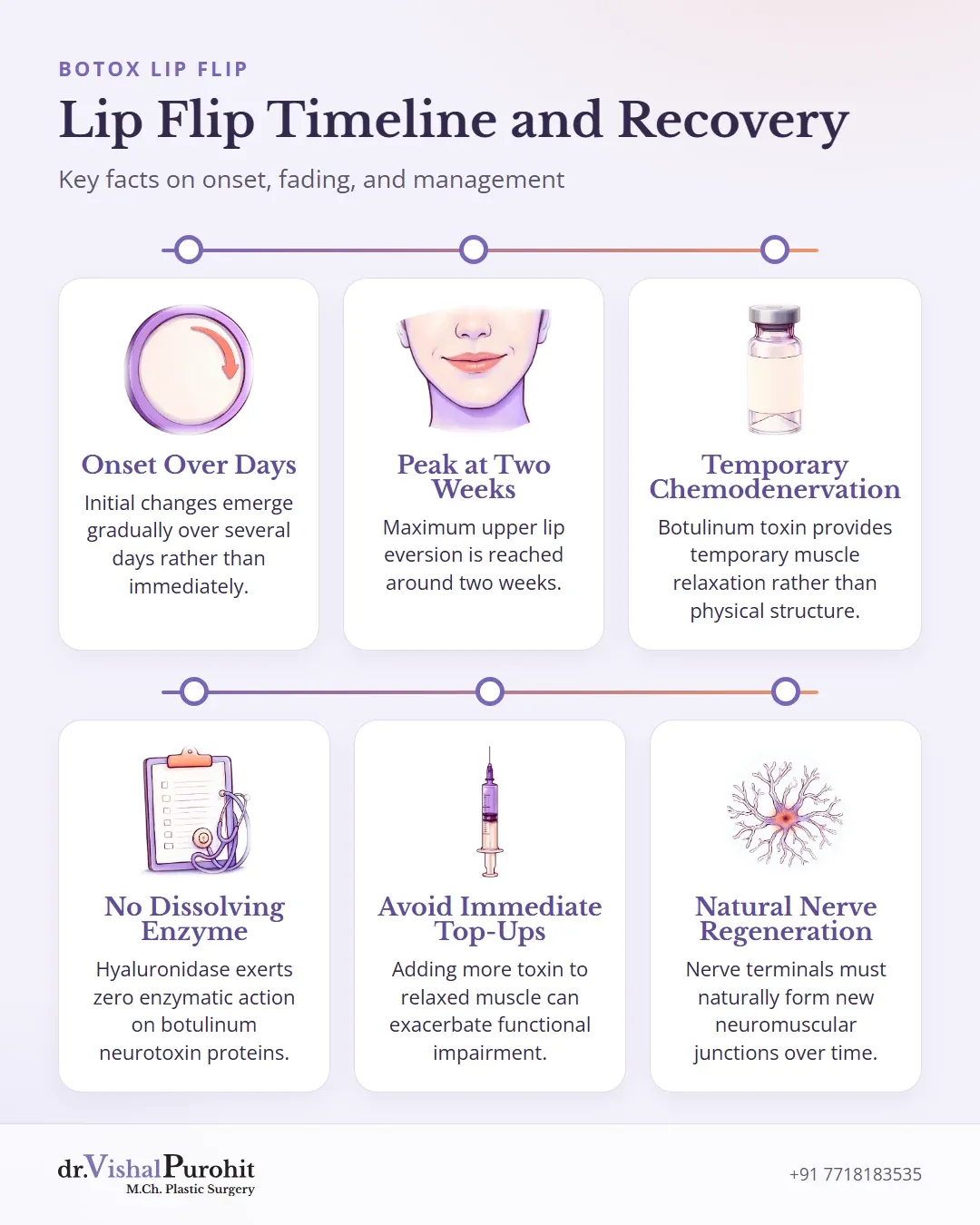
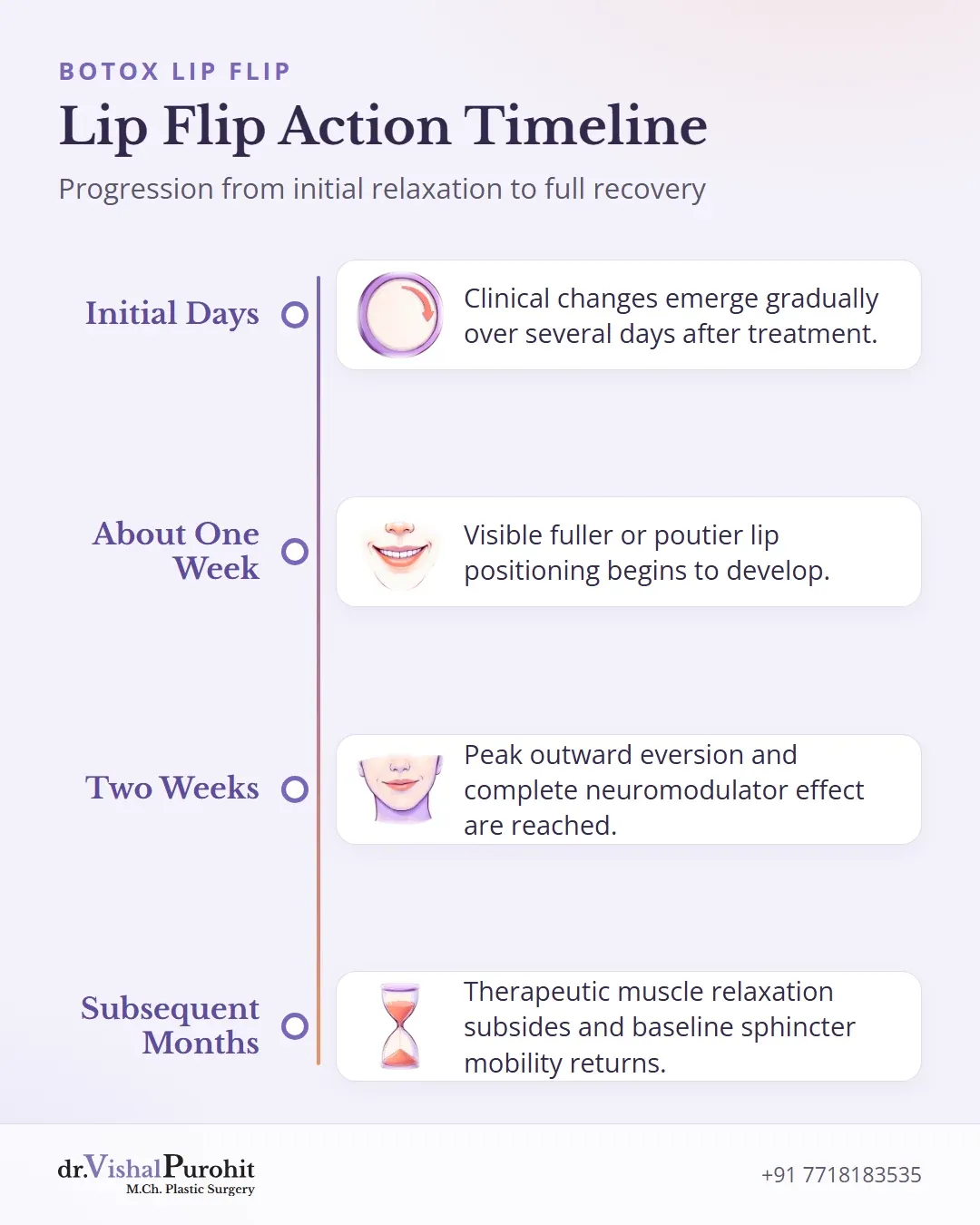
A Botox lip flip relaxes superficial orbicularis oris muscle fibers, allowing the upper vermilion to roll gently outward1. Initial clinical changes emerge gradually over several days rather than appearing immediately2. In general published findings, visible fuller or poutier lip positioning develops after about one week2.
Peak aesthetic eversion and complete neuromodulator effect are reached by approximately two weeks2. By this stage, temporary weakening of the underlying muscle fibers allows maximum outward display of the upper lip12. Weakening of the orbicularis oris muscle also temporarily softens local contraction lines, though excessive weakness can compromise normal pursing or smile symmetry34.
Dr. Purohit’s note: The precise onset timeline and total treatment duration for an individual patient are evaluated and discussed during consultation.
Over the subsequent months, this therapeutic muscle relaxation gradually fades. As neuromodulator activity subsides, physiological muscle activity and baseline sphincter mobility steadily return15.
Published Measurements and Real-World Variation
Clinical literature examining botulinum toxin type A upper lip eversion is largely limited to small series and case reports6. In one preliminary report of three patients receiving botulinum neurotoxin along the upper vermilion border, subtle upper lip eversion was recorded at two weeks without oral movement difficulties during short follow-up7.
Another study evaluated temporary upper lip projection by selective neuromodulation of the orbicularis oris, noting exploratory outcomes without dynamic assessments such as smiling views6. In consumer medical guidance, visual changes take about one week to appear, with full effect observed around two weeks2.
Patient experiences often reflect considerable variation in how long visible relaxation persists. In the practice of Dr. Vishal Purohit, expected onset and overall duration are not fixed in advance and are decided at the consultation.
Why Lip Flips Are Not Reversible Trials
A Botox lip flip cannot act as an immediately reversible test run for dermal fillers. Although botulinum toxin provides temporary chemodenervation rather than a permanent surgical alteration8, its effects cannot be dissolved or halted on demand.
Key points
- A lip flip cannot serve as a reversible trial because its effects cannot be dissolved on demand.
- Resolution of unwanted muscle weakness relies entirely on the toxin wearing off gradually over time.
When unwanted outcomes or unintended muscle weakness occur after botulinum toxin placement, resolving the issue generally depends on the gradual diminishing of the toxin’s effect over time9. It is not an instant on-off switch.
Key Differences in Treatment Behavior
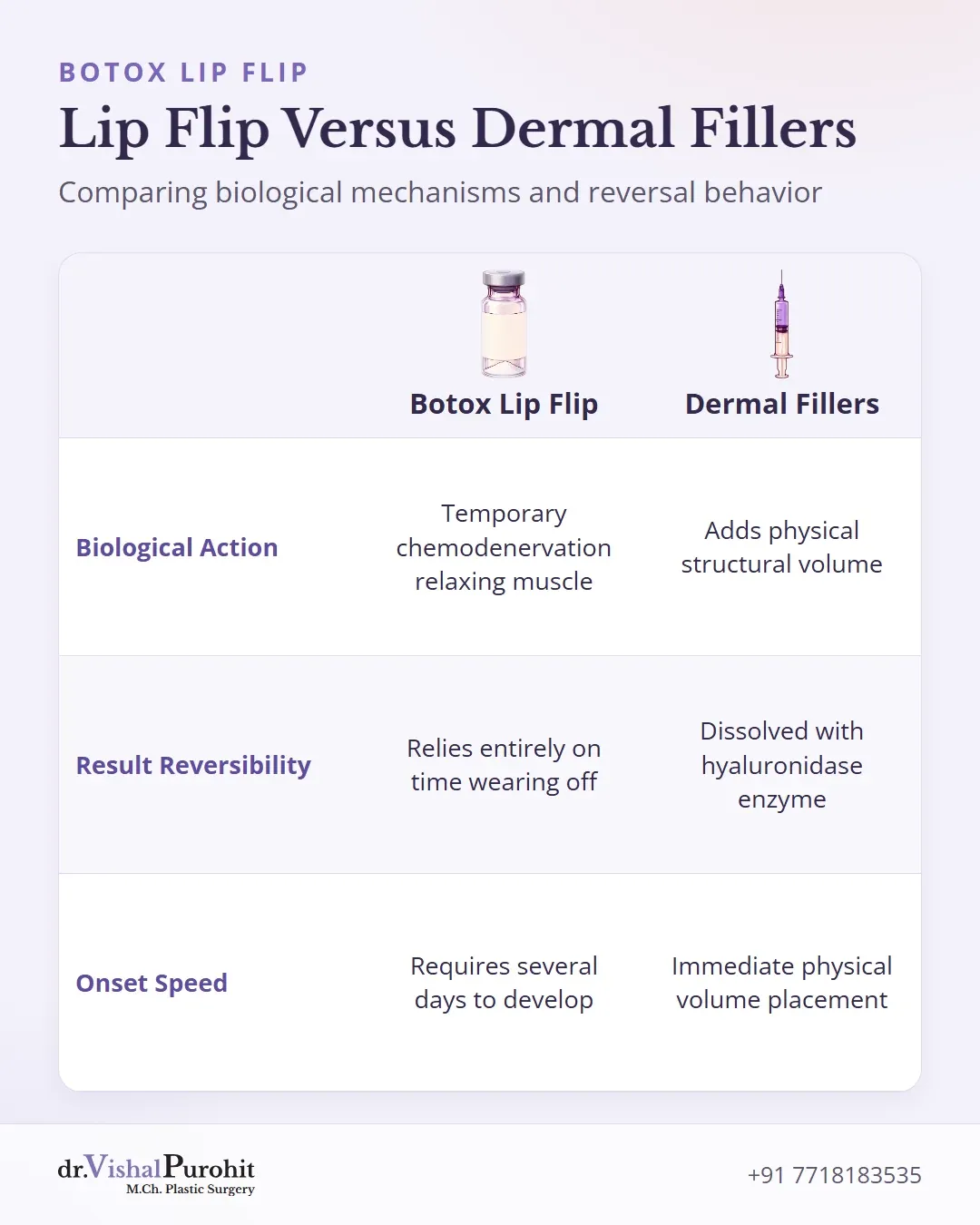
- Botulinum toxin works by temporary chemodenervation rather than adding physical structure8.
- Unlike hyaluronic acid fillers that can be dissolved if needed, toxin reversal relies entirely on time as the effect wears off9.
- Results are not immediate and require several days to develop10.
- Choosing no treatment remains a valid personal decision for every patient.
In his practice in Jaipur, Dr. Vishal Purohit evaluates each patient individually during consultation. Clinical photographs taken are preserved strictly for medical treatment records and are never displayed publicly.
Discussing Disappointment and Avoiding Top-Ups
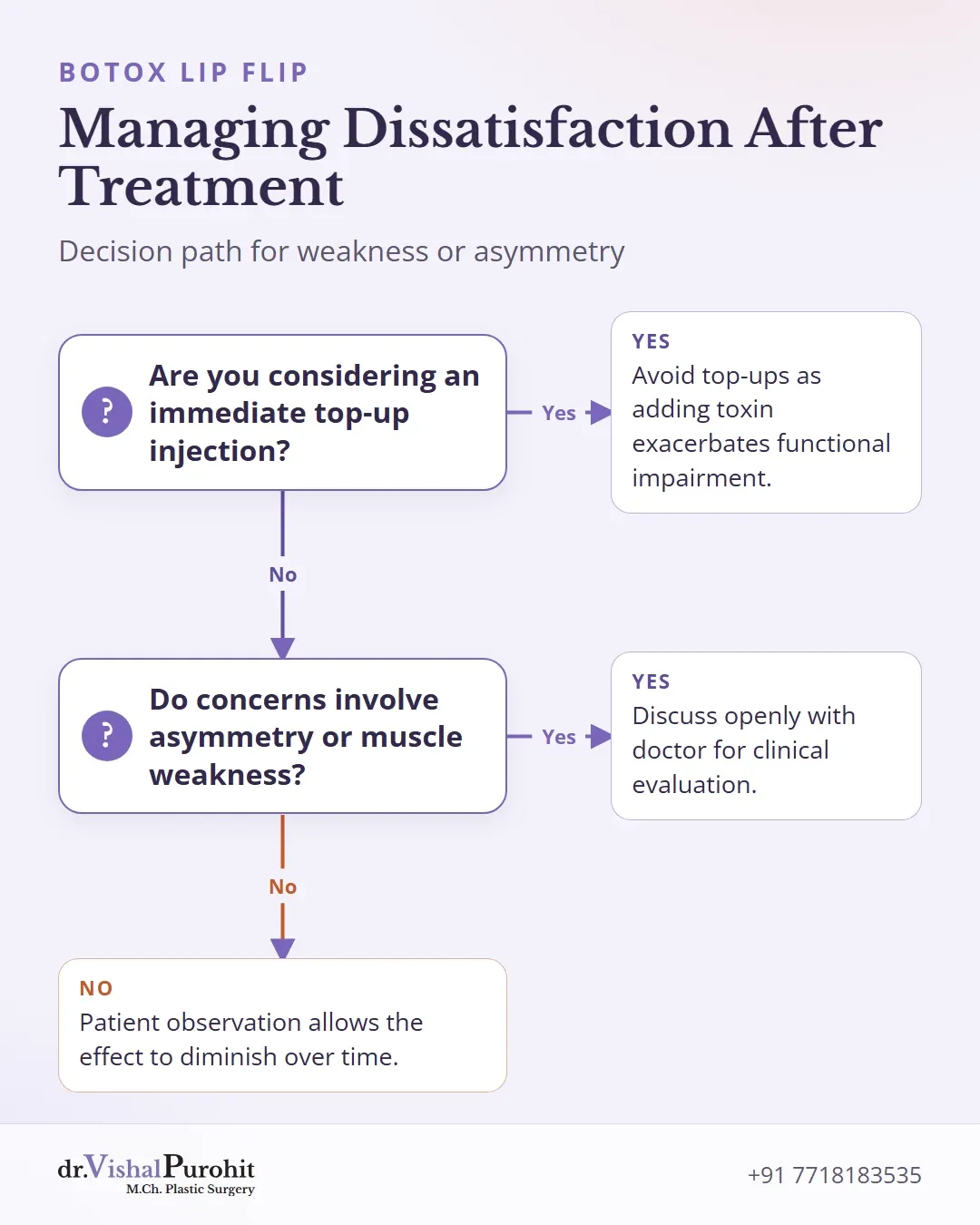
When unexpected asymmetry, weak smile movement, or dissatisfaction occurs after a lip flip, patients should discuss these concerns openly with the doctor rather than seeking an immediate top-up injection.
In cosmetic botulinum toxin procedures, improper placement or unintended diffusion of toxin can lead to excessive muscle weakness, which may cause temporary functional impairments or cosmetic defects9. Adding more botulinum toxin to an already relaxed orbicularis oris muscle can exacerbate functional impairment. In such circumstances, improvement depends upon the diminishing effect of the toxin over time, requiring patient observation rather than corrective injections9.
General aesthetic literature notes that patients are typically advised to return to the clinic within two weeks if they have concerns regarding asymmetry or complications11. However, Dr.
If functional issues or cosmetic concerns arise, an in-person assessment allows the doctor to evaluate muscle activity and determine whether observation is the safest course of action.
Reassessing Function Before Repeat Sessions
Treatment with botulinum toxin has a temporary effect, so repeat procedures are necessary to sustain the appearance1213. However, scheduling any subsequent session should never follow a rigid standardized calendar. Patient safety and individual satisfaction remain primary.
At Dr. Vishal Purohit’s practice in Jaipur, scheduling and the decision to proceed with repeat treatments are not preset; they are decided at the consultation.
Before planning another session, a thorough evaluation is essential to confirm that prior muscle relaxation has cleared and that normal oral motor function has returned12.
Key Clinical Assessments

A follow-up consultation focuses on three key areas:
- Personal aesthetic goals: Reviewing whether the lip appearance continues to align with what the patient desires2.
- Cosmetic benefit: Confirming whether the outward roll of the upper lip vermilion produced a satisfactory result4.
- Baseline oral motor competence: Ensuring full return of muscle strength, as repeated injections require clinical reassessment of movement and functional recovery1214.
Hyaluronidase Misconceptions and Reversal Limits
A common misconception among patients is that an unwanted Botox lip-flip result can be quickly reversed or dissolved using hyaluronidase. In clinical practice, Dr. Vishal Purohit clarifies that this enzyme cannot undo the effects of a neurotoxin.
Key points
- Hyaluronidase only dissolves hyaluronic acid fillers and cannot reverse botulinum neurotoxin.
- Botox acts on nerve terminals and is unaffected by enzymatic degradation from hyaluronidase.
- Recovery from an unwanted lip-flip requires waiting for nerve terminals to regenerate naturally over time.
Distinct Mechanisms of Action

The biological targets of these two injectable treatments explain why reversal is not possible:
- Hyaluronic acid degradation: Hyaluronidase is an enzyme that specifically degrades hyaluronic acid matrices15, which is why it can disperse or dissolve hyaluronic acid dermal fillers1617.
- Presynaptic neurotoxin binding: Botulinum toxin acts by binding neuronal membranes to cleave SNARE proteins and inhibit acetylcholine exocytosis at the motor endplate18.
Because hyaluronidase exerts zero enzymatic action on botulinum neurotoxin proteins1518, it provides no clinical reversal for excessive lip relaxation, asymmetrical movement, or functional weakness.
Management of Unwanted Relaxation
When botulinum toxin type A produces an undesirable lip-flip result, the chemical denervation is reversible only through biological recovery18. Affected nerve terminals must naturally form new functional neuromuscular junctions over time18. Consequently, patients experiencing an unsatisfactory outcome must wait for the neurotoxin effect to wear off gradually.
Lip Flip Consultation in Jaipur
Planning a non-surgical aesthetic procedure requires a balanced assessment of individual muscle dynamics and realistic expectations. To understand treatment indications, explore Botox Lip Flip in Jaipur or review Botox Lip Flip FAQs. An in-person consultation with an M.Ch. plastic surgeon ensures that oral motor competence and aesthetic goals are evaluated carefully before deciding on any injection.
This is educational information, not medical advice.