
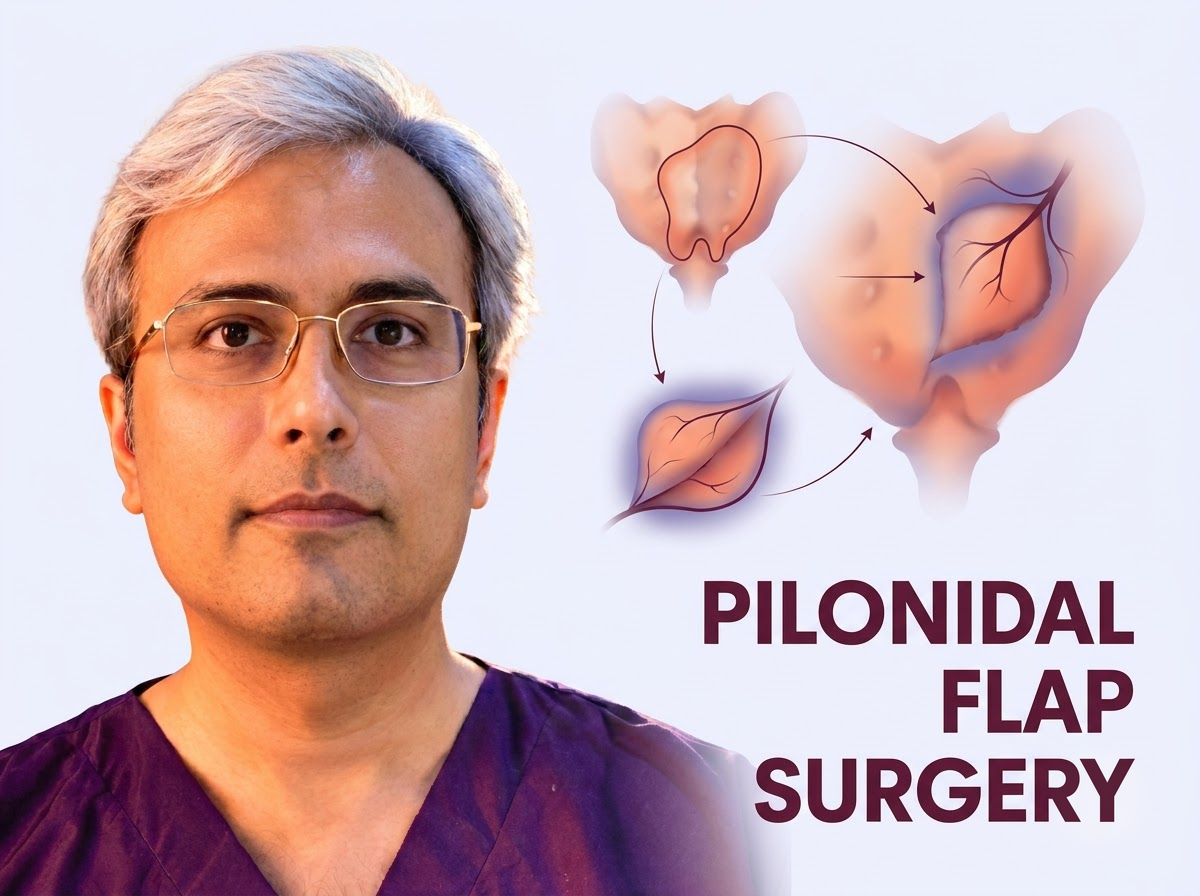

Why Flap Surgery is the Gold Standard for Pilonidal Sinus
Pilonidal sinus disease is a chronic condition affecting the upper gluteal cleft. While traditional general surgery approaches treat it with simple excision or open packing, these techniques carry an unacceptably high recurrence rate between 20% and 35%, leaving patients with months of painful dressings and wound breakdown.
As a plastic and reconstructive surgeon, Dr. Vishal Purohit addresses the primary root cause: the depth of the anatomical natal cleft and the midline shearing forces that pull hairs inward. By mobilizing vascularized fasciocutaneous tissue (such as the Limberg Rhomboid Flap or Karydakis Off-Midline Flap), we permanently flatten the cleft and position the suture line away from the midline friction zone.
Advanced Surgical Flap Options
1. Limberg (Rhomboid) Transposition Flap
Following a precise 60°/120° rhomboid excision of all sinus tracts, a full-thickness fasciocutaneous flap is mobilized from the adjacent gluteal region. The flap rotates into the defect, transferring healthy vascularized tissue and completely eliminating the deep cleft.
2. Karydakis Off-Midline Flap
An asymmetrical elliptical excision that undermines a thick skin-fat flap on one side, advancing it across the midline to secure the surgical scar laterally. This technique produces rapid healing and an aesthetically subtle contour.
3. Bascom Cleft Lift Procedure
Specially indicated for multi-recurrent or refractory sinuses with extensive scarring, moving the cleft apex outward to prevent hair accumulation.
Recovery & Healing Timeline
Unlike open secondary healing which requires 2 to 4 months of painful daily dressings, reconstructive flap surgery heals primarily:
- Day 1–2: Comfortable walking, pain managed with mild oral analgesics.
- Day 7: Clinical wound inspection and hygiene verification.
- Day 12–14: Suture removal; incision is strong and durable.
- Week 3: Full resumption of desk work, driving, and routine physical activity.