
Distinguishing between filler migration and facial overfilling is essential when assessing an unnatural post-treatment contour. While displaced product shifts into adjacent tissue compartments, excessive volume creates disproportionate fullness across the injection site.
Early swelling can closely mimic displacement during initial recovery, making careful clinical assessment necessary before considering intervention. For patients exploring corrective pathways, understanding Dissolving Fillers with Hyaluronidase: What Patients Should Know provides clinical context on how misplaced hyaluronic acid deposits are evaluated and managed.
Distinguishing Migration From Overfilling
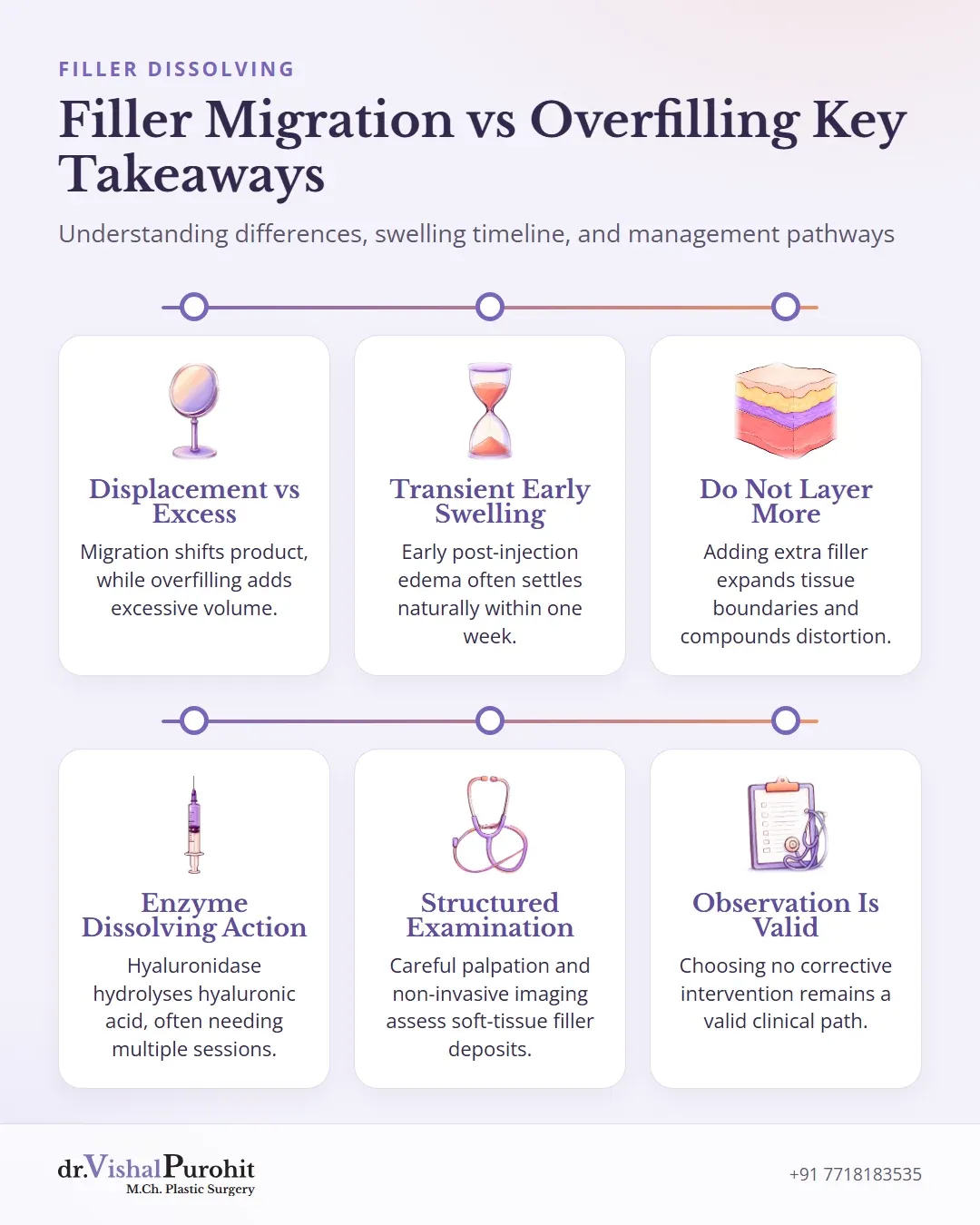
Filler migration occurs when hyaluronic acid gel shifts from its original anatomical site into adjacent tissue compartments1. In contrast, overfilling reflects excessive product volume placed in the target area2. While their physical origins differ, both issues can present with unwanted prominence, distorted proportions, or a loss of natural facial contours2.
Key Clinical Differences
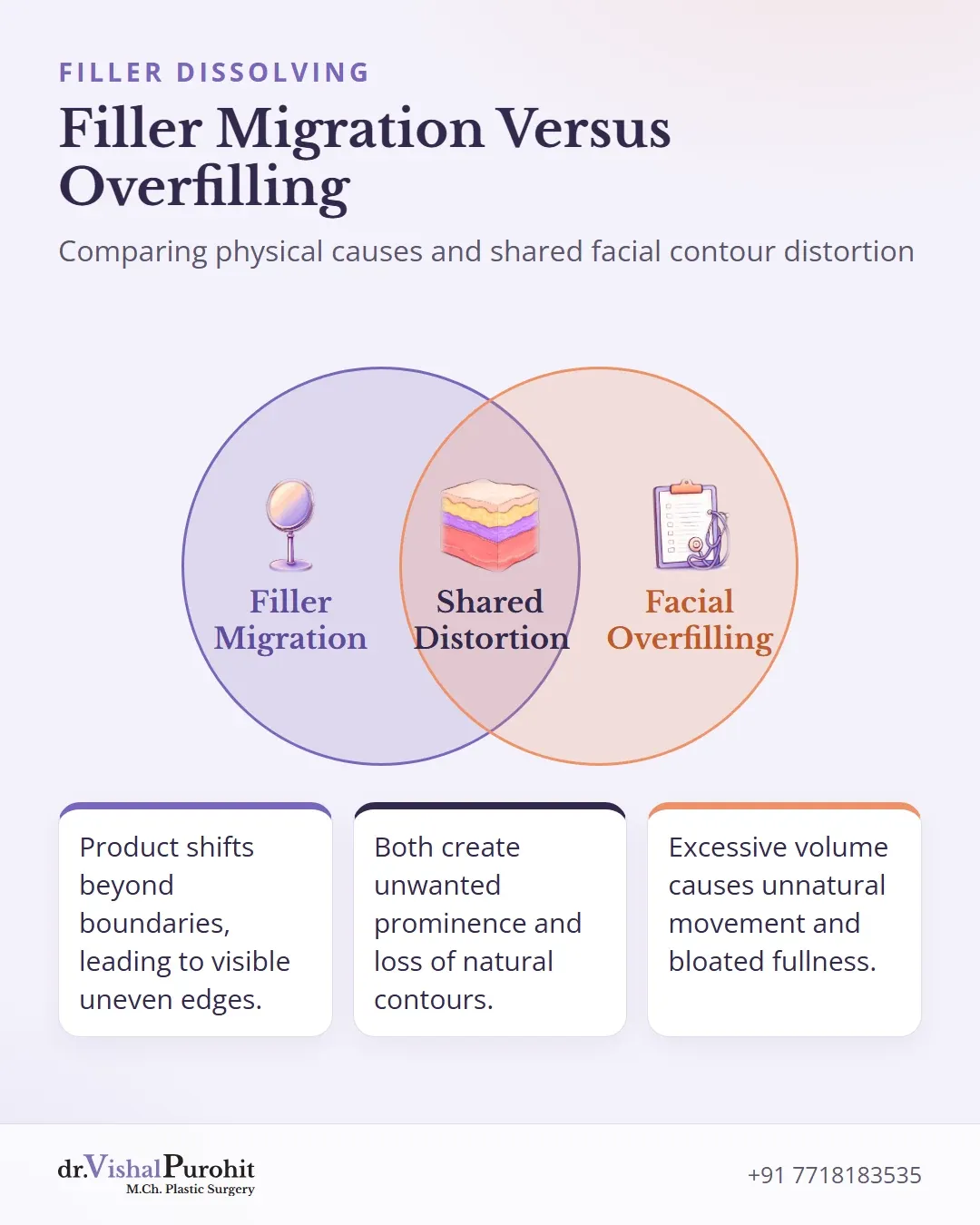
- Filler migration: Product shifts beyond the intended boundary into surrounding tissues, which can lead to visible edges or contour irregularities1.
- Overfilling: Too much product is injected into the site, creating disproportionate fullness, unnatural movement, or a bloated look often termed facial overfill syndrome2.
Careful evaluation distinguishes whether a patient is dealing with structural displacement of the gel or an excessive product volume12.
Dr. Purohit’s note: In his practice in Jaipur, Dr. Vishal Purohit assesses each presentation individually to determine the underlying cause before planning corrective management.
Early Post Injection Swelling Versus Displacement
New hyaluronic acid filler frequently causes acute inflammatory edema immediately after treatment23. This normal tissue reaction can mimic displacement, apparent overfilling, or uneven fullness during the initial healing period24.
Evaluating Early Tissue Changes

Swelling typically peaks the morning after injection and usually lasts between two days and two weeks5. Most uncomplicated post-procedural edema resolves within approximately one week2. Because early fullness often reflects transient edema rather than displaced product, clinicians evaluate the area carefully before considering corrective steps56.
A clinical evaluation includes:
Clinical History and Tissue Health
- Reviewing medical history and checking tissue health for underlying pathology5.
- Confirming that selecting no treatment is always a valid choice.
Symptom Evaluation
- Evaluating tenderness, noting that uncomplicated persistent swelling is almost always painless5.
For non-urgent dissatisfaction, watchful waiting allows acute inflammatory edema to settle naturally5. Rushing into immediate intervention during active swelling can lead to unnecessary procedures5. When swelling fails to resolve over subsequent weeks, a formal review determines whether true displacement or overfilling requires treatment5. Urgent complications, however, require prompt medical assessment5.
Clinical Examination and Tissue Assessment
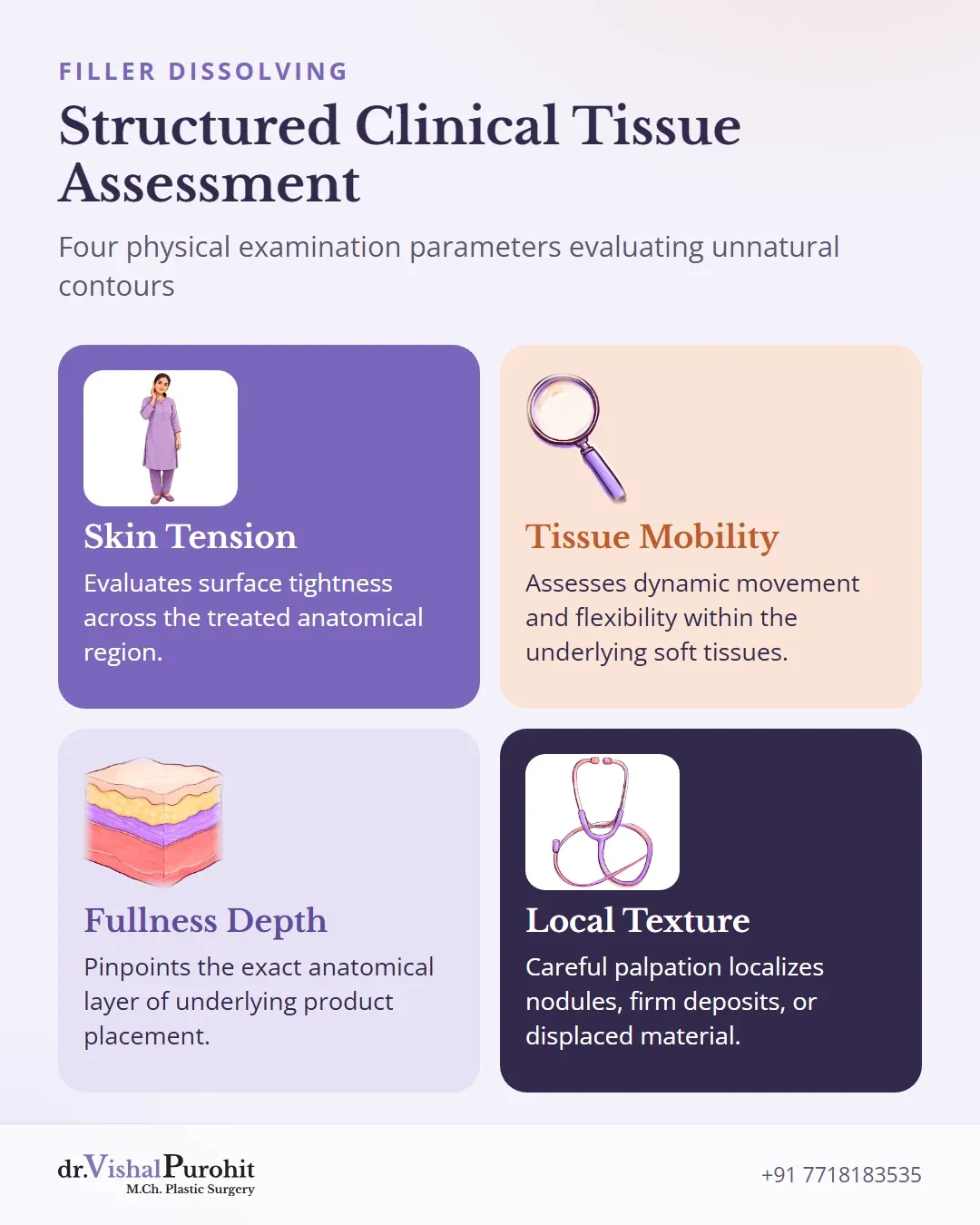
A structured physical examination evaluates skin tension, mobility, depth of fullness, and local tissue texture to determine why a treated region appears unnatural. Clinical assessment includes careful palpation to localize nodules, firm deposits, or displaced material78.
In complex or refractory presentations, non-invasive imaging may help clarify whether contour irregularities represent residual filler or native anatomy:
- Ultrasound examination can assist in evaluating soft-tissue anatomy, assessing tissue characteristics, and supporting treatment planning910.
- Magnetic resonance imaging may be considered to evaluate filler location and depth when multiple materials or long-standing deposits are suspected711.
Whether imaging is needed or used in a patient’s evaluation is decided at the consultation. Dr. Vishal Purohit carries out a direct in-person evaluation in Jaipur to determine the underlying cause before any corrective steps are planned. In situations involving unwanted or displaced hyaluronic acid filler, targeted assessment confirms whether intervention is suitable.
Why Adding More Filler Compounds Problems
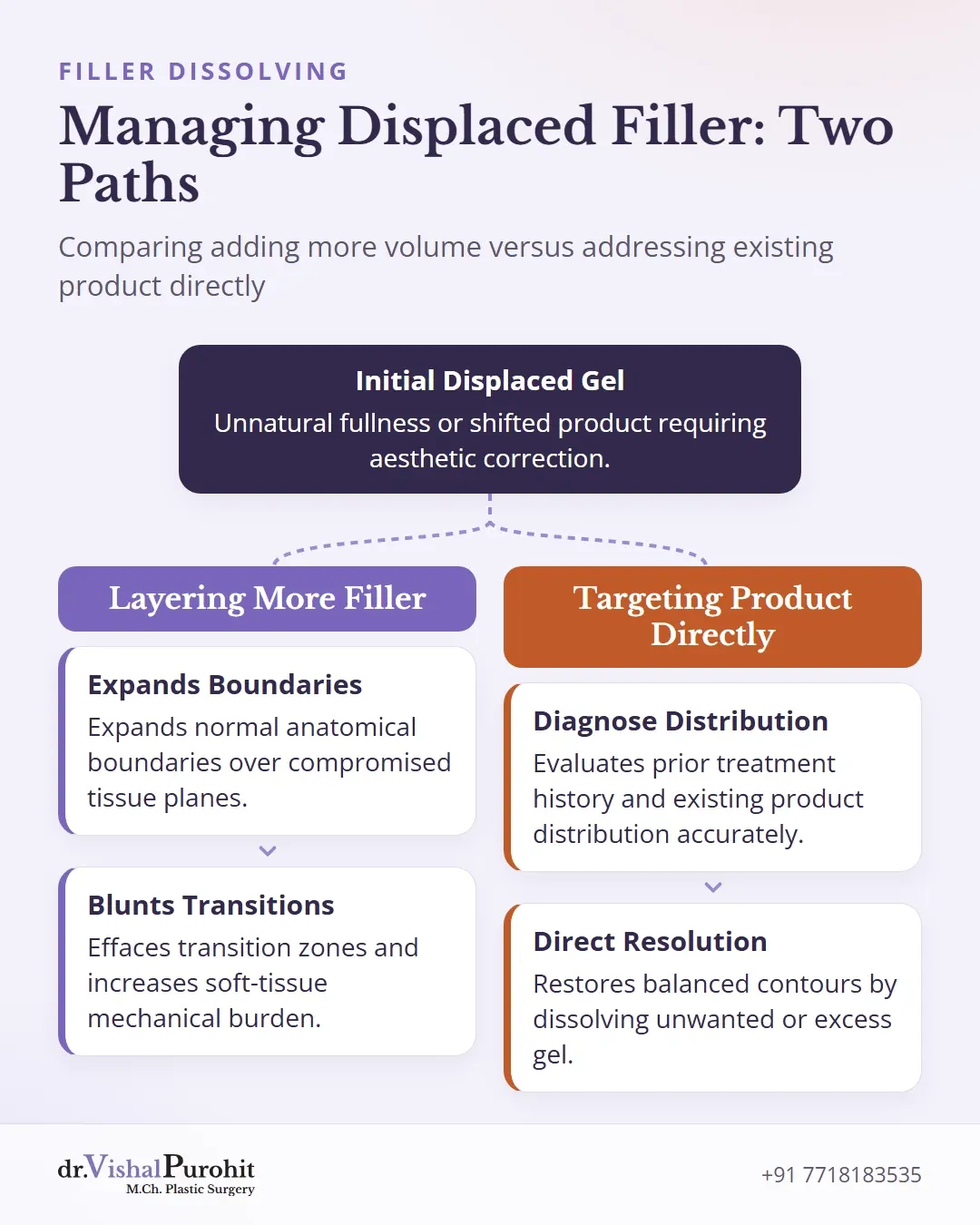
Attempting to correct displaced gel or unnatural fullness by injecting additional filler often compounds the underlying distortion12. When filler has shifted or created an unnatural appearance, layering more volume over compromised tissue planes expands normal anatomical boundaries rather than restoring balance1213. This practice can efface natural facial transition zones, blunting contours and creating an overfilled appearance12.
Key points
- Injecting additional filler over displaced or unnatural gel expands anatomical boundaries and worsens facial distortion.
- Layering more volume increases mechanical burden and compresses surrounding soft tissue structures.
- Restoring balanced contours requires diagnosing and addressing existing product, such as through dissolving, rather than adding more gel.
Overcorrection presents distinct clinical challenges compared to initial treatment14. Injected filler can compress surrounding structures, and adding further volume increases mechanical burden within the soft tissues1415.
Achieving an accurate aesthetic resolution requires diagnosing existing product distribution instead of placing extra gel1316. Hyaluronic acid filler can often be broken down and dissolved with hyaluronidase injections1217. At his practice in Jaipur, Dr. Vishal Purohit assesses the anatomical placement and history of prior treatments before recommending an intervention. Re-establishing balanced contours depends on addressing the misplaced or excess product directly, rather than trying to mask underlying flaws with further injections1218.
Management Options and Corrective Limits
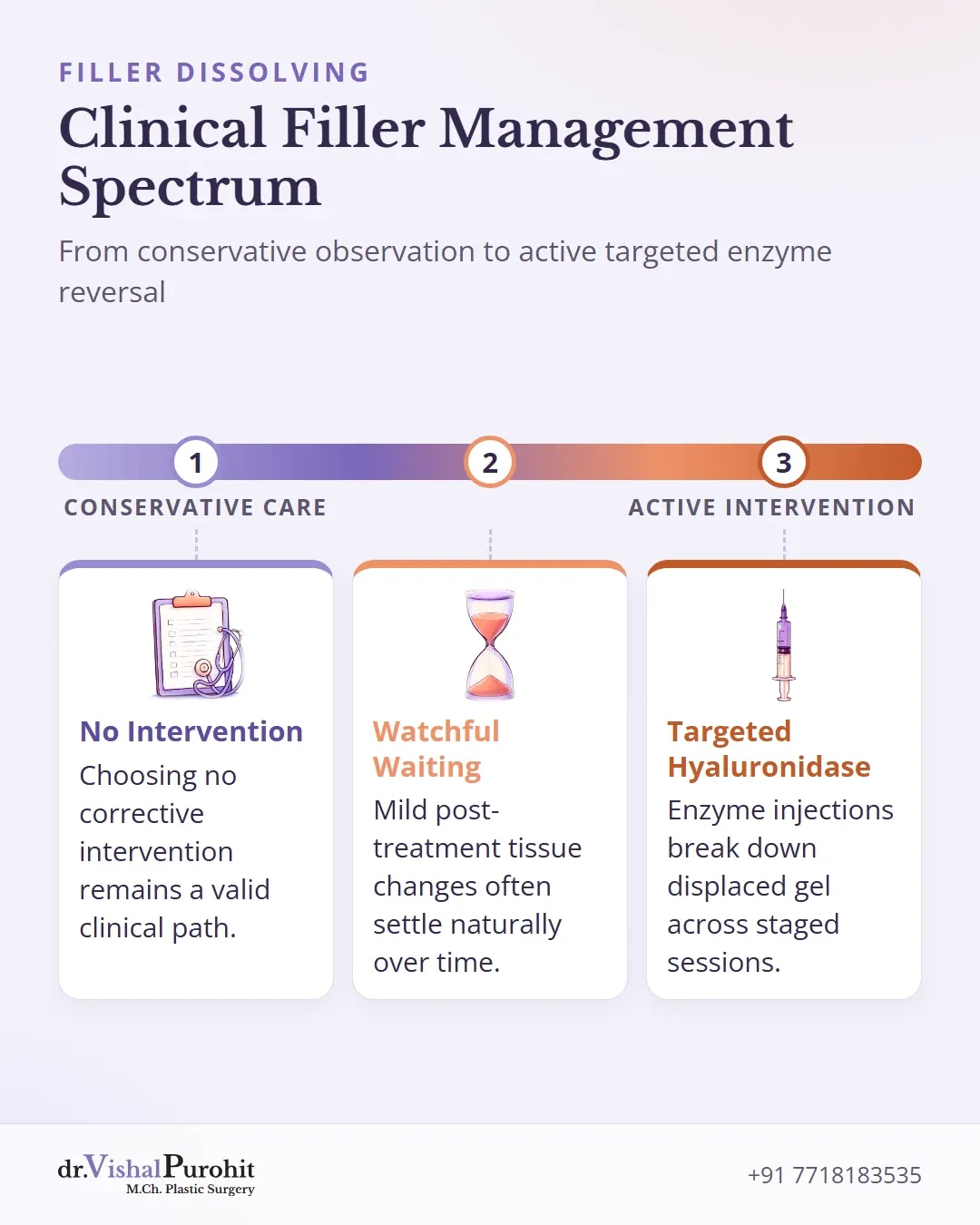
When displaced or excessive dermal filler is identified, management paths depend on individual assessment and clinical findings.
Corrective pathways include:
- Patient observation or watchful waiting, as mild post-treatment changes may settle over time19.
- Targeted hyaluronidase injections to dissolve displaced or excessive hyaluronic acid11214.
Hyaluronidase is a soluble protein enzyme that breaks down and hydrolyses hyaluronic acid12. It is frequently utilized for unwanted, uneven, or migrated hyaluronic acid filler and in filler complications11214. While enzyme therapy can often dissolve hyaluronic acid filler, it is never completely reversible in a single step, and multiple sessions may be discussed1214. The response to hyaluronidase is dose-dependent, with effects typically observed hours to days following treatment12.
Choosing no corrective intervention remains a valid clinical path. Specific dissolving protocols, product choices, and whether an individual patient requires enzyme reversal or watchful waiting are not pre-set; each plan is decided at the consultation with the M.Ch. plastic surgeon.
Clinical Filler Evaluation and Dissolving in Jaipur
Distinguishing displaced gel from excessive volume requires direct assessment of soft-tissue dynamics and product placement. For individuals seeking assessment of unwanted hyaluronic acid deposits, learning about Filler Dissolving in Jaipur outlines available clinical pathways. Choosing no intervention remains a valid clinical path, and specific enzyme protocols are decided at the consultation. Patients can also review common questions through Filler Dissolving FAQs to understand how enzyme therapy breaks down hyaluronic acid.
This is educational information, not medical advice.