
Treating dynamic creases along the nose requires precise knowledge of central midface anatomy. Because the muscles involved in scrunching sit adjacent to those elevating the mouth, understanding Nose Wrinkles at Rest and Smiling: Which Lines Can Botox Treat? helps clarify regional movement patterns.
When botulinum toxin migrates into nearby lip elevators, it can temporarily alter resting symmetry or smile dynamics. Thorough dynamic assessment before injection allows clinicians to identify individual muscle borders and manage subtle baseline variations safely.
Combined Nasal and Lip Assessment
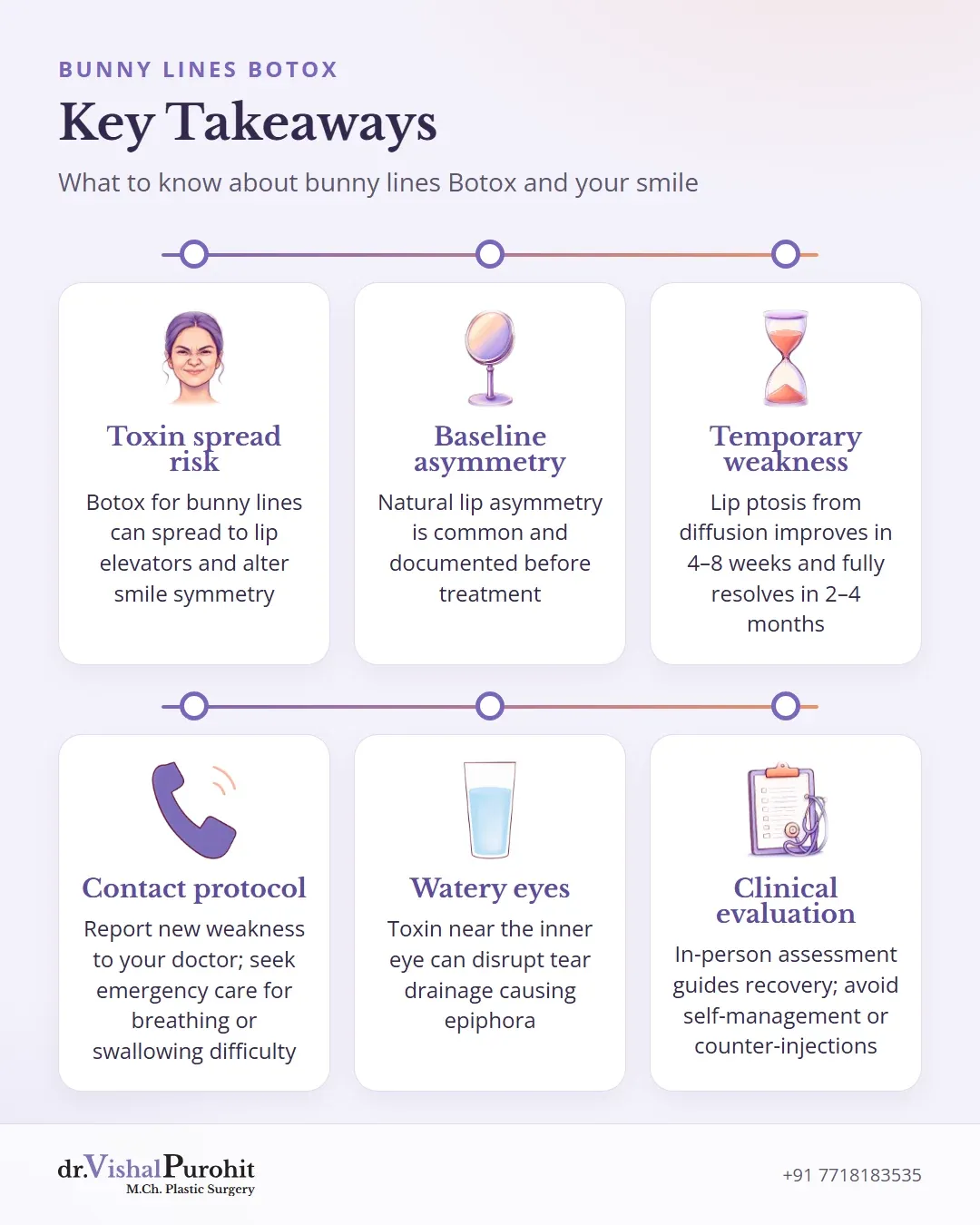
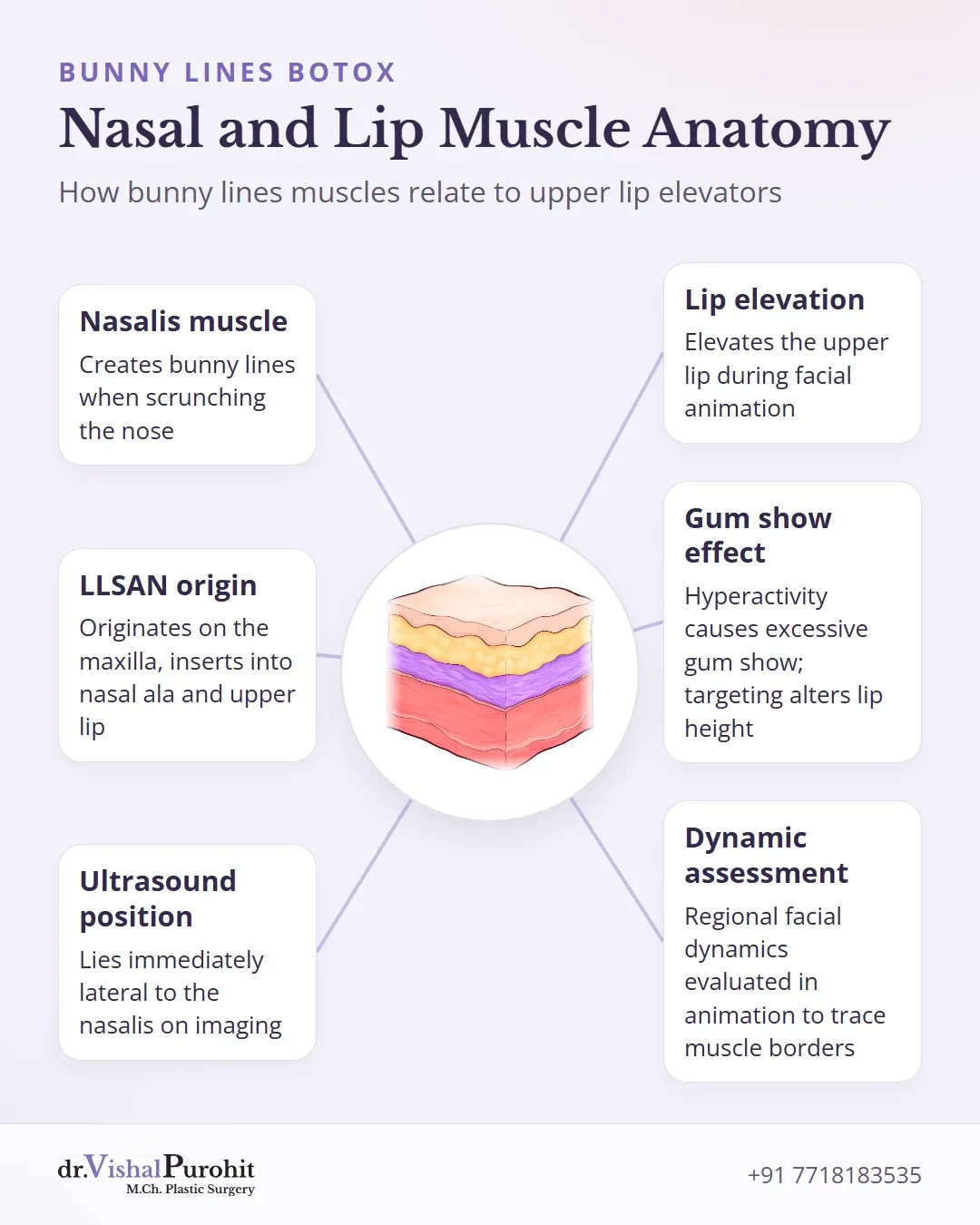
The muscular anatomy of the central midface requires careful dynamic assessment before administering Botox for bunny lines. The muscles responsible for crinkling the nose sit directly adjacent to the levator labii superioris alaeque nasi12.
This muscle originates along the maxilla and inserts into both the nasal ala and the upper lip13. On ultrasound examination, it lies immediately lateral to the nasalis muscle2. Because the levator labii superioris alaeque nasi functions to elevate the upper lip during facial animation3, any unintended toxin diffusion into its fibers can lengthen the upper lip or cause upper lip ptosis and an asymmetric smile24.
Evaluating nasal scrunching and upper-lip movement together allows an injector to trace muscle borders accurately. In clinical literature, hyperactivity of this adjacent muscle causes excessive gum show when smiling, and targeting it alters lip height and softens the nasolabial fold235.
Dr. Purohit’s note: At his practice in Jaipur, Dr. Vishal Purohit assesses regional facial dynamics in animation to evaluate individual muscle contraction patterns.
A precise evaluation helps delineate adjacent muscle groups prior to treatment.
Pre Existing Facial and Smile Asymmetry
Subtle differences in lip elevation and resting smile symmetry are common prior to any aesthetic injection. Patients are frequently unaware of their natural baseline asymmetry until their attention is drawn to the area during assessment6.
Key points
- Natural facial and smile asymmetry is common and often unnoticed before treatment.
- Documenting baseline dynamics aligns expectations and distinguishes natural variation from injection outcomes.
- Thorough pre-treatment evaluation guides individualized planning for balanced results.
Identifying and documenting baseline facial asymmetry before treatment helps align expectations with realistic outcomes67. It also prevents a patient from attributing pre-existing facial dynamics or natural lip variation to subsequent Botox injections6.
In his practice in Jaipur, Dr. Vishal Purohit conducts a thorough facial evaluation prior to treatment. Clinical photographs are taken and used for treatment records only, never shown publicly.
Why Baseline Assessment Matters
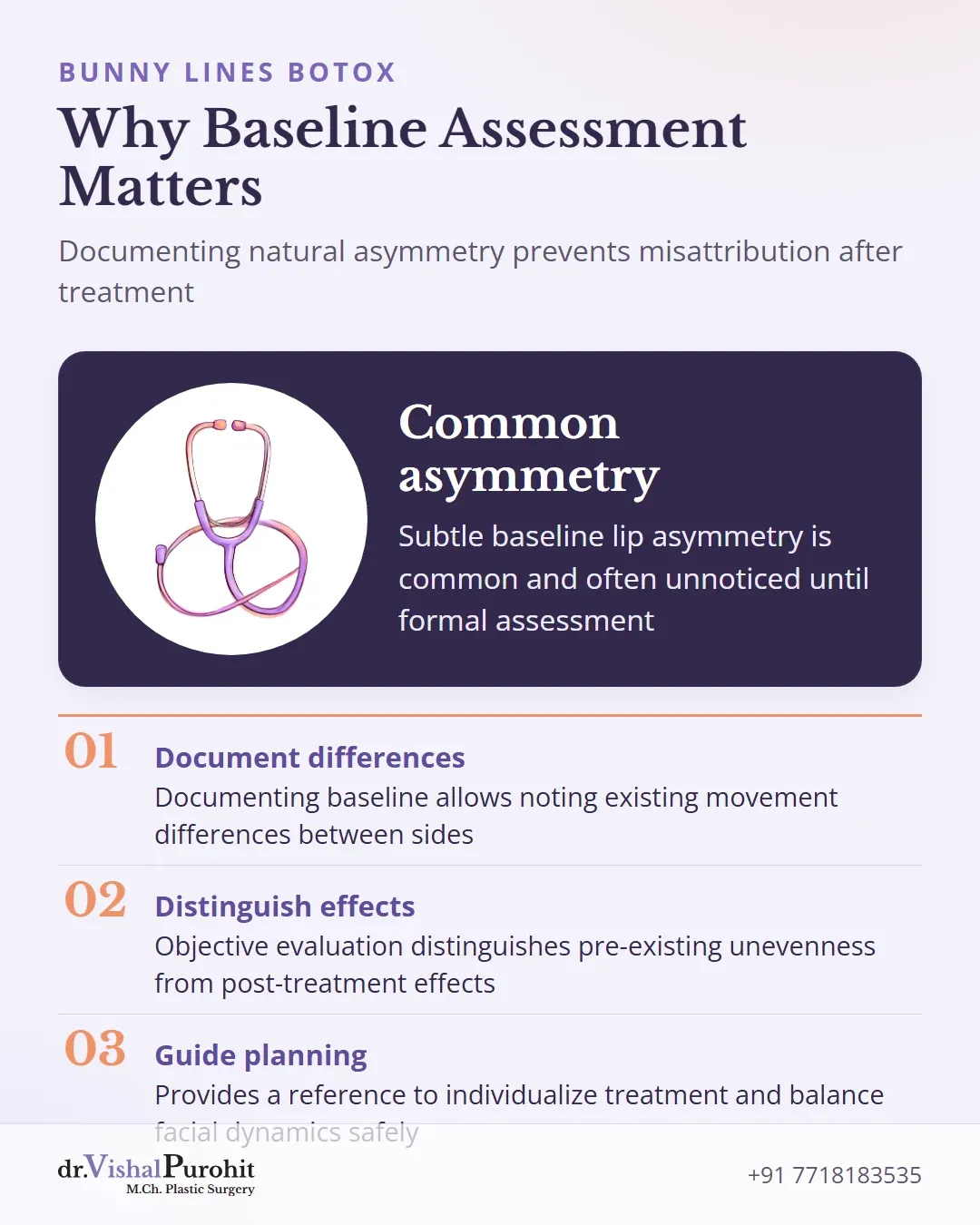
Clinical literature highlights key benefits of examining facial symmetry before administering botulinum toxin:
- Documenting baseline facial asymmetry allows the clinician to note existing differences in movement between sides67.
- Objective pre-treatment evaluation helps distinguish pre-existing unevenness from potential post-treatment side effects6.
- It provides a reference point to individualize treatment planning and balance facial dynamics safely6.
Reporting Lip Weakness and Functional Changes
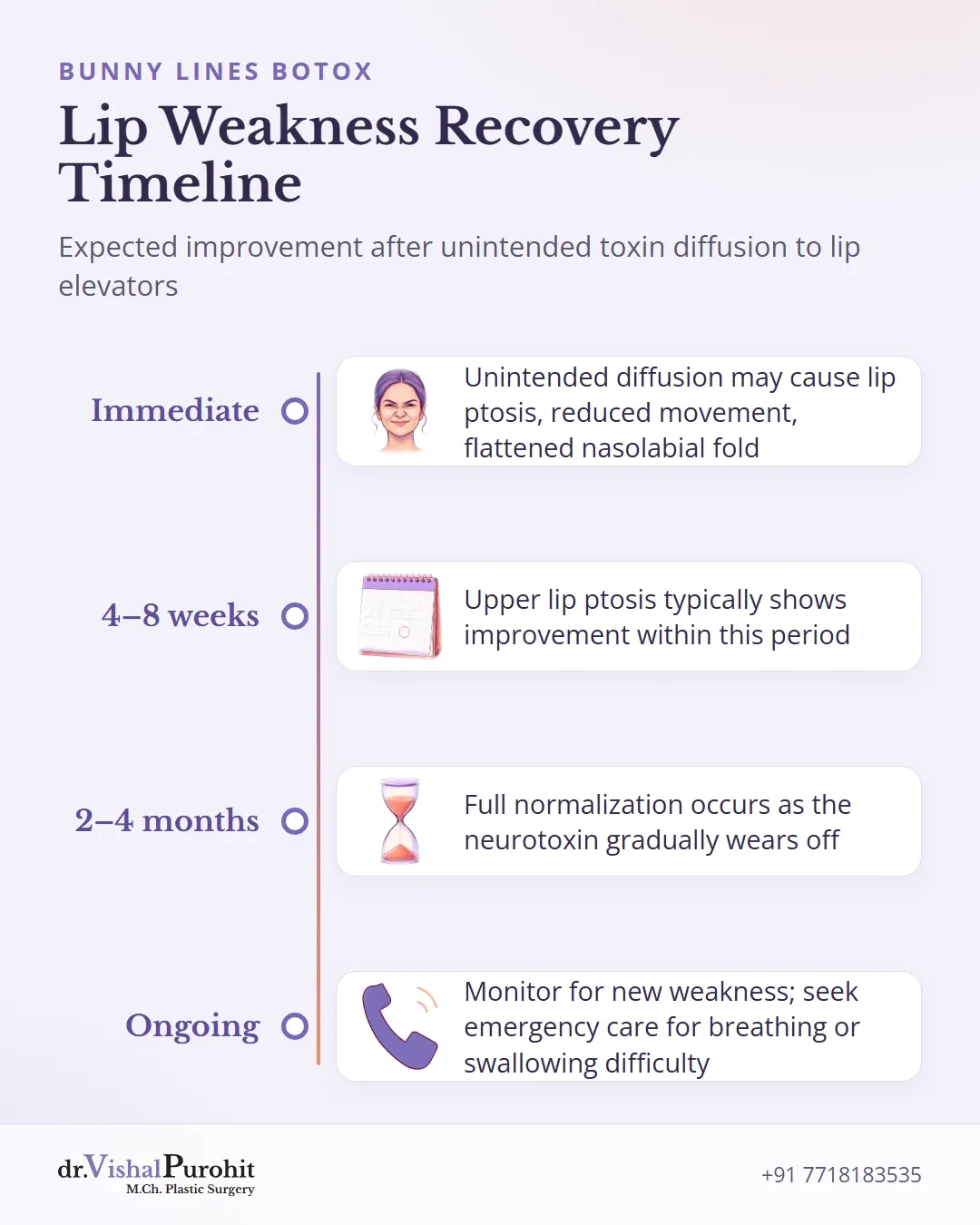
When botulinum toxin is injected to treat bunny lines on the nasalis muscle, unintentional diffusion can spread to nearby muscles responsible for elevating the upper lip, such as the levator labii superioris alaeque nasi (LLSAN)7. Such unintended spread may cause lip ptosis, reduced upper lip movement during smiling, or flattening of the nasolabial fold7.
Key points
- Toxin diffusion during bunny line treatment can unintentionally weaken upper lip elevator muscles.
- Resulting smile asymmetry or lip ptosis is temporary and resolves within several weeks to months.
- New weakness should be promptly reported, while severe symptoms like swallowing or breathing difficulties require emergency care.
Unwanted diffusion into midface elevator muscles can also lead to an asymmetric smile or functional difficulty78. In medical literature, upper lip ptosis resulting from unintended toxin migration is temporary, with published reports noting improvement within 4 to 8 weeks9 and eventual full normalization over time6.
When to Contact the Clinician

Patients should promptly report any new muscle weakness, smile asymmetry, or difficulty with lip function. The specific protocol for managing such changes and assessing review visits in Dr. Purohit’s practice is decided at the consultation.
If any general weakness, or difficulty with breathing, swallowing, or speaking occurs after a toxin procedure, this represents a medical emergency that requires immediate emergency care rather than waiting.
Clinical Evaluation Over Online Remedies
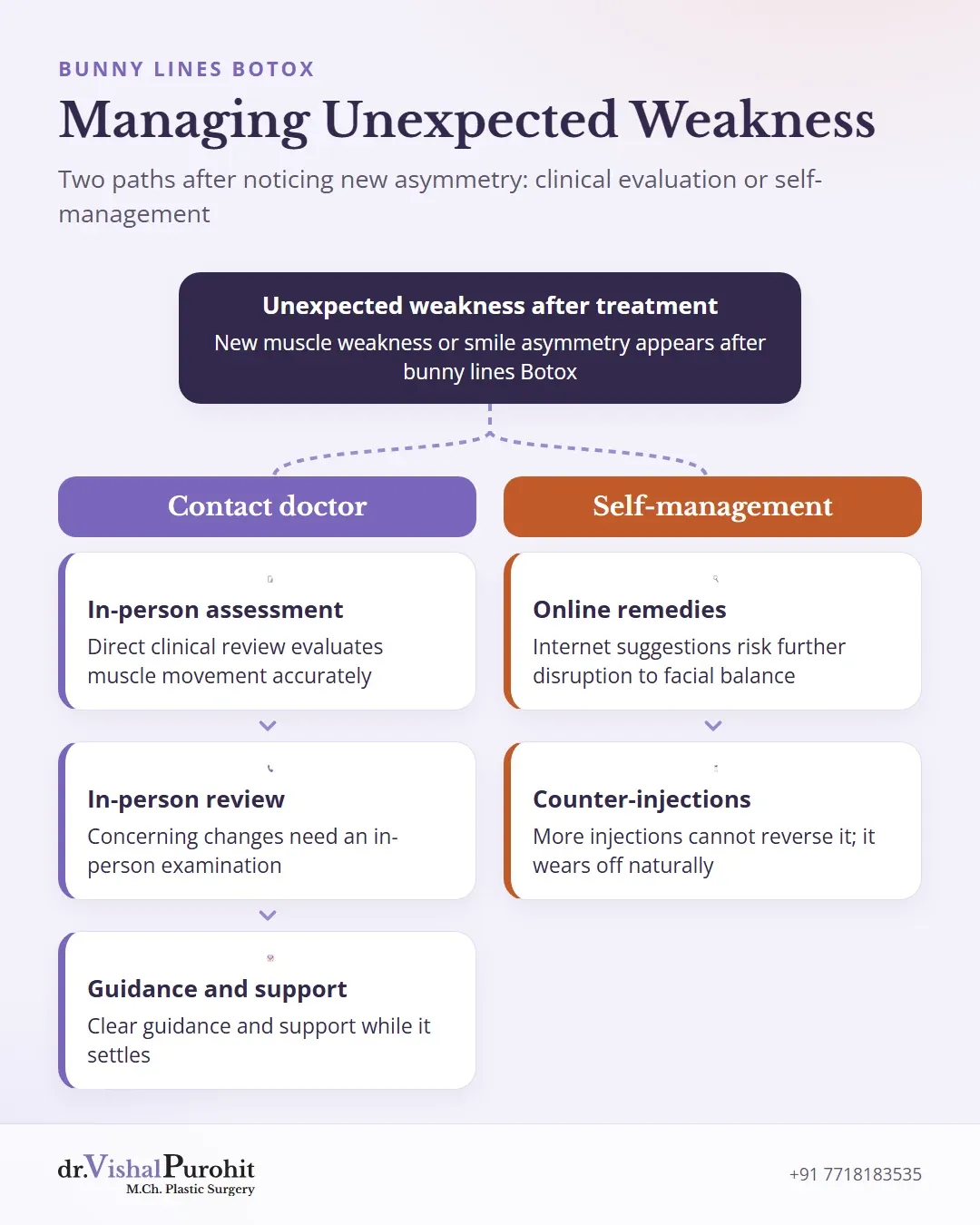
Diffusion beyond the intended site can lead to unwanted weakness in adjacent facial muscles1011. When unintended local weakness occurs, the effects are temporary and self-limiting, as the action of the medication diminishes over time121314. The neurotoxin gradually wears off over 2 to 4 months following treatment13. In many instances, clinical improvement relies entirely upon this natural, diminishing effect rather than active reversal14.
Patients experiencing unexpected weakness or asymmetry should contact the treating doctor directly rather than searching for online remedies or attempting corrective counter-injections. In-person clinical assessment allows the doctor to evaluate muscle movement accurately.
Dr. Vishal Purohit assesses any unexpected symptoms through direct clinical review at his practice in Jaipur. Concerning findings need an in-person examination.
Attempts to self-manage unintended muscle weakness through unverified internet suggestions risk further disruption to facial balance. Direct communication with the treating doctor provides clear guidance and emotional support while muscle activity recovers12.
Epiphora and Tear Pump Mechanics
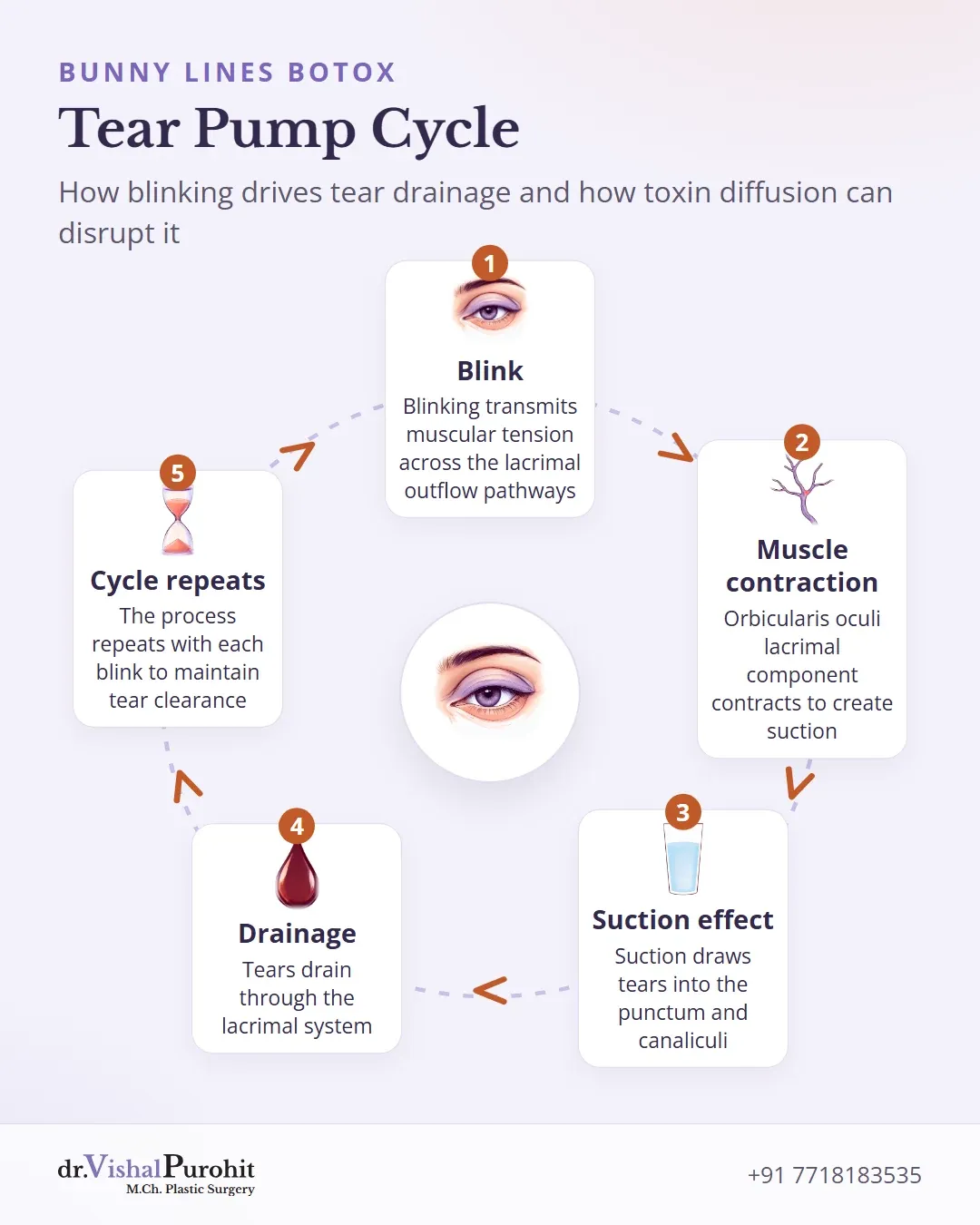
The lacrimal system functions as a closed negative-pressure circuit where blinking transmits muscular tension across the outflow pathways15. Fibres of the orbicularis oculi originate from the medial palpebral ligament, maxilla, frontal bone, and lacrimal bone16. Its lacrimal component directly facilitates tear drainage16, exerting a suction effect that draws secretions into the punctum and canaliculi15.
Altered orbicularis function impairs punctual apposition and disrupts normal tear-pump mechanics15. In clinical practice, Dr. Vishal Purohit notes that when botulinum toxin type A diffuses toward the medial canthus or inner eye corner, it may temporarily weaken this pump mechanism.
Patients who experience watery eyes or epiphora should monitor the condition until muscular coordination normalizes.
Clinical Assessment for Bunny Lines in Jaipur
Careful dynamic assessment of central midface muscles helps address nasal wrinkles while accounting for upper lip elevation. Individuals considering treatment can explore Bunny Lines Botox in Jaipur to understand how facial animation patterns and natural asymmetries are evaluated. For further details on injection safety, temporary side effects, and regional anatomical considerations, review the Bunny Lines Botox FAQs or arrange a consultation to discuss personalized facial dynamics.
This is educational information, not medical advice.