
Nasal crinkles often appear when smiling, laughing, or squinting. While active expression folds soften with targeted muscle relaxation, deeper resting creases etched into the skin require realistic expectations.
Evaluating how perinasal muscles move helps distinguish dynamic folding from structural lines. Patients curious about wider facial movement can explore Can Bunny-Lines Botox Change Your Smile or Upper Lip? to understand how adjacent muscle groups interact during treatment.
Comparing Neutral and Smiling Photographs
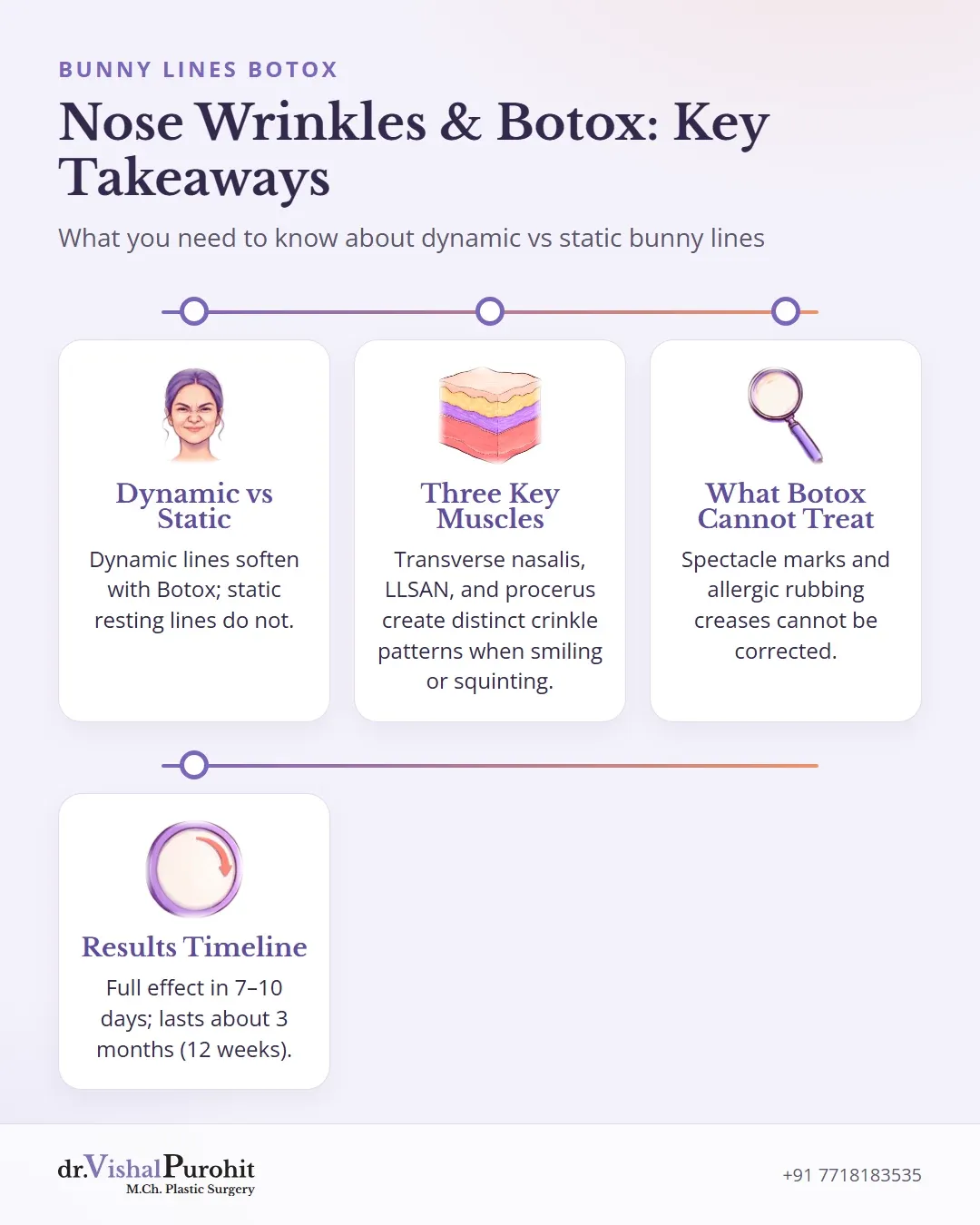
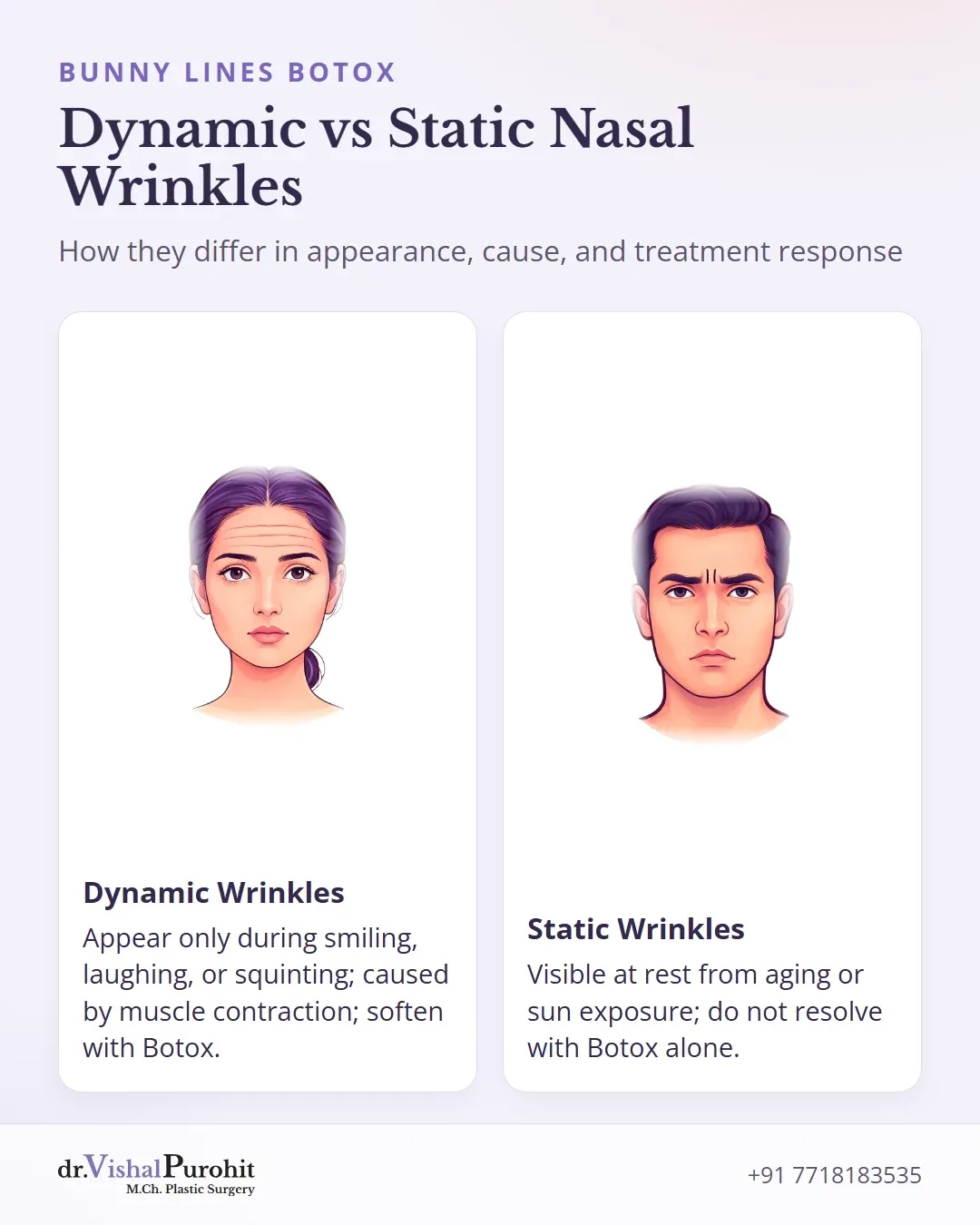
Standardised photographs taken at rest and during active facial expression allow a detailed analysis of facial lines before any injection is planned1.
Dr. Purohit’s note: Clinical photographs are taken for treatment records only and are never shared publicly.
Evaluating facial lines at rest and during muscle contraction helps distinguish between two distinct forms of rhytides:
Dynamic wrinkles
Standardised photographic documentation of the face in repose and during active expression provides an objective baseline to compare posttreatment changes and evaluate how lines respond to therapy1. This careful assessment ensures that patients understand the difference between dynamic and static creases and have realistic expectations about the outcomes botulinum toxin can achieve1.
Identifying Underlying Nasal Muscle Action
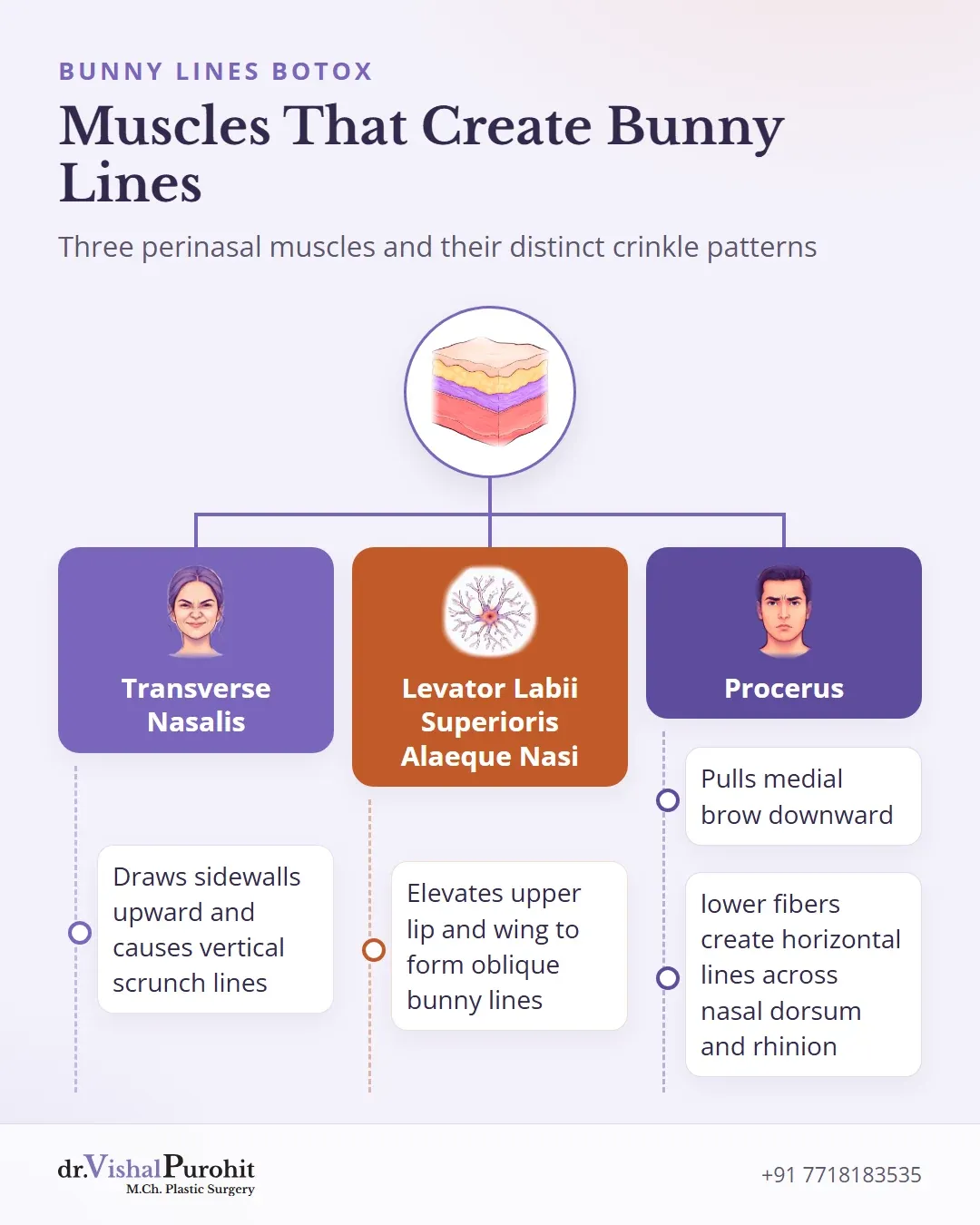
A visible crease across the nasal bridge or sidewalls does not automatically identify a single muscle driver3. Multiple facial muscles can contribute to dynamic surface skin folding in this region, and treatment assessment depends on recognizing their distinct actions34.
Contributing Perinasal Muscles
Different anatomical structures generate specific dynamic line patterns:
- Transverse nasalis: This muscle depresses the cartilaginous part of the nose and draws the nasal sidewalls upward and medially567. It is responsible for vertical wrinkles and nasal sidewall scrunch lines34.
- Levator labii superioris alaeque nasi (LLSAN): Running lateral and nearly perpendicular to the nasalis, this muscle elevates the upper lip and the nasal wing58. It contributes to oblique bunny lines radiating along the lateral nasal pyramid34.
- Procerus: Arising from the nasal bone, the procerus muscle pulls the medial brow downward5. Contraction of its lower fibers can produce horizontal lines across the nasal dorsum, rhinion, and supra-rhinion45.
Distinguishing between these muscular drivers ensures that dynamic nasal lines are evaluated according to each patient’s specific contraction pattern rather than approached as a uniform presentation34.
Spectacle Indentations and Allergic Creases
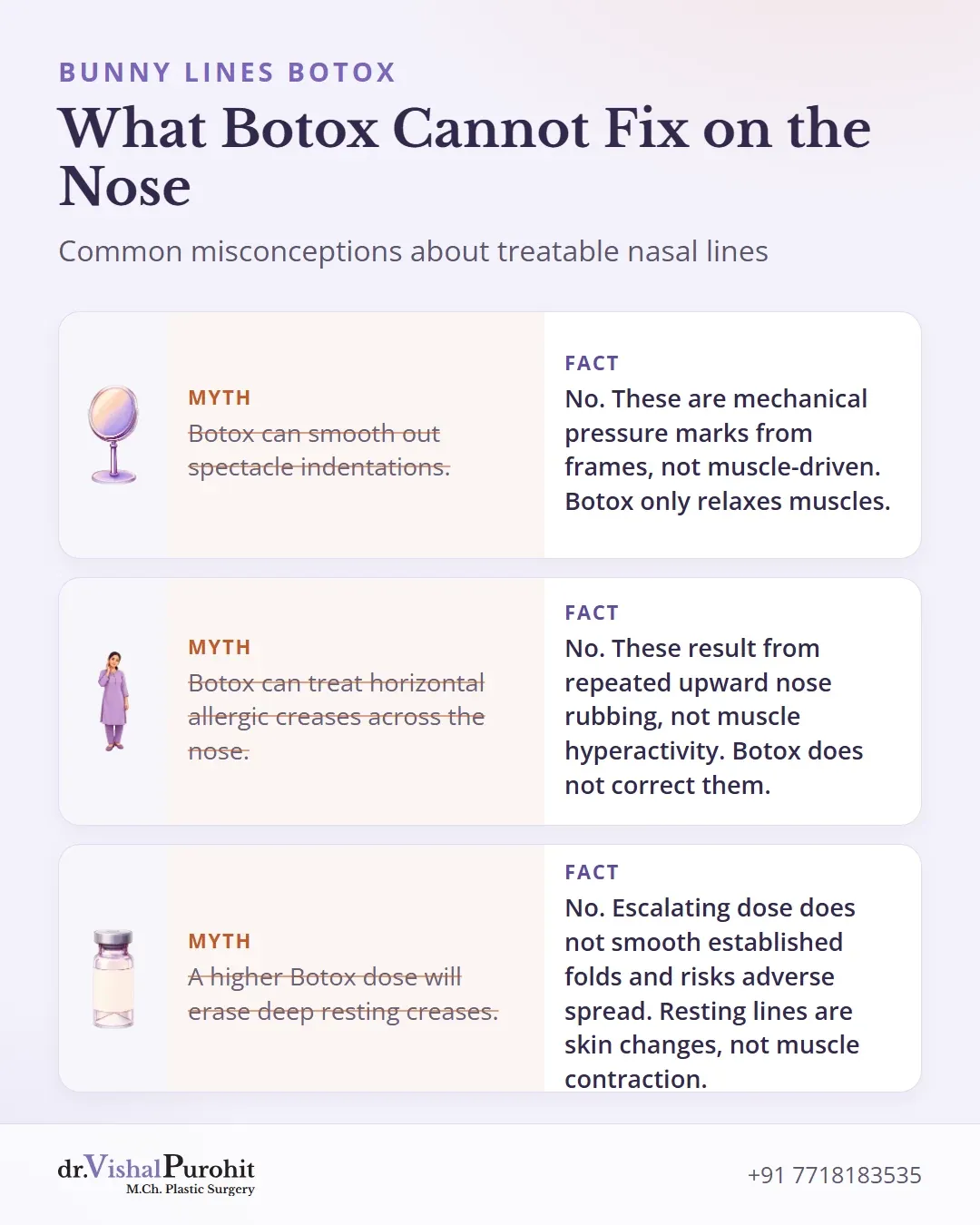
Dynamic nasalis crinkling must be distinguished from other nasal marks during assessment. Wrinkles formed during facial expression differ fundamentally from indentations caused by external pressure and creases formed by repeated skin habits.
Distinguishing Nasal Lines
- Eyeglass bridge marks: Mechanical indentations caused by the constant resting pressure of spectacle nose pads or heavy frames.
- Transverse allergic creases: Horizontal structural skin lines across the lower nasal bridge, commonly resulting from repeated upward rubbing of the nose.
- Dynamic nasal lines: Crinkling and scrunching patterns that appear along the nasal sidewalls when smiling or squinting.
Treatment Scope
Botulinum toxin works by temporarily relaxing targeted muscle contraction. Because its therapeutic effect is limited to neuromodulation of hyperactive facial muscles, it cannot correct mechanical frame indentations or structural skin creases formed by external pressure or physical rubbing.
At his practice in Jaipur, Dr. Vishal Purohit assesses each patient’s nasal lines to determine whether dynamic muscle activity is the underlying cause before deciding on an injection plan. Choosing no treatment remains a valid option.
Persistent Creases Despite Relaxed Muscle
A careful clinical assessment separates dynamic wrinkles from static lines1. Dynamic bunny lines appear only during facial animation when the nasalis muscle contracts, whereas static creases remain visible at rest due to age-related changes, sun exposure, or loss of skin elasticity1910.
Botox relaxes muscular activity, which softens dynamic folding during expression111. However, etched lines that have settled into the skin structure do not disappear simply by weakening the muscle112. Complete line removal is never promised. In Dr. Purohit’s practice, clinical photographs are taken solely for treatment records to evaluate these resting patterns, without public sharing.
The literature highlights key considerations regarding persistent nasal creases:
Muscle versus skin change
Botulinum toxin targets muscular contraction rather than deep cutaneous structural changes112.
Treatment aims to soften active creasing while preserving balanced, natural expression3.
Judging Results and Repeat Decisions

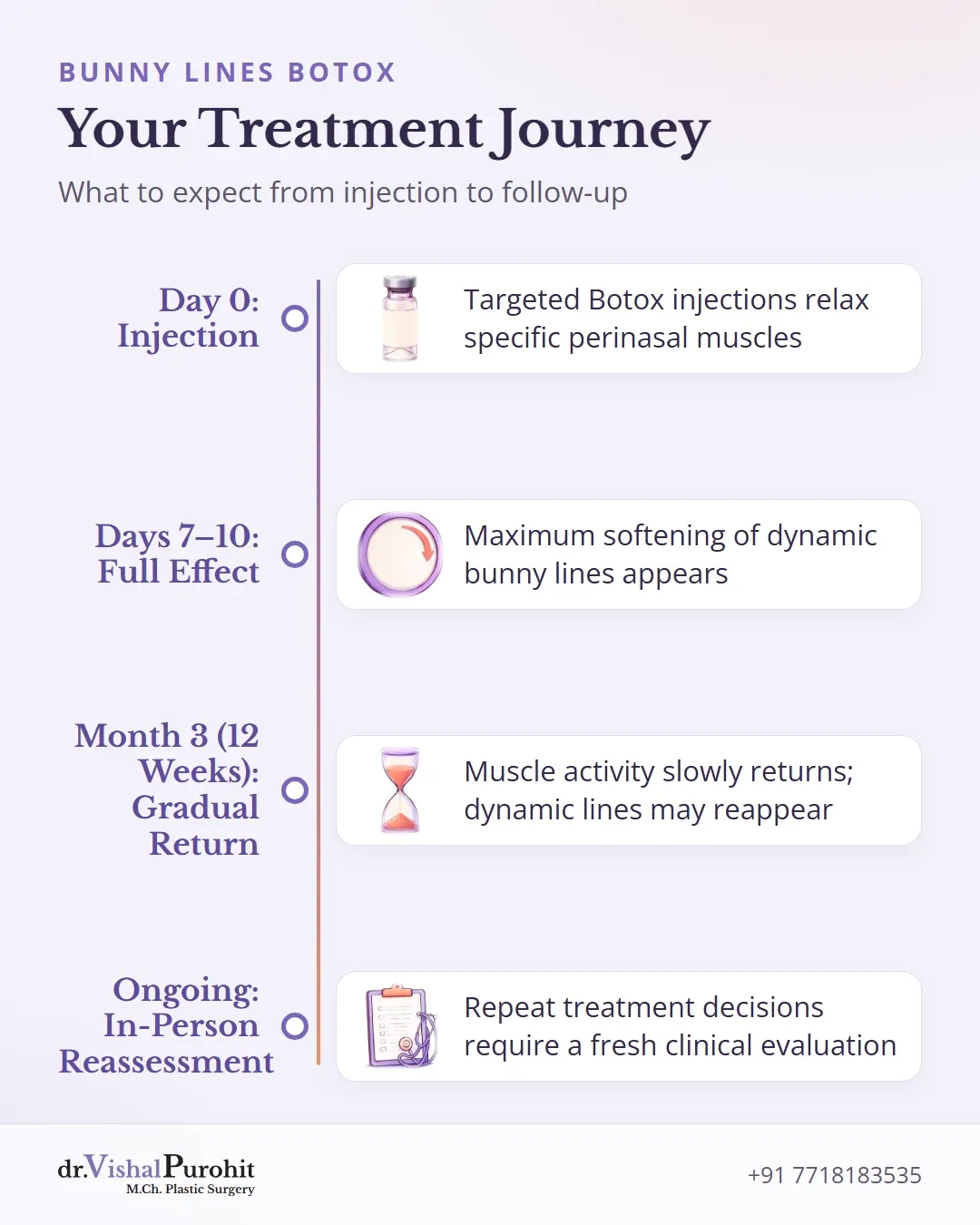
Evaluating the outcome of treatment begins with agreeing on an expression-based goal. Comparing matched photographs taken at rest and during smiling helps separate residual static skin creases from returning muscle movement. In general aesthetic practice, medical photography serves to document these baseline and follow-up states13.
At his practice in Jaipur, Dr. Vishal Purohit keeps clinical photographs strictly for treatment records, with no public sharing. For patients assessing their response:
- Full effects generally take 7 to 10 days to appear13.
- Toxin activity produces temporary muscle relaxation lasting an average duration of around 3 months14 to 12 weeks15.
- Chemical denervation softens dynamic wrinkles by reducing muscle movement over the skin, though deeper resting lines may require ongoing dermal repair to improve16.
Decisions regarding repeat injections require an in-person clinical reassessment. Because individual anatomy and muscle movement vary, results carry no permanent promises or guarantees13. Specific aspects of repeat care—including review visit timing, top-up policies, and retreatment schedules—are not fixed in advance and are decided at the consultation. Choosing not to undergo further treatment remains a valid option.
Skin Lines Versus Nasal Reshaping
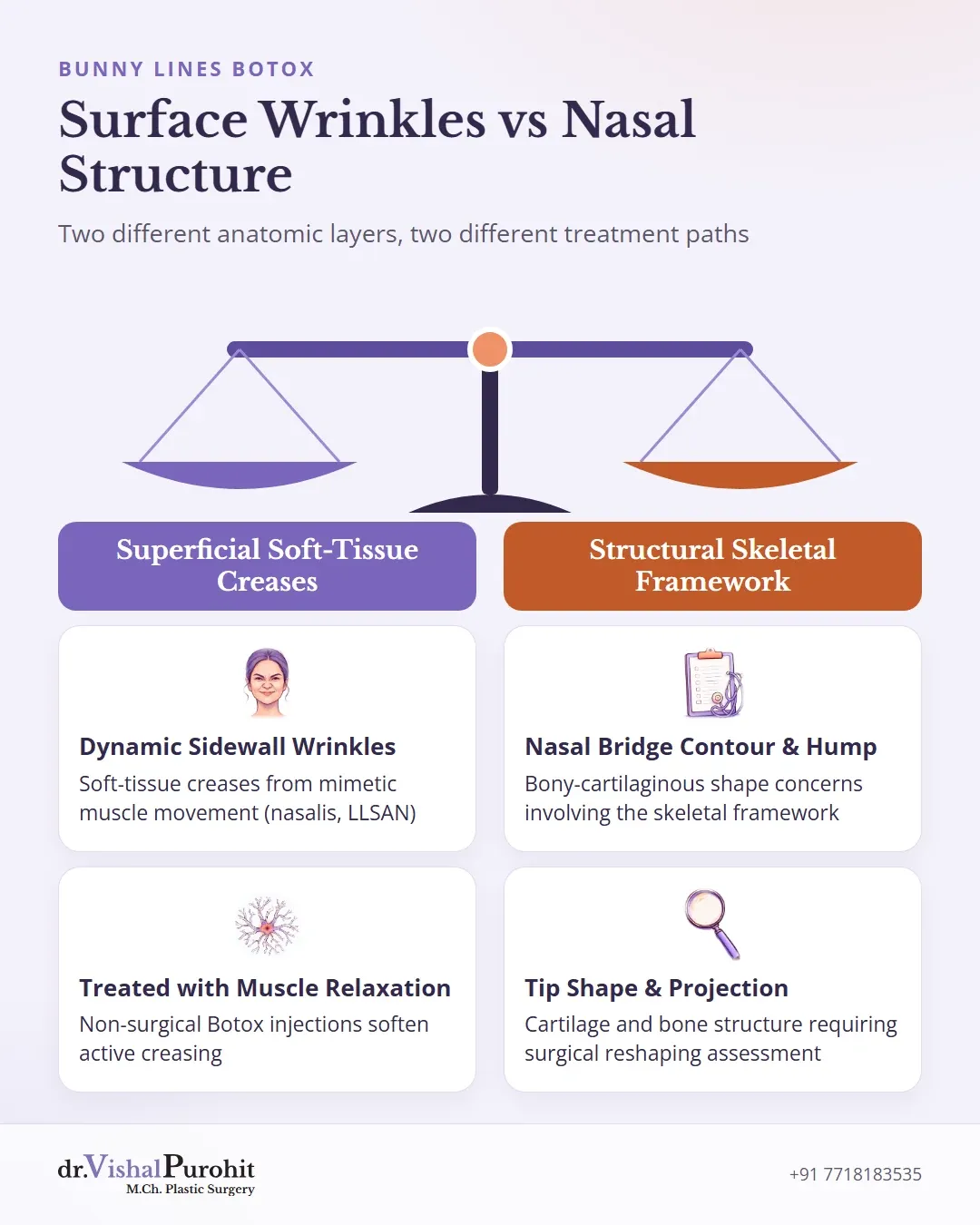
Surface creases on the nose are fundamentally different from the underlying nasal architecture. Skin folding on the lateral nasal sidewall arises from superficial mimetic muscle movement, such as contraction of the nasalis or levator labii superioris alaeque nasi17. In contrast, concerns regarding the nasal bridge contour, a dorsal hump, or tip shape stem from structural cartilage and bone18.
Because these issues involve completely different anatomic layers, combination treatment is not routine:
- Dynamic superficial wrinkles on the nasal sidewall are soft-tissue creases addressed by targeted non-surgical muscle relaxation17.
- Structural contour concerns, such as a prominent bony-cartilaginous hump or lack of tip projection, involve the skeletal framework1819.
In Dr. Vishal Purohit’s practice, structural concerns require an independent clinical assessment rather than injection therapy. A patient seeking changes to the nasal bones, bridge alignment, or tip support requires formal evaluation for structural reshaping on the rhinoplasty page.
Choosing observation or no treatment is entirely valid for dynamic nasal wrinkles, and patients face no pressure to pursue intervention. Dynamic surface lines remain harmless, and any choice to treat them or leave them alone is a personal aesthetic decision.
Consulting for Nasal Creases in Jaipur
Distinguishing dynamic skin folding from resting lines ensures realistic aesthetic expectations. Patients can explore Bunny Lines Botox in Jaipur to review treatment details, or check Bunny Lines Botox FAQs for common questions. An in-person consultation with M.Ch. plastic surgeon Dr. Vishal Purohit provides an objective evaluation of facial movement. Choosing observation or no treatment remains a valid option.
This is educational information, not medical advice.