
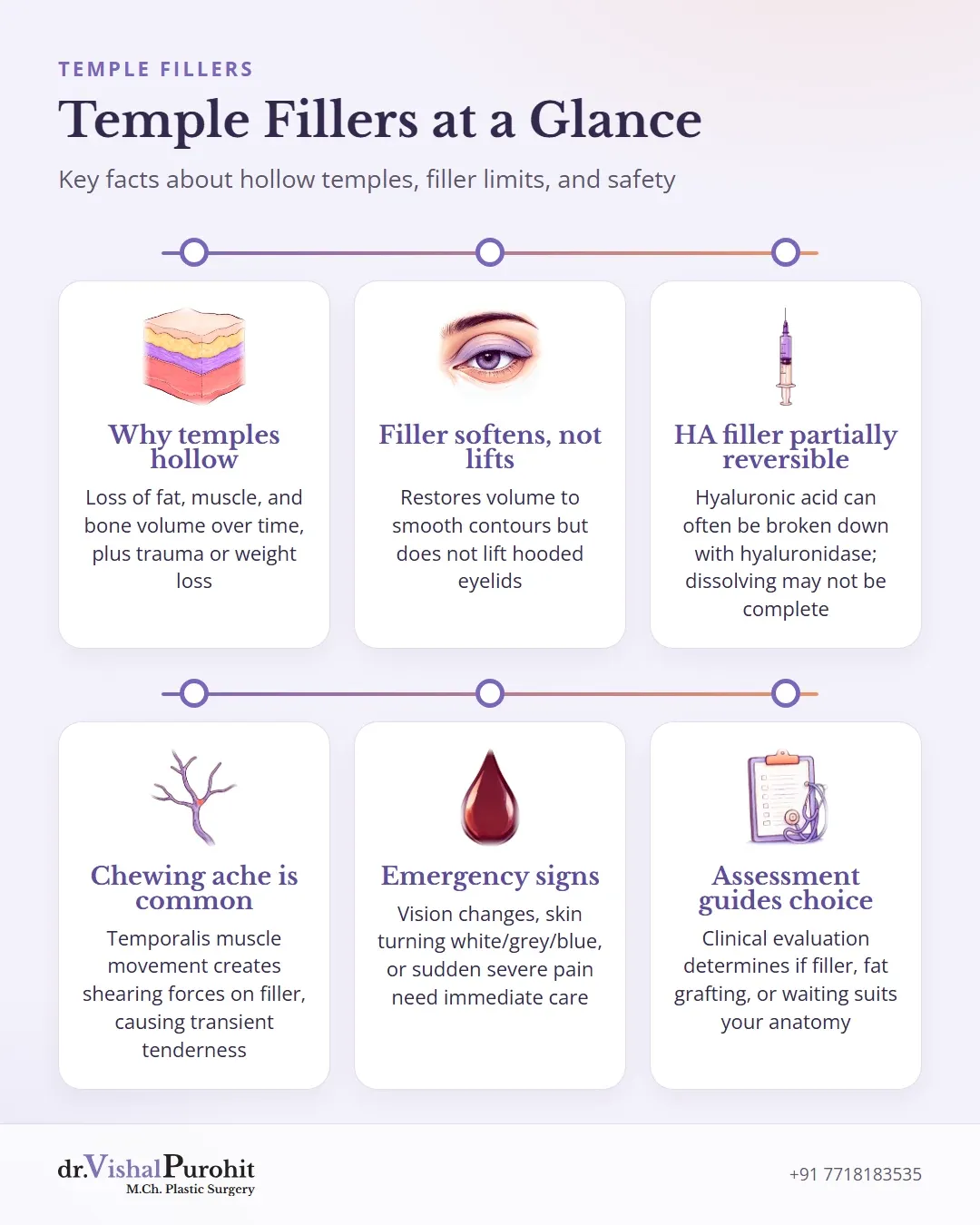
Temporal hollowing develops when fat, muscle, and bone volume decrease over time. It can leave the upper face appearing gaunt, uneven, or noticeably aged.
Many patients wonder can fillers help hollow temples when contour changes alter the transition between the forehead and cheeks. A careful medical assessment determines whether injectable filler or another approach suits individual facial anatomy.
Understanding Why Temples Become Hollow
Changes That Combine Over Time
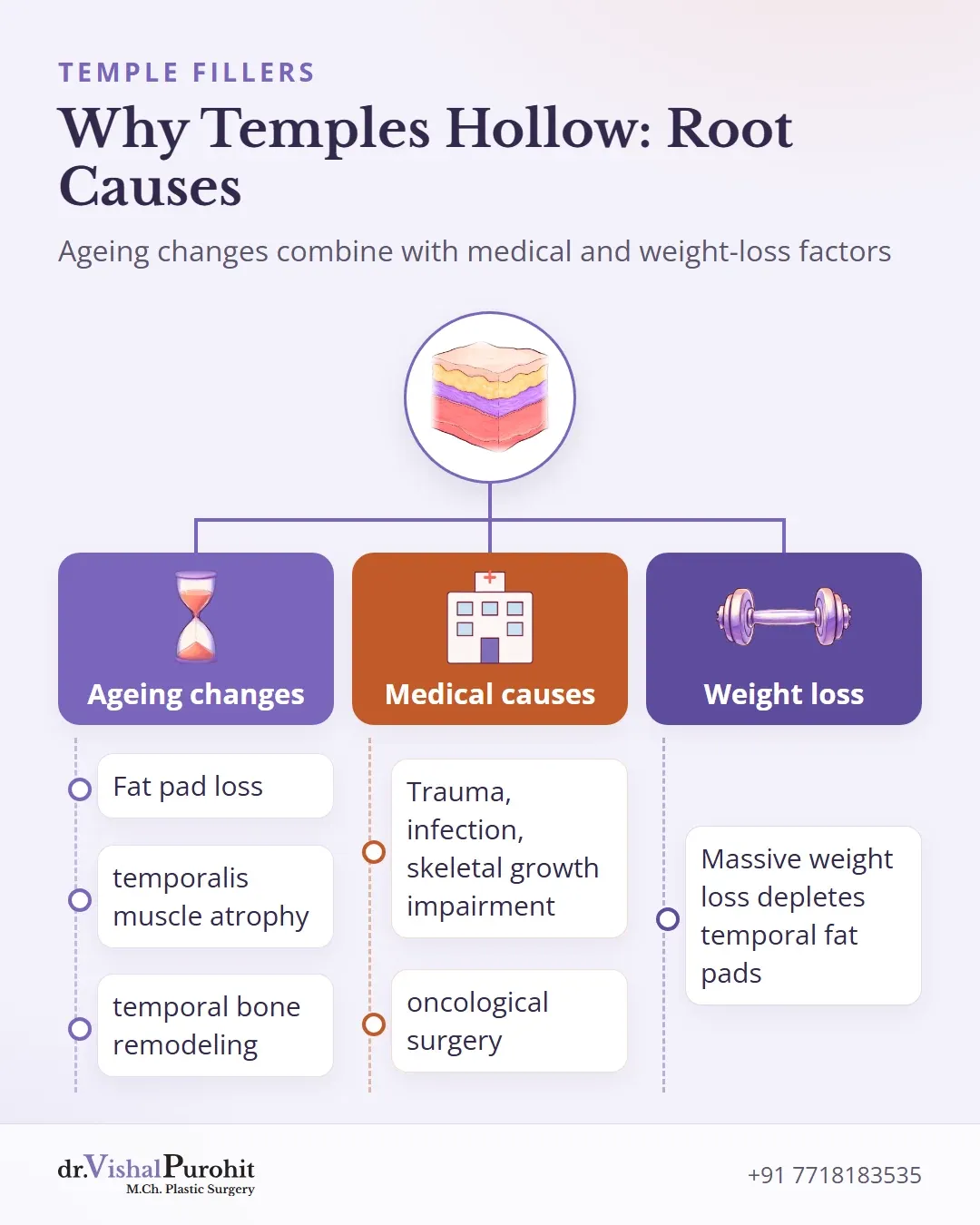
Temporal hollowing usually reflects several changes together: loss of fat from the multiple fat pads and layers of the temporal region1, age-related atrophy of the temporalis muscle and fat layers, and remodeling of the temporal bone2.
During physiological ageing, soft and hard tissue volume loss occurs with a disharmonic redistribution of subcutaneous fat. A younger face tends to have a smoother, fuller, convex temporal contour, while the ageing temple becomes hollow34.
Hollowing is a recognised sign of facial ageing and can make the face look gaunt, older, longer and narrower, with more prominent bony margins and a concave upper face56.
When Ageing Is Not the Whole Story
Hollowing can also follow local or systemic pathophysiological changes:
In thin patients, fat and muscle volume loss can create the appearance of an exposed zygoma7. Because the cause is not always ageing, clinical assessment is needed before cosmetic camouflage, rather than treating it as ageing alone34.
Assessing Goals and Outer Brow Limits
Setting a conservative goal
A conservative contour goal is usually discussed: soften the sunken temple margins without framing normal facial variation as a defect. The discussion separates a contour concern from a feature that is simply part of the person’s facial pattern. The aim is an individual plan rather than a fixed template.
Brow position, not an eye lift
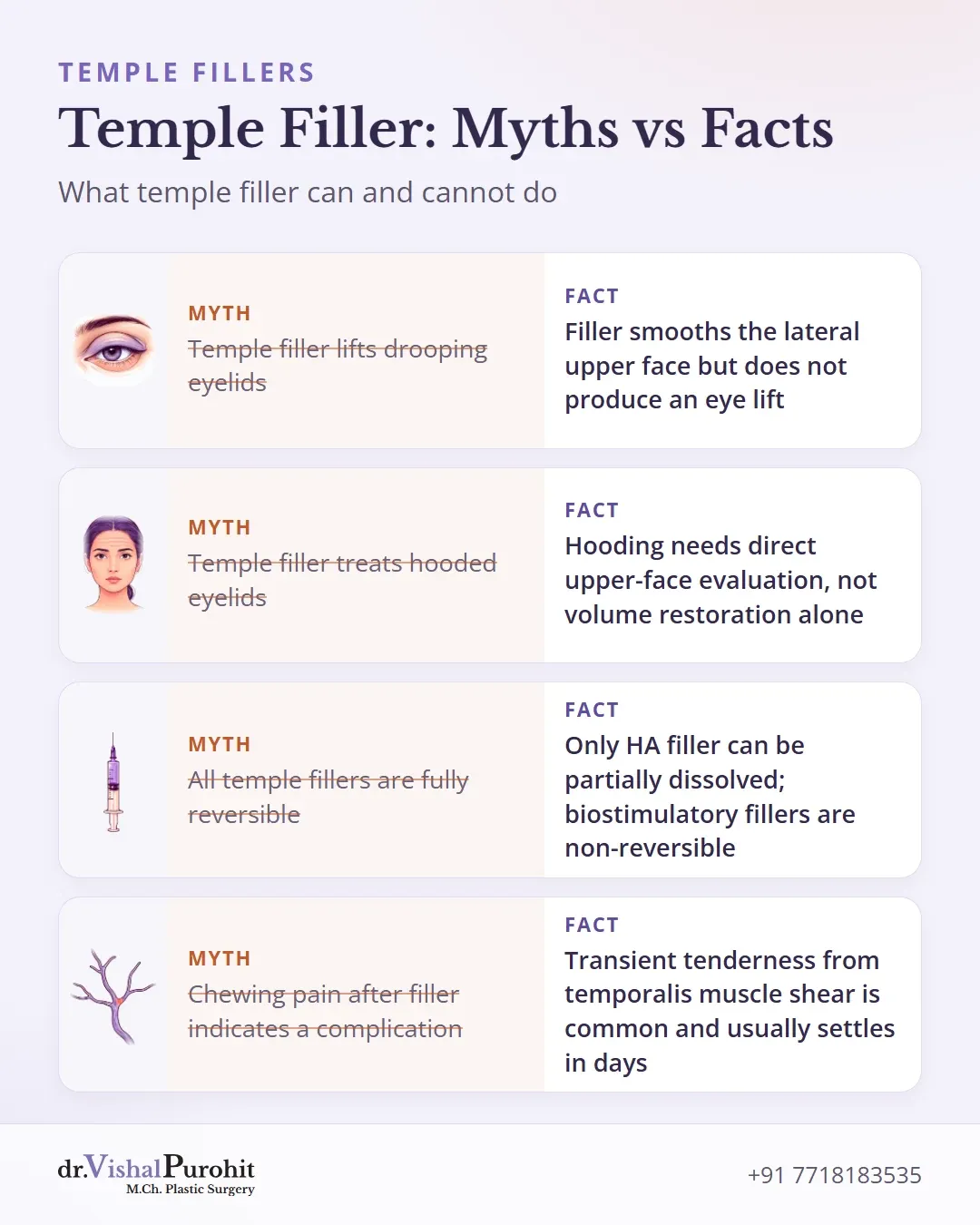
The temple and brow are assessed together because both may show volume loss, and temple treatment may be considered before direct brow manipulation in that situation8. Temple volume restoration can improve lateral brow position8. If lateral brow ptosis remains afterwards, it is assessed separately for possible direct brow manipulation8.
Volume restoration is intended to smooth the temple-forehead transition, not to provide an eye lift. Temple filler is not a treatment for hooded eyelids; hooding needs direct upper-face evaluation. The lateral brow is assessed for position; eyelid hooding is a separate concern.
Filler Materials and Reversibility Considerations
The options
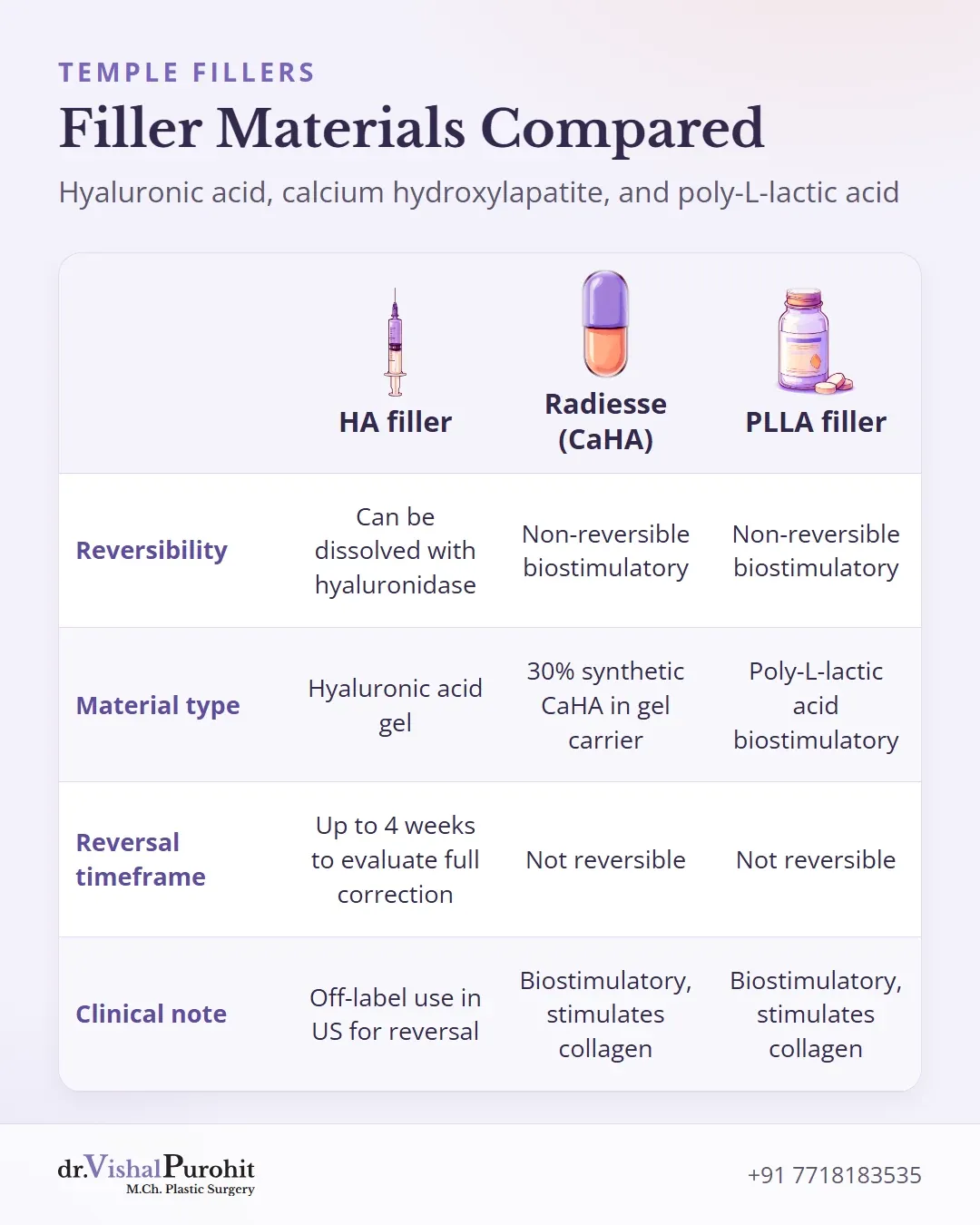
Patients can discuss hyaluronic acid (HA) filler or a collagen-stimulating injectable. HA filler can be titrated in small increments and reversed when necessary9. Biostimulatory products differ: Radiesse is a biostimulatory filler of 30% synthetic CaHA in a gel carrier10, and poly-L-lactic acid is a biostimulatory filler that is non-reversible11. The evidence available here contains no head-to-head comparison, so no single product can be called preferable.
Key points
- Hyaluronic acid fillers can be titrated and reversed, whereas biostimulatory options are non-reversible.
- Reversal with hyaluronidase is not assured to be complete and may take up to 4 weeks to evaluate.
- Critical complications like vision loss require rapid restoration of blood flow that enzyme reversal is unlikely to achieve in time.
Reversal is partial
Hyaluronidase can break down HA filler in many clinical situations9, but correction is not assured and may not be complete. Full correction may take up to 4 weeks to judge12, and the use is off-label in the United States12. One text describes hyaluronidase for vascular occlusion, including behind the eye for blindness13; another questions whether it can act in time14. After visual loss, circulation must return within about an hour and a half to limit lasting damage, and hyaluronidase is unlikely to work that fast14. Temple injection with HA or biostimulatory filler can cause irreversible vision loss15.
In his Jaipur practice, the product used is decided at the consultation.
Filler and Fat Transfer Alternatives
Dermal filler
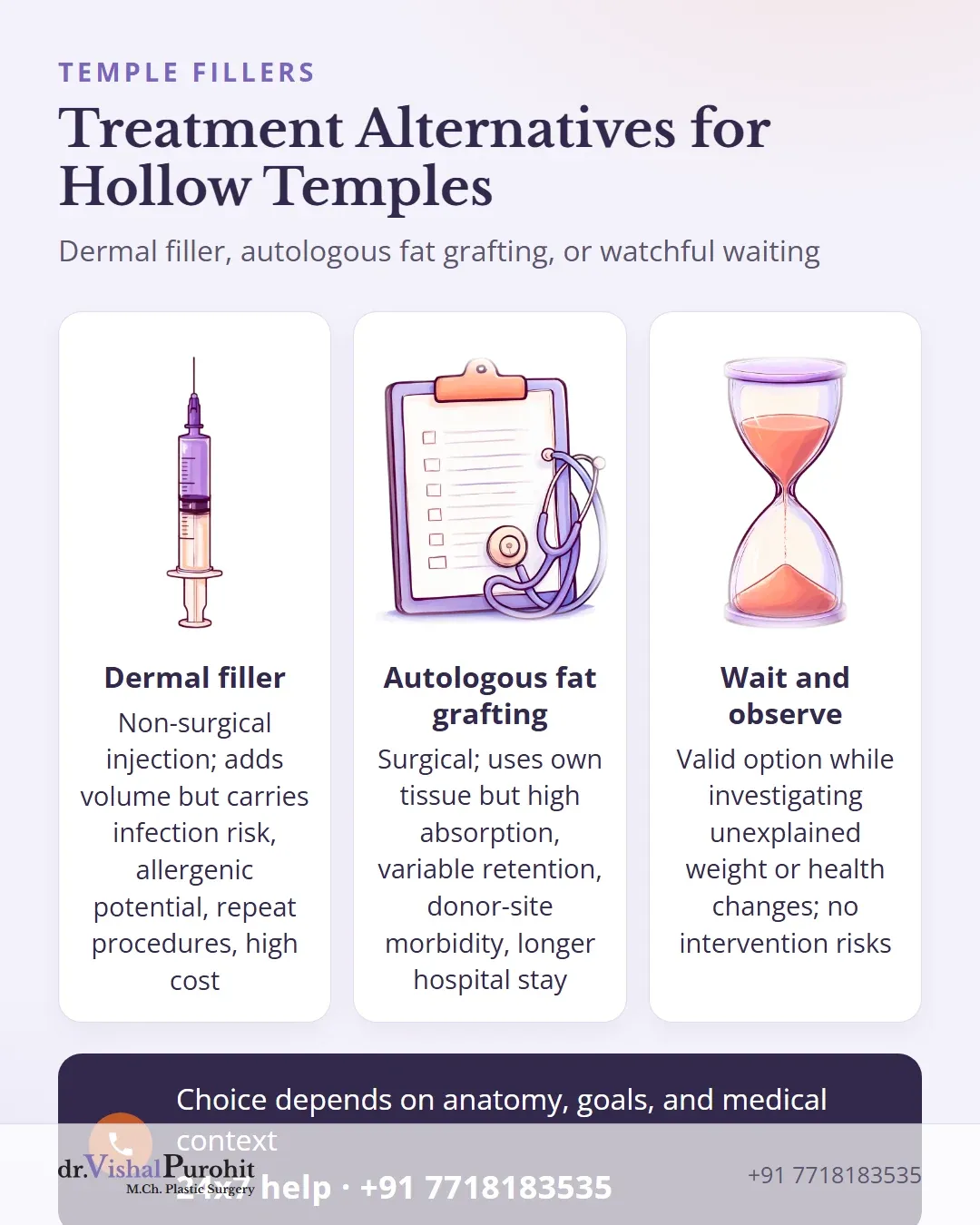
Dermal filler adds volume by injection, without surgery. Synthetic fillers can give acceptable results, but drawbacks include a greater risk of infection, allergenic potential, the need for repeated procedures and relatively high costs16.
Dr. Purohit’s note: Dr. Vishal Purohit offers dermal fillers as a non-surgical treatment in his Jaipur practice.
Autologous fat grafting
Fat grafting is a surgical alternative that restores facial volume, and temporal hollowing is among the changes it can address17. Its limitation is predictability: absorption is high, volume retention varies, and the methods used to assess survival differ widely3. A review found that it addresses temporal hollowness with high patient satisfaction and a favourable safety profile, while retention variability remains18. Autologous tissue can involve donor-site morbidity and a longer hospital stay19.
Choosing to wait
Choosing no treatment, or postponing cosmetic correction, remains a valid option, including while unexplained weight or health changes are being investigated.
Post-Treatment Chewing Ache and Follow-Up
Why chewing may ache
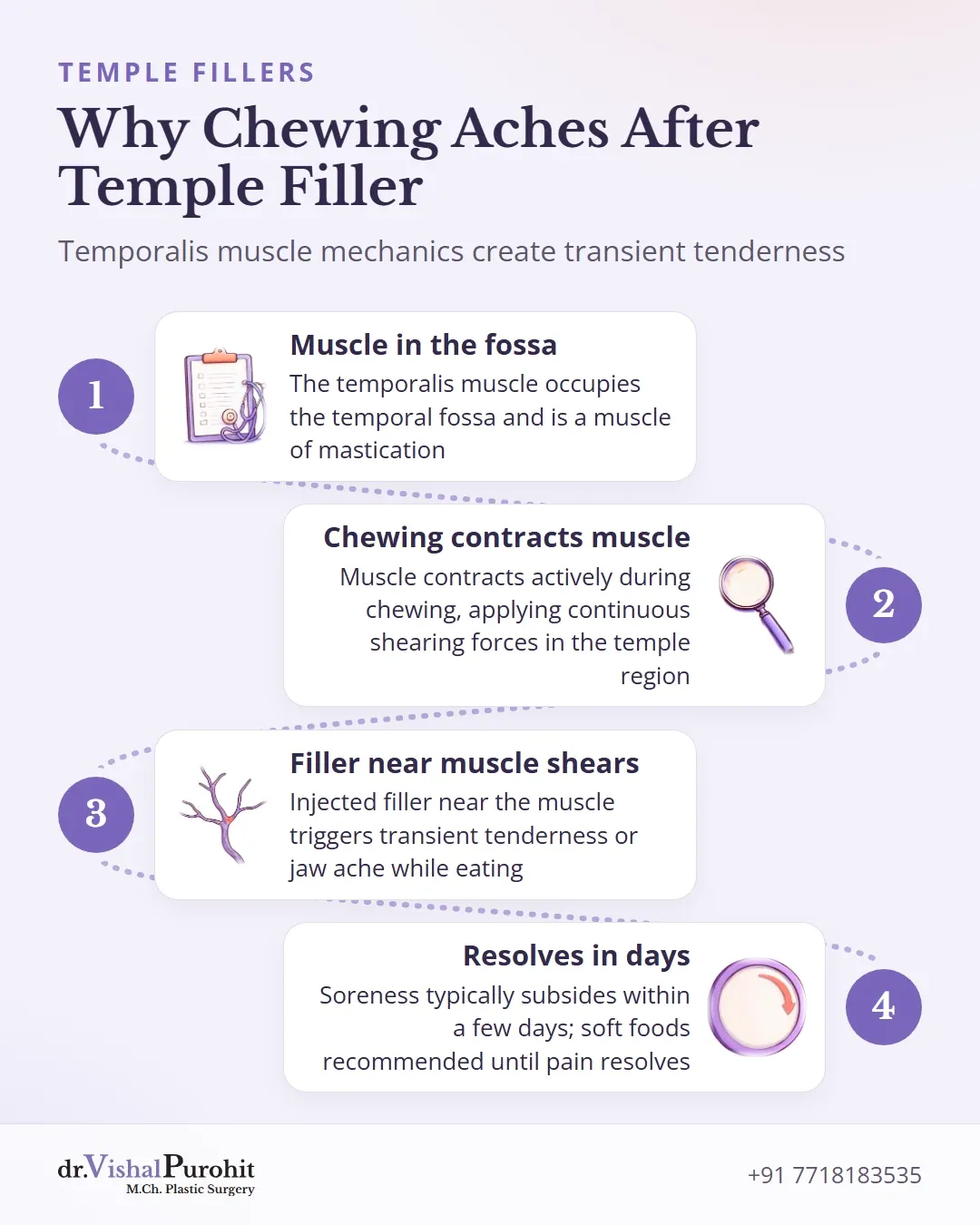
Tenderness or jaw ache while chewing can occur after temple filler treatment15. The temporalis muscle lies in the temporal fossa and is a muscle of mastication, so it moves with chewing and applies continuous shearing forces in the temple region2021.
Soreness or tenderness that worsens with chewing or eating is among the reported adverse events after dermal filler placement in the temples, and these are often mild and transient15. General guidance suggests eating soft foods until the pain resolves15.
Follow-up and travel
In a study of a poly-L-lactic acid filler for temporal augmentation, tenderness, swelling and chewing discomfort typically subsided within a few days22. Severe or worsening ache should not be dismissed.
Two-wheeler commuters in India should plan alternative transport during the initial soreness rather than wearing a tight helmet over treated temples or riding without required headgear. Whether Dr. Purohit advises any specific travel or helmet precaution is decided at the consultation.
Severe Vascular Risks and Emergency Care
Blood supply near the eye
The temple’s complex blood supply includes arteries from the external carotid artery, such as the superficial temporal artery, which connect to the ophthalmic artery but follow their own pathway; this makes backflow into the ophthalmic circulation less likely23. Filler injected into the forehead and temples can, in rare cases, damage blood vessels and cause blindness or embolization24.
Key points
- Temple filler injections carry rare but severe vascular risks, including vessel damage, embolization, and vision loss.
- Complications such as skin necrosis or blindness are uncommon, but both represent serious outcomes.
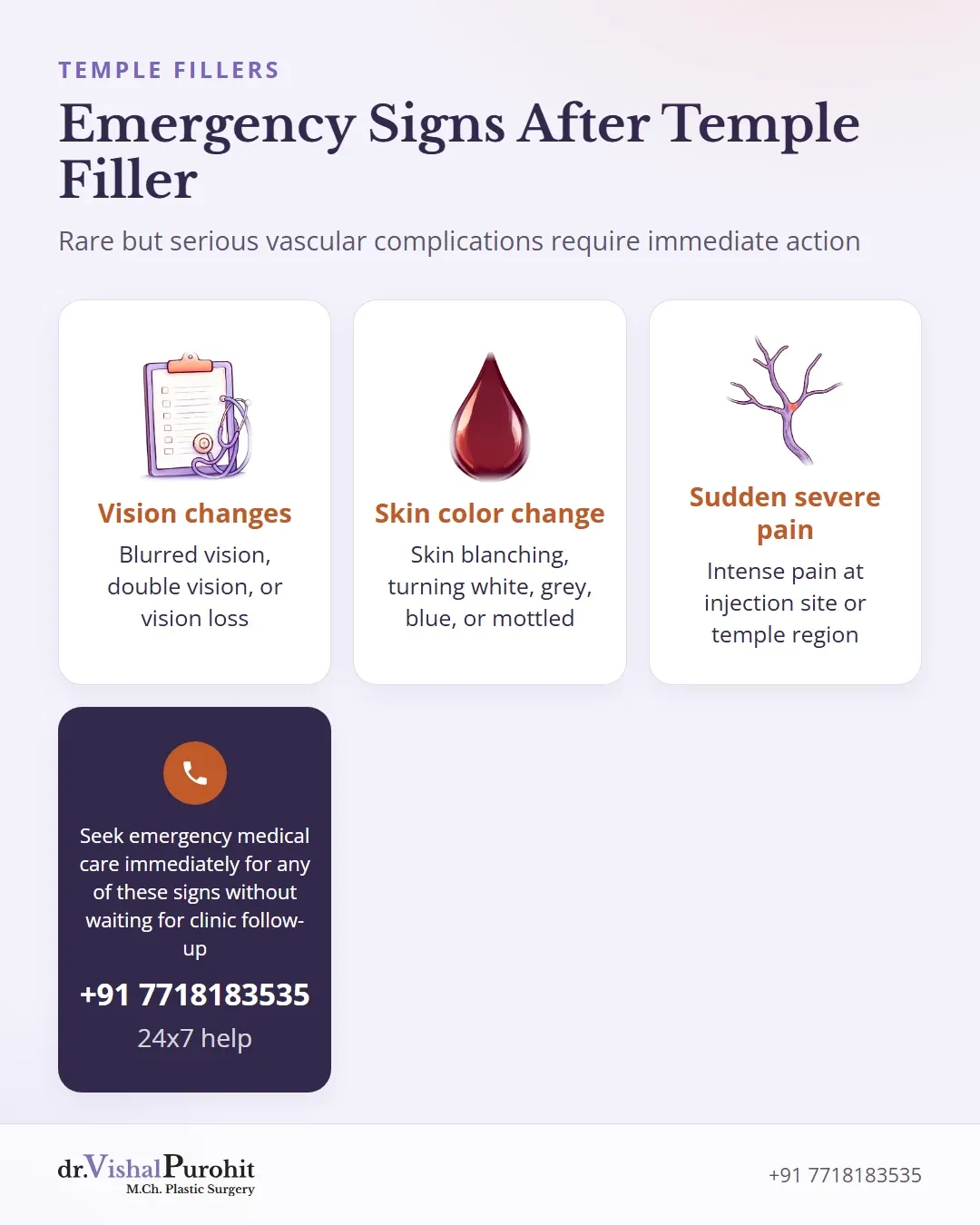
- Symptoms like vision changes, skin blanching, or sudden severe pain require immediate emergency care.
Necrosis and vision loss
Skin necrosis has been reported after hyaluronic acid (HA) filler was injected into the temple area23. Blindness after temple injections has been described in earlier studies, although one report found no injection-induced blindness once cases involving fat grafting were excluded23. These events are rare24, but both are serious outcomes23.
When emergency care is needed
After temple filler, these symptoms need emergency care at once, not a wait for clinic follow-up:
- any change in vision, including blurred vision, double vision or vision loss;
- skin blanching, or skin turning white, grey, blue or mottled;
- sudden severe pain.
Dr. Purohit, who practices in Jaipur, advises patients to seek emergency care at once for these signs.
Consultation for Hollow Temples in Jaipur
Temple volume changes require careful evaluation to understand anatomical limits, realistic brow effects, and suitable materials. To explore options, review Temple Fillers in Jaipur or read answers to common questions in Temple Fillers FAQs. Contact +91 7718183535 to schedule a personal assessment.
This is educational information, not medical advice.