
TUE - SUN: 11:00 AM – 07:00 PM

Aesthetic & Reconstructive Surgery

Surgical Scar Revision & Dermal Remodeling in Jaipur

Surgical Scar Revision & Dermal Remodeling in Jaipur - Dr. Vishal Purohit Plastic Surgeon Jaipur11+ Years of Surgical Experience

Precision geometric excision, vector-redirecting Z-plasty, W-plasty, and micro-suturing to minimize traumatic and surgical scars.

Advanced plastic surgical scar reconstruction transforming wide, raised, tethered, or irregular scars into fine, inconspicuous lines blending with natural skin tension folds.

View clinic timings and contact details →
  • M.Ch Plastic Surgeon · RMC Reg. 28041/14185
  • Day-care / short-stay procedure
  • Tonk Road, Jaipur
  • Jump to FAQs (10)

Procedure Time

45–90 minutes

Anesthesia

Local Anesthesia with mild sedation or Daycare General Anesthesia

Hospital Stay

Outpatient Daycare procedure

Recovery Time

Suture removal: 5–7 days; Scar maturation & refinement: 6–12 months

Indications

Wide surgical scars, hypertrophic facial scars, tethered post-traumatic marks, uneven step-offs, burn contractures

Techniques

Geometric Broken Line Closure (GBLC), Z-plasty tension redirection, W-plasty margin camouflage, subcision, multilayer micro-suturing

Tethered, prominent scars

Can tight, irregular scars be surgically corrected?

Noticeable, raised, or bound-down marks cause persistent pulling across mobile facial areas and joints, creating visible step-offs and restriction during normal daily movements.

Contracted scars across mobile tissue

Abnormal tension vectors pull tightly across joints or expressive facial areas, distorting movement and contour.

Depressed, tethered fibrous marks

Subsurface fibrous bands anchor scarred skin directly to underlying muscle or fascia, creating puckered depressions.

Wide, raised linear scars

Excessive width and continuous straight lines catch light conspicuously, showing hypertrophic elevation and uneven step-offs.

Deep architecture and tension vectors

Scars persist because continuous linear tension and deep fibrous tethering anchor tissue abnormally to muscle or fascia. Surface therapies cannot release contracted bands or reorient wound vectors. Reconstructing dermal architecture requires transposing flaps, releasing deep anchors, and redistributing tensile strain along natural skin tension folds.

Dr. Vishal Purohit - M.Ch Plastic & Cosmetic Surgeon Jaipur

Dr. Vishal Purohit

M.Ch Plastic & Cosmetic Surgeon

✓

Credential Level

M.Ch Super-Specialty

RMC Reg. 28041/14185

Your Surgical Guide

Artistic Proportion & Advanced Surgical Safety

"Our priority is to release deep tethered bands, redirect mechanical tension vectors, and meticulous multilayer micro-suturing to transform conspicuous scars into fine lines aligned with relaxed tension folds."

— Dr. Vishal Purohit

1

M.Ch Plastic & Reconstructive Surgery, SMS Medical College, Jaipur

The highest super-specialty surgical qualification in India, ensuring total anatomical mastery of neurovascular planes and soft tissues.

2

11+ Years as a Plastic Surgeon

Practising plastic surgery in Jaipur since 2015, with a focus on natural, proportionate results.

3

Accredited Operating Suites

Dr. Vishal Purohit operates in sterile hospital operating theatres, with certified cardiac anaesthesiologists and ICU support.

Simple & Transparent

Your 3-Step Surgical Journey

We remove anxiety and uncertainty with a structured, transparent pathway designed for absolute safety and peace of mind.

1

Confidential Assessment

Dr. Purohit evaluates your anatomical baseline, skin elasticity, and health history. You receive an honest feasibility blueprint, personalized surgical plan, and transparent cost with zero pressure.

Step 1: Planning
2

Precision Operating Suite Procedure

Performed by Dr. Vishal Purohit in a sterile hospital operating theatre under gentle anaesthesia. Using advanced minimally invasive techniques, target areas are treated with microscopic care.

Step 2: Procedure
3

Monitored Recovery & Transformation

Supported with tailored recovery guidelines and post-operative follow-up visits. As tissue heals and settling occurs over the coming weeks, your refined results emerge.

Step 3: Recovery
Clinical Guide & In-Depth Information

Comprehensive Medical Overview

Detailed procedural analysis, anatomical considerations, and patient guidelines by Dr. Vishal Purohit.

Advanced Plastic Surgical Scar Revision Techniques in Jaipur

Traumatic lacerations, surgical incisions, and childhood injuries frequently heal with disfiguring scars characterized by excessive width, abnormal tension vectors, depression, or hypertrophic elevation. Dr. Vishal Purohit employs advanced plastic and reconstructive surgical techniques to remodel scars, redirect tension lines, and camouflage marks within natural skin relaxed tension folds (RSTLs).

Core Surgical Scar Revision Principles

Unlike superficial surface treatments, surgical scar revision directly addresses the deep architecture of the scar tissue:

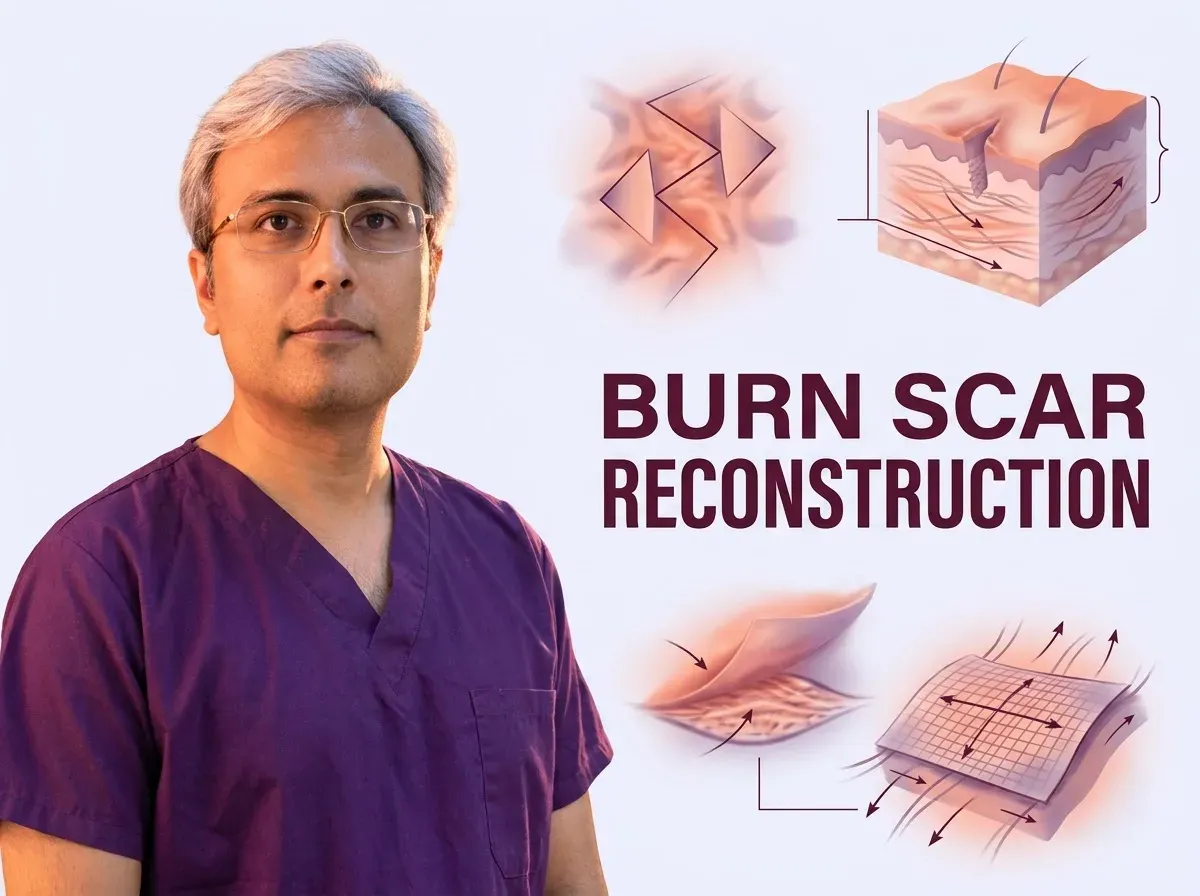
  • Z-Plasty & Tension Redirection: Transposing opposing triangular flaps to lengthen contracted tissue, relieve pulling across joints or mobile facial areas, and rotate scars parallel to natural skin wrinkles.
  • W-Plasty & Geometric Broken Line Closure (GBLC): Irregularizing a long, noticeable linear scar into an accordion-like geometric pattern, breaking up light reflection so the human eye can no longer track the scar line.
  • Subcision & Dermal Release: Releasing fibrous tethering bands that anchor depressed or puckered scars to underlying muscle or fascia, frequently supported by regenerative autologous micro-fat grafting.
  • Tension-Free Multilayer Micro-Suturing: Meticulous deep dermal absorbable sutures relieve all tensile strain from the epidermal surface, allowing the skin edges to appose with microscopic precision.

Multimodal Scar Optimization

Following surgical revision, Dr. Vishal Purohit provides a structured post-operative protocol including medical-grade silicone sheeting, tailored compression therapy, and targeted sun protection to ensure permanent scar maturation.

Your Safety Comes First

Why Your Surgeon’s Training Matters

Surgical Scar Revision & Dermal Remodeling in Jaipur involves delicate anatomy, blood supply and tissue handling. Choosing on price alone, or an operator without plastic-surgery training, raises the risk of contour irregularities and complications.

With Dr. Vishal Purohit, your safety is backed by intensive-care support, certified cardiac anaesthesiologists and hospital-grade theatre protocols.

What to watch out for

  • Operators without plastic-surgery training
  • Rushed or imprecise tissue handling
  • Clinic rooms without emergency backup
  • Higher chance of visible scars or revision surgery

With Dr. Vishal Purohit

  • M.Ch super-specialist plastic surgeon
  • Careful, tissue-preserving technique
  • Hospital-grade operating theatre
  • Personal follow-up through recovery
Refined dermal contour

Inconspicuous lines aligned with natural folds

Surgical repositioning relieves contracture, levels step-offs, and breaks linear light reflection, allowing refined marks to mature inconspicuously over time.

Redirected tension vectors

Z-plasty flap transposition relieves tight contractures across joints and rotates scar lines parallel to wrinkles.

Released dermal tethering

Subcision frees deep fibrous anchors from underlying muscle and fascia, smoothing out depressed, puckered contour step-offs.

Broken light reflection

Geometric broken line closures irregularize long linear edges, allowing fine margins to blend with natural skin.

Got Questions?

Frequently Asked Questions

Honest, clinically precise answers from Dr. Vishal Purohit regarding Surgical Scar Revision & Dermal Remodeling in Jaipur.

What is surgical scar revision in Jaipur?

Surgical scar revision is an operation that tries to make a scar less noticeable and better match nearby skin tone and texture; it cannot completely erase a scar. M.Ch. plastic surgeon Dr. Vishal Purohit in Jaipur can explain whether your scar’s position, tension or function makes revision worth considering and what improvement may be realistic.

Scar revision aims to reduce how conspicuous a scar looks, not remove it entirely. Surgery follows careful principles: gentle tissue handling, tension-free closure, and incisions placed to follow natural skin tension lines where possible. Timing is usually planned several months after surgical intervention so the scar can mature naturally; earlier revision may be considered if placement is poor, landmarks are misaligned, or movement is restricted. The approach varies with scar location, tension and function, because different methods change the scar’s direction, shape or replace tissue. Revision cannot promise a scar will disappear. It aims for a less conspicuous result that blends better.

Scars may remain thick, red, raised, tethered or differently pigmented, and additional treatment may be needed. Revision is usually timed months later, with earlier intervention only in selected situations. Recovery and timing depend on the scar and procedure. If a scar bothers you or limits movement, you may consult Dr. Vishal Purohit in Jaipur to discuss realistic improvement, timing and possible additional treatment.

How does a Z-plasty improve scar appearance and mobility?

A Z-plasty can improve a tight or poorly placed scar by rearranging nearby skin flaps, lengthening and reorienting it rather than simply cutting it out. M.Ch. plastic surgeon Dr. Vishal Purohit in Jaipur can explain whether your scar’s tightness, direction or location makes this approach useful for movement or appearance.

It uses two opposing triangular skin flaps that are transposed, so the scar is reoriented about ninety degrees and functionally lengthened along its central limb. This recruits lax adjacent tissue, can narrow the scar, and makes its borders more irregular for camouflage. It may also release contracture and align the scar with relaxed skin tension lines. No skin excision is needed, but larger angles increase lengthening while increasing standing deformity, and tight sites may need multiple smaller Z-plasties. A scar cannot be completely erased. Timing is usually planned several months after surgery so the scar can improve naturally. Minimal wound tension matters because tension increases risk of hypertrophy or keloid.

Psychological adjustment after injury can affect recovery, and scars remain even after revision. A scar cannot be completely erased, so revision aims for improvement rather than perfection. If a scar limits movement or bothers you, you may consult Dr. Vishal Purohit in Jaipur to discuss whether Z-plasty or another revision approach suits your scar. He can explain benefits and limitations during consultation.

What is W-plasty or Geometric Broken Line Closure?

W-plasty and geometric broken-line closure are scar-revision techniques that break a straight scar into an irregular line so it is less noticeable. They do not erase a scar. M.Ch. plastic surgeon Dr. Vishal Purohit in Jaipur can explain whether reshaping a scar’s line may help your concern and what improvement is realistic.

W-plasty uses connected triangular flaps mirrored along each side of the scar. Unlike Z-plasty, it does not change the scar’s overall length; its irregular pattern makes the scar less conspicuous and disrupts wound contracture. Geometric broken-line closure is a more sophisticated version that uses varied shapes, such as triangles, rectangles, squares and semicircles, in differing widths and lengths. Its less predictable irregularity can camouflage the scar better, but it takes more time to perform. As with all such procedures, marking the planned design before surgery is helpful. Scar revision aims to make a scar less conspicuous and blend with surrounding skin, yet a scar cannot be completely erased.

Because scar appearance varies and healing differs, the right approach depends on scar location, size, direction and your skin. Some scars may need time to mature before revision is considered. Healing and scar appearance vary from person to person. If a scar bothers you, you may consult Dr. Vishal Purohit in Jaipur to discuss realistic improvement, timing and possible risks.

When is a scar mature enough to consider surgical scar revision?

Surgical scar revision is usually considered after a scar has matured, often around 6 to 12 months, though some scars may be revised earlier for functional problems or poor placement. M.Ch. plastic surgeon Dr. Vishal Purohit in Jaipur can help you understand when waiting or earlier review may be appropriate.

Scars often improve spontaneously during the first year as collagen remodels and becomes denser and more uniformly aligned; by about six weeks to twelve months collagen increasingly resembles intact skin, with ultimate tensile strength around 80% of uninjured skin. Revising an immature scar can increase hypertrophy risk. Earlier revision may be considered for severe functional impairment, scars crossing important landmarks, or well-localized low-energy injuries, while high-energy injuries may need longer. Adjunct treatments such as silicone sheets, laser or intralesional steroids may be used while the scar matures. Before surgery, surrounding skin should be soft, supple and nontender without significant redness, swelling or firmness, and the scar should be stable before planning surgery.

A scar may take one to two years to mature, and erythema or raised borders suggest immaturity. Timing is a joint decision between you and your surgeon, based on scar characteristics, function, expectations and whether improvement has plateaued. If a scar concerns you, you may consult Dr. Vishal Purohit in Jaipur to discuss timing, expected improvement and whether observation or adjunct care is sensible.

Can surgical scar revision correct depressed, pitted, or tethered scars?

Yes, surgical scar revision can often improve depressed, pitted or tethered scars, but it cannot completely erase a scar. The best approach depends on the scar’s size, depth, location and maturity. M.Ch. plastic surgeon Dr. Vishal Purohit in Jaipur can explain which options may suit your scar and what improvement is realistic.

Depressed scars may benefit from surgical revision, sometimes by excising the scar and advancing wound edges, with deeper tissue support where there is a tissue deficit. Small depressed scars, such as acne scars, may be smoothed with dermabrasion or laser, or filled with fat, collagen or hyaluronic acid. Tethered scars can pull on underlying tissue and may be considered for revision depending on cause and location. Revision is usually planned only after the scar has matured, and closure should be tension-free to reduce hypertrophy or keloid risk. The scar’s history, inflammation, location and timing also influence the plan, and some scars need multimodal care. Keloids remain especially difficult.

Recovery and final appearance vary by scar type and procedure. Scars often need time to mature before revision, and even a well-healed revision leaves a scar. If a depressed or tethered scar bothers you, you may consult Dr. Vishal Purohit in Jaipur to discuss realistic improvement, timing and possible risks. He can also explain why some scars need more than one treatment and why results vary.

What is the recovery time after scar revision surgery?

Recovery after scar revision surgery usually takes 2 to 4 weeks, depending on surgical scope, tissue dissection and your healing capacity; strenuous exertion and heavy lifting are usually restricted for 4 to 6 weeks. M.Ch. plastic surgeon Dr. Vishal Purohit in Jaipur can explain how scar maturity, location and your goals affect timing and expected improvement.

Scar revision is not simply removing a scar; it repositions or reshapes tissue so the scar blends better with surrounding skin, but a scar cannot be completely erased. Timing matters because collagen remodeling continues for months and immature scars are more prone to thickening. Many cosmetic revisions are delayed at least 6 to 12 months, while function-limiting or poorly placed scars may prompt earlier intervention. Surgical principles include gentle tissue handling, tension-free closure and incisions aligned with natural skin tension lines. Results also depend on scar type, cause, location, size and skin characteristics. Recovery and final appearance vary with procedure extent and individual healing.

Early walking is encouraged within 24 hours, but heavy lifting and strenuous exercise should wait 4 to 6 weeks under your surgeon's guidance. Complications can include hematoma, infection or recurrent widening. Follow your surgeon's wound-care instructions and attend scheduled reviews. If a scar bothers you functionally or cosmetically, you may consult Dr. Vishal Purohit in Jaipur to discuss realistic improvement and timing.

Is surgical scar revision painful?

Surgical scar revision is usually performed with anesthesia chosen for the procedure’s extent, your age and anxiety, so the operation itself is not felt; afterward, soreness and tightness can occur. M.Ch. plastic surgeon Dr. Vishal Purohit in Jaipur can explain which anesthesia and closure approach may suit your scar and comfort.

A scar is the visible mark left after a wound heals; revision can improve how it looks but cannot remove it completely. The surgeon assesses color, width, depth, location and orientation, then chooses a plan suited to your skin and goals. Reducing tension matters because tension can make scars thicken or spread. Anesthesia depends on procedure size and your comfort. Many scars mature for months before revision, unless they restrict movement or function. The aim is a less obvious scar that blends better with nearby skin, not perfection. If a scar affects function, earlier treatment may be considered. Your expectations and emotional readiness also matter, because surgery will not erase the scar.

Afterward, a scar may look red or purple before fading over 12 to 18 months. Possible complications include bleeding under the skin, infection, tissue death, color change, distortion or recurrent widening. Recovery and scar care depend on the procedure and your health. If a scar bothers you, you may consult Dr. Vishal Purohit in Jaipur to discuss realistic improvement, timing and risks. Improvement is possible, but not guaranteed.

Why can scar revision surgery improve a scar without removing it completely?

Scar revision surgery can make a scar less noticeable and better blended with nearby skin, but it cannot erase it completely because scars are permanent healing tissue. M.Ch. plastic surgeon Dr. Vishal Purohit in Jaipur can explain how your scar’s cause, location and healing history affect realistic improvement and limitations.

Scars form as part of normal wound healing, so revision changes how the scar looks rather than removing healing tissue. The final result depends on scar position, tissue loss, age, health, genetics, wound closure and healing complications; some factors are beyond surgeon control. The surgeon can apply wound-healing principles such as gentle tissue handling, tension-free closure and careful incision placement to optimize camouflage. Blunt trauma, burns or gunshot wounds may involve more surrounding injury and can need staged revisions; widened or atrophic scars may not improve with time. Timing also matters: some scars improve naturally over months, while early revision may be considered for improper placement or functional restriction.

Because scars cannot be erased, expectations matter; revision may improve, leave you still bothered, change little, or rarely worsen if healing complications occur. Scars remain, although appearance often improves over time. Recovery and follow-up depend on the procedure and your healing. If a scar concerns you, you may consult Dr. Vishal Purohit in Jaipur to discuss realistic improvement and whether revision is appropriate.

Why choose Dr. Vishal Purohit for scar revision in Jaipur?

Scar revision aims to make a scar less conspicuous and blend with surrounding skin, but it cannot completely erase it. M.Ch. plastic surgeon Dr. Vishal Purohit in Jaipur can explain whether your scar’s position, tension and maturity make revision worthwhile, and what improvement is realistic.

Good scar revision follows basic surgical principles: gentle tissue handling, tension-free closure, incisions perpendicular to skin edges, and, when possible, alignment with relaxed skin tension lines. Scars lying along these lines tend to look better than scars crossing them. Timing matters: revision is usually planned months after injury or surgery, and cosmetic surgical revision is often delayed six to twelve months for scar maturation, unless function is limited. Options may be used serially or concurrently; surgical revision is generally followed by nonsurgical maneuvers. A scar cannot be completely erased, so the aim is a less conspicuous scar that blends with surrounding skin. Technique selection depends on scar type, location, and patient factors; Dr. Purohit can discuss options during consultation.

Even with careful planning, complications such as hematoma, infection, necrosis, pigmentation changes, distortion or recurrent widening can occur, so expectations should stay realistic. Recovery and follow-up needs vary by procedure and scar location; your surgeon will explain wound care and warning signs before surgery. If a scar bothers you functionally or cosmetically, you may consult Dr. Vishal Purohit in Jaipur to discuss timing, likely improvement and possible risks.

How do you distinguish a widened scar, depressed scar, tethered scar and keloid?

A widened scar has stretched wider than the original wound, a depressed scar sits below surrounding skin, a tethered scar is stuck to deeper tissue, and a keloid grows beyond the original wound edges. M.Ch. plastic surgeon Dr. Vishal Purohit in Jaipur can help you understand which pattern your scar shows and what options may be relevant.

Scars are the unavoidable result of healed wounds and may differ in size, shape, color or texture. A depressed scar can follow less ideal early healing, such as seroma, hematoma, infection, closure under too much tension, or loss of underlying fat. A tethered scar can pull on or stick to deeper structures. A keloid is raised scar tissue that extends beyond the original wound borders and may stay raised, red, painful or itchy; it is more common where little fat lies beneath the skin. Hypertrophic scars are raised but stay within the original wound edges and may become wider over time.

Scar revision aims to make a scar less conspicuous and blend with surrounding skin, but results vary and abnormal scarring can recur. Timing and technique depend on scar type, location and healing; revision is usually planned several months after surgery to allow natural improvement. If a scar bothers you or limits movement, you may consult Dr. Vishal Purohit in Jaipur to discuss realistic improvement and possible next steps.

Need more clinical answers?

Explore all 93 answered Surgical Scar Revision / Z-Plasty / W-Plasty questions.

Surgical Scar Revision / Z-Plasty / W-Plasty FAQ Hub (93 FAQs)
Begin Your Journey

Ready to Discuss Surgical Scar Revision & Dermal Remodeling in Jaipur?

At his OPD suite, Kalpana Aesthetics (2nd Floor), Dr. Vishal Purohit evaluates your candidacy, discusses surgical options and gives you a transparent, tailored treatment plan.