
Emergency Orthoplastic Reconstruction for Severe Open Fractures
High-energy road traffic accidents and industrial trauma frequently cause severe open fractures of the lower extremity (Gustilo-Anderson Grade IIIB and IIIC) with extensive soft-tissue stripping, leaving bare cortical bone, shattered fragments, and orthopedic plates exposed. Cortical bone devoid of periosteum cannot survive without rapid soft tissue coverage; leaving exposed bone dry for even a few days leads to cortical desiccation, acute osteomyelitis, and eventual limb amputation.
The 'Fix and Flap' Orthoplastic Approach
In modern limb salvage, the orthoplastic team (orthopedic surgeon + plastic reconstructive surgeon) operates collaboratively:
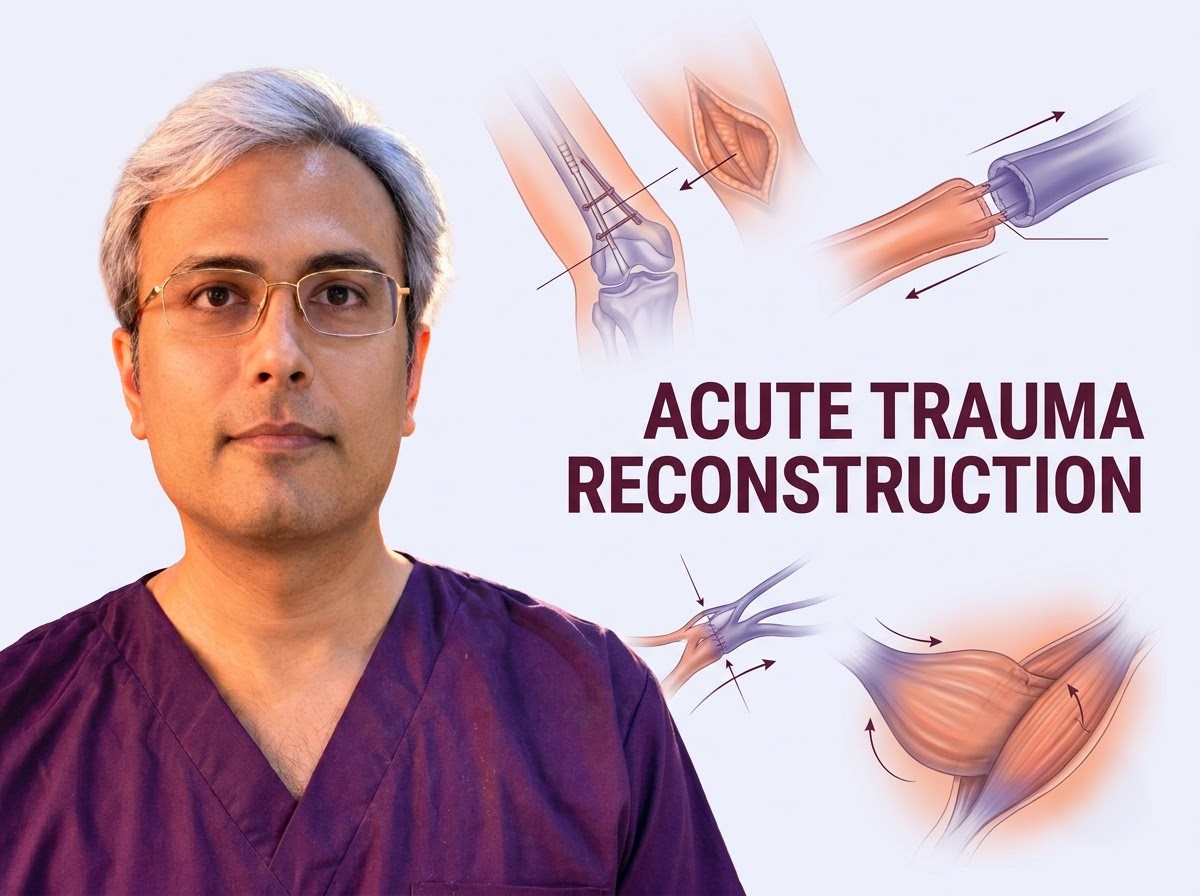
- Skeletal Stabilization: Rigid bone stabilization using external fixators, intramedullary nails, or low-profile plates.
- Radical Debridement: Meticulous excision of non-viable muscle, contused skin, and dirt debris to convert an acute dirty wound into a clean surgical defect.
- Early Flap Coverage (<72 hours): Transposing a vascularized local muscle flap (gastrocnemius for upper tibia, soleus for mid tibia, reverse sural or free flap for lower third) to cover bare bone and hardware.
Preventing Amputation and Restoring Mobility
Vascularized flap coverage restores biological circulation, delivers systemic antibiotics directly into the fracture gap, promotes rapid bone callus formation, and prevents deep infection, saving limbs that would otherwise face amputation.