
TUE - SUN: 11:00 AM – 07:00 PM

Aesthetic & Reconstructive Surgery

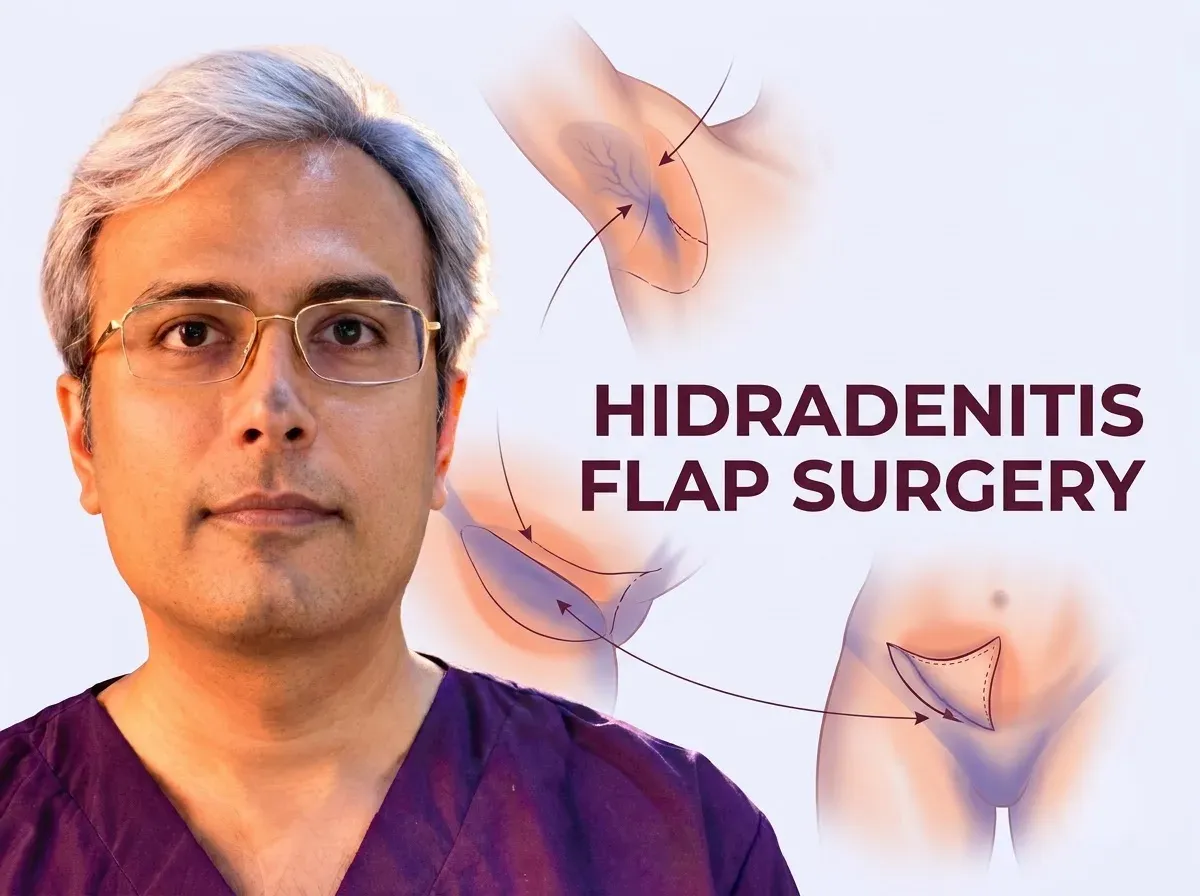
Hidradenitis Suppurativa Flap Surgery in Jaipur

Hidradenitis Suppurativa Flap Surgery in Jaipur - Dr. Vishal Purohit Plastic Surgeon Jaipur11+ Years of Surgical Experience

Radical excision of diseased apocrine gland fields with durable flap reconstruction.

Ending the painful cycle of recurrent boils, discharging sinuses, and severe scarring in the armpits and groin with specialized plastic surgical excision and primary flap coverage.

View clinic timings and contact details →
  • M.Ch Plastic Surgeon · RMC Reg. 28041/14185
  • Day-care / short-stay procedure
  • Tonk Road, Jaipur
  • Jump to FAQs (10)

Procedure Time

1.5–3 hours

Anesthesia

General Anesthesia

Hospital Stay

1–2 nights

Recovery Time

Drains removed: 5–7 days; Return to light activities: 2 weeks; Full healing: 3–4 weeks

Indications

Hurley Stage II and Stage III axillary, inguinal, and perineal Hidradenitis Suppurativa

Techniques

Wide radical excision with Thoracodorsal perforator (TDAP) flaps, Groin flaps, Local transposition

Trapped in Painful Cycles

Will these boils and draining wounds ever truly heal?

Hidradenitis Suppurativa fills daily life with deep abscesses, foul-smelling discharge, and subcutaneous sinus tracts that return relentlessly despite repeated treatments.

Recurrent Abscesses and Drainage

Deep, agonizing abscesses rupture and drain repeatedly, making ordinary movement in the armpits or groin persistently painful.

Sinus Tracts Beneath the Skin

Subcutaneous tunnels connect diseased areas, allowing infection to spread and preventing wounds from closing durably.

Severe Scarring and Contracture

Progressive scarring distorts surrounding tissue, and axillary involvement can restrict overhead arm mobility significantly.

Why the Disease Persists

Hidradenitis Suppurativa originates deep within the hair follicles and apocrine glands. Antibiotics and limited local drainage address surface flares but leave the entire diseased gland field intact. As long as that tissue remains, the inflammatory cycle of abscess, rupture, sinus formation, and scarring continues without resolution.

Dr. Vishal Purohit - M.Ch Plastic & Cosmetic Surgeon Jaipur

Dr. Vishal Purohit

M.Ch Plastic & Cosmetic Surgeon

✓

Credential Level

M.Ch Super-Specialty

RMC Reg. 28041/14185

Your Surgical Guide

Artistic Proportion & Advanced Surgical Safety

"Our priority is radical elimination of every disease-bearing apocrine gland and follicle, followed by durable flap reconstruction that restores supple, healthy tissue — ending the cycle rather than managing it."

— Dr. Vishal Purohit

1

M.Ch Plastic & Reconstructive Surgery, SMS Medical College, Jaipur

The highest super-specialty surgical qualification in India, ensuring total anatomical mastery of neurovascular planes and soft tissues.

2

11+ Years as a Plastic Surgeon

Practising plastic surgery in Jaipur since 2015, with a focus on natural, proportionate results.

3

Accredited Operating Suites

Dr. Vishal Purohit operates in sterile hospital operating theatres, with certified cardiac anaesthesiologists and ICU support.

Simple & Transparent

Your 3-Step Surgical Journey

We remove anxiety and uncertainty with a structured, transparent pathway designed for safety and peace of mind.

1

Confidential Assessment

Dr. Purohit evaluates your anatomical baseline, skin elasticity, and health history. You receive an honest feasibility blueprint, personalized surgical plan, and transparent cost with zero pressure.

Step 1: Planning
2

Precision Operating Suite Procedure

Performed by Dr. Vishal Purohit in a sterile hospital operating theatre under gentle anaesthesia. Using advanced minimally invasive techniques, target areas are treated with microscopic care.

Step 2: Procedure
3

Monitored Recovery & Transformation

Supported with tailored recovery guidelines and post-operative follow-up visits. As tissue heals and settling occurs over the coming weeks, your refined results emerge.

Step 3: Recovery
Clinical Guide & In-Depth Information

Comprehensive Medical Overview

Detailed procedural analysis, anatomical considerations, and patient guidelines by Dr. Vishal Purohit.

Ending the Chronic Pain of Hidradenitis Suppurativa

Hidradenitis Suppurativa (HS) is a debilitating inflammatory condition of the hair follicles and apocrine glands that causes deep, agonizing abscesses, foul-smelling drainage, and subcutaneous sinus tracts in the armpits, groin, and buttocks. Simple antibiotics, incisional drainage, and limited local excisions almost always fail, leading to repeated flare-ups.

Dr. Vishal Purohit offers definitive surgical management for moderate-to-severe (Hurley Stage II & III) HS. By performing wide, radical excision of the entire disease-bearing anatomical gland field and reconstructing the defect with healthy local or regional fasciocutaneous flaps, we eliminate the tissue harboring the disease and prevent recurrence.

Surgical Techniques for HS Defect Reconstruction

Axillary (Armpit) HS Reconstruction

After wide radical excision of the axillary vault, direct primary closure causes severe shoulder contracture. Dr. Purohit uses Thoracodorsal Artery Perforator (TDAP) flaps, parascapular flaps, or local transposition flaps to provide supple, hair-free tissue while preserving full overhead arm mobility.

Inguinal & Perineal HS Reconstruction

Groin and perineal defects are reconstructed using groin advancement flaps, pudendal thigh flaps, or V-Y advancement flaps, positioning incisions away from natural moisture and friction folds.

Your Safety Comes First

Why Your Surgeon’s Training Matters

Hidradenitis Suppurativa Flap Surgery in Jaipur involves delicate anatomy, blood supply and tissue handling. Choosing on price alone, or an operator without plastic-surgery training, raises the risk of contour irregularities and complications.

With Dr. Vishal Purohit, your safety is backed by intensive-care support, certified cardiac anaesthesiologists and hospital-grade theatre protocols.

What to watch out for

  • Operators without plastic-surgery training
  • Rushed or imprecise tissue handling
  • Clinic rooms without emergency backup
  • Higher chance of visible scars or revision surgery

With Dr. Vishal Purohit

  • M.Ch super-specialist plastic surgeon
  • Careful, tissue-preserving technique
  • Hospital-grade operating theatre
  • Personal follow-up through recovery
Free from the Cycle

Life without recurring abscesses or sinuses

Wide radical excision paired with flap reconstruction removes the source of disease, allowing the affected region to heal with durable, healthy tissue and restored function.

Restored Overhead Arm Mobility

TDAP and transposition flaps provide supple, hair-free tissue in the axilla, preserving full shoulder movement without contracture.

Disease Field Eliminated

Radical excision removes the entire gland-bearing tissue responsible for recurrence, addressing Hurley Stage II and Stage III disease at its source.

Durable Wound Closure

Regional flaps — groin, pudendal thigh, or V-Y advancement — reconstruct perineal and inguinal defects away from friction and moisture folds.

Got Questions?

Frequently Asked Questions

Honest, clinically precise answers from Dr. Vishal Purohit regarding Hidradenitis Suppurativa Flap Surgery in Jaipur.

What is hidradenitis suppurativa (HS) flap surgery in Jaipur?

HS flap surgery rebuilds skin after wide removal of affected tissue, using nearby tissue to cover larger defects when simple closure or grafts may not suit. M.Ch. plastic surgeon Dr. Vishal Purohit in Jaipur can explain when flap reconstruction may be considered and its limitations.

Hidradenitis suppurativa is a chronic inflammatory follicular disease of apocrine gland-bearing skin, causing tender nodules, abscesses, tunnels and scars. Surgery can remove active disease and scarred tissue, but it is not used alone; medicines and lifestyle measures also matter. Reconstruction depends on defect size and location. Larger areas, or places where tightening could reduce movement or function, may need skin grafts or flaps. Flaps may use skin, deeper tissue or muscle. Closing with a flap should generally be avoided because hair follicles can reintroduce disease. When lesions cannot be fully removed, a muscle-containing flap may be used; a thoracodorsal artery perforator flap is increasingly used for armpit defects.

After extensive surgery, patients may be admitted for observation, with attention to bleeding and anemia. Open wounds may receive topical care such as povidone iodine ointment or alginate dressing followed by paraffin gauze. Negative-pressure dressings can help secure skin grafts in difficult areas. Skin grafting is generally considered unsuitable for inguinoperineal disease. If HS affects your daily life, you may consult Dr. Vishal Purohit in Jaipur to discuss surgical options, reconstruction choices and expected recovery.

When might medicines or laser treatment be insufficient for established HS tunnels?

Established HS tunnels may not respond well to medicines or laser, especially in advanced disease or long-standing, widespread disease. M.Ch. plastic surgeon Dr. Vishal Purohit in Jaipur can explain in detail during consultation when medical or laser care may be insufficient and what surgical options could be discussed for your situation.

HS tunnels are often resistant to available medicines, particularly in advanced stages, so surgery is often needed. Early disease may be managed medically and symptoms may ease, but repeated drainage gives only short-term relief. Laser has specific roles: CO2 laser ablation is used for small areas or where function must be preserved; Nd:YAG laser showed significant improvement after three months but needs more research before becoming standard. For chronic, extensive disease, removing the affected area and nearby apocrine gland zone to about 2 cm beyond disease is described as best for minimizing recurrence. Deroofing recurrence ranges from 10 to 27 percent, and wide local excision with or without grafting or reconstruction is standard for larger areas.

Even radical surgery is considered by many to cure only the area removed, and new lesions may appear where none was seen initially. Surgery should be performed as early as possible after abscesses, fistulas, scars or sinus tracts form. If tunnels keep recurring despite medicines or laser, you may consult Dr. Vishal Purohit in Jaipur to discuss whether surgical removal and reconstruction are appropriate for your situation.

What flap reconstruction methods are used after axillary HS excision?

After axillary hidradenitis suppurativa excision, flap reconstruction is generally reserved for larger defects or areas where movement matters; smaller areas may close primarily or heal by secondary intention. The choice depends on defect size and location. M.Ch. plastic surgeon Dr. Vishal Purohit in Jaipur can explain suitable closure options during consultation.

The method depends on the size and location of the defect. For larger axillary defects after wide excision, or where wound contracture could limit movement, reconstruction may use skin grafts or flaps. A pedicle thoracodorsal artery perforator flap is increasingly used for axillary coverage and may offer better function and appearance than split-thickness or full-thickness skin grafts. If disease cannot be completely resected, a musculocutaneous perforator flap based on thoracodorsal vessels may be suitable, especially for recurrent disease in the axilla. However, primary closure with local, rotation or transposition flaps should generally be avoided because hair follicles reintroduced into an HS-prone axillary site may recur within the flap.

Recovery and wound care depend on whether the wound is closed, grafted or reconstructed, and on defect size. Negative-pressure dressings may help secure grafts or support healing. Postoperative care is individualized, and no outcome is guaranteed. If axillary HS has recurred or limits movement, you may consult Dr. Vishal Purohit in Jaipur to discuss defect size, closure options and realistic recovery.

What is the recurrence rate after radical excision and flap surgery for HS?

Recurrence after radical excision for hidradenitis suppurativa varies by site and closure: one report found 33% after radical excision, while wide excision overall was estimated at 2.5% over a median 36 months. A systematic review estimated 8% with flap closure. Dr. Vishal Purohit, M.Ch. plastic surgeon in Jaipur, can explain how extent of excision and reconstruction affect your risk.

It is the width of excision, not the closure technique, that influences therapeutic outcome. Recurrence is likely if excision is inadequate or apocrine gland distribution is unusually wide. Rates vary considerably by site, with the highest reported 50% in the submammary region. An overall recurrence rate of 2.5% has been estimated after wide surgical excision (median postoperative follow-up, 36 months). A systematic review estimated 13% recurrence after wide excision overall, with 15% primary closure, 8% flap closure and 6% graft closure, but pooled estimates are heterogeneous and follow-up differs. Disease may also develop in other areas rather than truly recur after wide excision.

Because recurrence can appear adjacent to excised areas or elsewhere, surgery is most valuable in chronic or recurrent disease and may be spaced at least three months apart if new disease appears. Recovery and wound care depend on defect size and closure method. If hidradenitis suppurativa concerns you, you may consult Dr. Vishal Purohit in Jaipur to discuss extent of excision, reconstruction options and realistic recurrence risk.

What is the recovery period following hidradenitis flap surgery in Jaipur?

Recovery after hidradenitis flap surgery varies with defect size, location and reconstruction method, so no single timeline applies. Dr. Vishal Purohit, M.Ch. plastic surgeon in Jaipur, can explain how the chosen closure affects healing, activity and follow-up for your individual situation, and what to expect.

Hidradenitis suppurativa surgery removes inflamed sinus tracts and debris; reconstruction is chosen to suit defect size and site. Flap reconstruction may be avoided because reintroducing hair follicles into a disease-prone site can cause recurrence within the flap. Split-thickness skin grafting can be easier and may allow faster healing, though it has aesthetic and donor-site trade-offs. Negative-pressure dressings can help graft position. For larger defects where shorter healing is preferred, delayed split-thickness skin grafting with platelet-rich plasma may reduce morbidity and pain and may accelerate recovery. Recovery timelines differ by defect size, location, closure method and disease extent, so individualized planning with your surgeon in Jaipur matters carefully, with follow-up planning for your case.

After surgery, patients are admitted for observation, with attention to bleeding and wound care; open wounds may need topical care. Healing depends on whether closure is primary, graft or flap, and on disease extent. If you are considering surgery, you may consult Dr. Vishal Purohit in Jaipur to discuss expected recovery, wound care, follow-up and when to resume activities for your case.

Is surgical treatment for hidradenitis suppurativa covered by health insurance?

Whether hidradenitis suppurativa surgery is covered by health insurance depends on your insurer and policy. Dr. Vishal Purohit, M.Ch. plastic surgeon in Jaipur, and his team can help with clinical documentation and pre-authorisation or reimbursement paperwork, and coordinate eligible hospital cashless claims subject to the insurer's prior approval, but coverage is never guaranteed.

Hidradenitis suppurativa is a chronic, recurrent inflammatory skin disease with painful nodules, abscesses and sinus tracts in areas such as the axillae, groin and inframammary regions. Surgery is indicated in most stages except the mildest forms, and may include unroofing, wide excision, punch debridement or incision and drainage. Reconstruction depends on defect size and location; skin grafting is generally considered unsuitable for inguinoperineal disease, while flaps may cover larger defects. Medical therapy may be used first to calm inflammation, and perioperative antibiotics are chosen by disease severity. For mild-to-moderate disease, systemic antibiotics or anti-inflammatory biologics may be used before surgery; severe disease may need glucocorticoids, cyclosporine or biologics.

After surgery, patients are observed; open wounds may be managed with povidone iodine ointment or alginate dressings, and negative-pressure dressings can help secure grafts. Recurrence within a flap is possible if hair follicles are reintroduced into a predilection site. If you are considering surgery for hidradenitis suppurativa, you may consult Dr. Vishal Purohit in Jaipur to discuss options and documentation support.

Can groin and perianal hidradenitis suppurativa be treated surgically?

Yes, groin and perianal hidradenitis suppurativa can be treated surgically, especially when medicines have not controlled it or the area is extensive. Local cure can be achieved with elective surgery. M.Ch. plastic surgeon Dr. Vishal Purohit in Jaipur can explain whether excision, reconstruction or another option suits your situation.

Surgery helps by removing epithelialized sinus tracts and inflammatory debris that act like foreign bodies under the skin, which may prevent progressive scarring. The approach depends on severity, size and location: smaller lesions may be managed with incision and drainage, deroofing or narrow-margin excision, while larger or deeper disease may need wide excision. Reconstruction then depends on the defect; flaps can cover wide excision defects, whereas skin grafting is generally considered unsuitable for inguinoperineal disease. Medical treatment may be used before surgery to calm inflammation. Multidisciplinary care and lifestyle measures such as weight management and smoking cessation may support treatment. Negative-pressure dressings can help secure skin grafts where used.

After surgery, patients may be admitted for observation, with attention to bleeding and anemia risk. Open wounds may be managed with topical care such as povidone iodine ointment or alginate dressing followed by paraffin gauze. Skin grafts can have poor aesthetic results and a donor-site wound, while flaps may be used for larger defects. If groin or perianal hidradenitis suppurativa affects you, you may consult Dr. Vishal Purohit in Jaipur to discuss surgical options and recovery.

Why choose Dr. Vishal Purohit for hidradenitis suppurativa surgery in Jaipur?

Choosing Dr. Vishal Purohit in Jaipur means discussing hidradenitis suppurativa surgery with an M.Ch. plastic surgeon who can explain options, suitability, benefits and limitations for your disease pattern. Surgery is considered when medical therapy has not controlled inflammation, and the plan depends on lesion size, site and whether complete resection is possible.

Hidradenitis suppurativa surgery aims to remove epithelialized sinus tracts and inflammatory material that act like foreign bodies, helping stop progressive sinus formation and scarring. The reconstruction method depends on defect size and location: small areas may allow excision with primary or secondary closure, while larger or function-sensitive areas may need skin grafts or flaps. For completely resected lesions, closure is chosen to suit the defect; for lesions that cannot be completely resected, a musculocutaneous flap may be recommended. Negative-pressure dressings can help maintain split-thickness skin grafts in difficult contours. Preoperative medical treatment may calm inflammation when margins are hard to define.

After extensive surgery, patients may be admitted for observation, with attention to bleeding and anemia when blood loss is significant. Open wounds may need topical care such as povidone iodine ointment or alginate dressing followed by paraffin gauze; negative-pressure dressings can support grafts. Skin grafting may heal faster but can have poorer aesthetics and a donor-site wound, while flaps are more complex. If hidradenitis suppurativa keeps recurring, consult Dr. Vishal Purohit in Jaipur to discuss surgical options and realistic recovery.

How do you distinguish hidradenitis from ordinary boils or an infected cyst?

HS is distinguished by recurrent painful nodules, abscesses, sinus tracts and scars in inverse areas such as the armpits, groin or buttocks, plus double comedones, rather than random boils or a solitary stable cyst. M.Ch. plastic surgeon Dr. Vishal Purohit in Jaipur can help assess whether your pattern fits HS and discuss options.

Ordinary boils occur randomly and are not limited to inverse areas, while epidermal cysts are usually solitary and clinically stable. HS is chronic and recurrent: early deep painful nodules may flare into abscesses, then tunnels and scars can form; a hallmark is the double comedo, a blackhead with multiple surface openings communicating under the skin. Common sites include armpits, groin, buttocks, inframammary folds and perianal area. Early lesions can remit without treatment; microbiology is most useful when presentations are atypical or later stages. If a mimic such as mycobacterial infection, squamous cell carcinoma or Crohn disease is suspected, biopsy or relevant tests may be needed.

HS can significantly affect quality of life and may need medical or surgical care depending on severity; surgery may be required in severe or persistent cases. Because diagnosis and treatment depend on stage and site, an individual assessment matters. If you have recurrent painful lumps, drainage or scarring in these areas, you may consult Dr. Vishal Purohit in Jaipur to discuss evaluation and appropriate next steps.

What does the presence of tunnels under the skin mean for hidradenitis suppurativa treatment?

Tunnels under the skin in hidradenitis suppurativa are chronic epithelialized sinus tracts that often resist medicines alone, so treatment usually needs surgical removal and careful mapping. M.Ch. plastic surgeon Dr. Vishal Purohit in Jaipur can explain how tunnel extent guides whether focal, regional or wider surgery is appropriate.

In hidradenitis suppurativa, tunnels are not simple surface sores; they are epithelialized sinus tracts with debris that can act like foreign bodies under the skin. Removing them helps control inflammation and may prevent progressive invasion, further sinus formation and scarring. The surgical approach is matched to disease extent: focal procedures such as deroofing for isolated or localized tunnels, regional excision for confluent tunnels, and wide excision for extensive disease. Preoperative high-frequency ultrasound, and MRI for deep or anogenital disease, can map tunnels and margins to reduce incomplete excision. Reconstruction is individualized; secondary intention healing is commonly used for large defects and helps recurrence surveillance, while primary closure, grafts and flaps have specific roles and limitations.

Deroofing may leave recurrence rates of 10 to 27 percent, while one staged carbon dioxide laser marsupialization series reported 1.4 percent surgical-site recurrence during available follow-up. Surgery should not be used alone; combining it with dietary restrictions and medical therapy offers the best chance of preventing new lesions and controlling disease progress. If tunnels or recurrent abscesses concern you, you may consult Dr. Vishal Purohit in Jaipur to discuss mapping, surgical extent and reconstruction options.

Need more clinical answers?

Explore all 88 answered Hidradenitis Suppurativa / Excision and Flap Closure questions.

Hidradenitis Suppurativa / Excision and Flap Closure FAQ Hub (88 FAQs)
Begin Your Journey

Ready to Discuss Hidradenitis Suppurativa Flap Surgery in Jaipur?

At his OPD suite, Kalpana Aesthetics (2nd Floor), Dr. Vishal Purohit evaluates your candidacy, discusses surgical options and gives you a transparent, tailored treatment plan. He performs the operation himself.