
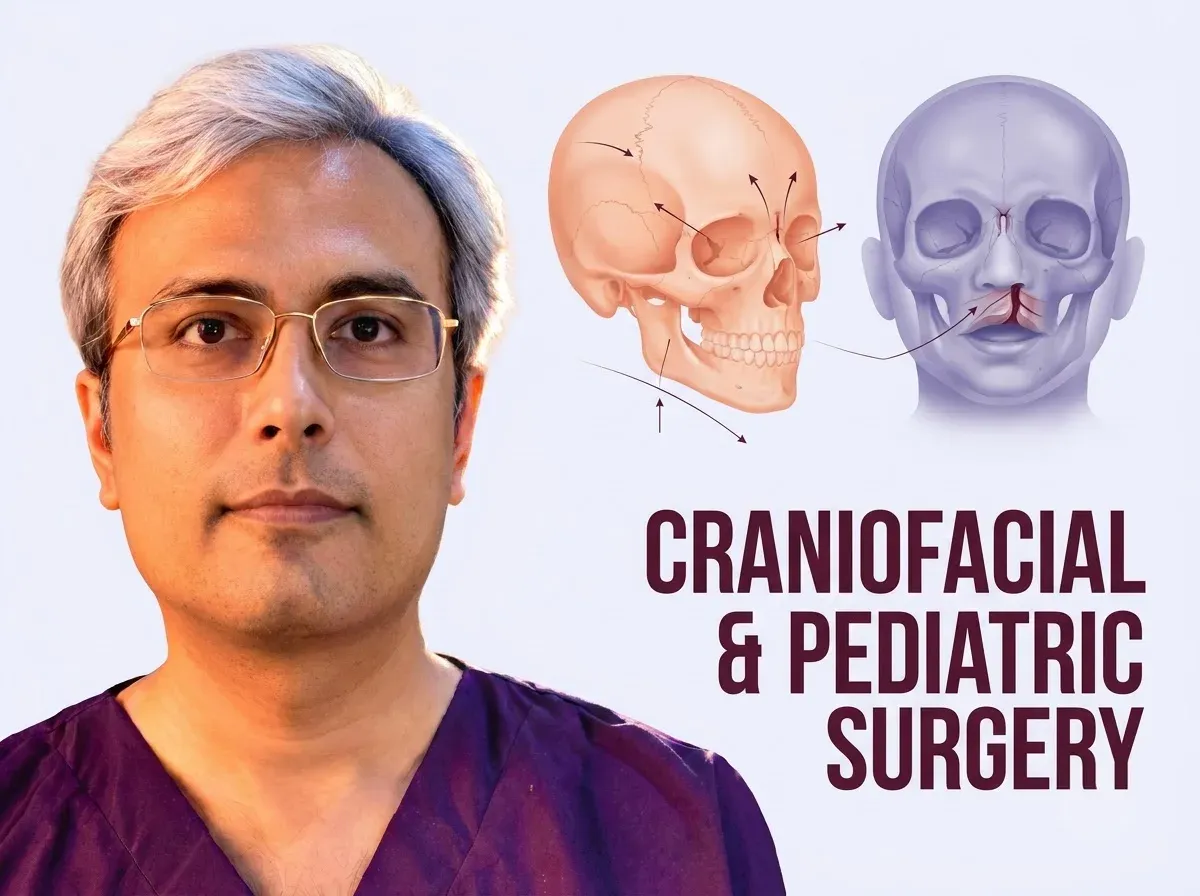

Comprehensive Reconstruction for Secondary Cleft Lip Nasal Deformity
Even following successful primary cleft lip repair in infancy, patients frequently reach adolescence with characteristic secondary cleft nasal deformities. The asymmetric muscle pull, deficient bony piriform aperture, and hypoplastic lower lateral cartilage result in a slumped nasal dome, horizontal nostril orientation, skewed nasal tip, shortened columella, and severe internal nasal airway obstruction from a deviated septum.
The Open Structural Rhinoplasty Approach
Dr. Vishal Purohit utilizes advanced open structural rhinoplasty principles to address both aesthetic symmetry and breathing:
- Cartilage Framework Reconstruction: Rebuilding the deficient nasal framework using autologous septal, ear (conchal), or costal (rib) cartilage grafts to create a rigid columellar strut and provide tip projection.
- Alar Cartilage Repositioning & Suspension: Freeing the slumped lower lateral cartilage on the cleft side from vestibular skin and suspending it symmetrically to the contralateral normal cartilage (Tajima suspension technique).
- Airway and Septal Realignment: Straightening the severely deviated nasal septum and reconstructing the piriform aperture base with cartilage or bone grafting to expand the nasal airway.
- Nostril Floor & Sill Symmetrical Alignment: Re-orienting the flattened horizontal nostril into an upright, aesthetic vertical oval that matches the unaffected side.
Confidence and Airway Function for Young Adults
Typically performed in teenage or adult years once facial skeletal growth is complete, secondary cleft rhinoplasty produces transformative, lifelong facial harmony and unrestricted nasal breathing.