
Dermal fillers provide targeted volume to define the mandibular border, but their role in treating age-related changes depends heavily on anatomy. When soft tissue descent creates mild indentations, strategic placement can smooth the visible jaw contour without repositioning structural tissue.
However, injectable treatments have distinct physical limits. Patients evaluating lower facial options must understand what soft tissue augmentation can achieve and when surgical evaluation offers a more appropriate pathway for marked laxity.
Volume and Contour Versus Laxity
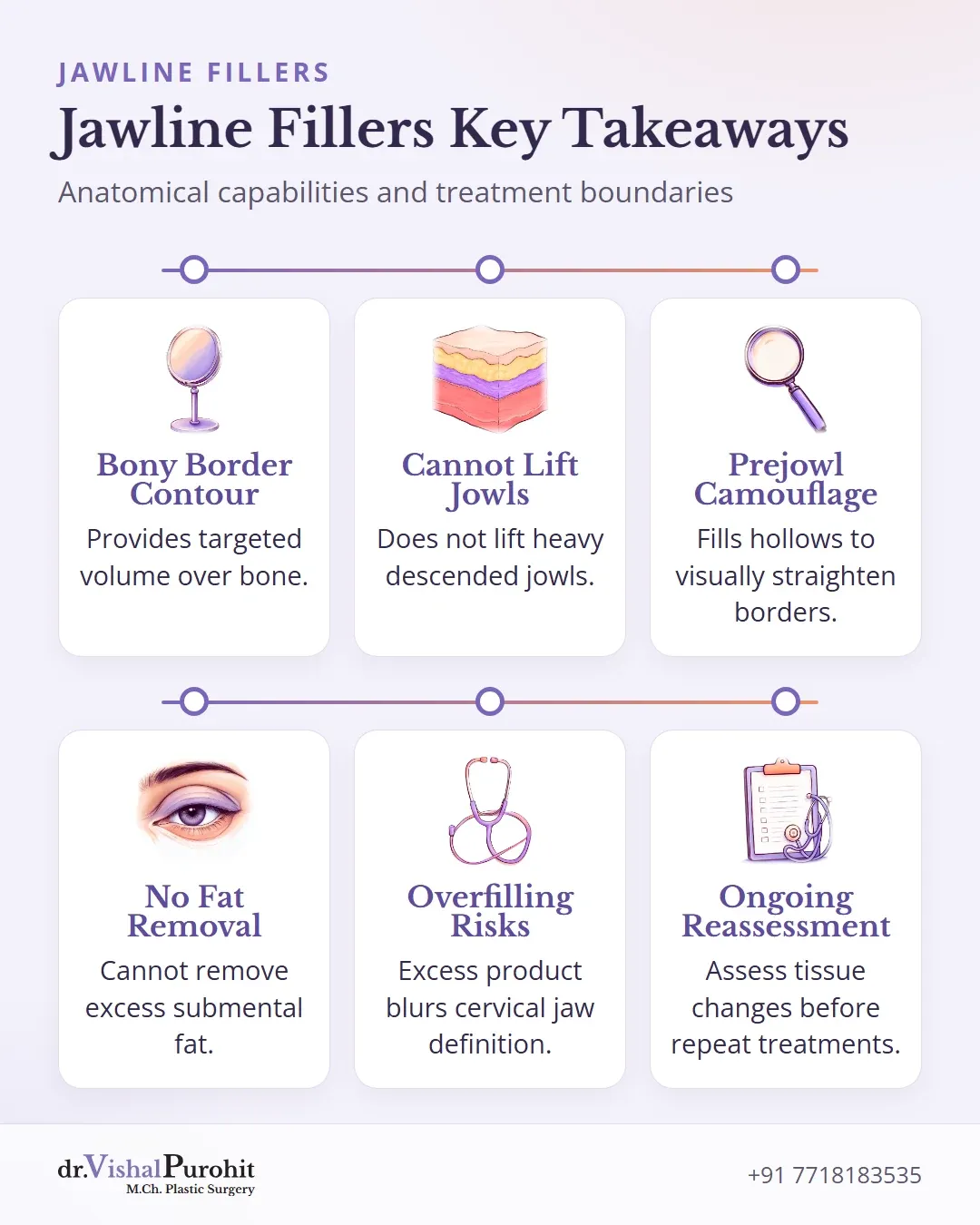
Mandibular border definition relies on establishing structural volume over bone rather than altering skin tone1. In facial aging, soft tissue descent, fat redistribution, and resorption of underlying bone contribute to a less defined jawline234. Age-related changes in the mandible, such as reduced ramus and mandibular body dimensions, reduce the sharpness of the lower facial boundary2.
Dermal filler acts by placing targeted structural support to project and shape bony contours1. However, injectable products have distinct mechanical limits:
What Fillers Can Do
- Provide localized contour and shape along the bony border1.
Patients presenting primarily with marked tissue laxity or significant submental fullness require different clinical pathways, as soft tissue fillers only address volume and projection35. Adding volume over a bone base cannot pull up descending soft tissues or erase excess skin35.
Dr. Purohit’s note: In Dr. Vishal Purohit’s practice, suitability is determined after assessing individual facial anatomy. Choosing no treatment is always a valid choice, and aesthetic procedures remain entirely elective.
What Filler Can Camouflage
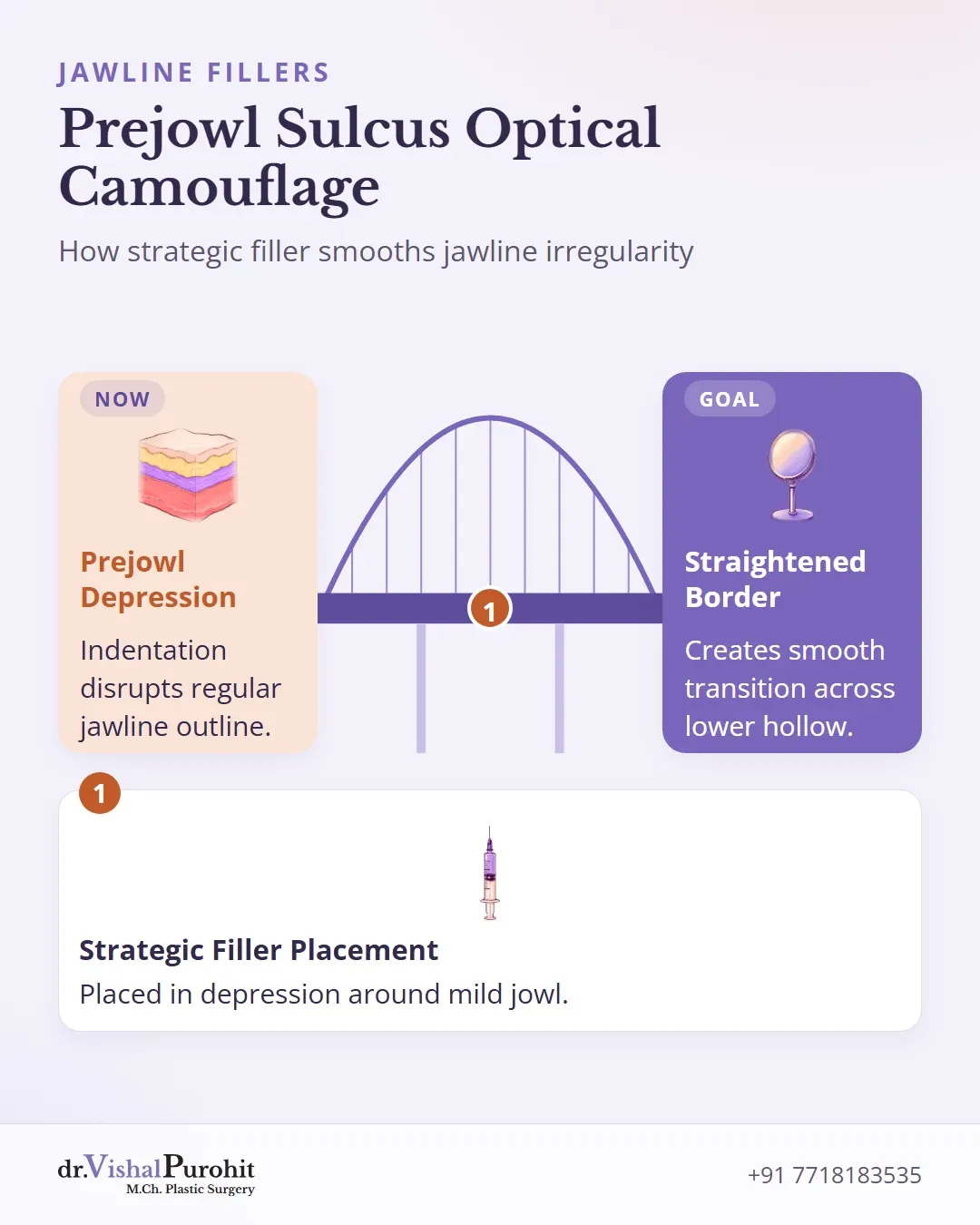
Lower facial aging and soft-tissue descent often lead to the formation of jowls and an adjacent hollow known as the prejowl sulcus67. This indentation between the jowl and chin disrupts the jawline, creating an irregular lower border67.
Dermal filler can be placed strategically in the prejowl sulcus anterior to the jowl, as well as along the jawline, to diminish this concavity78. By filling the depression before and behind a mild jowl, the treatment creates an optical camouflage that visually straightens an irregular mandibular border7.
Key aspects of this non-surgical approach include:
- Creating a smoother mandibular transition across the hollow7.
- Providing visual alignment without repositioning underlying anatomical structures.
- Softening the appearance of age-related lower facial irregularities67.
Whether dermal filler is appropriate for camouflaging a mild jowl, as well as the choice of technique, instrument, or product, is decided at the consultation with Dr. Vishal Purohit. Filler cannot lift descended tissues or remove excess fat; it simply smooths the visible contour by adding volume adjacent to the prominence7.
What Filler Does Not Remove

Dermal filler does not lift heavy descended jowls, tighten platysmal bands, or remove excess submental fat deposits910.
Fillers add volume outward rather than lifting tissue vertically10. In an already heavy lower face, injecting filler in an attempt to pull up sagging skin risks creating excess bulk along the jawline instead of restoring a defined border910.
Key anatomical limitations include:
Heavy Jowls
Soft-tissue descent along the mandibular border cannot be lifted mechanically with injectable filler91011.
Platysmal Bands
Muscular neck bands do not respond to dermal filler placement.
Double-Chin Fullness
Submental fat compartments require reduction strategies, such as surgical lipectomy, rather than filler augmentation9.
For patients with severe skin laxity, heavy descending tissue, or pronounced neck fullness, surgical options—such as a surgical facelift or neck contouring—provide structural tissue repositioning that non-surgical injections cannot achieve111213.
In his practice in Jaipur, Dr. Vishal Purohit assesses lower-facial structure carefully before treatment. When significant laxity exists, he discusses surgical choices or choosing no intervention, ensuring volume is not added where it cannot help.
Diagnostic Alternatives and Structural Assessment
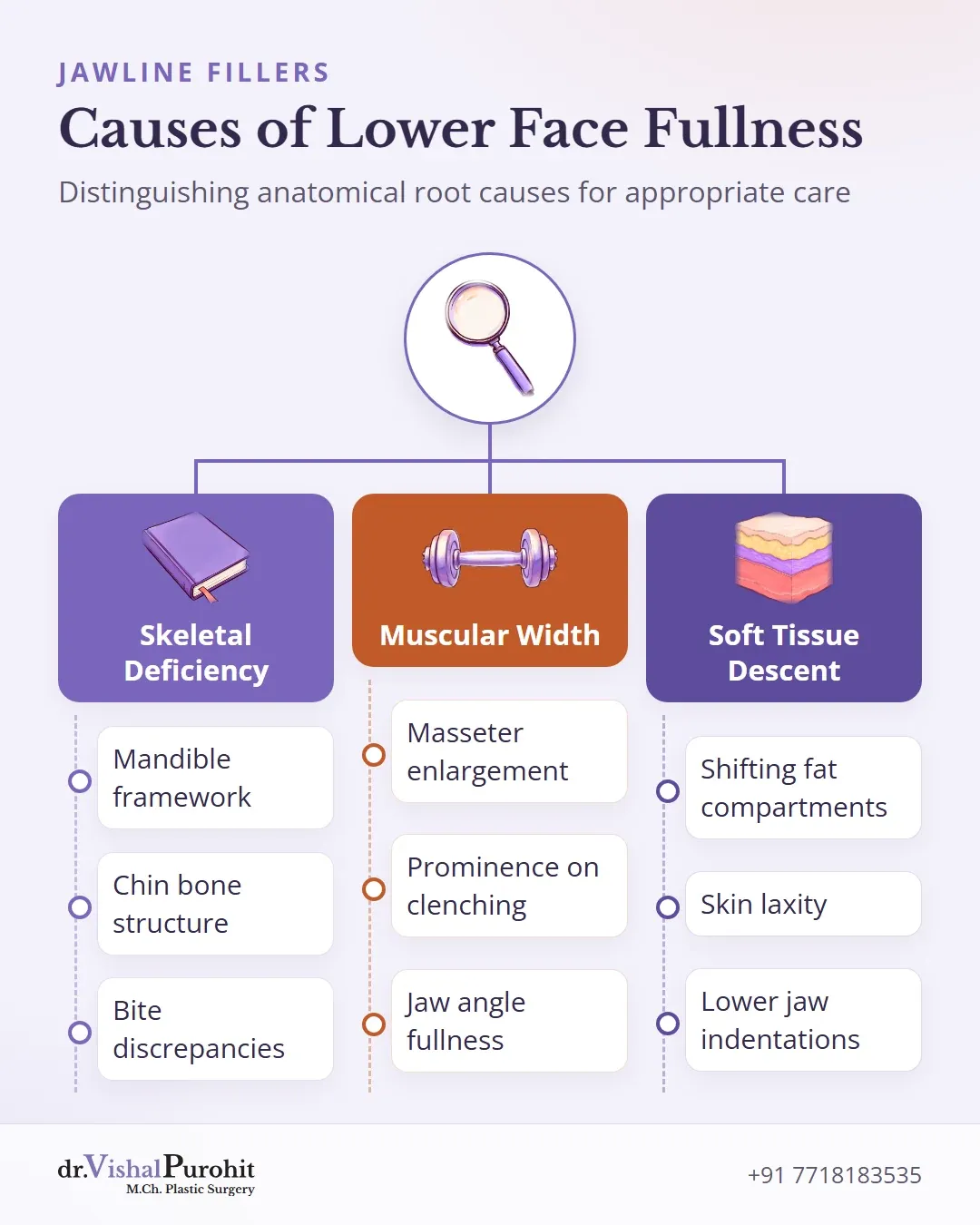
Distinguishing between skeletal deficiency, muscular width from masseter hypertrophy, and soft tissue descent is essential before choosing any procedure. When evaluating the lower face, the underlying cause of fullness or lack of definition dictates the appropriate clinical approach:
- Skeletal deficiency involves the bony framework of the mandible or chin.
- Muscular width arises from enlargement of the masseter muscle, which presents as fullness at the angle of the jaw and becomes more prominent on clenching14.
- Soft tissue descent relates to shifting fat compartments and skin laxity along the jawline.
Skeletal bite discrepancies require orthodontic or maxillofacial evaluation rather than soft-tissue filler camouflage. Dermal fillers along the jaw define borders or angles, but they cannot address structural misalignment of the teeth or jaws.
Whether Dr. Vishal Purohit considers soft-tissue filler, orthodontic referral, or alternative structural management for an individual patient is not confirmed beforehand; it is decided at the consultation. A thorough anatomical assessment ensures that dental and skeletal discrepancies receive appropriate specialist evaluation instead of masking underlying functional concerns.
Overfilling Risks and Unwanted Bulk
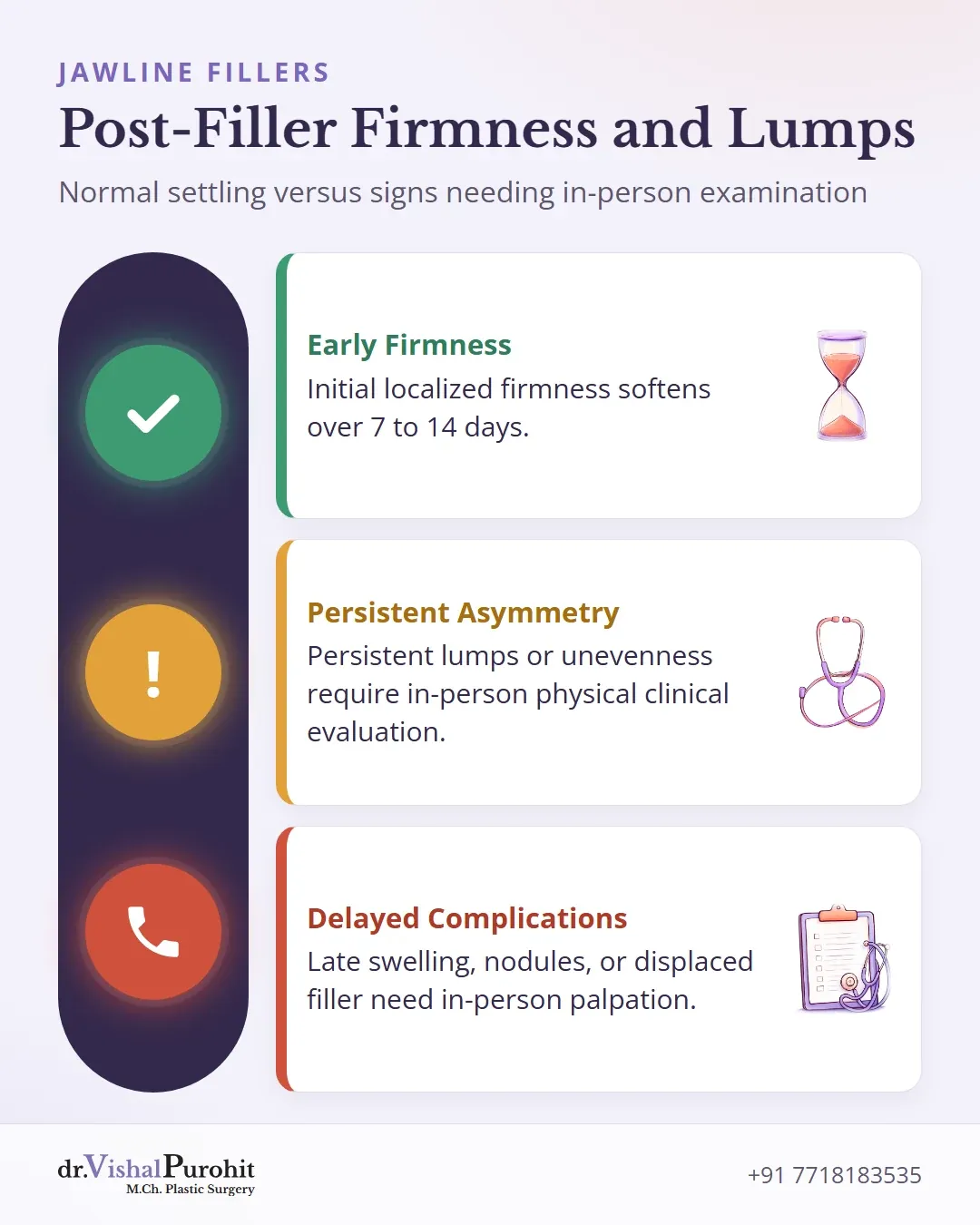
Injecting excessive dermal filler along the lower face can compromise natural definition. When too much product is placed along the jawline, it can obscure the separation between the jaw and neck, leading to blurred cervical definition. It may also widen the lower facial dimensions, producing an unintentionally heavy, square, masculinised, or distorted contour.
Patients may occasionally notice unevenness or nodules following treatment. While initial firmness can soften over 7 to 14 days as tissues settle15, delayed complications or filler misplacement can cause persistent swelling, nodules, or inflammation16. Such reactions might appear weeks, months, or even years later1718.
When persistent lumps, noticeable irregularity, or asymmetry occur, physical clinical evaluation is necessary:
- A video call cannot replace a physical examination for lumps, firmness or uneven areas that need checking.
- In-person evaluation allows a doctor to properly palpate the tissues, identify whether a lump represents displaced product, inflammation, or an early nodule, and determine appropriate management.
If hyaluronic acid (HA) filler needs correction, the enzyme hyaluronidase can often dissolve the material18. However, hyaluronidase treatment is never fully reversible, does not guarantee complete restoration of native tissue contours, and carries its own procedural considerations. Reversal decisions and dissolving protocols are decided at the consultation.
Long-Term Contour and Reassessment
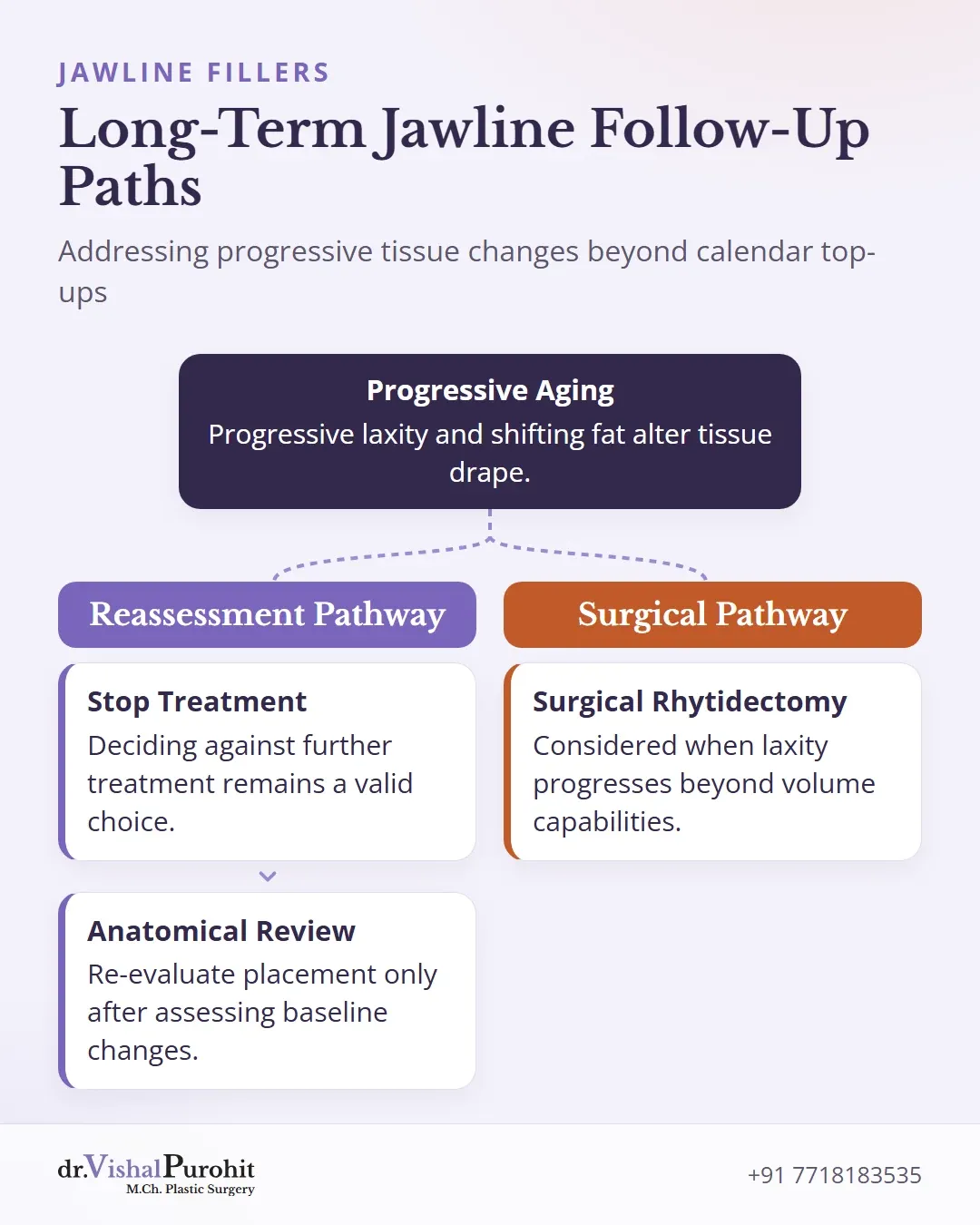
Temporary jawline filler results should not be topped up on a rigid calendar schedule without carefully reassessing baseline tissue changes. Lower-face aging involves progressive skin laxity along with the descent and shifting of facial fat compartments319. These ongoing anatomical shifts alter how soft tissues drape over the jawline and directly change whether repeat filler remains suitable over time319.
Individual responses and filler persistence vary based on tissue interactions and metabolism20. Continued reassessment is necessary before administering any repeat treatment19. Whether a patient is a candidate for repeat injections, touch-ups, or an alternative plan is not fixed in advance; his own practice on touch-ups and repeat timing is decided at the consultation.
Patients may consider several pathways during long-term follow-up:
- Deciding against further treatment, which is always a valid choice.
- Re-evaluating filler placement only after assessing underlying anatomical changes.
- Exploring surgical paths, such as rhytidectomy, when skin laxity and soft-tissue descent progress beyond what volume addition can address3.
Every patient’s lower face changes differently, and maintenance plans must reflect anatomical realities rather than arbitrary intervals.
Clinical Jawline Assessment in Jaipur
Evaluating lower facial volume, soft-tissue laxity, and skeletal framework requires careful clinical judgment. Individuals seeking targeted contouring can review Jawline Fillers in Jaipur to explore non-surgical possibilities or consult the Jawline Fillers FAQs for detailed answers on treatment boundaries and anatomical considerations.
This is educational information, not medical advice.