

TUE - SUN: 11:00 AM – 07:00 PM

Aesthetic & Reconstructive Surgery

Face Implants Surgery in Jaipur

Face Implants Surgery in Jaipur - Dr. Vishal Purohit Plastic Surgeon Jaipur11+ Years of Surgical Experience

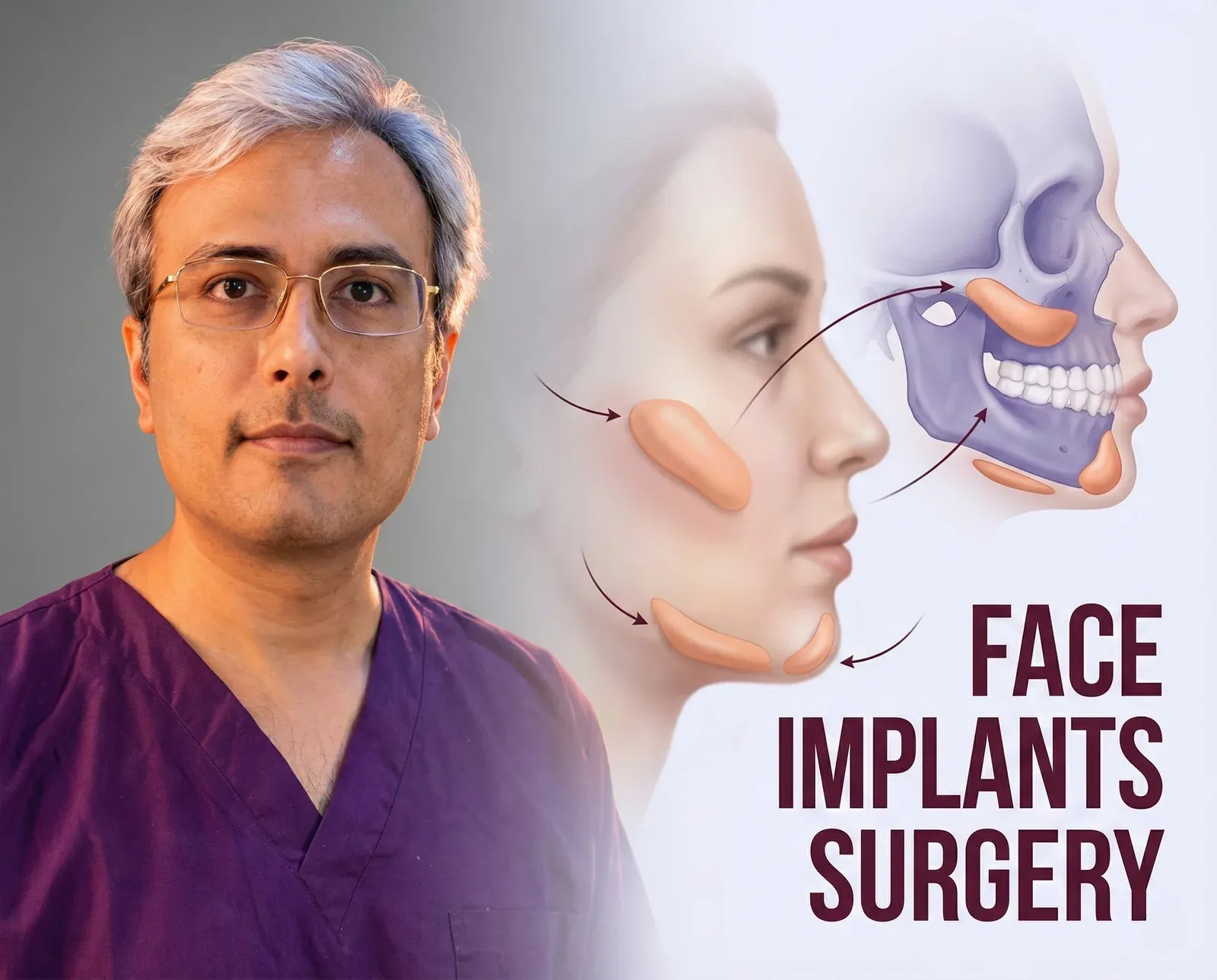
Adding projection to the chin, cheeks or jaw angle

Silicone or Medpor implants placed through incisions inside the mouth, under general anaesthesia with at least one day in hospital.

View clinic timings and contact details →
  • M.Ch Plastic Surgeon · RMC Reg. 28041/14185
  • At least one day in hospital
  • Tonk Road, Jaipur
  • Jump to FAQs (10)

Treatment Areas

Chin, cheeks and jaw angles

Procedure Time

3-4 hours

Anesthesia

General anaesthesia

Hospital Stay

At least one day

Recovery Time

Soft diet and mouth care until the stitches inside the mouth dissolve

Cost

Depends on the implant, from ₹85,000

The Structural Foundation

Desiring a Stronger Jawline, Defined Chin, or High Sculpted Cheekbones?

Bone structure shapes the face. A small chin, a soft jawline or flat cheekbones can change the balance of the profile.

Recessed / Weak Chin Profile

Under-projected chin disrupting the profile aesthetic line between the nose, lips, and neck.

Flat, Undefined Cheeks

Lack of cheekbone projection that gives the midface a tired, hollow, or prematurely aged look.

Lack of Mandibular Jaw Angle

Blunt jawline transition blending softly into the neck without masculine strength or feminine contour.

Bony Architecture: The Keystone of Facial Harmony

Soft tissue and skin drape over the facial skeleton. Where bone projection is small, a shaped silicone or Medpor implant placed on the bone adds projection.

Dr. Vishal Purohit - M.Ch Plastic & Cosmetic Surgeon Jaipur

Dr. Vishal Purohit

M.Ch Plastic & Cosmetic Surgeon

✓

Credential Level

M.Ch Super-Specialty

RMC Reg. 28041/14185

Your Surgical Guide

Artistic Proportion & Advanced Surgical Safety

"A chin, cheek or jaw-angle implant adds projection to the bone underneath, to balance the profile."

— Dr. Vishal Purohit

1

M.Ch Plastic & Reconstructive Surgery, SMS Medical College, Jaipur

The highest super-specialty surgical qualification in India, ensuring total anatomical mastery of neurovascular planes and soft tissues.

2

11+ Years as a Plastic Surgeon

Practising plastic surgery in Jaipur since 2015, with a focus on natural, proportionate results.

3

Accredited Operating Suites

Dr. Vishal Purohit operates in sterile hospital operating theatres, with certified cardiac anaesthesiologists and ICU support.

Simple & Transparent

Your 3-Step Surgical Journey

We remove anxiety and uncertainty with a structured, transparent pathway designed for safety and peace of mind.

1

Confidential Assessment

Dr. Purohit evaluates your anatomical baseline, skin elasticity, and health history. You receive an honest feasibility blueprint, personalized surgical plan, and transparent cost with zero pressure.

Step 1: Planning
2

Precision Operating Suite Procedure

Performed by Dr. Vishal Purohit in a sterile hospital operating theatre under gentle anaesthesia. Using advanced minimally invasive techniques, target areas are treated with microscopic care.

Step 2: Procedure
3

Monitored Recovery & Transformation

Supported with tailored recovery guidelines and post-operative follow-up visits. As tissue heals and settling occurs over the coming weeks, your refined results emerge.

Step 3: Recovery
Silicone and Medpor Implants

Precision Chin, Cheek & Jawline Augmentation

Shaped silicone and porous polyethylene (Medpor) implants, placed through incisions inside the mouth.

Chin Implant

Balanced Profile Projection

Placed through an incision inside the mouth to bring the chin forward; sliding genioplasty is the bony alternative.

Malar & Submalar Cheek Implants

High Cheekbone Definition

Adds projection to flat cheekbones through an incision inside the mouth.

Mandibular Angle Implants

Chiseled Jawline Definition

Adds definition to the angles of the lower jaw through an incision inside the mouth.

Skeletal Enhancement Targets

Chin Anterior Projection

Restoring profile projection line

Chin Vertical Height

Lengthening or squaring the chin

Submental Skin Tension

Sharpening the neck-chin angle

Malar Cheekbone Apex

Adding cheekbone projection

Mandibular Jaw Angle

Defining the jaw angle

Intraoral Incisions

Incisions inside the mouth

Clinical Guide & In-Depth Information

Comprehensive Medical Overview

Detailed procedural analysis, anatomical considerations, and patient guidelines by Dr. Vishal Purohit.

Introduction to Facial Implants

At a glanceWhat facial implants do, and what they do not
Facial implantsSkeletal augmentationSolid surgical devices that add projection to underlying facial bones.
What they change
  • Add projection to a receding chin
  • Augment flat cheek contours
  • Define a soft jaw angle
What they do not do
  • Correct a dental bite problem
  • Act like temporary soft-tissue fillers

Facial implants provide structural enhancement to the underlying skeletal framework of the face. They add projection to a small chin, flat cheeks or a soft jaw angle with a shaped implant. By augmenting the facial bones, these biocompatible devices help create balanced facial proportions.

There are distinct anatomical limits to what facial implants can accomplish. They do not correct a bite problem, which needs an orthodontist or jaw surgery. Significant skeletal discrepancies involving dental misalignment require specialized orthognathic care rather than cosmetic augmentation.

Additionally, facial implants are not fillers. Injectable products introduce temporary gels into the soft tissues that degrade over time. In contrast, implants are solid surgical devices placed against facial bones. Dr. Vishal Purohit assesses facial structure in Jaipur to identify whether bone augmentation is appropriate.

Types of Facial Implants

MaterialsFacial implant materials: silicone and porous polyethylene
Straightforward placementSilicone implants

Smooth surface allowing uncomplicated removal, with no soft-tissue ingrowth.

SurfaceSmooth non-porous surface on bone

Tissue integrationMedpor implantsPorous polyethylene

Porous structure allows fibrovascular ingrowth, making later removal more challenging.

Surface125 to 250 micrometres porosity

Implants are placed through incisions inside the mouth directly on bone.

Facial implants are designed to augment specific bony contours of the craniofacial skeleton. Dr. Vishal Purohit places chin, cheek and jaw-angle implants to address localized volume deficiencies. The anatomical requirements of each facial area dictate the appropriate shape and material selection.

Surgical textbooks describe two primary biomaterials utilized for facial augmentation, each presenting distinct mechanical and biological handling characteristics:

  • Silicone implants feature a smooth surface that allows straightforward placement and uncomplicated removal if required, though textbooks describe that they do not permit soft tissue ingrowth and may carry a tendency toward displacement or bone resorption under pressure.
  • Medpor (porous polyethylene) implants possess an intramaterial porosity between 125 and 250 micrometres, which allows fibrovascular ingrowth from surrounding tissues to provide stable integration, though textbooks describe that this porous incorporation makes subsequent surgical removal significantly more challenging.

The choice between these biomaterials depends on individual anatomy, surgical goals and structural tissue thickness. Biocompatibility remains high for both options, and each material adapts to the underlying facial contours when positioned properly on the bone.

Candidates for Facial Implants

SuitabilityWho is a candidate for facial implants
  • Facial volume deficitReceding chin, flat cheeks or undefined jaw angles.
  • Non-smokerMust stop smoking for at least 1 month before surgery.
  • Stable dental biteFunctional dental occlusion without significant malocclusion.
  • Good general healthFree from systemic conditions or uncontrolled bleeding disorders.

Suitable candidates for facial augmentation present with structural volume deficits of the facial skeleton. Common aesthetic concerns include a small or receding chin, flat cheeks or an undefined jaw angle. These physical traits often result from natural developmental morphology or age-related skeletal changes.

General physical fitness is essential for undergoing elective facial surgery. Candidates must be in good health without active systemic conditions or uncontrolled bleeding disorders that could impair wound healing. Realistic expectations regarding the aesthetic outcome and natural facial balance are equally necessary.

Patients must be non-smokers who agree to stop smoking for at least 1 month prior to surgery. In Dr. Vishal Purohit's practice, this smoking cessation timeline is mandatory for all operations to minimise the risk of tissue necrosis, wound dehiscence and peri-implant infection.

Candidates must also possess a functional, stable dental occlusion. Individuals presenting with significant malocclusions, mandibular retrusion or functional bite problems are referred to dental and maxillofacial specialists for formal orthognathic assessment. Facial implants cannot substitute for corrective orthodontic treatment or corrective jaw realignment.

Preoperative Consultation for Facial Implants

First consultationWhat the facial implant consultation covers
Facial proportions
  • Vertical facial thirds
  • Horizontal projections
  • Profile structural balance
Dental examination
  • —Occlusion assessment
  • —Checks bite alignment
  • —Rules out untreated malocclusion
Surgical planning
  • —Implant size and material
  • —Avoids over-augmentation
  • —Implant vs sliding genioplasty

The preoperative consultation begins with a careful clinical assessment of the face. Dr. Vishal Purohit evaluates facial proportions and profile to determine overall structural harmony. Measurements of vertical facial thirds and horizontal projections guide the diagnostic planning process.

A detailed examination of the dental occlusion forms a crucial component of the initial evaluation. The bite must be assessed to confirm that lower facial retrusion does not stem from an untreated malocclusion. Normal or near-normal dental alignment is required before considering isolated implant placement.

Surgical planning involves choosing the implant, its size and material to match the underlying bony framework. The dimensions are calculated based on skeletal anatomy, soft tissue thickness and aesthetic objectives. Over-augmentation is carefully avoided to maintain natural soft tissue drape over the implant contours.

For individuals presenting with lower facial deficiency, the consultation addresses whether to proceed with an implant or sliding genioplasty for the chin. If vertical adjustments or significant advancements are needed, osseous surgery may offer distinct structural advantages compared to onlay alloplastic augmentation.

Preparing for Facial Implants

PreparationPreparing for facial implant surgery: what to stop, what to arrange
Stop before surgery
  • Smoking for at least 1 month
  • Aspirin and anti-inflammatory medicines
  • Supplements affecting coagulation
Arrange and prepare
  • Rigorous oral hygiene and mouth rinses
  • Formal inpatient hospital admission
  • Preoperative testing and health checks

Patients must stop smoking 1 month before the planned surgical date. Tobacco use severely restricts capillary microcirculation and impairs surgical healing. In accordance with clinic protocol, refraining from nicotine for at least 1 month prior to any operation reduces the incidence of tissue breakdown and infection.

Preoperative medical management includes specific medicines to stop as advised by the surgical team. Anti-inflammatory agents, aspirin and supplements that affect platelet function or coagulation are suspended prior to surgery. This step minimises intraoperative bleeding and reduces postoperative hematoma formation around the implant pocket.

Rigorous oral hygiene must be established prior to the procedure. Because surgical access is achieved transorally, maintaining a healthy oral cavity free of active periodontal inflammation diminishes the presence of pathogens. Chlorhexidine mouth rinses may be recommended in the days leading up to surgery.

Practical arrangements must also account for a hospital stay. Patients undergo the operation under monitored conditions and must plan for formal inpatient admission. Dr. Vishal Purohit coordinates preoperative testing to confirm general health and anaesthetic safety before admission takes place.

The Surgical Procedure for Facial Implants

The operationFacial implant surgery step by step
Anaesthesia:
General anaesthesia
Hospital stay:
At least one day in hospital
  1. 1Incisions inside mouthLower sulcus for chin or upper mucosa for cheeks.
  2. 2Subperiosteal pocketDissection strictly beneath the periosteum over facial bone.
  3. 3Implant seatingDevice seated directly against underlying cortex.
  4. 4StabilisationThe implant is secured in place, as textbooks describe.
  5. 5Layered closureMuscle and mucosa closed with dissolving stitches.

Facial implant surgery is conducted under general anaesthesia with at least one day in hospital. Dr. Vishal Purohit carries out the surgical procedure within a sterile operating theatre environment.

Surgical access is obtained through incisions inside the mouth to avoid external cutaneous scarring. For chin and jaw implants, the incision is placed in the lower gingivobuccal sulcus, leaving an adequate mucosal cuff. For cheek augmentation, incisions are created within the upper buccal mucosa.

Subperiosteal dissection is performed directly over the facial skeleton to create a precise pocket on the bone. Textbooks describe that dissecting strictly beneath the periosteum maintains vascular integrity, preserves overlying soft tissues and limits the risk of injury to adjacent sensory and motor nerves.

The implant placed and secured as textbooks describe is seated directly against the underlying cortex. Centric alignment is verified using anatomical landmarks. Stabilization is achieved with titanium screws or sutures to prevent displacement, followed by layered closure of muscle and mucosa using dissolving stitches.

Recovery After Facial Implants

Recovery timelineRecovery after facial implant surgery
  1. Day 1 to early weeks Soft diet and rinsesSoft foods and mouth rinses after meals until stitches dissolve.
  2. After several days Daily activitiesResume basic daily routines while resting facial tissues.
  3. Initial weeks Avoid heavy exertionAvoid strenuous activities, heavy lifting and exercise.
  4. Several months Tissue maturationAcute swelling settles over weeks; final definition refines over months.

Regular follow-ups occur on day 1, suture removal if needed, 1 month and 3 months.

Postoperative care focuses on supporting tissue integration and protecting the intraoral closure lines. Patients follow specific aftercare protocols during the early healing period:

  • A soft diet and mouth care until the stitches inside the mouth dissolve, avoiding hard foods to reduce mechanical strain on healing intraoral wounds.
  • Gentle oral rinses after every meal to keep mucosal suture lines clean and prevent bacterial contamination within the oral cavity.
  • Avoidance of strenuous physical activities, heavy lifting and vigorous exercise during the initial weeks to minimise blood pressure spikes and swelling.
  • Regular follow-up visits conducted on day 1, at suture removal if non-dissolvable external stitches were used, at 1 month and at 3 months.

Initial oedema and tissue tightness are prominent during the first few days after surgery. Most acute swelling settles over weeks as lymphatic drainage re-establishes and the soft tissues drape over the newly augmented bony angles.

Dr. Vishal Purohit monitors tissue healing during scheduled clinical appointments in Jaipur. While basic daily activities can typically be resumed after several days, subtle refinements in final facial definition continue to develop over several months of tissue maturation.

Risks and Complications of Facial Implants

SafetyFacial implants: normal effects and warning signs
Expected healing effects
  • Localized swelling and tightness
  • Temporary lip or cheek numbness
  • Mild bruising resolving over weeks
Call at once for warning signs
  • Severe pain or expanding haematoma
  • Marked redness or purulent drainage
  • Wound breakdown inside mouth
Call +91 7718183535

Every surgical operation entails recognized physiological responses and potential complications. Certain effects are expected following facial implant placement, including localized swelling, tightness, numbness of the lip or cheek, and mild bruising. Sensation typically recovers gradually over several weeks as temporary nerve stretching resolves.

Unintended outcomes are possible following surgery. Textbooks and clinical studies report potential risks such as infection, implant shifting, asymmetry, nerve injury, and bone changes under a chin implant. When an implant is unfixated or positioned high on the alveolar cortex, underlying bony resorption may occur.

Surgical literature notes that sensory neurapraxia affecting the mental or infraorbital nerves can occur during retraction, which rarely may persist. Implant malposition or persistent infection may require surgical repositioning or complete removal of the foreign material. Results remain inherently variable based on anatomy and healing biology.

Patients are given clear emergency contact instructions to report urgent symptoms immediately. If severe pain, expanding haematoma, marked redness, wound breakdown, or purulent drainage develop, call +91 7718183535 at once for warning signs. Prompt clinical evaluation by Dr. Vishal Purohit ensures timely management.

Results and Expectations of Facial Implants

ExpectationsFacial implant results: progression and longevity
  1. First daysFacial contours obscured initially by tissue oedema.
  2. Weeks to monthsTrue surgical shape shows as swelling settles.
  3. Long termSolid implants maintain dimensions while natural ageing continues.
Long-term factors
  • Natural facial ageing continues around implant
  • Stable health and weight preserve skin drape

Postoperative facial contours are obscured initially by tissue oedema. The true surgical shape shows as swelling settles over subsequent weeks and months. As the overlying soft tissues adapt to the underlying implant, definition along the jawline, chin or midface becomes progressively more refined.

Unlike injectable fillers or autologous fat grafts, solid facial implants provide stable volumetric projection. The implant does not dissolve or undergo metabolic breakdown within the body. Silicone and porous polyethylene devices retain their original physical dimensions and mechanical properties over extended periods.

However, facial augmentation does not halt normal biological processes. Natural ageing continues around it over time. Overlying soft tissues, dermis and subcutaneous fat undergo gradual thinning, loss of elasticity and gravity-related laxity as the decades advance.

Dr. Vishal Purohit explains to patients that structural augmentation cannot prevent normal superficial soft tissue descent. Long-term aesthetic outcomes reflect both the stable underlying implant contours and the evolving health, weight and lifestyle factors of the patient.

Cost of Facial Implants in Jaipur

PricingFacial implant cost factors in Jaipur
  1. 1Starting priceStarts from ₹85,000 for standard facial implant treatment.
  2. 2Number of areasSingle area or multiple anatomical regions treated simultaneously.
  3. 3Implant biomaterialSelection between solid silicone and porous polyethylene Medpor.
  4. 4Hospital stayOperating theatre fees and inpatient hospital admission under GA.

A comprehensive written quote follows diagnostic consultation.

Cosmetic skeletal augmentation is usually not covered by insurance.

The financial investment required for surgical facial augmentation varies according to several clinical factors. Total expense depends on the implant, starting from ₹85,000 for standard treatment. Variations arise depending on whether a single facial area or multiple anatomical regions require simultaneous reconstruction.

Additional cost considerations include the specific biomaterial selected, such as solid silicone versus porous polyethylene and the theatre and hospital stay. Operating facility charges and the required inpatient hospital stay under general anaesthesia also form part of the total expenditure.

A comprehensive written quote after the consultation outlines all anticipated surgical and hospital charges. Dr. Vishal Purohit provides this itemised estimate following an individualized diagnostic evaluation, ensuring clarity regarding operative requirements before scheduling the surgical procedure.

Cosmetic facial skeletal augmentation is elective in nature and is usually not covered by insurance policies. Third-party financing, subject to availability, can help with planning.

Alternatives to Facial Implants

OptionsFacial implants, dermal fillers or bone surgery: choosing an option

Patients considering structural facial enhancement may explore both non-surgical and alternative surgical modalities. Temporary soft tissue volumisation can be achieved using dermal fillers. For the midface, individuals may consider cheek fillers to restore malar volume without surgical downtime.

Lower facial contours can similarly be modulated through non-invasive techniques. Patients seeking modest, non-permanent projection can evaluate chin fillers as an office-based procedure. Hyaluronic acid gel injections provide immediate volume but naturally degrade over several months, requiring ongoing maintenance sessions.

Lateral mandibular definition can also be enhanced temporarily using injectable options. Patients often explore jawline fillers to sharpen the mandibular border. Fillers are temporary and give less projection than an implant placed on the bone.

When bony correction of the lower face is desired without placing alloplastic material, sliding genioplasty for the chin represents an established surgical alternative. Dr. Vishal Purohit evaluates whether non-surgical volumisation, implant augmentation or autologous bony repositioning best matches the structural needs of the patient.

Sliding Genioplasty and Bite Problems

Related surgeryOsseous chin surgery and bite correction

Sliding genioplasty is an osseous surgical procedure that repositions the patient's natural mandibular bone rather than introducing an alloplastic device. Dr. Purohit performs sliding genioplasty himself in Jaipur to correct severe chin retrusion, vertical deficiencies or substantial lower facial asymmetries.

During this operation, the chin bone is cut and moved, as textbooks describe. A horizontal osteotomy is executed through an intraoral incision below the mandibular tooth roots. The mobilized inferior bony segment is advanced, lengthened, shortened or shifted into anatomical alignment and secured with rigid titanium plates.

This autologous approach avoids alloplastic complications such as implant migration, capsule contracture or foreign-body reaction. It also allows simultaneous multidirectional changes in both vertical height and horizontal projection, which textbooks describe as difficult to reproduce with standard onlay chin implants.

When retrognathia is accompanied by underlying occlusal discrepancies, isolated chin procedures are insufficient. In such cases, bite problems are referred to an orthodontist or maxillofacial surgeon for comprehensive orthognathic correction. Coordinated jaw realignment ensures that both functional mastication and aesthetic balance are properly addressed.

Your Safety Comes First

Why Your Surgeon’s Training Matters

Face Implants Surgery in Jaipur involves delicate anatomy, blood supply and tissue handling. Choosing on price alone, or an operator without plastic-surgery training, raises the risk of contour irregularities and complications.

With Dr. Vishal Purohit, your safety is backed by intensive-care support, certified cardiac anaesthesiologists and hospital-grade theatre protocols.

What to watch out for

  • Operators without plastic-surgery training
  • Rushed or imprecise tissue handling
  • Clinic rooms without emergency backup
  • Higher chance of visible scars or revision surgery

With Dr. Vishal Purohit

  • M.Ch super-specialist plastic surgeon
  • Careful, tissue-preserving technique
  • Hospital-grade operating theatre
  • Personal follow-up through recovery
Your Transformation

A More Balanced Profile

Projection added where the bone is small, so the chin, cheeks and jaw sit in better balance.

A Better-Balanced Profile

The chin, nose and lips sit in better proportion from the side.

Sharper Jawline & Neckline

A chin brought forward can give a clearer line between the face and the neck.

An Implant That Does Not Dissolve

The implant keeps its shape; the face around it continues to age.

Got Questions?

Frequently Asked Questions

Honest, clinically precise answers from Dr. Vishal Purohit regarding Face Implants Surgery in Jaipur.

What is facial implant surgery?

Facial implant surgery places solid, pre-shaped implants to enhance the chin, jaw or cheeks and create a more balanced face. The operation usually takes about one and a half hours and is done under general anaesthesia or intravenous sedation with local anaesthesia. M.Ch. plastic surgeon Dr. Vishal Purohit in Jaipur can explain whether this approach suits your facial structure.

These implants augment areas where the facial skeleton lacks projection, improve contour irregularity and restore harmony; common sites include the chin, jaw, cheeks and nasal bridge. They may also address congenital or traumatic asymmetries and midface hollowing, with computer-assisted custom designs for complex defects. Different materials and shapes are chosen for the treated area and desired change. Alloplastic implants offer a long-term solution, while using your own tissue carries donor-site problems, shrinkage and shaping limits. They are placed in the subperiosteal plane and anchored, so they remain stable while soft tissues age. When performed by a qualified plastic surgeon, facial implants are considered safe and effective, but risks such as bleeding, infection, asymmetry, numbness or implant movement should be discussed.

After surgery, care may include antibiotics, a liquid then soft diet for several days, drains and close follow-up; significant complications are uncommon, but swelling or fluid collections may need attention. Implants are often fixed with screws to reduce movement. If you are considering facial contour enhancement, you may consult Dr. Vishal Purohit in Jaipur to discuss likely benefits, limitations and recovery expectations.

What are facial enhancement implants?

Facial enhancement implants are solid, pre-shaped three-dimensional objects placed to increase size or projection of specific facial areas such as the chin, jaw and cheeks, aiming for a more harmonious, balanced appearance. M.Ch. plastic surgeon Dr. Vishal Purohit in Jaipur can explain whether this approach suits your facial proportions and goals.

They are used to improve facial proportions or reconstruct defects, and may be made from your own tissue or other materials. Common placement sites include the chin, jaw, cheeks and nasal dorsum. The material and shape are chosen according to the area treated and the contour change desired. Because each face and goal differ, planning varies; risks such as infection, malposition, asymmetry, nerve injury, seroma, extrusion or exposure should be discussed with your surgeon. When performed by a qualified plastic surgeon, facial implants are considered safe and effective, but risks should be discussed. The important trade-off is accepting a permanent implant and possible risks for a more defined contour. A qualified plastic surgeon can discuss suitability.

The procedure is approximately one and a half hours and commonly uses general anaesthesia or intravenous sedation with local anaesthesia. Recovery and aftercare also vary by placement site and individual healing. If you are considering facial implants, you may consult Dr. Vishal Purohit in Jaipur to discuss likely contour change, material choice, risks and whether this option fits your goals. You can ask about scars, swelling and follow-up during consultation.

What is facial augmentation surgery?

Facial augmentation surgery uses solid, pre-shaped implants to enhance or balance areas such as the chin, jaw and cheeks, aiming for a more harmonious facial appearance. M.Ch. plastic surgeon Dr. Vishal Purohit in Jaipur can explain whether added contour or skeletal support may suit your facial proportions and goals.

Implants may improve facial proportions or reconstruct defects using your own tissue, donor tissue or synthetic material. Common sites include the chin, jaw and cheeks, and the choice depends on the area treated and desired contour change. A qualified plastic surgeon considers skeletal anatomy and facial shape patterns to select implant shape, size and position. The procedure usually takes about one and a half hours and may use general anaesthesia or intravenous sedation with local anaesthesia. Risks include infection, malplacement, asymmetry, nerve injury, seroma, contour imperfection, implant exposure or extrusion, and over- or under-correction, so benefits and limitations should be discussed individually.

When performed by a qualified plastic surgeon, facial implants are considered safe and effective, but risks remain and should be discussed before surgery. Because implant placement and incision approach vary with the treated area, your surgeon will discuss expected changes, possible asymmetry and follow-up needs. If facial contour concerns affect your confidence, you may consult Dr. Vishal Purohit in Jaipur to understand suitable options, likely improvement and the risks that matter for you.

What are chin, cheek, and jawline implants?

Chin, cheek and jawline implants are solid, pre-shaped three-dimensional objects used to enhance the size and appearance of these facial areas for a more harmonious, balanced look. M.Ch. plastic surgeon Dr. Vishal Purohit in Jaipur can explain during a consultation whether this kind of augmentation suits your facial proportions and goals.

The procedure changes facial skeletal contour rather than skin or fat alone. Implants are chosen in different materials and shapes according to the area treated and the contour change desired. Custom designs can extend along the jawline when more projection is needed, while jaw implants augment the gonial angle and cheek implants sit on the cheekbones. Incisions are made through intact skin or mucosa away from the implant site to reduce exposure and contamination risk. Fixation with screws may be used to limit movement. The operation is usually about one and a half hours and commonly uses general anaesthesia or intravenous sedation with local anaesthesia.

When performed by a qualified plastic surgeon, facial implants are considered safe and effective, but risks such as bleeding, infection, swelling, asymmetry, numbness or implant movement can occur and should be discussed. Recovery details depend on the areas treated and your surgeon's plan. If you are considering facial contour enhancement, you may consult Dr. Vishal Purohit in Jaipur to discuss likely benefits, limitations and risks.

Why do people undergo facial implant surgery?

People often choose facial implant surgery to improve facial harmony and balance, or to correct cosmetic, traumatic or congenital asymmetry. Solid implants can enhance the chin, jaw or cheeks. M.Ch. plastic surgeon Dr. Vishal Purohit in Jaipur can explain whether augmentation fits your goals and anatomy.

Facial implants are solid, pre-shaped three-dimensional objects placed to enhance specific facial areas and create a more harmonious appearance. Motives vary: some people want better facial balance, some want to address asymmetry, and others want to soften aging-related changes. Implants can be used alone or with other facial procedures. Different implant materials and shapes are chosen according to the treated area and desired contour. Compared with temporary fillers, midface implants provide three-dimensional augmentation that is permanent yet removable; fillers may move with sagging tissues, while lifting results can relapse. Autologous tissue remains the gold standard, but it can involve donor-site problems, resorption and limited shaping, so alloplastic materials are often chosen.

The procedure usually takes about one and a half hours and uses hidden incisions, so scars are not visible and results are immediately evident. Risks include infection, malposition, asymmetry, numbness, hematoma or seroma, and implant or hardware problems; significant complications are uncommon with midface implants. If you are considering facial implants, you may consult Dr. Vishal Purohit in Jaipur to discuss likely benefits, limitations and recovery.

Which areas of the face can be enhanced with implants?

Facial implants can enhance the chin, jaw, cheeks and other selected facial areas to create a more balanced profile. M.Ch. plastic surgeon Dr. Vishal Purohit in Jaipur can explain which area and implant shape may suit your facial proportions and goals, and what improvement is realistic.

Facial implants are solid, pre-shaped three-dimensional objects used to enhance the size and appearance of specific areas, including the chin, jaw and cheeks, for a more harmonious balance. Common sites include the nasal dorsum, chin and malar eminence; midface augmentation may involve the malar, submalar, paranasal and infraorbital rim areas. Most aesthetic facial augmentation occurs in the middle and lower thirds of the face. There are different implant materials and shapes, chosen according to the area being treated and the desired contour changes, and a qualified plastic surgeon can discuss suitability with you during a consultation. Implants are often used to improve facial proportions rather than create an unnatural look.

Facial implant surgery may take about one and a half hours and is often done under general anaesthesia or sedation with local anaesthesia. Risks such as bleeding, infection, asymmetry, numbness or implant movement can occur and should be discussed. You can speak to your surgeon about these areas in more detail during a consultation. If you are considering facial implants, you may consult Dr. Vishal Purohit in Jaipur to discuss likely improvement, incision placement and scarring.

What facial problems can facial implants correct?

Facial implants can improve facial balance by augmenting underdeveloped or deficient areas and correcting some asymmetry from trauma or congenital differences. M.Ch. plastic surgeon Dr. Vishal Purohit in Jaipur can explain whether your concern is skeletal contour, aging-related hollowness, or asymmetry, and what realistic change an implant may offer.

They are solid, pre-shaped objects placed to enhance specific facial areas such as the chin, cheeks and jaw angles, and may also address the nose, temple or glabella. They can augment skeletal deficiency, restore contour irregularity and rejuvenate midface hollowness, but they disguise rather than fully correct jaw skeletal discrepancies. Common sites include the chin, zygomas and mandibular angles; less frequently the nose, glabella and temple. Implants may be organic or synthetic, and synthetic materials include high-density polyethylene, silicone and titanium. Because implants are foreign bodies, risks include asymmetry, malposition, infection, bone erosion or poor cosmesis; pooled complication rates in systematic reviews range from 4% to 11%, lower for malar and chin implants and higher for paranasal regions.

Surgery is often about one and a half hours under general anaesthesia or intravenous sedation with local anaesthesia. A qualified plastic surgeon considers facial implants safe and effective, but risks should be discussed individually. If facial imbalance or asymmetry concerns you, you may consult Dr. Vishal Purohit in Jaipur during a consultation to discuss likely improvement, implant placement, risks and possible complications.

Can facial implants improve overall facial balance?

Facial implants can improve overall facial balance by adding carefully chosen volume to areas such as the chin, cheeks or jaw, creating a more harmonious facial appearance. They are solid, pre-shaped three-dimensional implants used to enhance specific facial areas. M.Ch. plastic surgeon Dr. Vishal Purohit in Jaipur can explain whether this approach suits your facial structure and goals.

Facial implants alter facial form by changing volume and mass in selected anatomical zones, helping correct aesthetic deficiencies and improve balance. They may be used when skeletal relationships are within the normal range but more definition or angularity is desired, or when facial dimensions seem unbalanced. Common placement areas include the chin, malar eminence and nasal dorsum. Alloplastic implants offer a long-term way to augment skeletal deficiency and restore contour, while autogenous tissue may be less predictable in shape and size retention. When performed by a qualified plastic surgeon, facial implants are considered safe and effective, though risks should be discussed.

The procedure takes about one and a half hours, using general anaesthesia or intravenous sedation with local anaesthesia. Preparation may include dental cleaning, chlorhexidine mouthwash for 48 to 72 hours, and stopping clotting-affecting medicines. After surgery, a liquid diet for three days and soft diet for five days may be advised. Risks should be discussed with your surgeon. If considering facial implants, consult Dr. Vishal Purohit in Jaipur to discuss improvement, recovery and risks.

Can facial implants make my face look more attractive?

Facial implants can improve harmony and balance in selected areas such as the chin, cheeks or jaw, but they do not guarantee a more attractive face for everyone. M.Ch. plastic surgeon Dr. Vishal Purohit in Jaipur can explain which areas may benefit and what changes are realistic for your features.

Facial implants are solid, pre-shaped objects placed to enhance specific facial areas and create a more harmonious, balanced appearance. They are used for cosmetic, traumatic or congenital asymmetry, with common sites including the chin, malar area and nasal dorsum. Alloplastic materials are frequently chosen because they can be shaped predictably, while autologous tissue remains the gold standard but may involve donor-site problems, resorption or limited molding. Stable results depend on anchoring implants to fixed bone and avoiding mobile areas where displacement or extrusion is more likely. The approach varies by anatomy, desired contour and whether implants are combined with other procedures for carefully selected suitable patients.

Midface implants can be a relatively low-risk, long-lasting option in appropriate candidates, and significant complications are uncommon, although swelling, fluid collection or malposition can occur. Implants are reversible and may be combined with facelift surgery when volume loss is present. If you are considering facial implants, you may consult Dr. Vishal Purohit in Jaipur to discuss realistic contour changes, incision placement and possible risks.

Can facial implants improve facial symmetry?

Facial implants can improve some facial asymmetries by adding volume or contour to areas such as the chin, cheeks or nasal dorsum, but they do not fully correct underlying skeletal differences. M.Ch. plastic surgeon Dr. Vishal Purohit in Jaipur can explain whether your asymmetry may be improved, disguised or better addressed another way.

Facial implants are solid, pre-shaped objects used to enhance specific facial areas and create a more harmonious, balanced appearance. They are used for cosmetic, traumatic and congenital asymmetries, and can restore balance after craniomaxillofacial treatment or with jaw surgery. However, asymmetry can also occur from surgical malposition or too large a pocket, especially with cheek implants. Pre-existing asymmetry should be discussed before treatment, because implants may disguise rather than fully correct skeletal discrepancies. Minor asymmetries may settle over about six months as swelling resolves. The procedure takes about one and a half hours and is commonly done under general anaesthesia or intravenous sedation with local anaesthesia.

After surgery, swelling and bruising can occur; minor asymmetries may improve over about six months as tissues soften. Cold packs and tapering steroids may be used for significant early swelling. Risks such as malposition, asymmetry, infection or implant-related problems should be discussed beforehand. If facial imbalance concerns you, you may consult Dr. Vishal Purohit in Jaipur to review your facial proportions, realistic improvement and whether implants suit your goals.

Need more clinical answers?

Explore all 557 answered Facial Implants (Chin & Jaw) questions.

Facial Implants (Chin & Jaw) FAQ Hub (557 FAQs)
Begin Your Journey

Ready to Discuss Face Implants Surgery in Jaipur?

At his OPD suite, Kalpana Aesthetics (2nd Floor), Dr. Vishal Purohit evaluates your candidacy, discusses surgical options and gives you a transparent, tailored treatment plan. He performs the operation himself.

Coming from outside Jaipur? Travel and stay guide