
Swelling and bruising after eyelid surgery are not complications. They are the expected biological response to an incision, and almost every patient gets some of both. What varies is how much, how long, and how well it is managed.
This guide covers what to expect week by week, the handful of measures that genuinely reduce periorbital swelling, and — most importantly — the small number of symptoms that mean you should be seen urgently rather than waiting for your next appointment.
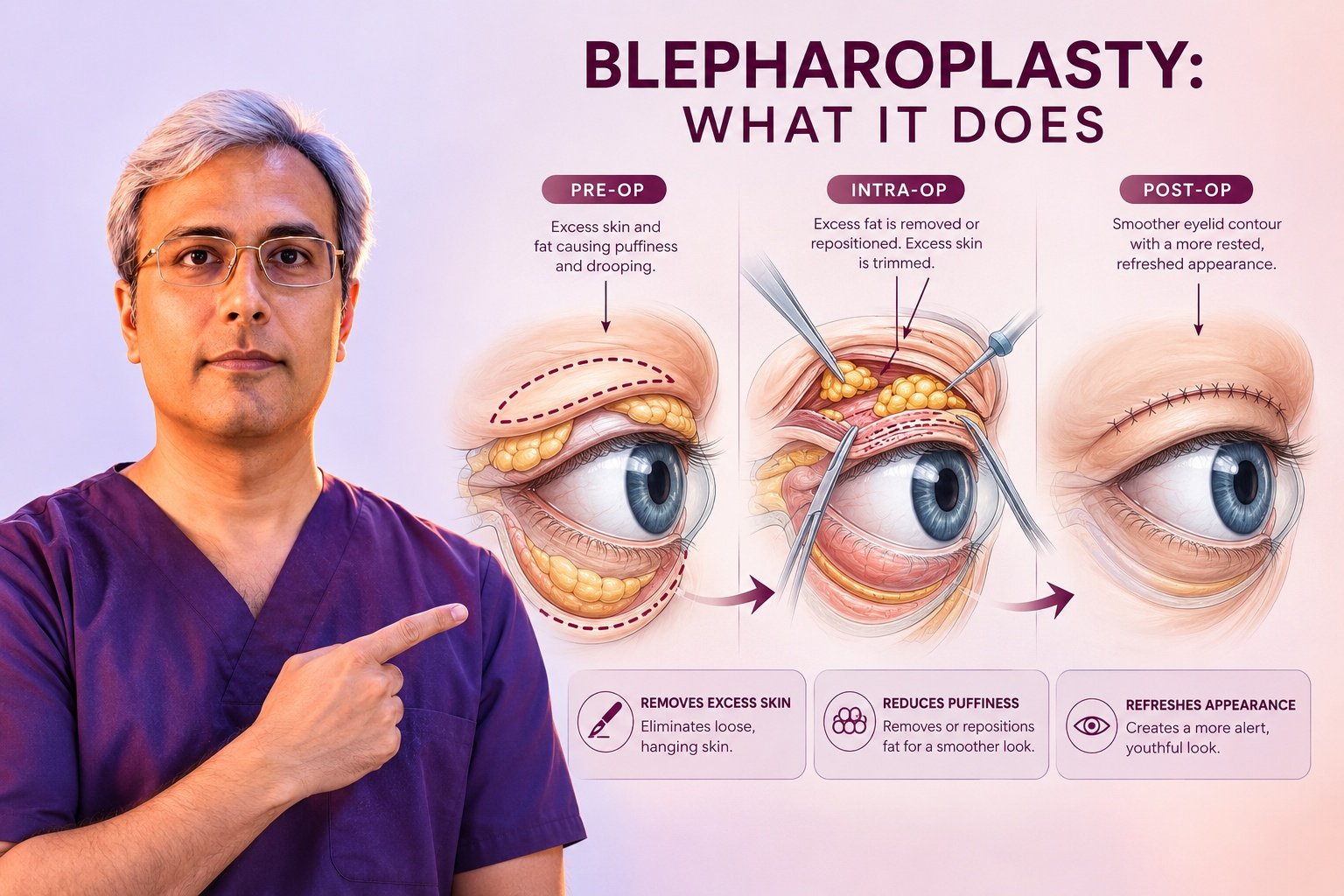
For the complete picture of the procedure itself, read our full guide to blepharoplasty. If you are still deciding, you may also want to read about cosmetic surgery in Jaipur and what a consultation involves.
Read this section first — the one true emergency
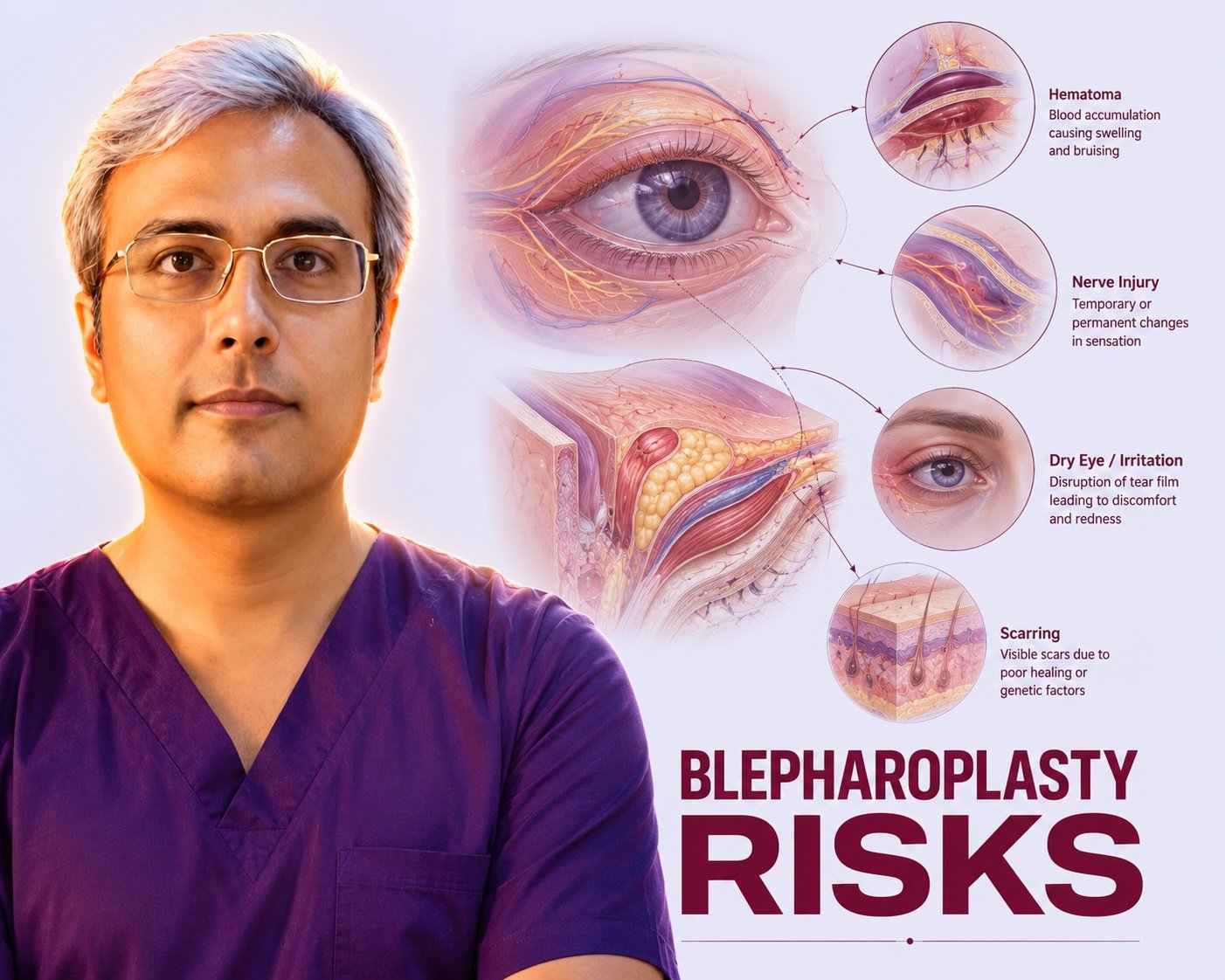
Bleeding behind the eye (retrobulbar haemorrhage) is rare, but it is sight-threatening and it is time-critical. It usually declares itself within the first 24 to 48 hours.
Go to an emergency department immediately — do not wait for a phone call to be returned — if you develop:
- Severe, escalating pain behind or around the eye, quite different from ordinary post-operative soreness
- Rapidly increasing tightness or pressure, with the eyelid becoming hard and tense
- The eye appearing pushed forward, or a sudden marked increase in swelling over minutes to hours
- Loss or dimming of vision, double vision, or a curtain over the vision
- Nausea and vomiting in combination with any of the above
Our contact number is +91-7718183535. Call us on the way, not instead of going.
Why Eyelids Swell the Way They Do
Eyelid skin is the thinnest in the body, and the tissue underneath is loose and richly supplied with blood vessels. Fluid moves into that space easily and drains out of it slowly. This is why a relatively small operation produces disproportionate-looking swelling, and why it responds so well to two simple measures — gravity and cold — in the first few days.
Fluid is also gravity-dependent. It tends to settle downwards overnight, so the lower lids and upper cheeks are usually the puffiest first thing in the morning and improve through the day. Bruising migrates the same way: discolouration that starts at the lid often tracks down onto the cheek over the first week. This looks alarming and is entirely normal.
Recovery Timeline at a Glance
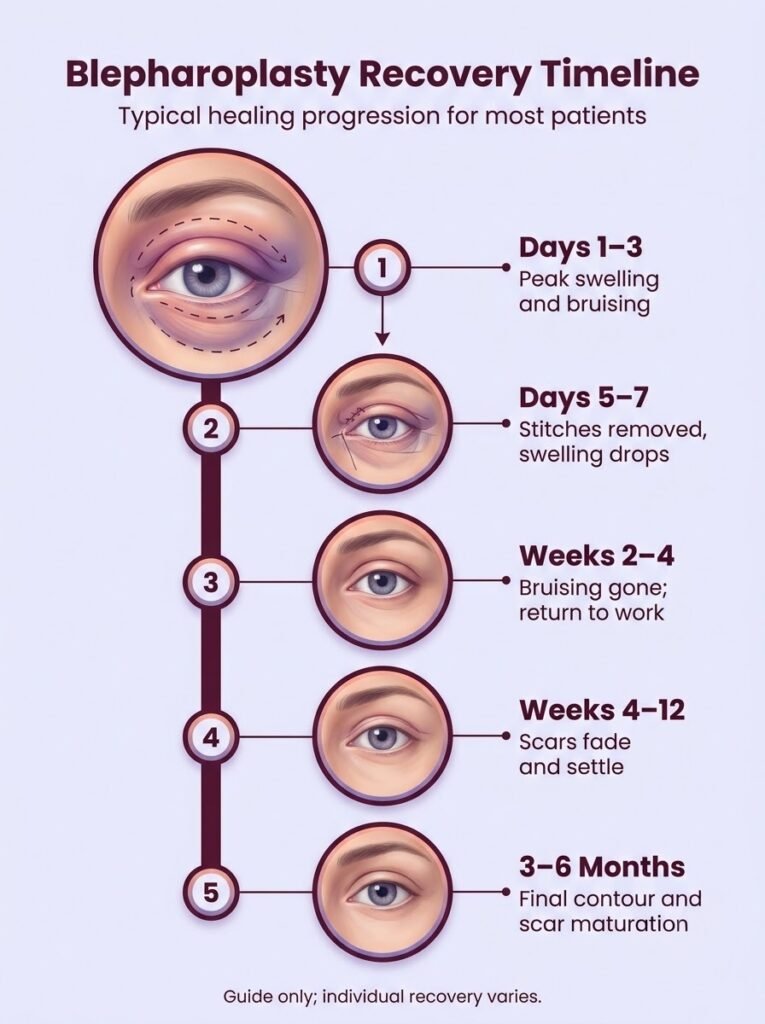
| Time point | What most patients experience |
|---|---|
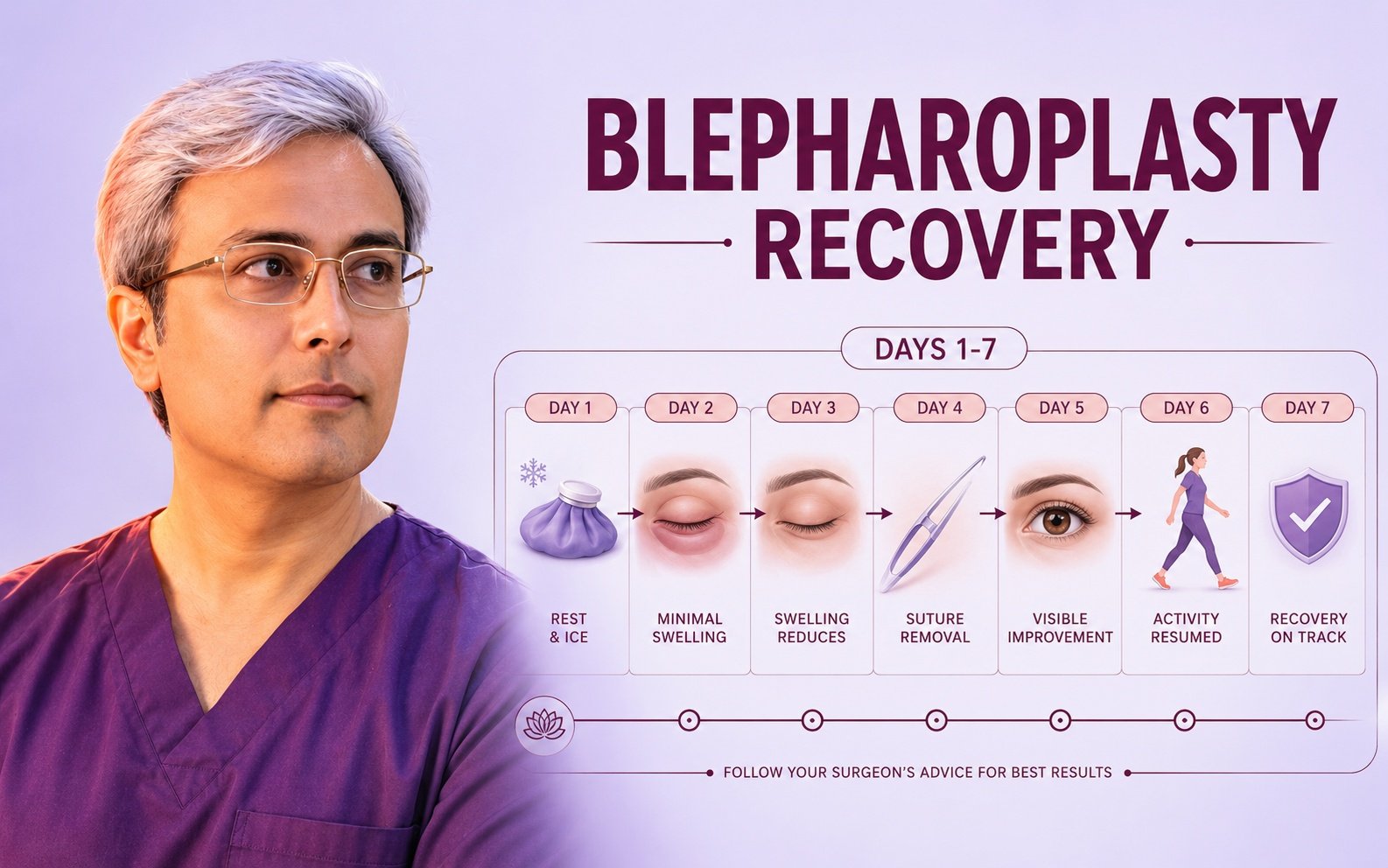
| Days 1–3 | Swelling peaks, usually around day 2–3. Bruising appears and darkens. Watering, grittiness, mild blurring. |
| Days 5–7 | Sutures removed. Bruising begins to change colour. Swelling clearly past its worst. |
| Weeks 2–4 | Bruising resolves. Presentable in normal social settings for most people, often with light makeup. Return to desk work. |
| Weeks 4–12 | Residual, subtle swelling settles. Scars go through a pink phase, then begin to fade. |
| 3–6 months | Final contour and scar maturation, particularly for lower eyelid surgery. |
Individual recovery varies with the technique used, whether upper or lower lids were operated on, skin quality, age, and your own bleeding tendency. Treat the table as a guide, not a schedule.
Days 1 to 7: The Active Phase
This is the week that most influences how quickly you settle down. Five things matter, and they matter far more than anything you can buy.
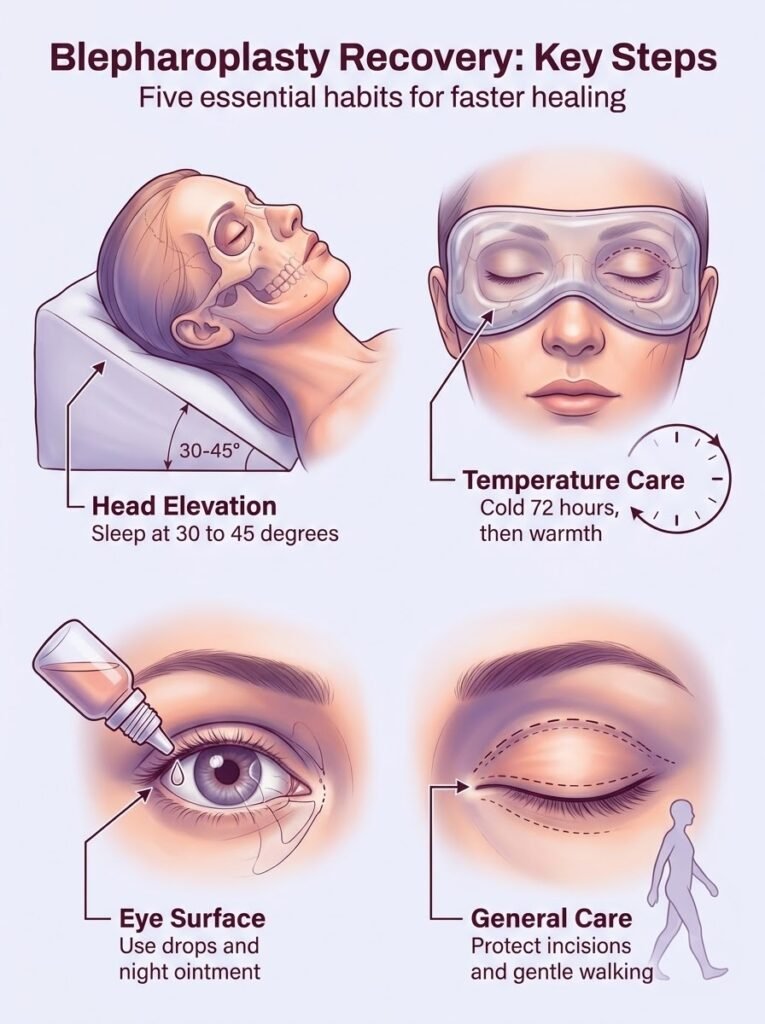
1. Keep your head elevated
This is the single most useful thing you can do, and it costs nothing. Sleep with your head raised at roughly 30 to 45 degrees for the first week — a wedge pillow, two or three ordinary pillows, or the head end of the bed propped up. Sleep on your back, not face-down. During the day, avoid bending forward at the waist; squat instead if you need to pick something up.
Patients who stay flat overnight consistently wake with more swelling than those who elevate.
2. Cold for the first 48 to 72 hours — then warmth
Cold constricts blood vessels and limits how much fluid and blood enter the tissue. It is genuinely useful, but only in the early window.
- Apply for 10 to 15 minutes at a time, roughly every hour while awake, for the first 2 to 3 days.
- Always wrap the pack in a clean, soft cloth. Never place ice directly on the skin.
- Rest it gently on the closed lids and surrounding area — no pressure on the eyeball itself.
- Chilled gel packs, a bag of frozen peas moulded to the face, or clean gauze soaked in cool water all work. Whatever you use must be clean.
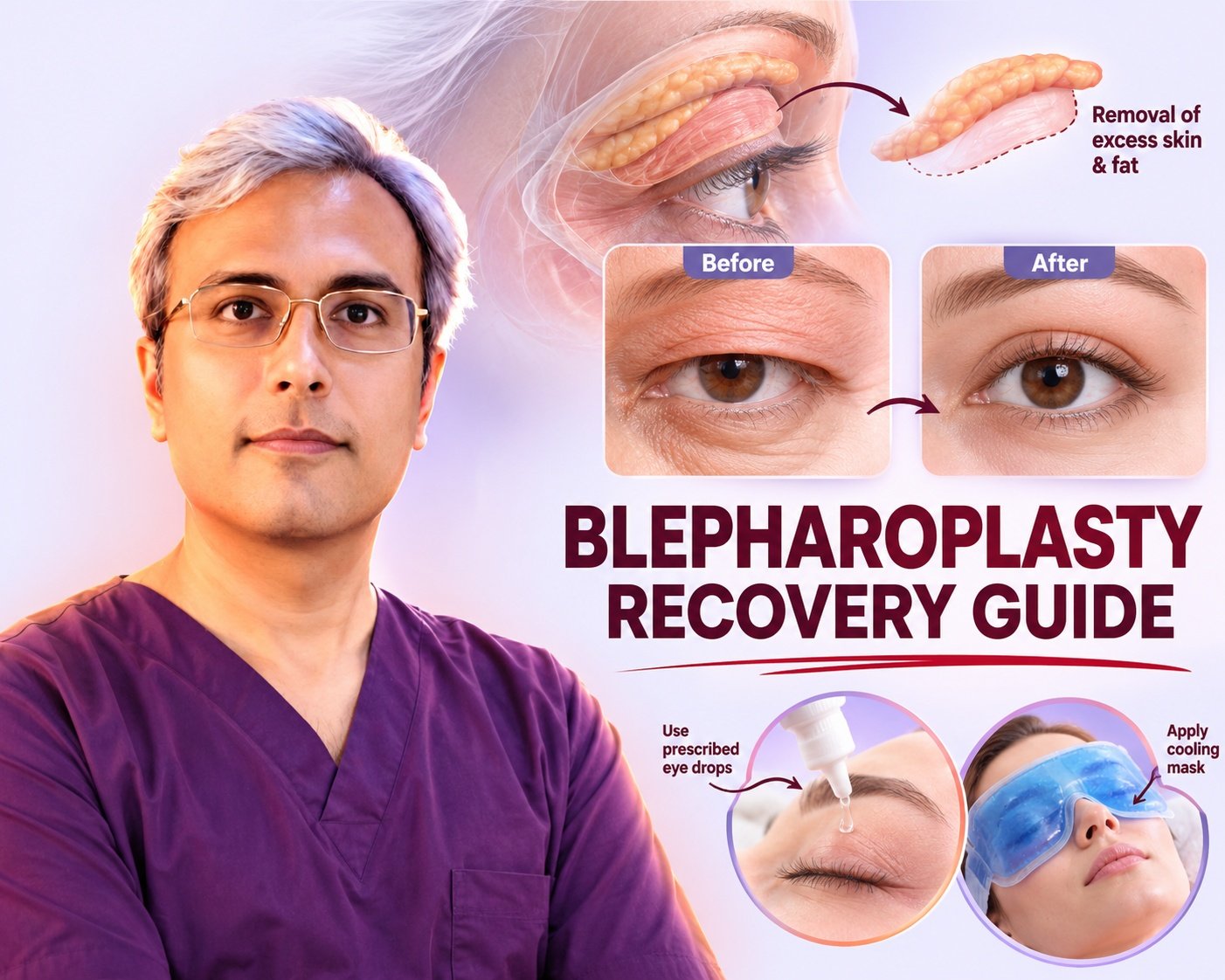
After 72 hours, cold stops adding much. Switch to gentle warm compresses, which increase local circulation and help the body clear the pigment left behind by bruising. The same 10-minute, several-times-a-day pattern applies. Comfortably warm, never hot — the skin here burns easily and your sensation may be reduced.
3. Look after the eye surface
After upper eyelid surgery the lids may not close completely for a week or two while there is swelling. This is expected and temporary, but it dries the eye surface and produces symptoms that worry people who have not been warned:
- Grittiness, as though there is sand in the eye
- Watering, which paradoxically is a sign of dryness
- Light sensitivity
- Blurred vision, especially after applying ointment
Use the lubricating drops prescribed for you through the day, and the ointment at night. Do not rub the eyes. Blurring caused by ointment clears within minutes of blinking; blurring that comes on suddenly, is severe, or is accompanied by pain is a different matter — see the emergency box above.
4. Protect the incisions
Keep the areas clean and dry as instructed. You will be told when you can shower and wash the face, usually within the first two to three days, with care taken to pat rather than rub. Sutures are typically removed around day 5 to 7.
5. Rest, but do not lie flat all day
Gentle walking around the house is good for circulation. Prolonged bed rest is not necessary and lying flat works against you.
Weeks 2 to 4: Settling and Returning to Life
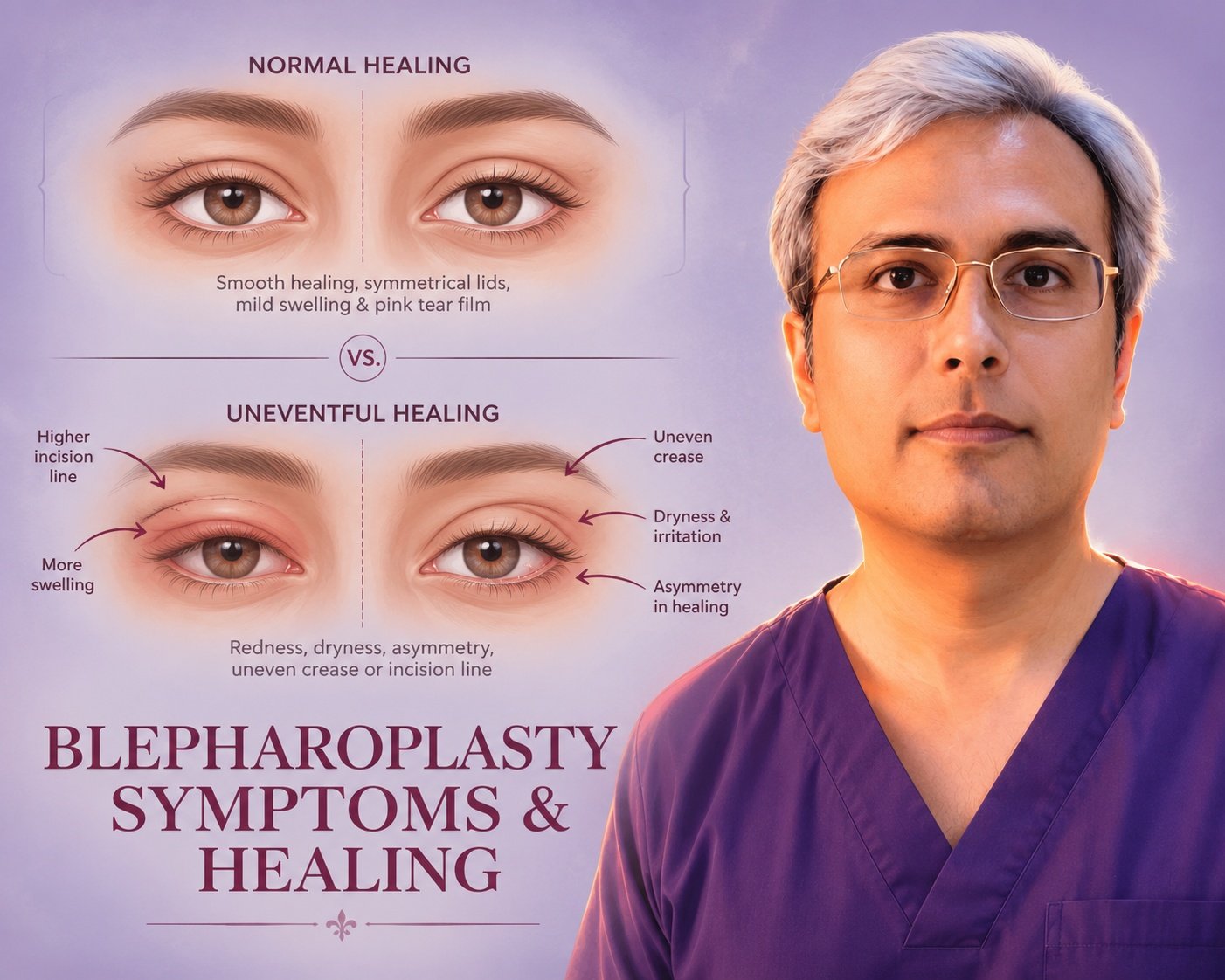
By the start of week two the dramatic swelling has usually gone. What remains is subtler — a slight fullness, a mild asymmetry between the two sides, and bruising that is fading through the classic sequence of purple to green to yellow before clearing.
Most people doing desk-based or non-physical work return around 7 to 14 days, often once bruising can be covered with makeup. Patients whose work is public-facing sometimes prefer to wait until the end of week two.
Asymmetry during this phase is normal. One eye almost always settles faster than the other. Judging your result at three weeks is judging it too early.
What Genuinely Helps, and What Does Not
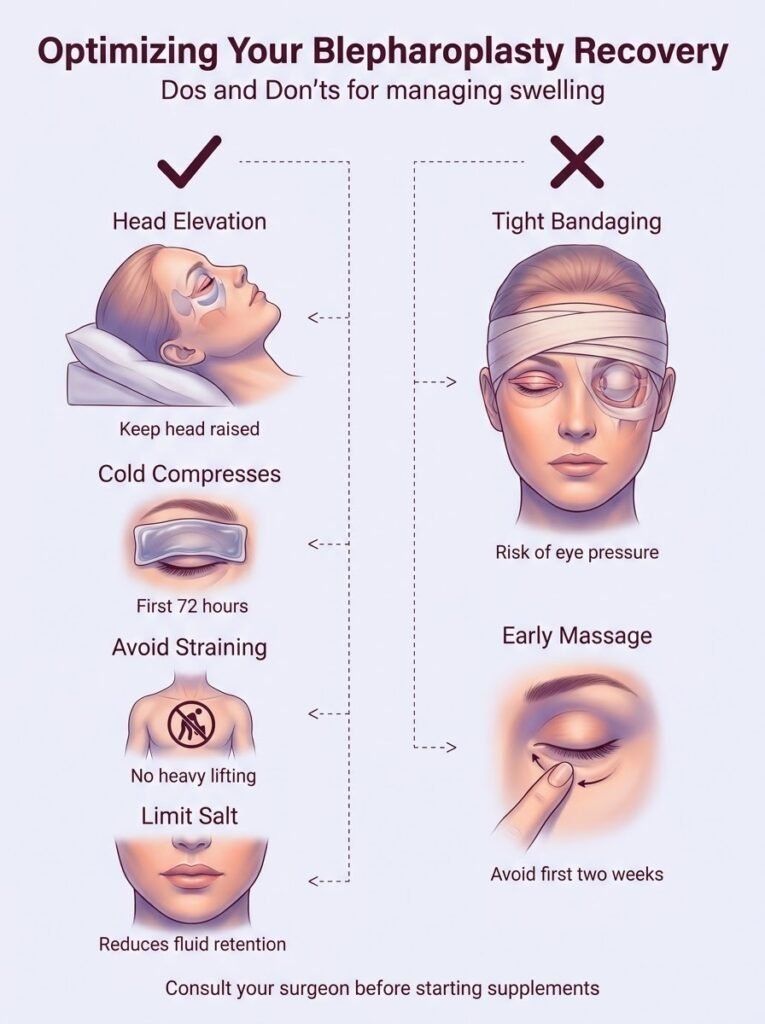
Helps, reliably:
- Head elevation
- Cold in the first 72 hours, warmth after
- Avoiding straining, bending and heavy lifting
- Stopping smoking — nicotine constricts the small vessels that healing tissue depends on
- Avoiding alcohol for at least the first week; it causes vasodilation and visibly worsens swelling
- Keeping salt intake moderate
Sometimes used, weak evidence:
- Arnica montana and bromelain. Widely taken, and patients ask about them constantly. The evidence is limited and mixed. They are generally harmless in standard doses, and if taking them helps you feel actively involved in your recovery, there is little reason to object. They are not a substitute for elevation and cold. Tell us before starting any supplement — several, including high-dose vitamin E, fish oil and garlic preparations, increase bleeding tendency.
Not recommended around the eyes:
- Tight compression bandaging. Firm circumferential wrapping is used elsewhere on the body, but around the orbit it risks pressure on the globe and — more importantly — it hides the very swelling asymmetry that would let us detect a developing haematoma early. Light supportive taping of the lower lid may be used in selected cases, and if so, we will apply it and tell you exactly when to remove it. Do not improvise your own compression.
- Massage in the first two weeks, unless we have specifically shown you a technique.
Medication After Surgery
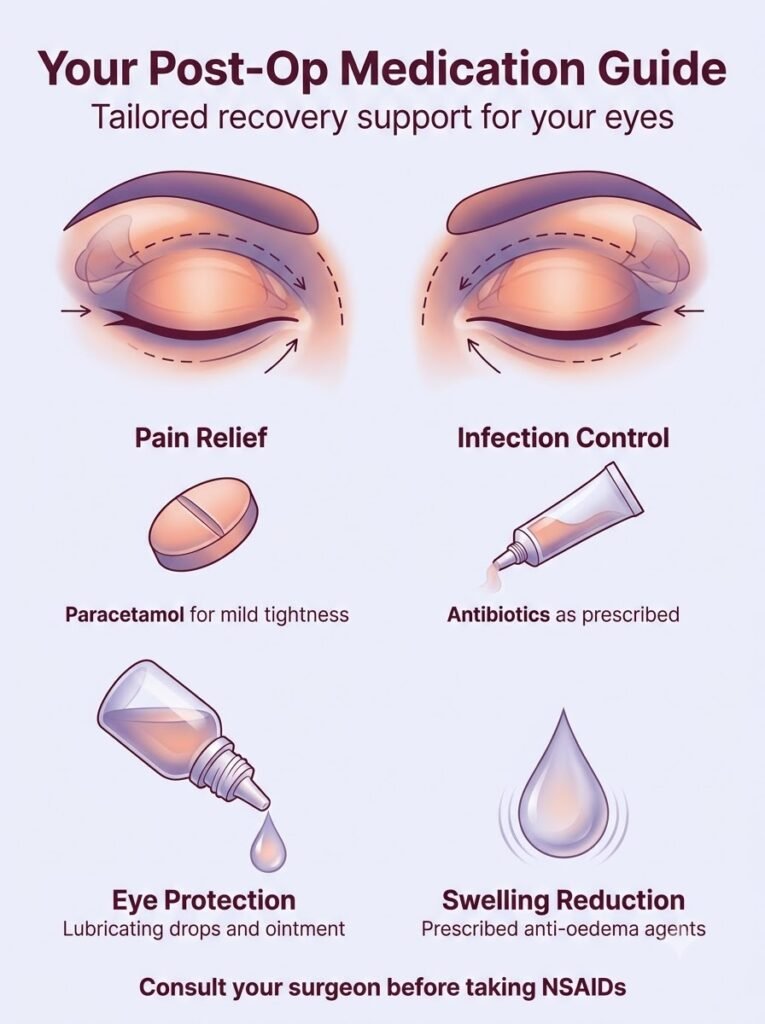
Your prescription is tailored to you. As a general framework:
| Type | Purpose | Notes |
|---|---|---|
| Paracetamol | First-line pain relief | Usually sufficient. Discomfort after blepharoplasty is typically mild — tightness rather than pain. |
| Antibiotics / antibiotic ointment | Reduce infection risk at the incision | Complete the course as prescribed. |
| Lubricating drops and night ointment | Protect the eye surface | The most important prescription in the first two weeks. |
| Anti-oedema agents | Reduce tissue swelling | Where used, these are prescribed individually. |
| Stronger analgesia | Reserved for the minority who need it | Ask rather than suffer — but also tell us, as unexpected pain is itself information. |
A note on anti-inflammatory painkillers. Common NSAIDs such as ibuprofen, diclofenac and aspirin also inhibit platelet function, which can increase bruising and bleeding. For that reason we generally prefer paracetamol in the early post-operative period. Do not add an NSAID on your own initiative — check with us first.
Blood thinners: never stop these on your own
If you take warfarin, a newer oral anticoagulant, aspirin, clopidogrel, or any similar medication for atrial fibrillation, a stent, a valve, a clot or a previous stroke, do not stop it because you read that blood thinners cause bruising. Stopping these drugs without supervision can cause a stroke or a heart attack.
Any decision to pause, bridge, or continue an anticoagulant is made before surgery, by us in consultation with you and your physician or cardiologist. Bring a complete list of your medicines and supplements to your pre-operative appointment. Read more about how we manage post-operative eye discomfort safely.
Upper Eyelids: Specific Considerations
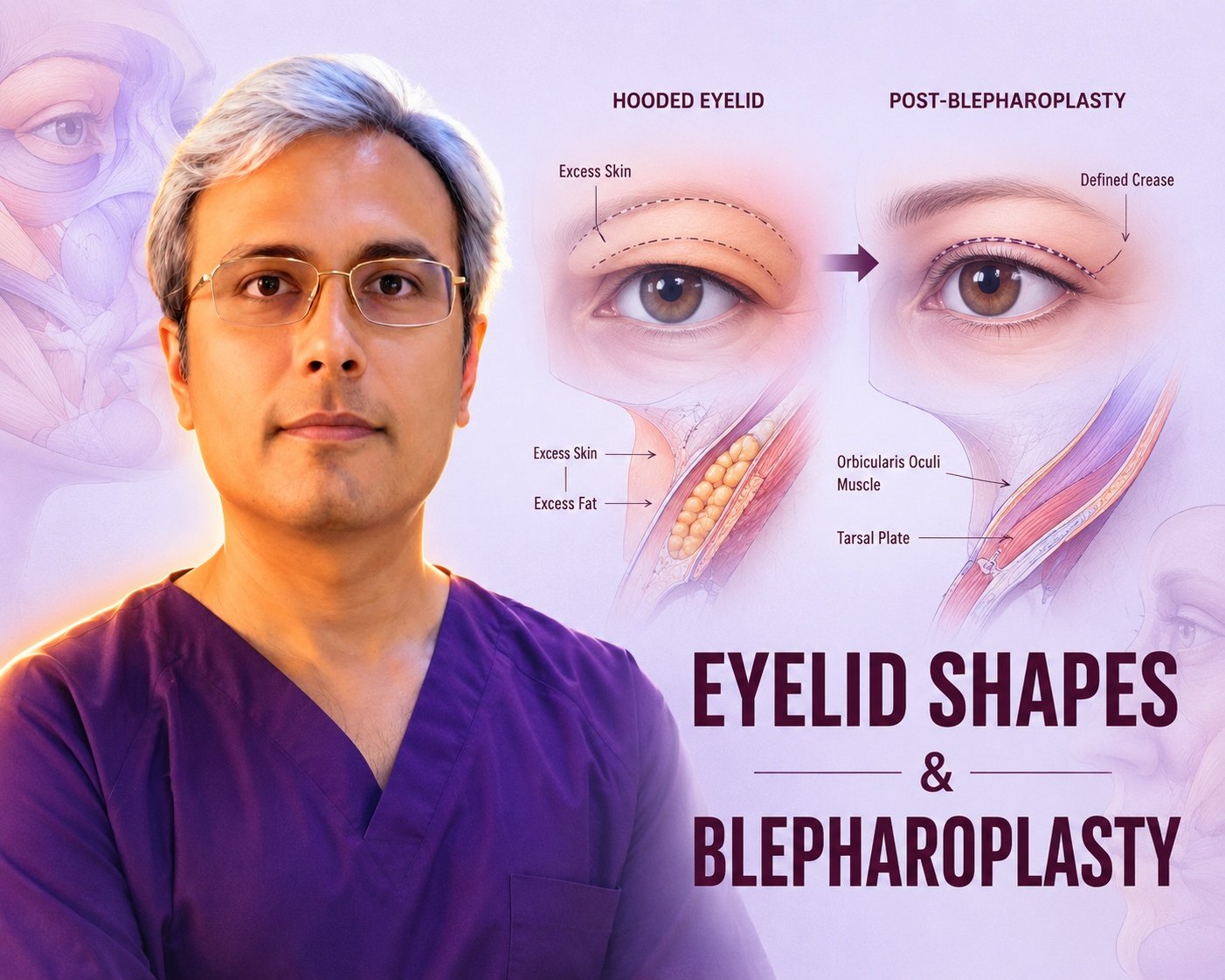
In hooded upper eyelids, excess skin has often been present for years, and the tissue takes time to redrape over the new, smaller envelope. Expect the upper lid crease to look higher, tighter and more prominent than its final appearance for the first few weeks.
Two things commonly surprise patients:
- The two sides settle at different rates. This is the rule rather than the exception, and it is not evidence that one side was operated on differently.
- Incomplete lid closure at night. Temporary and expected while swelling persists. It is precisely why night-time ointment is prescribed.
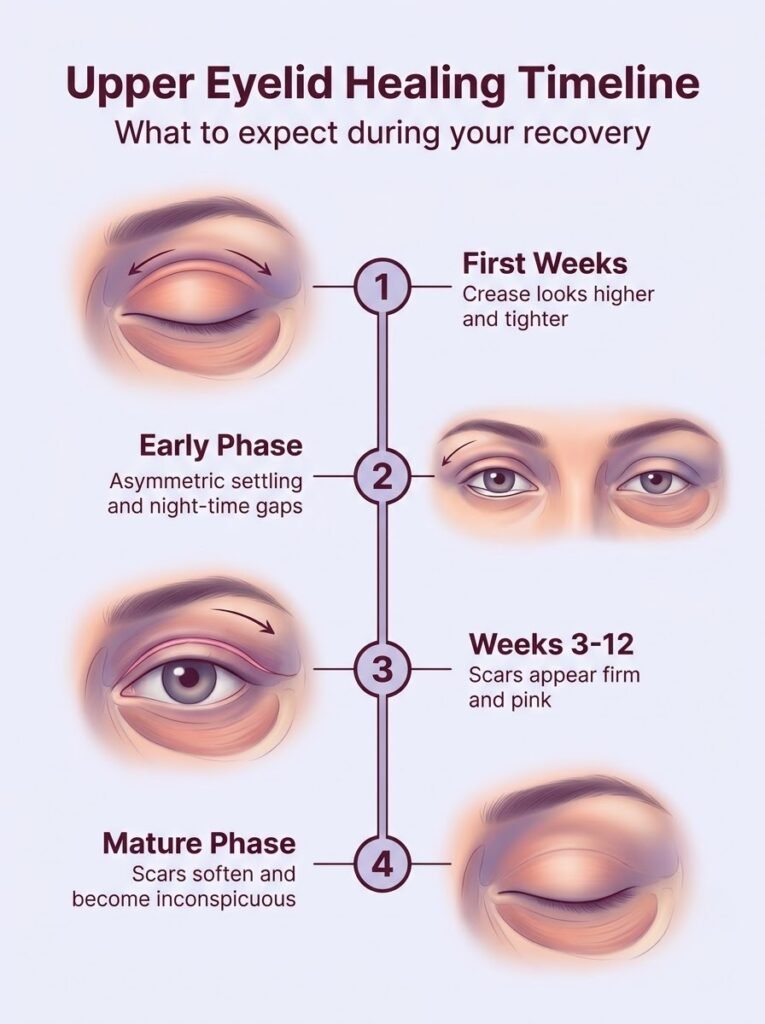
Scars sit within the natural crease and are usually inconspicuous once mature, but they pass through a firm, pink phase between roughly weeks 3 and 12 before softening.
Lower Eyelids: A Different Recovery
Lower eyelid surgery follows a different course, and it is worth understanding which approach was used in your case.
Transconjunctival (incision inside the lid, no external scar) is typically used when the problem is primarily fat bulging with good skin quality. There is no visible scar and no risk of scar contracture pulling the lid down.
Transcutaneous (incision just below the lash line) is used when skin and muscle also need addressing. The scar sits below the lashes and generally settles well.
Points specific to the lower lid:
- Bruising is usually more pronounced than with upper lids, and it migrates onto the cheek. Two to three weeks to full resolution is typical.
- Chemosis — a translucent, jelly-like swelling of the white of the eye — occurs in a minority of patients. It looks far more dramatic than it is, and it resolves, though it can take several weeks. Tell us if it appears; it is manageable.
- Lid position is watched carefully. Temporary slight lower-lid retraction or rounding of the outer corner can occur while there is swelling and usually corrects as things settle. Persistent pulling down of the lid margin is uncommon and is something we monitor for specifically at follow-up.
- The final result takes longer. Contour and scar maturation continue for three to six months. Do not assess your lower lids at four weeks.
Activity Restrictions
These limits exist to keep venous and orbital pressure low, because pressure spikes at the surgical site are what cause bleeding and haematoma.
- No lifting over about 5 kg for two weeks. Straining raises venous and orbital pressure at exactly the site that is trying to seal.
- No strenuous exercise, gym or running for two weeks. Light walking from day one is encouraged. Build back gradually over weeks three and four.
- Avoid straining, forceful coughing, sneezing and constipation in the first week. If you feel a sneeze coming, sneeze with the mouth open. Manage constipation early rather than straining.
- No bending forward at the waist for the first week. Squat instead.
- No swimming, saunas, steam rooms or hot yoga for two to three weeks, or until cleared.
- No eye rubbing — this one lasts a good few weeks.
- No contact lenses for about two weeks, and only once comfortable.
- No eye makeup or kajal for about two weeks, and nothing on the incision until it is fully sealed. Remove makeup gently, without dragging the lid.
- Sunglasses outdoors, both for light sensitivity and to protect maturing scars. Sun exposure on a fresh scar causes lasting pigmentation.
- Air travel — usually fine after about a week for short flights, but check with us for your specific case.
- Driving — only when your vision is clear, you are off any sedating medication, and you can turn your head and react comfortably.
Warning Signs: When to Contact Us
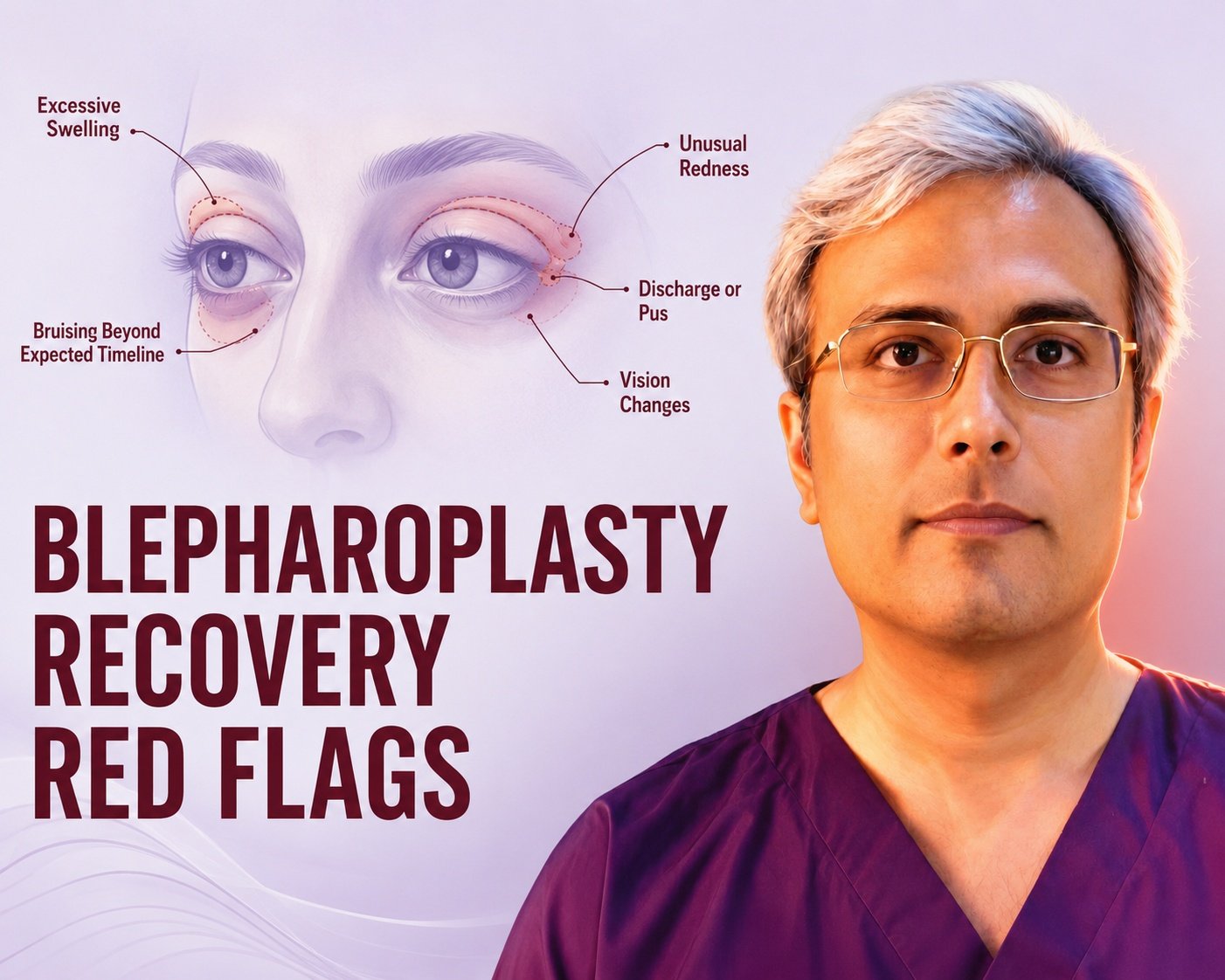
Emergency — go to hospital immediately (see the box at the top): severe escalating pain, rapidly increasing tightness or protrusion of the eye, loss or dimming of vision, double vision.
Call us the same day if you notice:
- Fever, chills, or feeling systemically unwell
- Yellow or green discharge from an incision, or a foul smell
- Spreading redness and heat around the wound, particularly if it is expanding
- Sudden marked swelling of one side after things had been settling
- Bleeding from a wound that does not stop with 10 minutes of gentle pressure
- A wound edge that has opened
- Persistent inability to close the eye beyond two weeks, or worsening rather than improving dryness
You are not troubling us by calling. An early phone call about something that turns out to be nothing is a far better outcome than a late one about something that was not. Read more on when to seek medical attention for complications.
Frequently Asked Questions
How long will the swelling last after blepharoplasty?
The bulk of it settles within 10 to 14 days. Most people are socially presentable by two weeks, particularly with light makeup once the incisions have sealed. Subtle residual swelling — noticeable to you, rarely to anyone else — can persist for six to twelve weeks, and for lower eyelid surgery the final contour continues to refine over three to six months.
Why is one eye much more swollen than the other after eyelid surgery?
Because bodies are not symmetrical and neither is healing. Unequal swelling between the two sides is normal in the first few weeks and usually evens out. What is not normal is one side suddenly becoming more swollen after a period of improvement — that warrants a same-day call.
Why does my vision go blurry after blepharoplaty?
The commonest cause is the ointment, which coats the eye surface and clears within a few minutes of blinking. Dryness from temporarily incomplete lid closure also blurs vision, as does swelling itself. Sudden, severe, or painful visual change is entirely different and needs emergency assessment.
How long before I can wear kajal or eye makeup after eyelid surgery?
Around two weeks, once the incisions are fully sealed, and only with gentle application and removal. Cream and powder foundation can usually be used on the surrounding skin — not on the incision line — a little earlier to cover bruising.
When can I fly after blepharoplasty?
Short domestic flights are usually fine after about a week, provided you are healing normally. Longer flights are better deferred to two weeks, partly because of the very dry cabin air. Bring your lubricating drops.
Will the blepharoplasty scars be visible?
Upper eyelid scars sit inside the natural crease and are typically difficult to see once mature. Lower lid scars, when an external incision is used, sit just below the lash line. Both pass through a firmer, pinker phase for several weeks before fading over months. Sun protection during this phase makes a measurable difference.
Do arnica or bromelain actually work?
The evidence is weak and inconsistent. They are generally harmless at standard doses and many patients like taking them. They will not substitute for keeping your head elevated. Always tell us what you are taking, since several supplements increase bleeding tendency.
When will I look like myself again after blepharoplasty?
Most people say around three to four weeks for everyday life, and around three months before they stop noticing anything at all. The result you are actually assessing is the one at six months.
Getting in Touch
If something concerns you at any point during your recovery, contact us rather than waiting. To discuss your case or arrange a consultation, call +91-7718183535.
This article is intended as general educational information about recovery after blepharoplasty and does not replace individual medical advice. Your own post-operative instructions, given to you by your surgeon, take precedence over anything written here. If you have symptoms that concern you, seek medical attention.
Dr. Vishal Purohit, MBBS, MS (General Surgery), MCh (Plastic Surgery) — Plastic, Reconstructive and Aesthetic Surgeon, Jaipur.







 English
  Hindi
Hindi