
The eyes are the first feature most people look at, and the eyelid frames them. A lid that sits high and crisp reads as alert; the same eye behind a heavy fold reads as tired, even when the person is perfectly rested. That gap between how you feel and how you appear is the reason most patients start reading about blepharoplasty.
Not every eyelid concern is the same problem, though, and this matters more than most articles admit. Some lid shapes are inherited and have been that way since childhood. Others are changes that arrived gradually with age. A few are signs of a medical condition that needs investigation before anyone reaches for a scalpel. Telling these apart is most of the consultation.
This article walks through the common eyelid shapes, what each one does to your facial balance, and what surgery realistically changes.
For the complete picture, read our full guide to blepharoplasty.
The Common Eyelid Shapes and What They Do to a Face
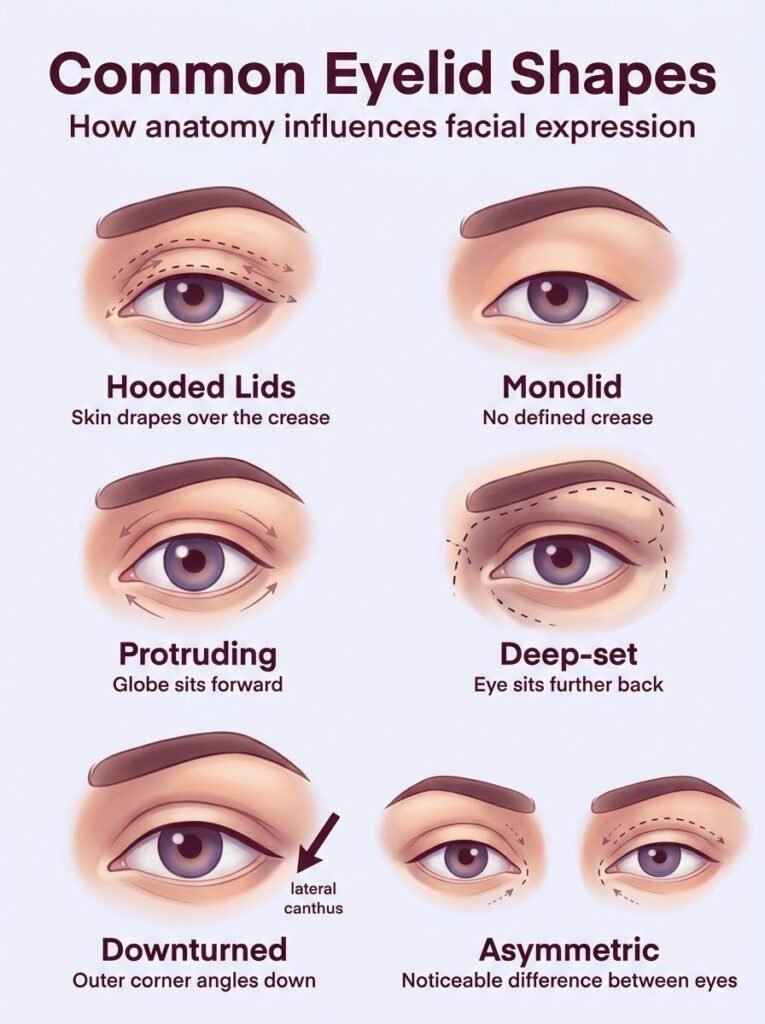
Hooded lids. Skin from the upper lid or brow region drapes over the crease so that little or no lid shows when the eye is open. Hooding can be inherited — plenty of people have had it since their twentieas — or it can develop with age as skin loses elasticity. It tends to shorten the apparent height of the eye and can make an otherwise open expression read as guarded or fatigued.
Monolid, or the eyelid without a defined crease. Common across East and Southeast Asian populations and seen in South Asian patients too, this lid has a low crease or none at all, often with an epicanthal fold running along the inner corner. It is a normal anatomical variant, not a defect. Patients who choose to alter it are usually asking for a defined crease rather than a different ethnicity of eye, and a good surgeon plans crease height to suit the individual face — a crease set too high is the classic signature of over-westernised surgery and is difficult to reverse.
Deep-set or hollow lids. The eye sits further back relative to the brow bone, casting a shadow that photographs as darkness under the brow. This can be a lifelong bone structure or the result of age-related fat loss around the orbit.
Prominent or protruding lids. The opposite pattern: the globe sits forward, with fat pads visible through the lid. Worth flagging that new or asymmetric prominence needs a thyroid workup before anything else, since thyroid eye disease presents exactly this way.
Downturned or upturned outer corners. The angle of the lateral canthus sets a great deal of the face’s expression. A downturned corner reads as sad or weary; the same face with a level corner reads neutral. Corners often drift downward with age as the supporting tendon loosens.
Asymmetric lids. Almost everyone has some degree of asymmetry, and mild differences are normal. Where the difference is noticeable, the cause is most often congenital — the person has simply always been that way. Other real causes include age-related stretching of the levator attachment, previous trauma or surgery, thyroid eye disease, and neurological causes such as third-nerve palsy or Horner’s syndrome. The last group needs medical assessment, not cosmetic surgery, which is why a proper consultation includes questions that may feel unrelated to how you look.
Upper Eyelid Hooding and Facial Expression
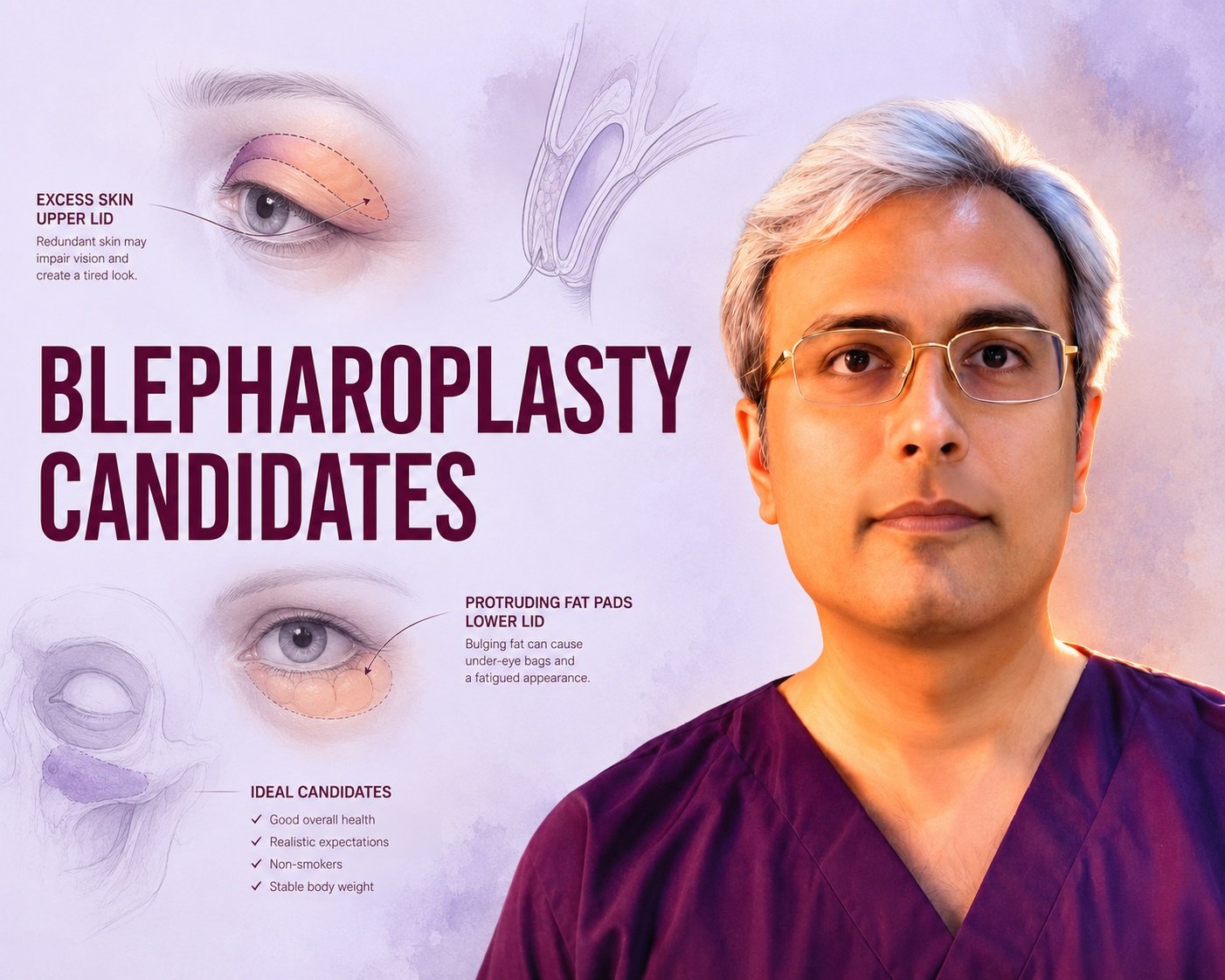
When excess upper lid skin hangs over the crease, it hides the tarsal platform — the strip of pretarsal skin visible between the lash line and the crease when your eye is open. This is what people mean by “lid show.” As it disappears, the eye looks smaller and eye makeup has nowhere to sit.
Hooding also flattens facial expression. The small movements of the upper lid carry a surprising amount of social signal, and a heavy fold mutes them. Patients frequently report being asked if they are tired or upset, which is often what finally brings them to a clinic.
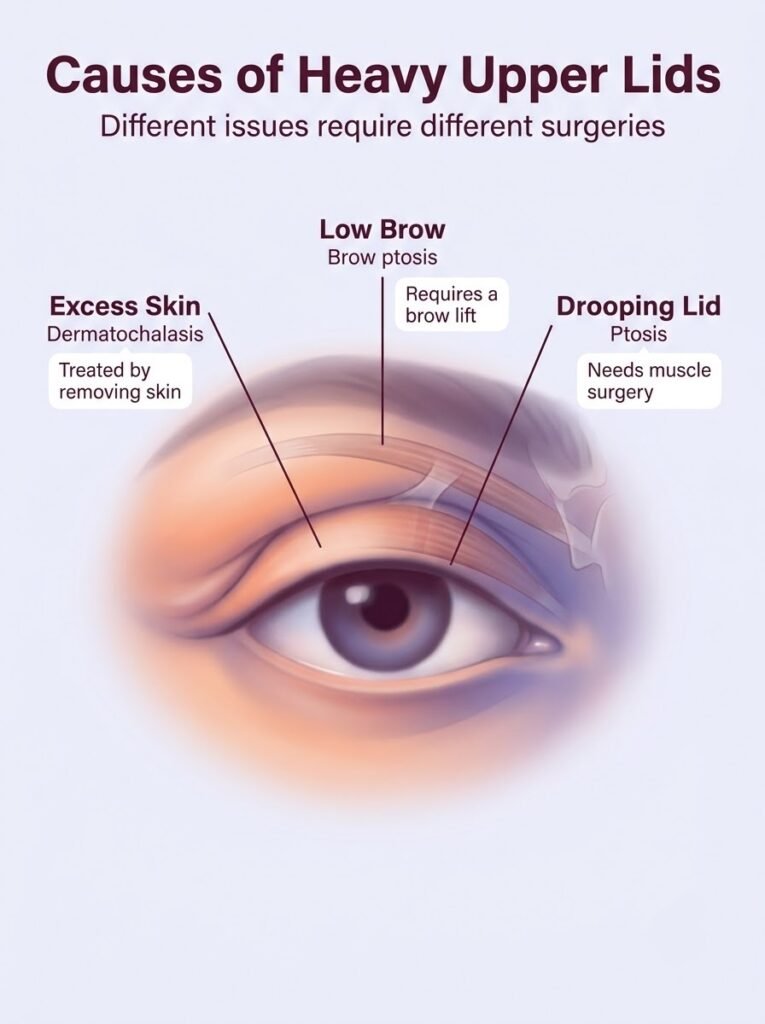
An important distinction sits underneath all of this. Three separate problems produce a similar-looking heavy upper lid, and they need three different operations:
- Dermatochalasis — excess lid skin. Treated by removing skin, which is what most people mean by “upper blepharoplasty.”
- Ptosis — the lid margin itself sits low because the levator muscle or its attachment is weak. Removing skin does not fix this and can make it look worse. It needs levator surgery.
- Brow ptosis — the brow has descended and is pushing lid tissue down. The lid is not the problem. A brow lift is.
Many patients have a combination. Getting this assessment right is the difference between a result that looks rested and one that looks operated on. You can read more about what the blepharoplasty procedure actually involves.
Lower Eyelid Puffiness and Under-Eye Bags
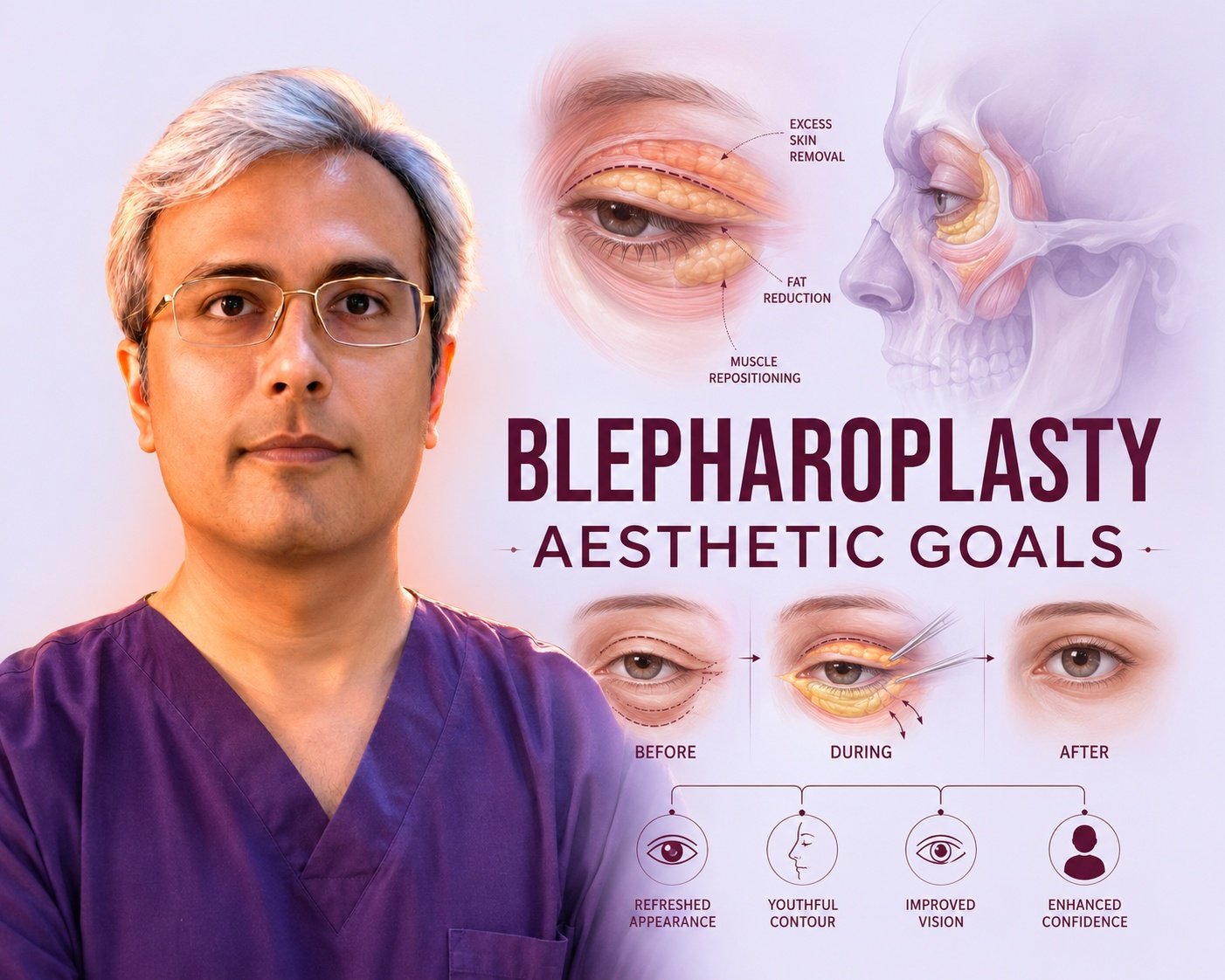
Lower lid fullness comes from orbital fat pushing forward as the septum that holds it back weakens with age, often combined with volume loss in the upper cheek. The result is a bag with a hollow immediately below it — the tear trough — and the shadow that hollow casts is usually what patients dislike most.
Modern lower lid surgery has moved away from simply removing fat. Aggressive fat excision was standard decades ago and produced the hollow, skeletonised lower lid that ages badly. The current approach favours repositioning fat over the orbital rim to fill the trough, removing only what is genuinely excess, so the transition from lid to cheek is continuous rather than stepped.
Lower lid work also carries more risk than upper lid work, which the next section covers.
Sunken Eyes and Volume Loss
A hollow upper lid sulcus, whether inherited or age-related, casts a shadow that makes the whole eye region read as tired. Redistributing or grafting orbital fat can soften this, as can filler in carefully selected cases.
The caution here is real: the periorbital region is unforgiving of overfilling. Too much volume produces a puffy, heavy look that is harder to correct than the original hollow. This is one area where less genuinely is more, and where staged treatment beats trying to achieve everything in one sitting. We discuss realistic expectations before, not after.
Canthopexy and Canthoplasty: Supporting the Outer Corner
When the outer corner of the eye has loosened, skin excision alone can pull the lower lid downward or outward. Supporting the corner prevents this, and there are two related procedures with genuinely different scopes:
- Canthopexy tightens and re-suspends the existing lateral canthal tendon without detaching it. It is the lighter of the two and is often performed alongside lower blepharoplasty as a preventive measure.
- Canthoplasty involves detaching the tendon, shortening it, and reattaching it at a new position. It is the more powerful option, used for significant laxity or lid malposition.
Both aim at stability of the outer corner so the lid sits against the globe rather than sagging away from it. Techniques that reinforce the eyelid suspension system, including orbicularis muscle suspension, are chosen based on how much laxity is present on examination — a snap-back test and lid distraction test at the consultation determine which of the two you actually need.
Eye Symmetry and Facial Balance
Eye symmetry contributes to how balanced a face appears, but perfect symmetry is neither achievable nor natural-looking. Faces are asymmetric by design, and surgically forcing two sides to match exactly tends to produce a result that reads as artificial.
The realistic goal is to reduce a difference that is noticeable to others down to one that is not — while making sure any underlying medical cause has been ruled out first.
Risks and Complications You Should Know About
No honest article about eyelid surgery skips this section.
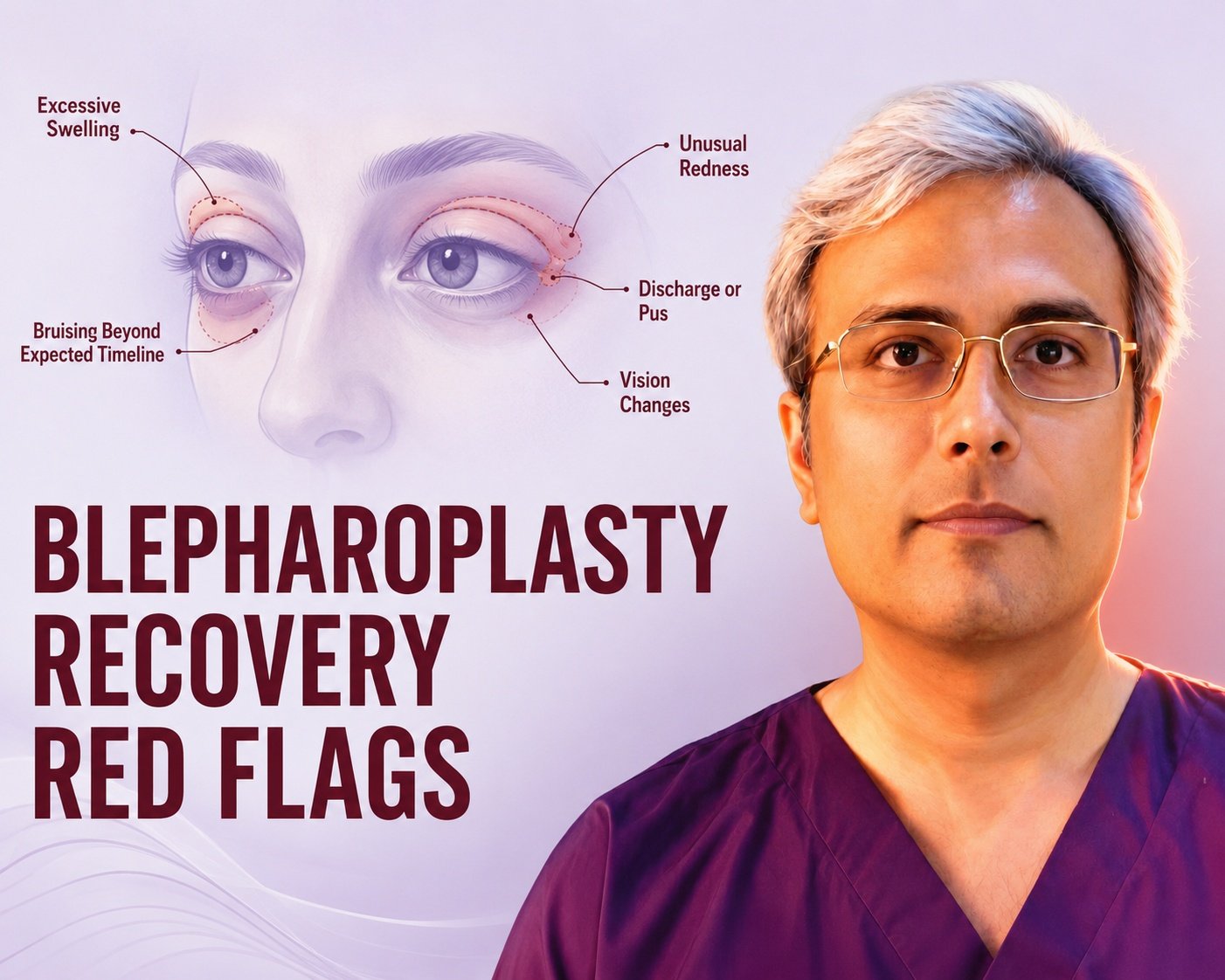
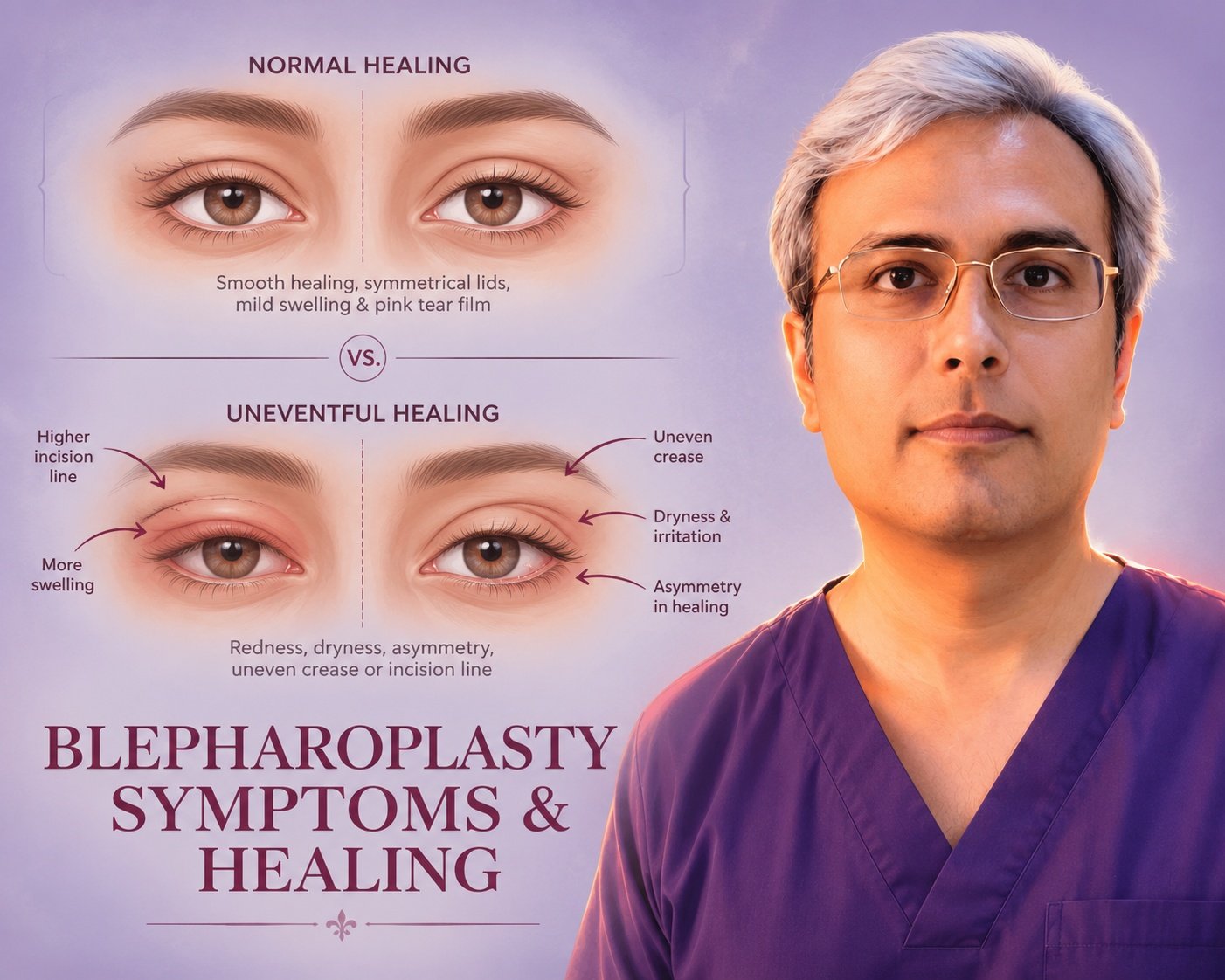
Common and usually temporary: bruising and swelling, dry or gritty eyes, light sensitivity, blurred vision from ointment, and a tight sensation for several weeks. Dry eye is the single most frequent complaint and is worse in patients who already have marginal tear film — which is why we test for it beforehand.
Less common: visible or thickened scarring, asymmetry requiring revision, chemosis (swelling of the conjunctiva), lagophthalmos (incomplete lid closure), and over- or under-correction.
Uncommon but serious: lower lid retraction or ectropion, where the lid pulls away from the eye; infection; and retrobulbar haemorrhage — bleeding behind the eye that can threaten vision. It is rare, but it is the reason we ask about blood thinners and supplements, and the reason sudden severe pain with vision change after surgery is an emergency, not something to wait on.
Revision surgery is sometimes needed. Any surgeon who tells you otherwise is selling something.
Who Is and Is Not a Good Candidate
Good candidates are generally in reasonable health, have realistic expectations, and have a functional or aesthetic concern that surgery can actually address.
Factors that need to be assessed or managed first:
- Dry eye disease or reduced tear production — blepharoplasty can worsen it significantly.
- Thyroid eye disease, active or unstable.
- Uncontrolled hypertension, diabetes, or bleeding disorders, including anticoagulant use.
- Smoking, which impairs healing.
- Negative vector anatomy — a prominent globe relative to the cheek, which raises the risk of lower lid retraction and changes the surgical plan.
- Significant lid laxity, which usually means canthal support is needed alongside any skin work.
- Body dysmorphic concerns or expectations that surgery cannot meet. Declining to operate is sometimes the right medical decision.
Non-Surgical Alternatives Worth Considering
Surgery is not the only option, and it is not always the best first step:
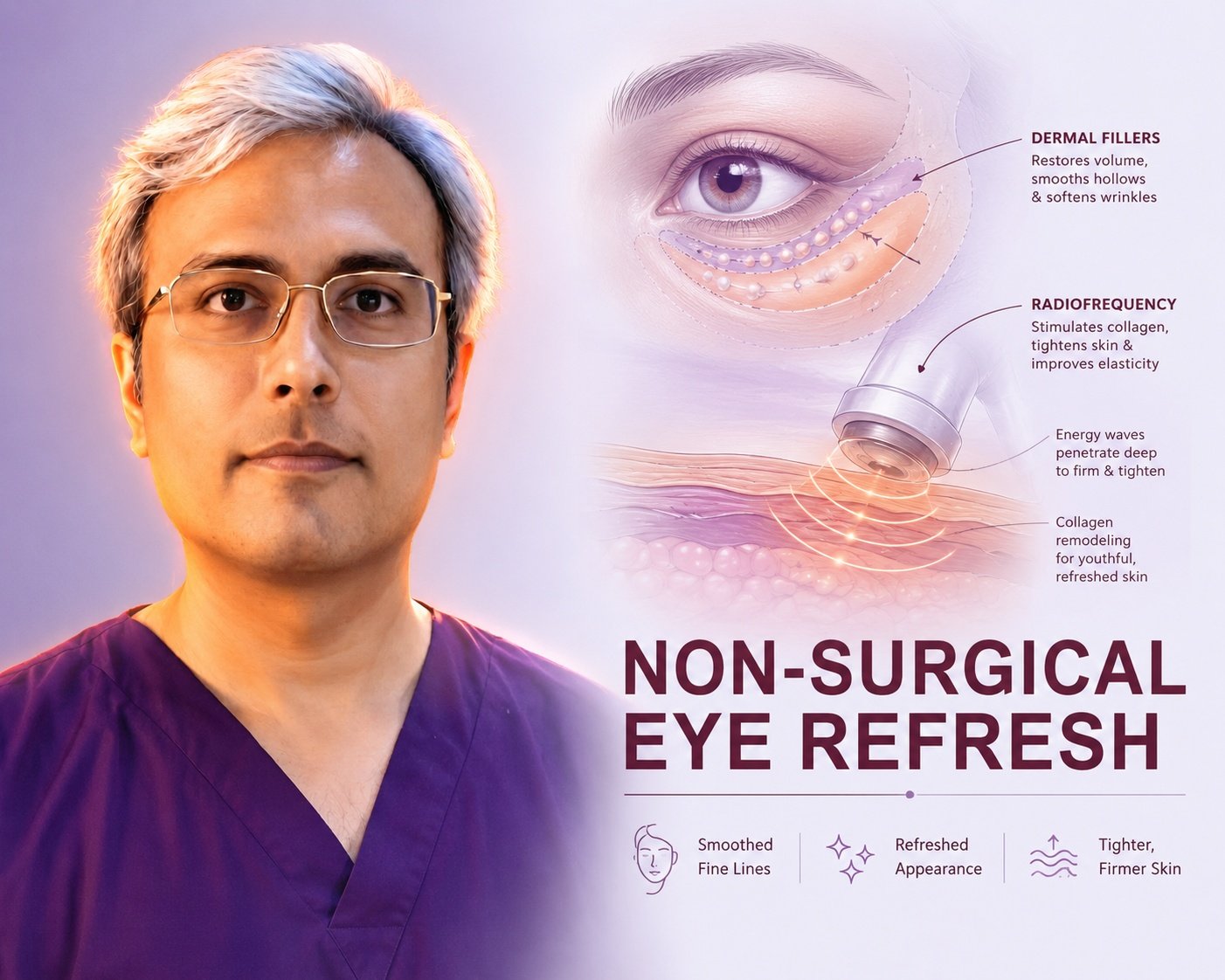
- Botulinum toxin can raise the lateral brow slightly and soften crow’s feet, which helps mild hooding.
- Hyaluronic acid filler in the tear trough can address a hollow without operating, though it suits some anatomies far better than others and can look lumpy in thin skin.
- Energy-based skin tightening (radiofrequency, certain lasers) can improve mild skin texture and laxity, but will not remove a genuine excess of skin.
- Treating the actual cause. Allergy, poor sleep, salt intake, and sinus issues all produce puffiness that no surgeon should be operating on.
If a non-surgical route can achieve what you want, that is what we will recommend.
How the Surgical Plan Is Built
- Comprehensive evaluation — history, medications, dry eye assessment, thyroid screening where indicated, lid measurements, and photographs.
- Diagnosis before technique — establishing whether the issue is skin, muscle, fat, brow position, canthal laxity, or a combination.
- A plan matched to your anatomy and your stated goals, discussed with what is and is not achievable made explicit.
- Precise execution, with canthal support added where laxity requires it.
- Structured follow-up, including suture removal and review at intervals, since the final result settles over months rather than days.
Research suggests periorbital rejuvenation can measurably change how alert and approachable a face is perceived to be — but the aim is for you to look like a rested version of yourself, not like someone else.
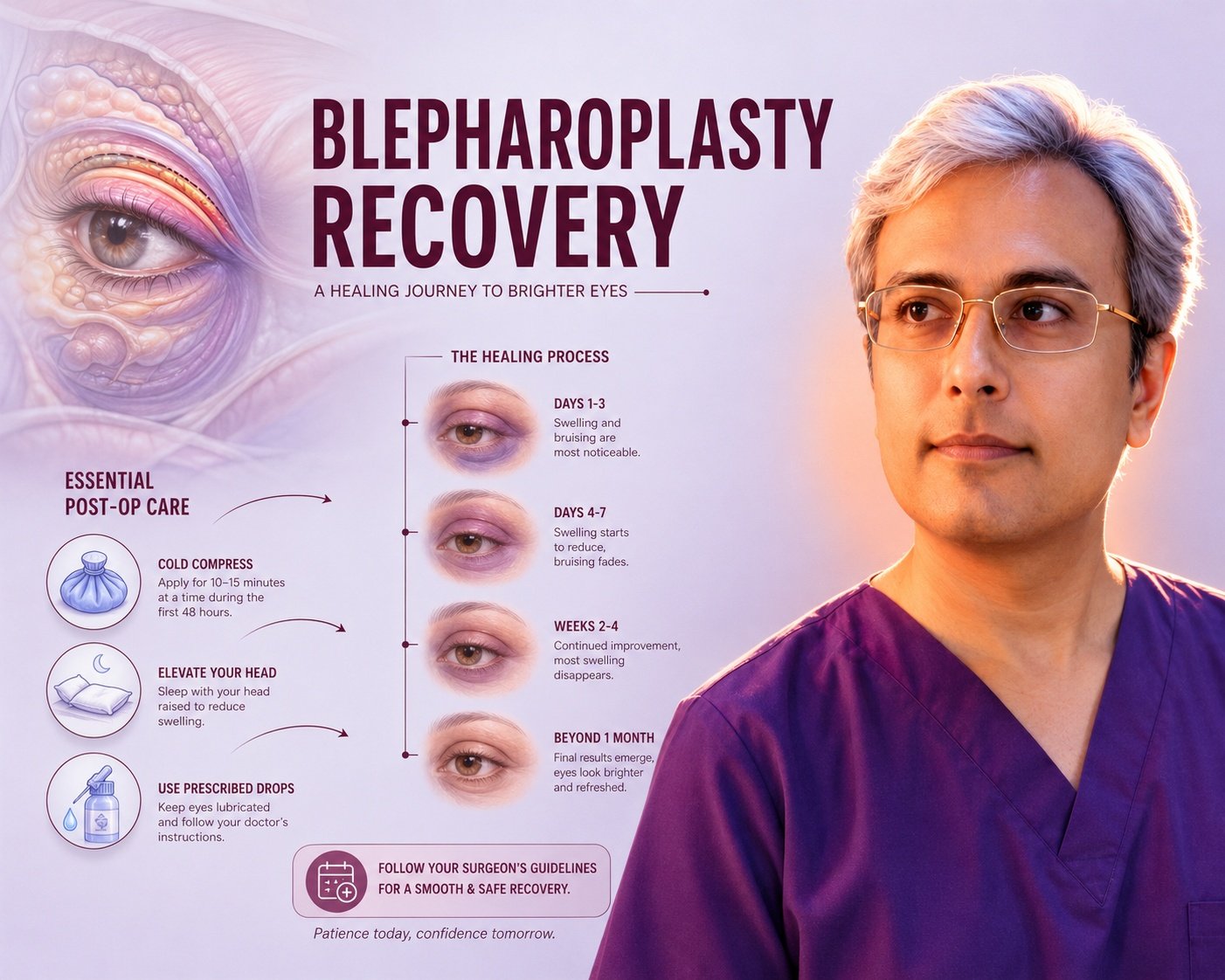
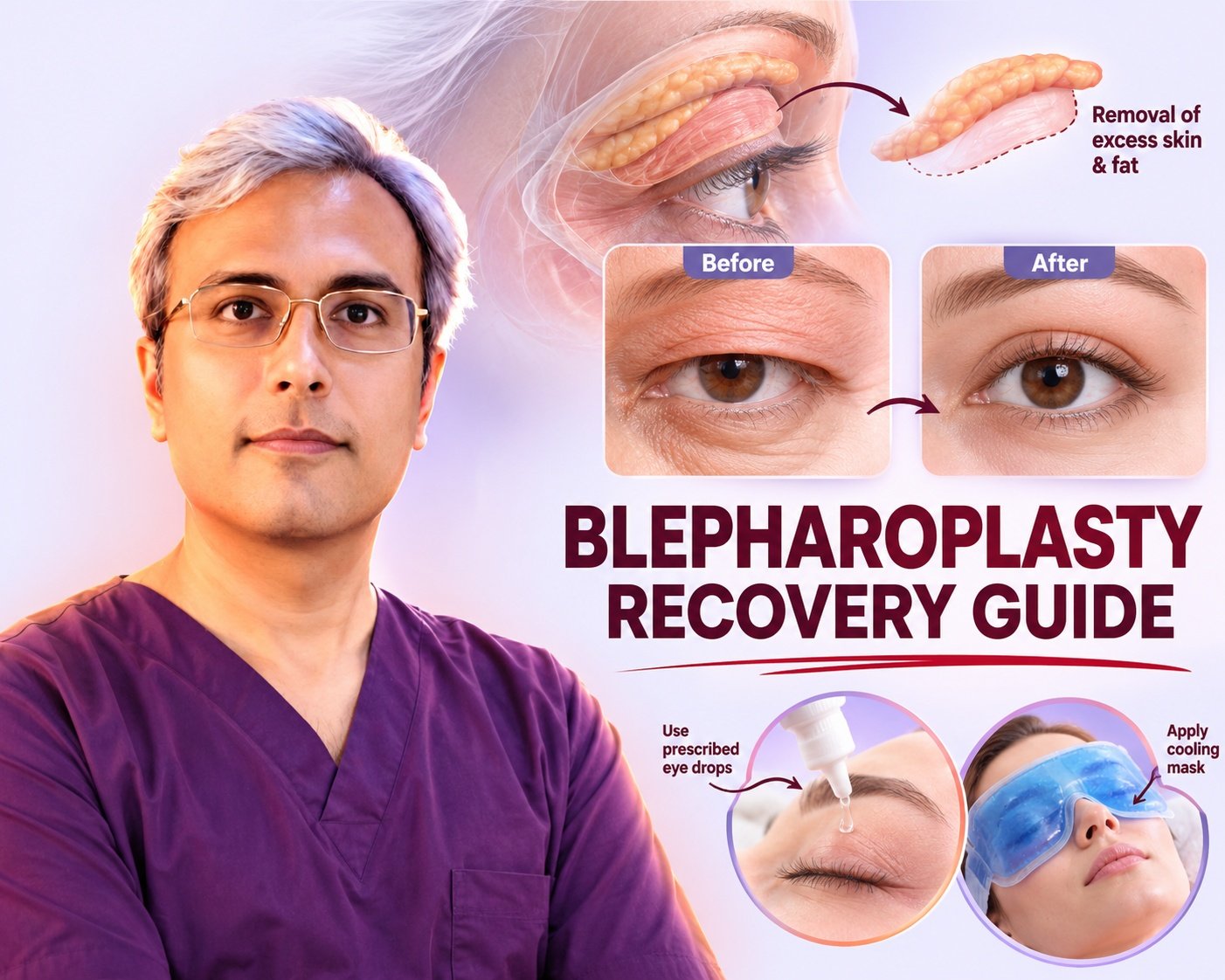
Realistic Recovery Timeline
| Timeframe | What to expect |
|---|---|
| Days 1–3 | Swelling and bruising peak. Cold compresses, head elevated. |
| Days 5–7 | Sutures removed for upper lid surgery. |
| Days 7–10 | Most patients return to desk work; bruising still visible and needs concealer. |
| 2–4 weeks | Presentable for social events and photographs. Exercise gradually resumed. |
| 6–8 weeks | Scars fade from pink toward pale. |
| 3–6 months | Final contour settles; scars continue to mature. |
Anyone promising you a few days is describing the best case, not the usual one.
Frequently Asked Questions
What is blepharoplasty and how does it change my face?
Blepharoplasty removes or repositions excess skin, muscle, and fat in the eyelids. By restoring visible lid show and smoothing the lid-to-cheek transition, it typically makes the eye region appear more open and less fatigued. It does not change the underlying shape of your eye or your bone structure.
How long is the recovery time?
Most patients return to desk work at around 7 to 10 days, though bruising is often still visible and needs concealing. Being comfortable in photographs usually takes 2 to 4 weeks, and the final contour settles over 3 to 6 months. Lower lid surgery generally takes longer to settle than upper lid surgery.
Who is a good candidate for this procedure?
Generally, patients in good health with realistic expectations and a concern that surgery can address. Dry eye disease, thyroid eye disease, bleeding disorders, uncontrolled blood pressure or diabetes, smoking, and certain anatomical patterns all need to be assessed first, and some are reasons to postpone or decline surgery.
Will my results look natural?
A natural result is the aim of every plan, and it depends heavily on conservative tissue removal and correct diagnosis of what is causing the problem. No surgeon can guarantee a specific outcome, and a small proportion of patients need revision. We will show you what is realistically achievable for your anatomy before you decide.
Can eyelid surgery change my eye shape?
Only within limits. Surgery can restore lid show, smooth the under-eye area, support a drooping outer corner, and create or refine a crease. It cannot change globe position or the bony orbit, and attempting to impose a fundamentally different eye shape tends to produce results that read as artificial.
What are the main risks?
Dry eyes, swelling, bruising, and temporary blurred vision are common. Less common risks include asymmetry, visible scarring, chemosis, and incomplete lid closure. Rare but serious complications include lower lid retraction, infection, and retrobulbar haemorrhage, which is a vision-threatening emergency. These are discussed in detail during consultation.
If you would like to discuss your eyelid concerns or book a consultation, contact Dr. Vishal Purohit in Jaipur at +91-7718183535.
This article is for general education and does not constitute medical advice or a guarantee of results. Individual outcomes vary. Please consult a qualified plastic surgeon for assessment of your own case.








 English
  Hindi
Hindi