
Blepharoplasty is not about changing your face. It is about restoring balance to the area around your eyes, so that people notice you look rested rather than noticing that you have had surgery.
That distinction sounds simple, but it is where most of the planning work actually happens. Two patients can walk in with the same complaint — “my eyes look tired” — and need entirely different operations, because the underlying cause is different in each. One has excess skin. The other has a drooping brow. A third has neither, and what she is seeing is a hollow below the lid rather than heaviness above it.
This article is about working out which of those you are, and what a realistic, well-defined goal looks like before you ever reach an operating theatre.
If you are considering cosmetic surgery in Jaipur, the consultation is where this begins. For the broader clinical picture, see the full guide to blepharoplasty.
Start Here: What Are You Actually Seeing?
Before you think about surgery, it helps to look carefully in a mirror in good, overhead light and separate four different things that all get described as “tired eyes.”
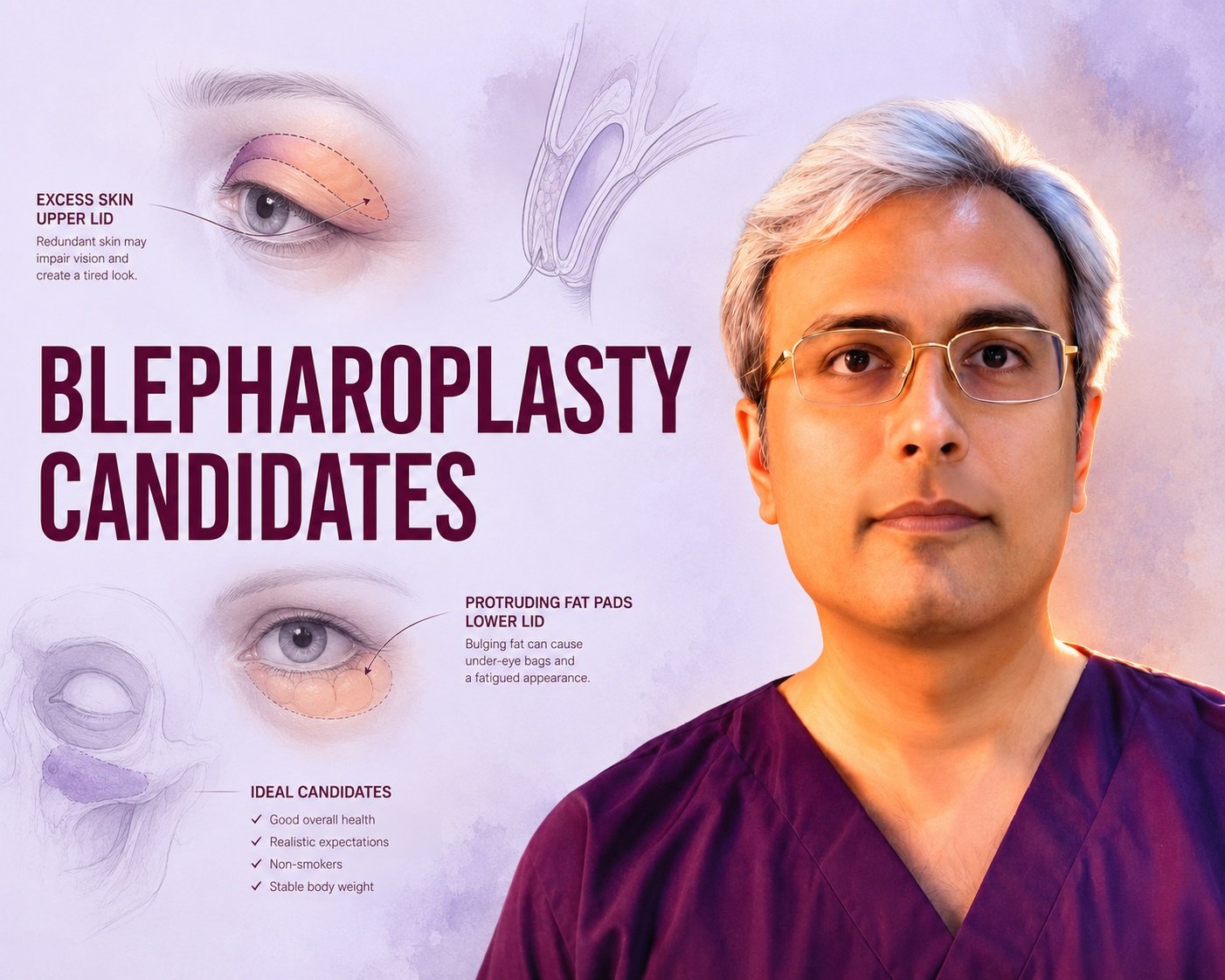
Skin overhang on the upper lid. Lift your brow gently with a finger. If the heaviness disappears, a large part of what you are seeing is brow position, not lid skin. If the fold remains even with the brow supported, you likely have genuine excess upper lid skin — dermatochalasis.
Brow position. Descent of the outer third of the brow crowds the upper lid and creates hooding. Operating on the lid alone in these patients can pull the brow down further and make the problem worse. This is one of the most common reasons a technically clean eyelid surgery produces a disappointed patient.
Lid opening. Look at how much of your coloured iris the upper lid covers, and compare the two sides. If the lid margin itself sits low, that is ptosis — a problem with the levator muscle or its attachment — and it is a different operation from skin removal. Patients frequently mistake ptosis for excess skin. Removing skin from a ptotic lid does not lift the lid.
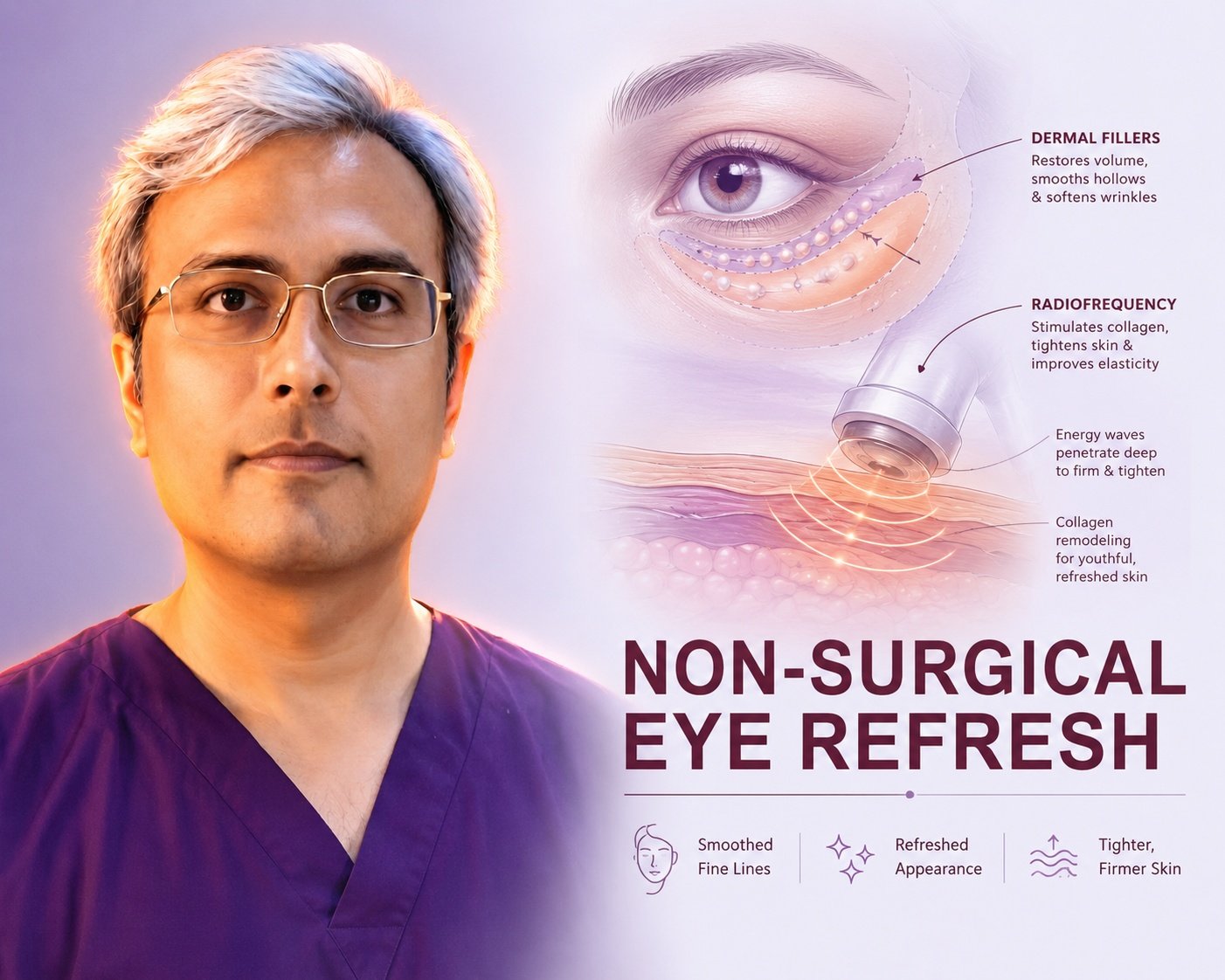
Under-eye contour. A “bag” and a “hollow” are opposite problems that often coexist. Fullness above and shadow below is the usual pattern, and treating only one of them tends to look odd.
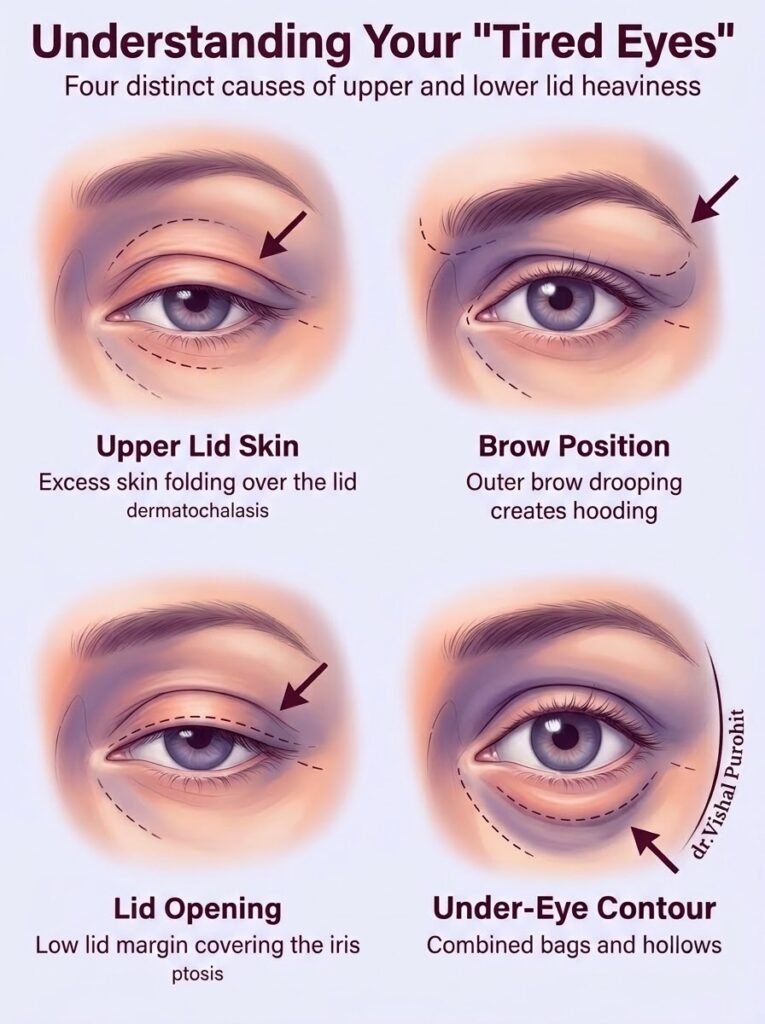
You do not need to diagnose yourself. But arriving at a consultation able to say “the heaviness stays even when I lift my brow, and it’s worse on the left” changes the quality of the conversation entirely.
What “Natural” Means in Measurable Terms
“Natural” is a vague word that patients and surgeons often use to mean different things. In planning, it translates into specific, measurable decisions:
- Crease height. The distance from lash line to lid crease is set deliberately, based on your existing anatomy and ethnicity rather than a fixed number. Placing an Asian upper lid crease at a Caucasian height is one of the classic ways a result announces itself as surgical. Incision placement is planned in millimetres, not by eye.
- Tarsal platform show. How much lid you see between the lash line and the fold when your eyes are open. A little is youthful. Too much reads as hollow and operated.
- Preserved lateral fullness. A young upper lid is not flat. Over-aggressive fat removal produces a skeletonised, sunken look that is difficult to reverse and tends to be read as “done.”
- Volume, not just tissue removal. Modern practice preserves and repositions more than it excises. Fat pad management in the lower lid is usually about redistribution across the orbital rim rather than simple removal.
When I say the aim is a natural result, this is what I mean concretely — not a philosophy, but a set of numbers and tissue decisions agreed before surgery.
Tailoring the Plan to Your Eyelid Anatomy
Every eyelid structure is different, and a few patterns come up repeatedly in consultation:
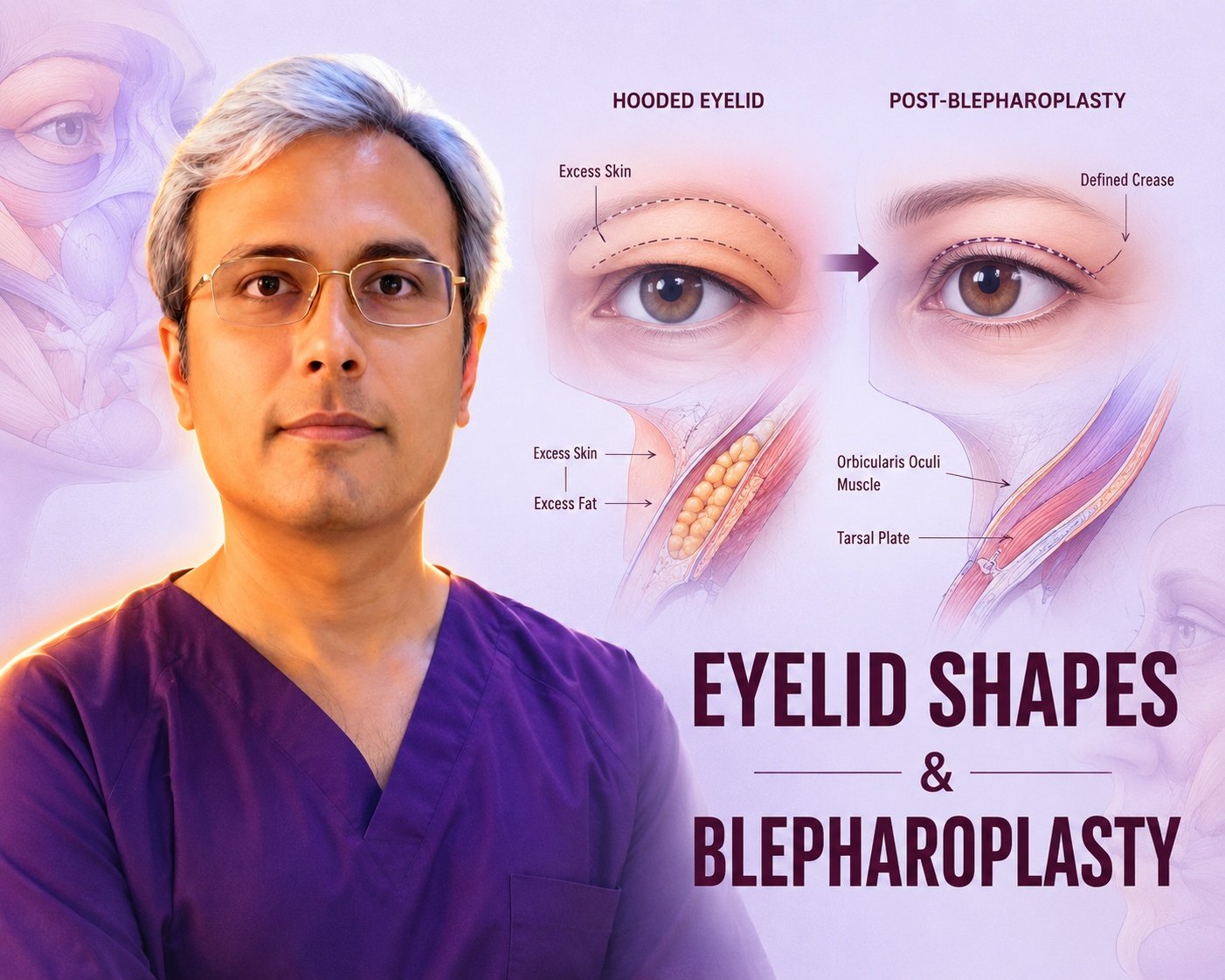
Hooded upper lids. Excess skin or fat overhangs the crease. The essential first step is separating true skin excess from brow descent, because the correct operation differs — and in some patients a brow procedure is the more appropriate answer, with or without lid surgery.
Heavy lids from thick tissue. Thicker skin and a bulkier orbicularis oculi muscle behave differently to thin, crepey skin. Muscle handling and closure technique are adjusted accordingly, since poor handling here is what produces visible ridging along the scar.
Lower lid fullness. Weakening of the orbital septum allows the fat pads to bulge forward — pseudoherniation rather than a true hernia. These pads are typically repositioned to fill the groove below rather than simply excised.
Tear troughs. The groove itself is largely a tethering problem: the tear trough ligament anchors the skin to bone, with bulging fat above the line and midface volume loss below it. This is why removing fat alone often deepens the shadow instead of erasing it.
Lid support. Canthal tendon laxity and tarsal plate strength are assessed before any lower lid work. Weak support plus skin removal is the recipe for scleral show or ectropion, and where laxity exists, a tightening procedure is planned alongside.
Asymmetry. Nearly everyone has some, and it is best identified and pointed out to you before surgery rather than discovered afterwards. Differences in margin-to-crease distance, brow height and levator function are measured, and the surgical plan compensates where it can. The honest goal is to reduce visible asymmetry, not to promise identical eyes — that is not achievable in any face.
Facial Harmony and Long-Term Durability of eyelid surgery
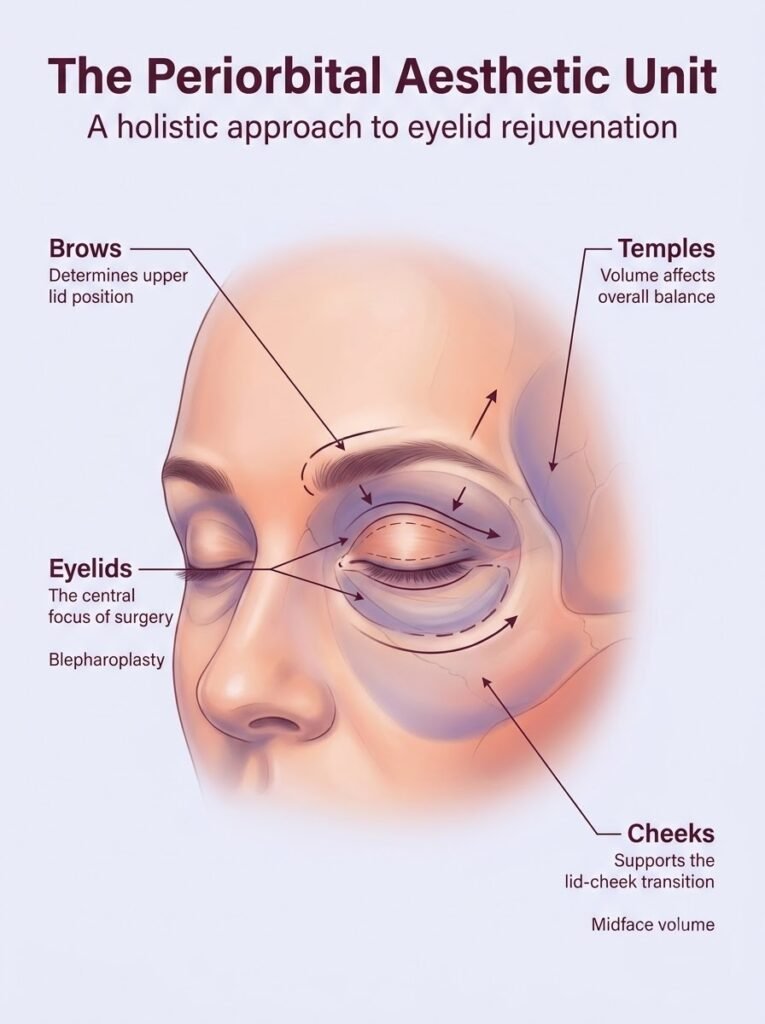
Eyelids do not exist in isolation. The periorbital region is read as a unit with the brow, temple and upper cheek, and a lid result that ignores brow position or midface volume tends to look disconnected even when the lid itself is well executed. Assessment therefore includes how your brows sit, whether the temple has hollowed, and how the lid-cheek junction transitions — all of which contribute to a genuinely rejuvenated appearance.
Durability follows from the same principles. Preserving volume rather than stripping it, and supporting the tissues that hold lid position, is what keeps a result stable. Ageing continues after surgery, so a well-planned blepharoplasty sets you back rather than stopping the clock. Most upper lid results hold well for many years; lower lids and brow position are more variable, and some patients will consider further work in the future.
Risks You Should Weigh Before Deciding for blepharoplasty
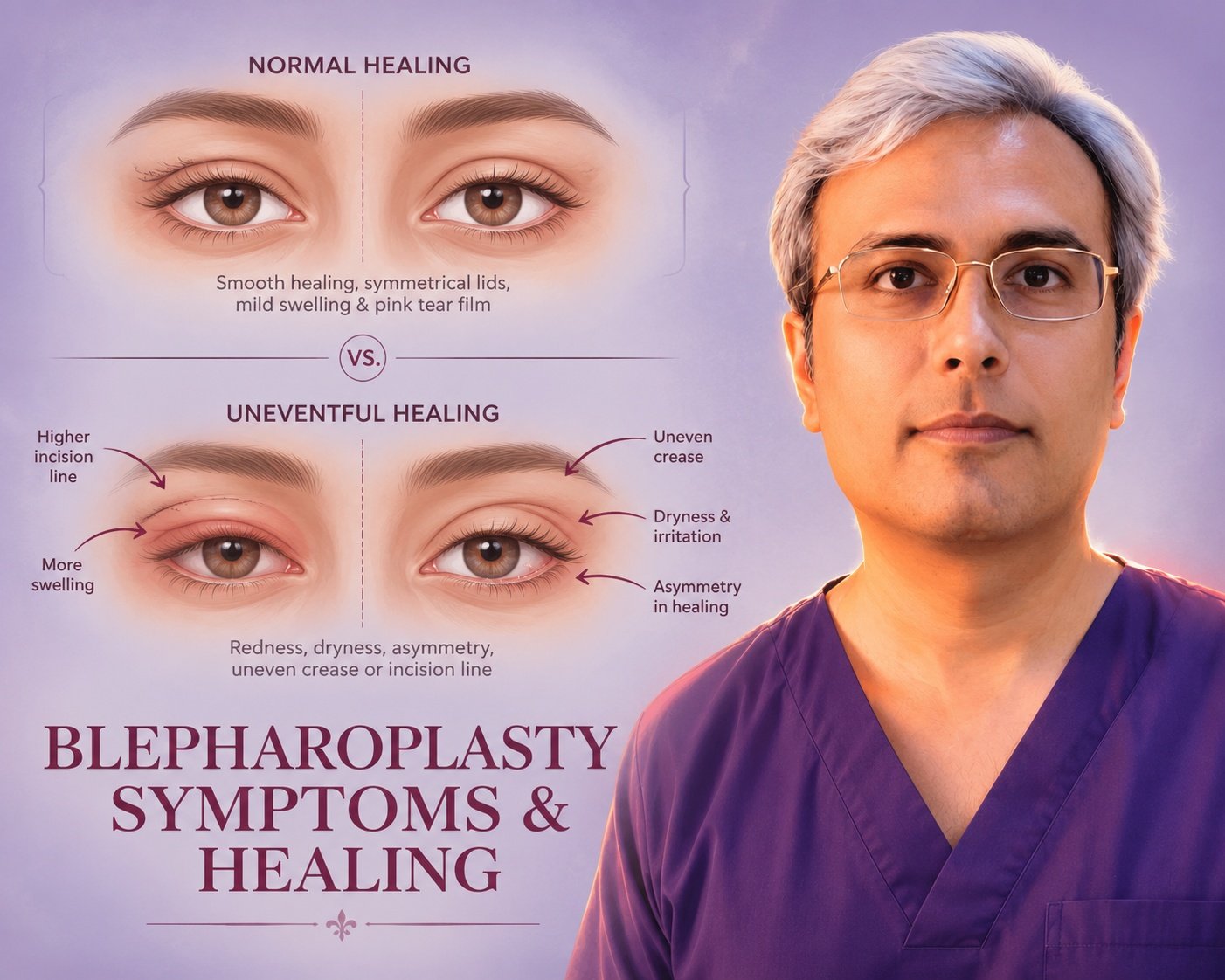
A goal-setting conversation is incomplete without this. Blepharoplasty is a safe and well-established operation, but it has real risks:
- Dry eye and irritation, particularly in patients with pre-existing dry eye — which is why tear function is assessed beforehand.
- Chemosis — swelling of the conjunctiva, more common after lower lid surgery, usually temporary but occasionally slow to settle.
- Lagophthalmos — incomplete lid closure from over-resection of skin.
- Scleral show or ectropion — downward pull of the lower lid, more likely where laxity was not addressed.
- Residual or new asymmetry, sometimes requiring revision.
- Visible scarring, uncommon in the upper lid crease but influenced by skin type and healing tendency.
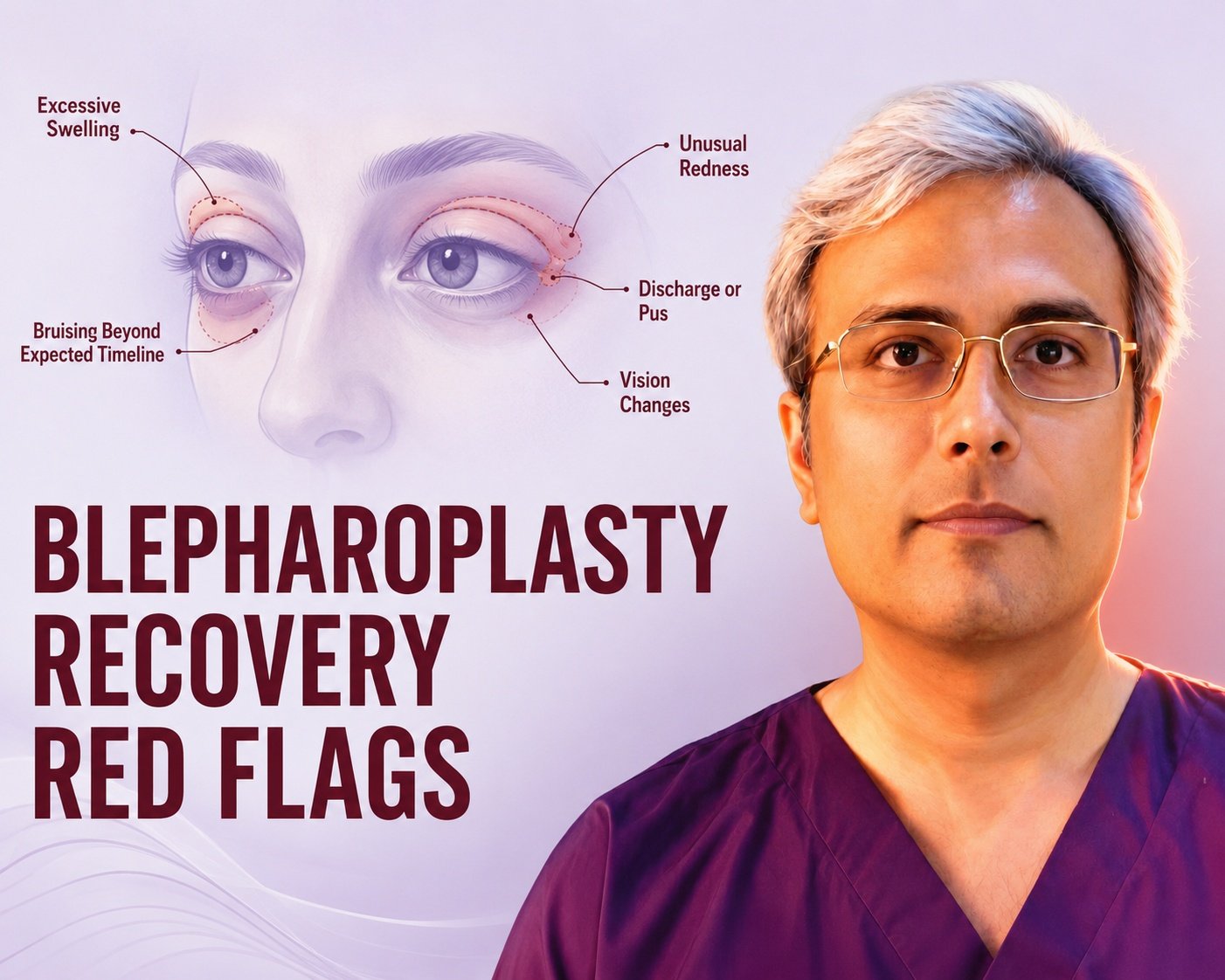
- Very rarely, vision-threatening complications such as retrobulbar haemorrhage.
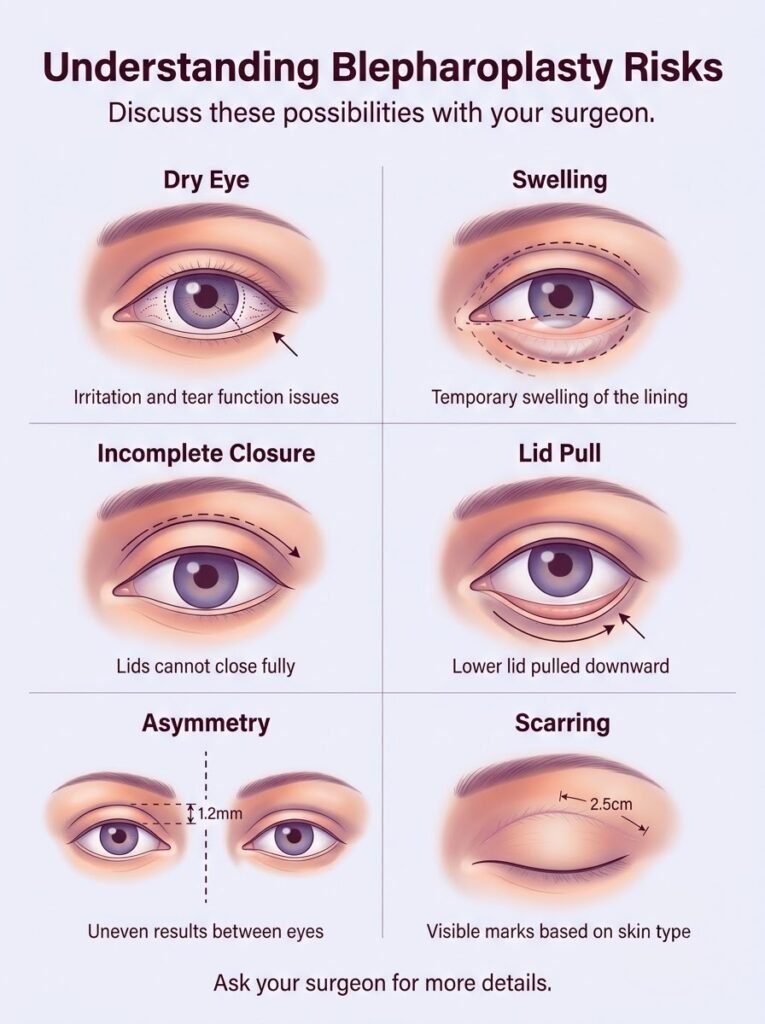
If any of these have not been discussed with you, ask.
Frequently Asked Questions
How long is the recovery after blepharoplasty, realistically?
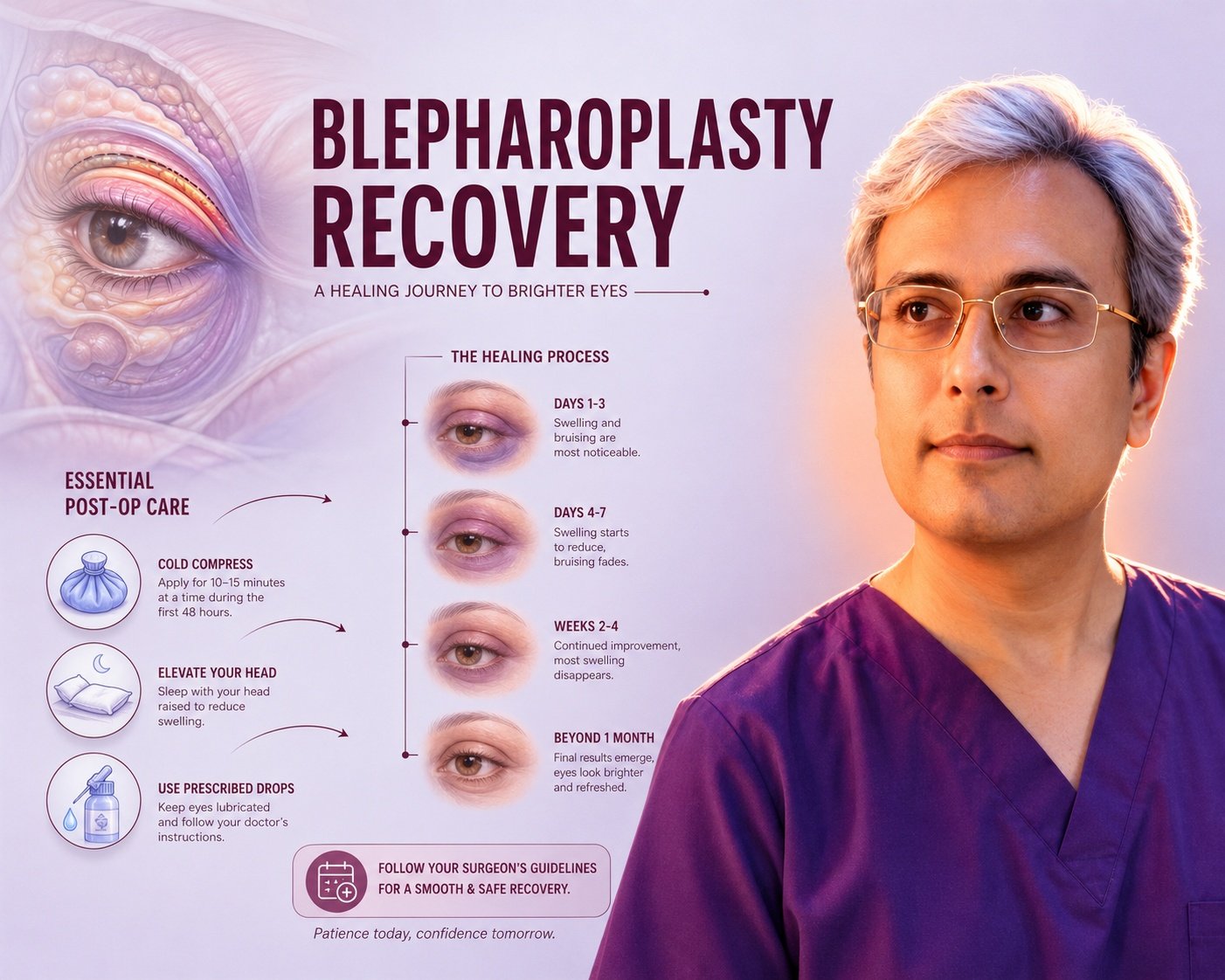
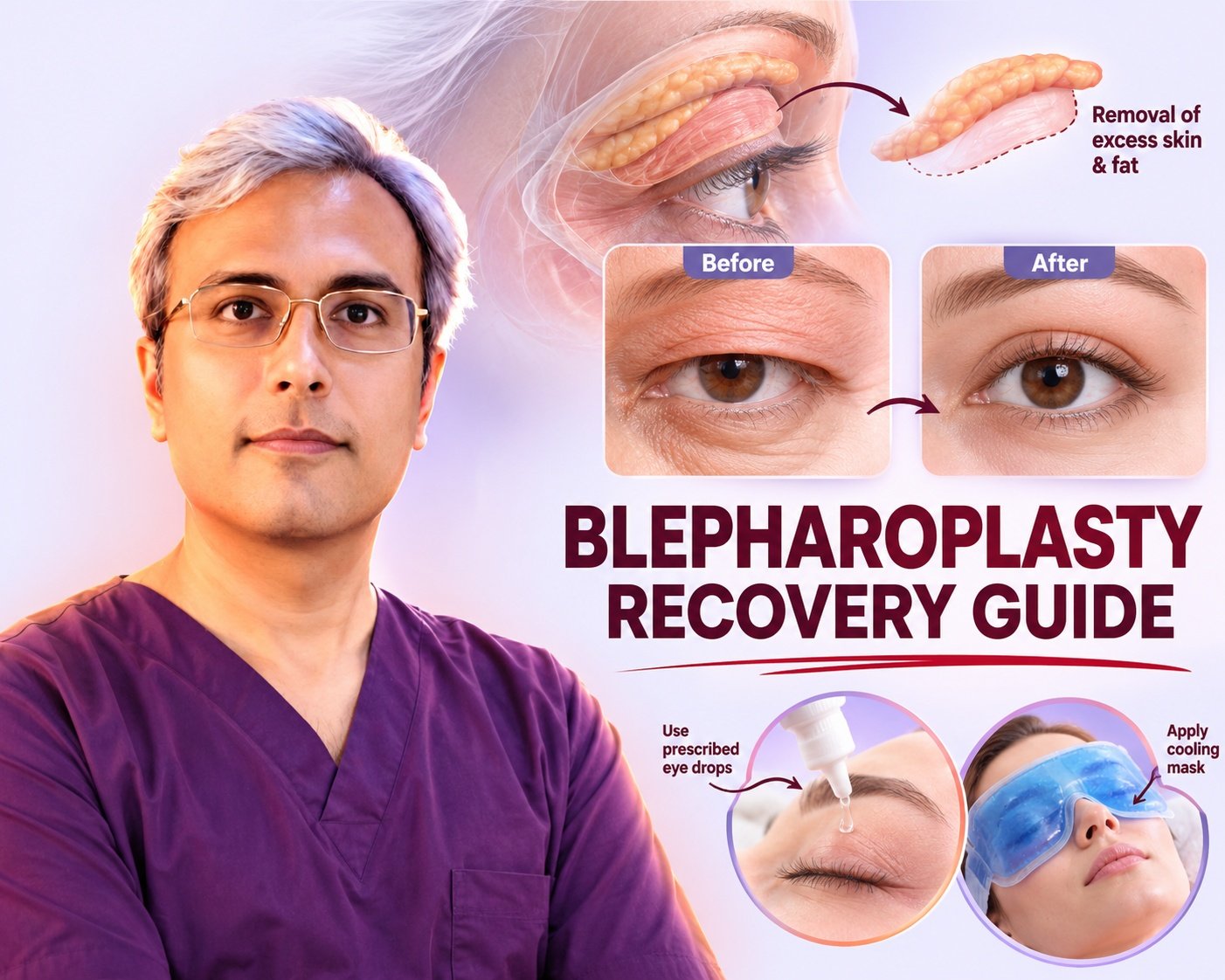
Sutures typically come out around day five to seven. Most people are comfortable doing desk-based work within about a week, and look socially presentable at roughly ten to fourteen days, though bruising varies considerably between individuals. Fine swelling around the crease continues to settle over three to six months, which is when the final result is judged. If you have an event in the diary, plan for weeks rather than days.
Will I look “overdone” after cosmetic blepharoplasty?
The approach is designed to avoid it — conservative skin removal, preserved volume, and a crease height matched to your own anatomy. No surgeon can guarantee an outcome, but over-correction is largely a consequence of over-resection, and that is a decision made in planning rather than an accident.
Does blepheraoplasty surgery help hooded eyes?
Often, yes — but only after establishing whether the hooding comes from lid skin, brow descent, or both. Where the brow is the main contributor, lid surgery alone will disappoint.
How do you choose the technique for blepharoplasty?
From examination: skin quality, muscle bulk, fat distribution, lid laxity, levator function, brow position and tear film status. Those findings determine whether the plan involves skin only, skin and muscle, fat repositioning, canthal support, ptosis correction, or a combination.
When is blepharoplasty surgery not the answer?
Puffiness from allergy, sinus disease or thyroid eye disease should be investigated and treated medically first. Isolated brow descent may be better addressed at the brow. And some early hollowing responds better to volume than to excision.
Will the results of cosmetic blepharoplasty last?
Upper lid results are generally long-lasting, often a decade or more. Ageing continues, so the honest answer is that surgery resets the starting point rather than freezing it.
To discuss your goals or arrange a consultation, contact Dr. Vishal Purohit in Jaipur at +91-7718183535.








 English
  Hindi
Hindi